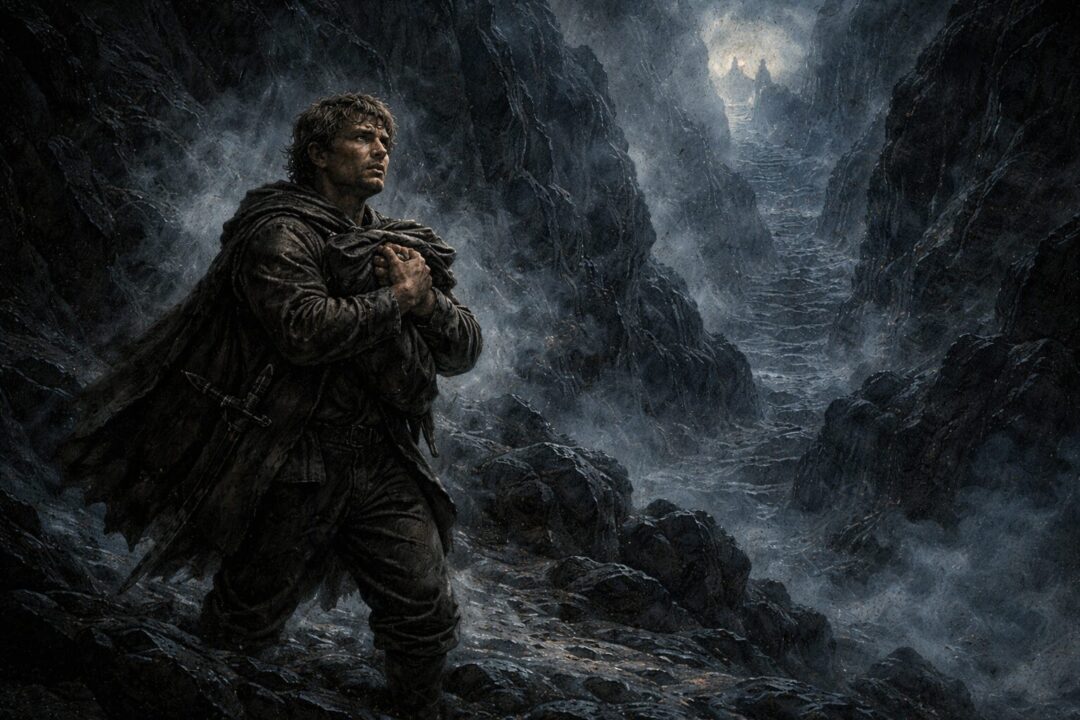
In Middle-earth, evil rarely arrives all at once. It does not announce itself with thunder or banners. Instead, it erodes. It whispers. It waits. It wears down even the strongest hearts through doubt, exhaustion, and isolation. No one understood this better than Samwise Gamgee, who walked beside Frodo Baggins from the quiet lanes of the Shire to the ashen slopes of Mordor—and saw what the One Ring truly did to a good soul.
Sam was never meant to be a hero of great songs. He was a gardener, a servant, and above all, a loyal friend. He did not seek adventure, glory, or renown. Yet his role became far more important than anyone could have known—because Sam was the one who remembered Frodo as he was, even when Frodo himself could not.
Sam Was Chosen Not for Strength, but for Faithfulness
From the very beginning, Sam’s strength lay not in power, but in constancy. While others in the Fellowship carried ancient wisdom, royal blood, or unmatched skill, Sam carried something quieter: an unshakeable devotion. He followed Frodo not because he believed the quest would succeed, but because Frodo should not face it alone.
This distinction matters. The Ring preyed upon ambition, fear, and desire. Sam had little of any of these. His dreams were small and rooted—gardens, home, peace. And yet, this very simplicity made him uniquely suited to notice the changes the Ring worked on Frodo.
Sam Noticed the Change Before Anyone Else
As the Fellowship broke and the road narrowed, Frodo grew quieter. His trust thinned. He spoke less of home and more of the burden he carried. Sam noticed the way Frodo would clutch the Ring when danger felt near, how his gaze lingered inward rather than outward.
Sam also noticed Frodo’s shifting relationship with Gollum. Where Sam saw danger and deception, Frodo saw a mirror—someone already broken by the Ring, someone who reflected his possible future. Frodo’s growing defensiveness toward Gollum, and sharpness toward Sam, did not come from cruelty. They came from fear.
These were not sudden changes. They came slowly, which made them more frightening. There was no single moment where Frodo stopped being Frodo. Instead, there were small losses: patience, warmth, trust. Sam saw each one and carried the weight of them in silence.
The Ring Wanted Frodo Alone
Sam tried to help in the only ways he knew—cooking when food was scarce, offering stories of the Shire, standing watch while Frodo slept. He reminded Frodo of who he was before the Ring, and who he could still be after.
But the Ring did not want Sam’s presence.
The Ring fed on isolation. It whispered that Frodo was misunderstood, that no one else could truly share his burden. Every act of care Sam offered became, through the Ring’s influence, a reminder of weakness or dependence. Slowly, Sam’s devotion was reframed as interference.
This was the Ring’s greatest cruelty: it did not simply corrupt Frodo—it turned love into suspicion.
Cirith Ungol: The Breaking Point
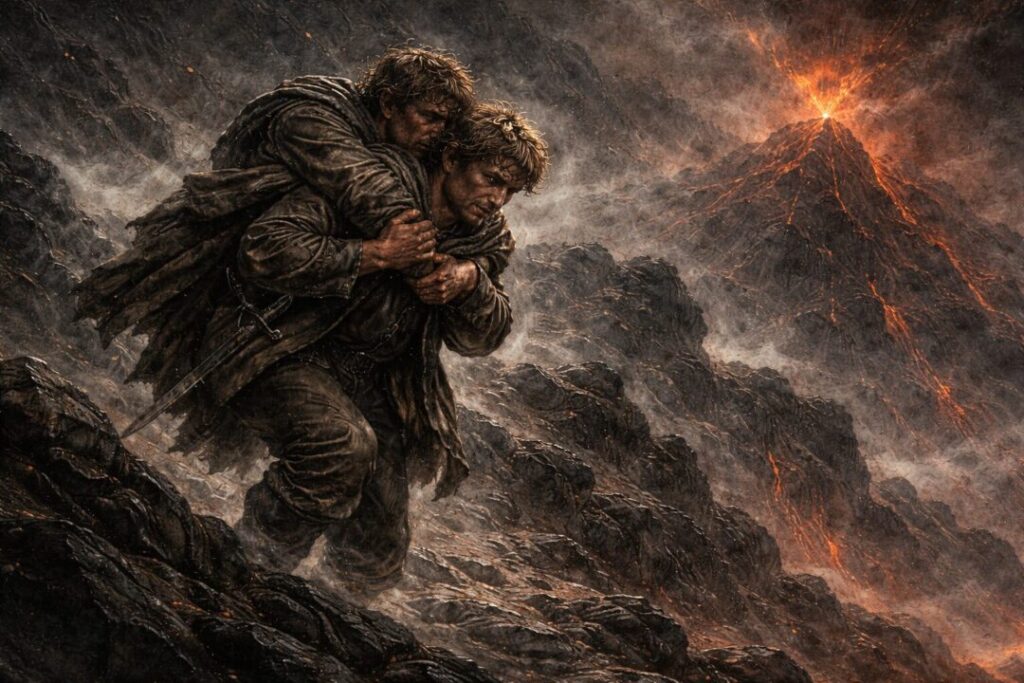
At Cirith Ungol, deception finally succeeded where brute force could not. Exhausted, starving, and under the Ring’s full weight, Frodo was convinced that Sam had betrayed him. Gollum’s lies found fertile ground in a mind already fractured by fear and pain.
When Frodo sent Sam away, it was the cruelest moment of their journey. Not because Frodo intended cruelty—but because the Ring spoke through him.
Sam obeyed.
And then he turned back.
This decision cannot be overstated. Sam did not argue. He did not fight Frodo for the Ring. He accepted Frodo’s words—and chose love anyway. By returning, Sam proved something essential about heroism in Middle-earth: victory often belongs not to the mighty, but to those who refuse to abandon compassion, even when it is rejected.
The Tower, the Rescue, and the Cost of Witnessing
When Frodo was taken by the orcs, Sam believed him dead. And yet, even then, he chose hope over despair. He carried the Ring briefly—not as a conqueror, but as a steward—and felt its weight keenly. Sam’s brief bearing of the Ring revealed something crucial: he was not immune to temptation, but his desires were too humble for the Ring to fully exploit.
Sam rescued Frodo not with strength of arms alone, but with belief—belief that Frodo was still worth saving, even if Frodo himself no longer believed it.
The Crack of Doom
Inside Mount Doom, Frodo failed.
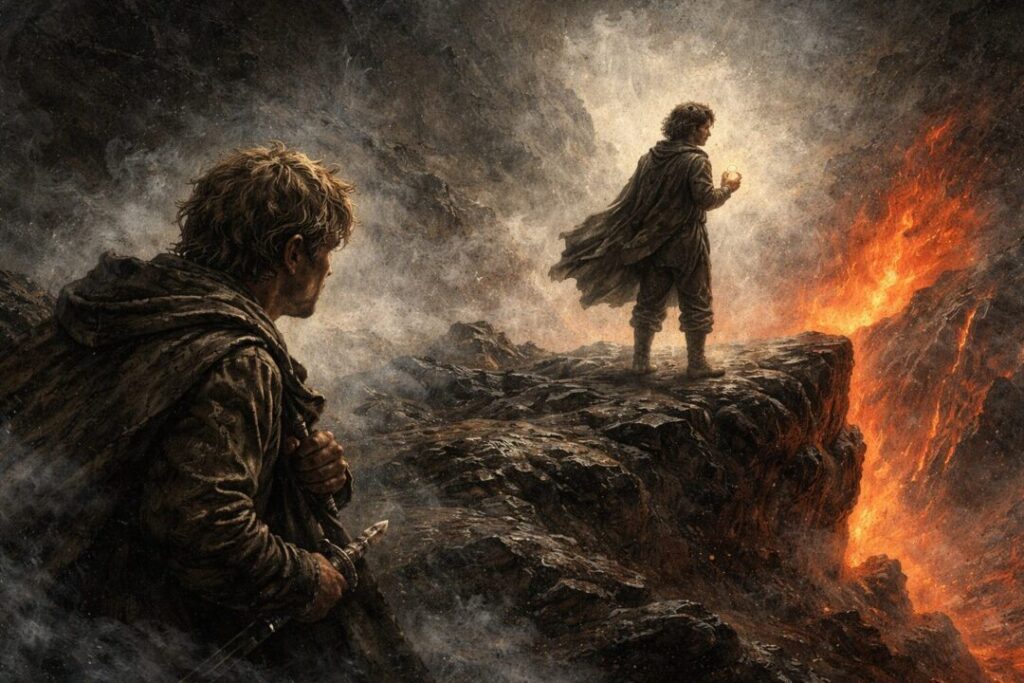
That truth is often softened, but it should not be erased. At the very edge of success, Frodo claimed the Ring for himself. The burden broke him at the moment when release was closest. And Sam saw it happen.
He did not strike Frodo down. He did not shout in anger or despair. He stood, helpless, bearing witness as the Ring completed its corruption.
This is one of the most important moments in the history of Middle-earth—not because Frodo fell, but because Sam did not. He did not lose compassion. He did not lose sight of Frodo as a person rather than a failure.
And through mercy shown long before—to Gollum—the world was saved.
Victory came not through moral perfection, but through pity, endurance, and grace extended even when it seemed foolish.
Carrying Frodo—and Carrying the Memory
Sam carried Frodo from the fire, just as he had promised long before. But he also carried something heavier: the knowledge of how close the world came to ruin, and how fragile even the best intentions can be under unbearable weight.
This memory did not leave Sam when the war ended.
Frodo could not remain in Middle-earth. His wounds were not only physical. They were spiritual, invisible, and permanent. When Frodo departed over the Sea, Sam stayed behind—not because his burden was lighter, but because someone had to remain and remember.
Sam Became the Keeper of the Story
Through words, memories, and the Red Book of Westmarch, Sam ensured that Frodo’s journey was told truthfully. Not as a flawless triumph. Not as a simple victory of good over evil. But as a sacrifice that nearly consumed the one who bore it.
Sam’s role as storyteller was as vital as his role as companion. He preserved the truth that courage can coexist with failure, and that endurance does not always mean emerging unscathed.
He also preserved Frodo’s dignity—refusing to let his final weakness erase years of suffering willingly borne for others.

The Quiet Heroism of Samwise Gamgee
Samwise Gamgee did not fall. But he lived with the knowledge of how close everything came to being lost. He lived knowing that goodness is not indestructible—and that love sometimes means carrying truths that cannot be fully shared.
His heroism was not loud. It was patient. It was faithful. It was rooted in everyday acts of care that held the world together when greater powers failed.
And that may be the bravest role of all.