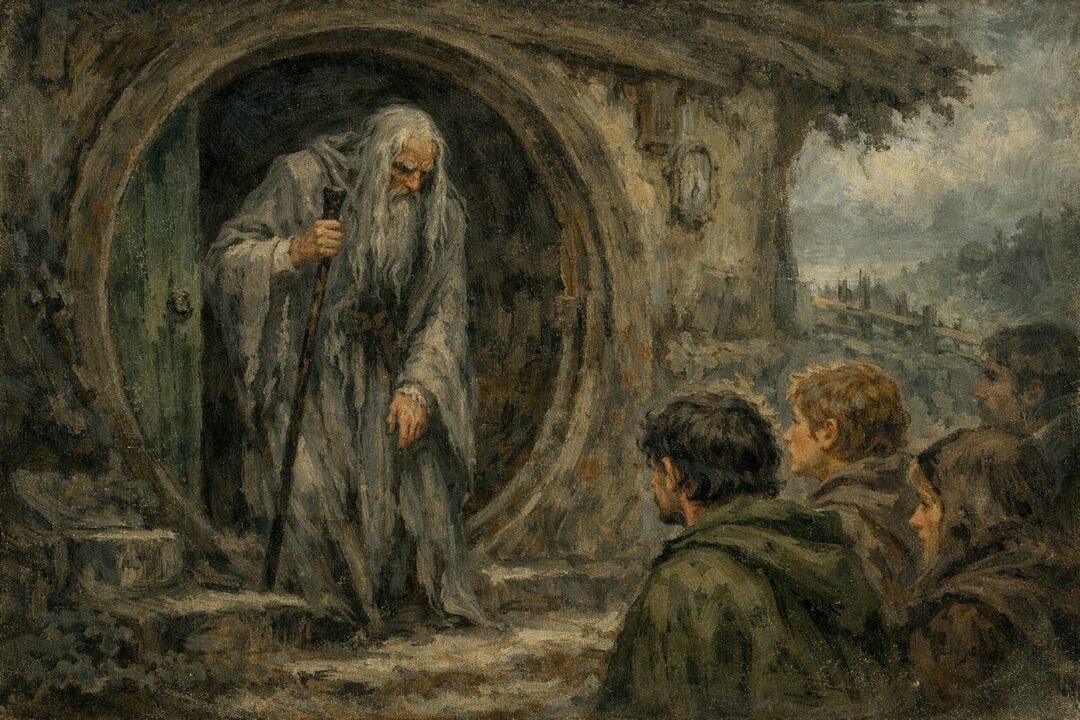
The Lord of the Rings is often remembered as a story with a clean, decisive ending. The Ring is destroyed. Barad-dûr collapses. The Dark Lord’s power is unmade in fire and ruin. Armies scatter. Kings are crowned. Songs are sung.
In popular memory, this moment is the conclusion.
Yet the book itself refuses to stop there. Tolkien deliberately carries the narrative forward into quieter, smaller spaces, where there are no banners, no great battles, and no clear triumph. That choice is not accidental, nor is it merely structural. It is thematic.
Sauron’s defeat is vast, impersonal, and cosmic. Saruman’s defeat is bitter, humiliating, and painfully human. And that contrast lies at the heart of what the War of the Ring is truly about.
The Enemy Who Survived the Victory
By the time the Ring is destroyed, Saruman has already been defeated in every conventional sense. His armies are broken. Isengard is flooded and ruined. His tower is stripped of power. His staff is taken. His voice—once his greatest weapon—is openly challenged.
He is no longer a rival Dark Lord.
And yet, he survives.
This survival is often treated as an inconvenience or an afterthought, but within the logic of Tolkien’s world, it is essential. Saruman’s continued existence after his fall demonstrates that evil does not vanish simply because it has been beaten in war. Power can be broken, but the will that sought power may persist.
Saruman becomes something far more unsettling than a conquering tyrant: a displaced intellect, a resentful manipulator, a being who knows exactly what he has lost and cannot accept it. He no longer seeks dominion over the world. He seeks to ruin what others love.
That distinction matters.

Evil Without a Throne
Sauron’s evil is externalized. It manifests as armies, towers, weapons, and terror. Saruman’s evil, by contrast, becomes intimate. It moves into homes, laws, and daily routines. It does not announce itself with banners. It disguises itself as order.
Tolkien allows Saruman to live because his story illustrates a critical truth: evil is not only a thing to be confronted on battlefields. It is also something that insinuates itself into systems, habits, and compromises.
Saruman survives because the war alone cannot destroy what he represents.
Why the Scouring of the Shire Matters
The Scouring of the Shire is often misunderstood as an epilogue problem—an awkward coda after the “real” ending. But in truth, it functions as the thematic answer to the entire narrative.
The Hobbits do not return home as conquerors. They return as witnesses.
They recognize immediately that something is wrong. The land is scarred. Rules have multiplied. People speak in whispers. Authority exists, but responsibility does not. The Shire has not been invaded—it has been managed into submission.
Saruman does not rule the Shire with orcs and siege engines. He rules it with paperwork, intimidation, and fear of punishment. His tyranny is quiet and bureaucratic, enforced by petty men who enjoy their borrowed power.
This is not a lesser evil. It is a more believable one.
The Hobbits’ growth throughout the story is proven not by their ability to fight, but by their refusal to accept this corruption as normal. They have seen Mordor. They know what domination looks like. And they will not tolerate its echo in their home.
The War After the War
One of Tolkien’s most radical choices is showing that victory does not mean restoration happens automatically. The Shire does not heal itself because the Ring is gone. It must be reclaimed, repaired, and replanted.
That labor is slow. It is local. It is unglamorous.
No wizard can do it for them.
This is not an accident of storytelling—it is Tolkien’s rejection of the idea that evil can be solved once and for all through force. The war ends, but responsibility begins.

Saruman vs. Sauron: Power and Control
Sauron rules through absolute domination. His vision is vast, abstract, and impersonal. Individuals matter only as tools. Fear is his currency.
Saruman, by contrast, rules through control. He measures, regulates, and reshapes. He enforces obedience not through awe, but through pressure. His authority is felt not in terror, but in exhaustion.
One is mythic. The other is disturbingly familiar.
Saruman represents fallen wisdom: intelligence severed from humility, knowledge divorced from restraint. He is not corrupted by ignorance, but by certainty. He believes he understands how the world should work, and therefore feels justified in bending it to his design.
Even stripped of his power, his voice remains dangerous. That is why Gandalf does not strike him down. Instead, he breaks the authority behind the voice. Judgment, not violence, ends Saruman’s influence.
An Ending Without Triumph
Saruman’s death is not heroic. It is not mourned. It is not even widely witnessed.
He is killed by the very servant he abused, in a moment stripped of grandeur or meaning. His spirit rises briefly, rejected by the West, and vanishes into nothingness.
This ending is deeply uncomfortable—and deliberately so.
Tolkien denies Saruman the dignity of a final stand because dignity is not something evil is owed. Some evils deserve not legend, but exposure. Not battle, but irrelevance.
By refusing to glorify Saruman’s end, Tolkien prevents readers from mistaking tragedy for nobility.

Why This Ending Was Never Optional
Removing Saruman from the final act would turn The Lord of the Rings into a story with a reset button: destroy the Ring, restore the world, roll credits.
Tolkien did not believe in such endings.
He had lived through a world where wars ended, but scars remained. Where systems collapsed, but bitterness endured. Where victory did not undo loss.
The Scouring of the Shire insists that even the smallest places are vulnerable, and that no land is protected by innocence alone. It also insists that renewal is possible—but only through effort, memory, and choice.
The Last Shadow to Fall
Sauron is the storm. Saruman is the aftermath.
Sauron’s defeat ends the age. Saruman’s defeat explains it.
By allowing Saruman to linger, Tolkien ensures that the War of the Ring is not remembered as a simple tale of good triumphing over evil, but as a meditation on power, responsibility, and the cost of victory.
The War ends.
The damage remains.
The world continues.
And that is why Saruman—not Sauron—feels like the final shadow to fall.