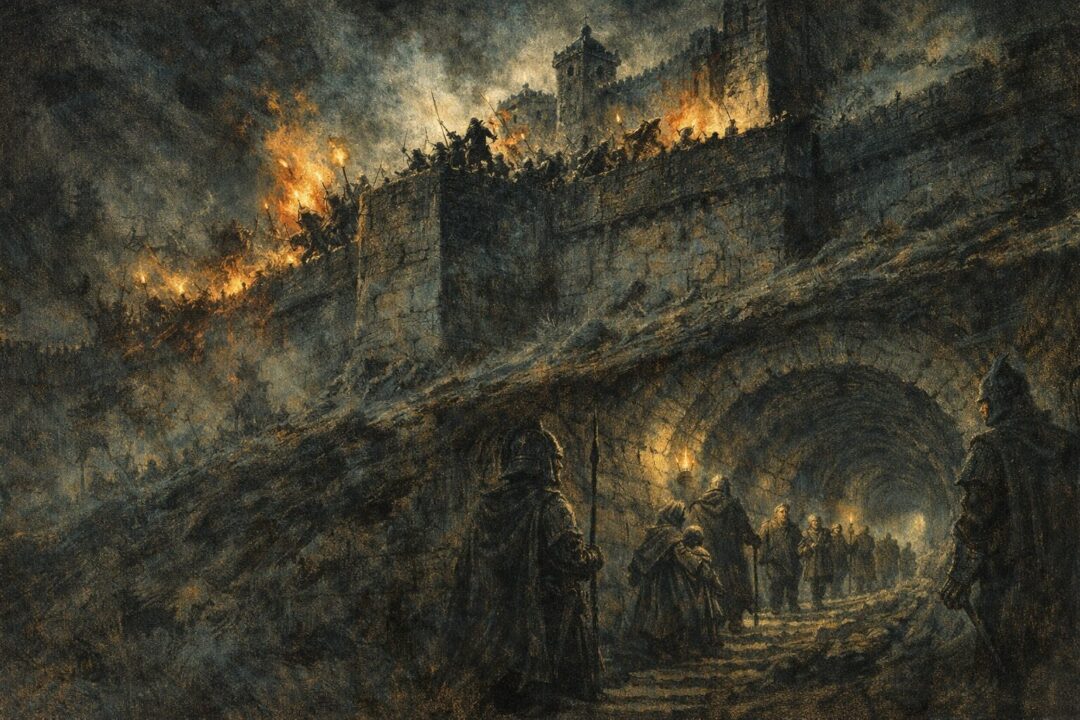
When people think of the Battle of Helm’s Deep, they picture a fortress under siege, rain pouring from the sky, and the last stand of Rohan against overwhelming odds. Tolkien himself presents it as a moment of near-collapse followed by miraculous deliverance.
But Tolkien’s battles are rarely as simple as what appears on the surface.
Beneath the Hornburg—the ancient fortress later called Helm’s Deep—lay a network of old passages, drainage tunnels, and forgotten stone corridors. Some were carved by the Rohirrim. Others were far older, remnants of Númenórean engineering or even earlier hands whose names are lost to history.
And during the long night of the siege, those tunnels mattered.
Why the Tunnels Existed at All
Helm’s Deep was never just a wall and a keep. It was designed as a refuge—a place where noncombatants could survive when the plains of Rohan could not.
Tolkien gives us brief but crucial lines describing how the people of the Westfold had already fled there before Saruman’s army arrived. That raises a question the narrative does not linger on:
Where did all those people go during the fighting?
They could not remain in the main caverns near the Glittering Caves. They could not crowd the Deeping Wall. And they certainly could not be allowed near the culvert once Saruman’s explosives shattered it.
The answer lies below.
The Quiet Evacuation
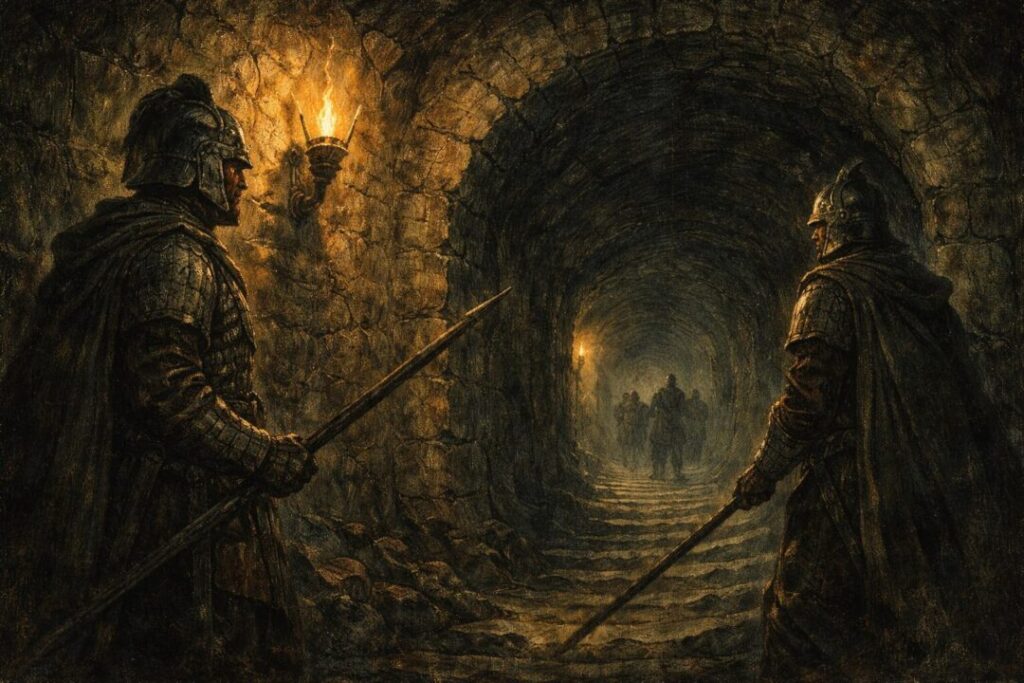
While the Uruk-hai assaulted the walls, small groups were being moved underground—guided by those who knew the fortress best. Old men, wounded soldiers, women carrying children who could not be allowed to cry.
No torches. No raised voices. Just hands on stone and whispered instructions.
From the perspective of the defenders above, this was a distraction they could not afford to think about. Every sword was needed on the wall. But if the tunnels failed, the battle would already be lost, regardless of who held the gate.
Who Guarded the Depths?
Tolkien never stages a dramatic fight below Helm’s Deep—and that is precisely the point.
There is no named hero here. No duel. No last words.
Instead, we are meant to understand that nothing went wrong.
That the tunnels held.
That the Uruk-hai never found them.
That silence, in this case, equals survival.
In Tolkien’s world, the absence of catastrophe is often the greatest victory of all.
Why Tolkien Leaves This in the Background
Modern fantasy would center this subplot. Tolkien deliberately does not.
Why?
Because Tolkien’s legendarium treats war as something that spills outward, affecting the innocent whether or not they are named. By refusing to dramatize the evacuation, he preserves its realism—and its dignity.
Helm’s Deep is remembered as a battle of kings and captains.
But it was also a night when ordinary people were saved because others stood in the dark and did their duty without recognition.
A Victory You Never Applaud—But Owe Everything To
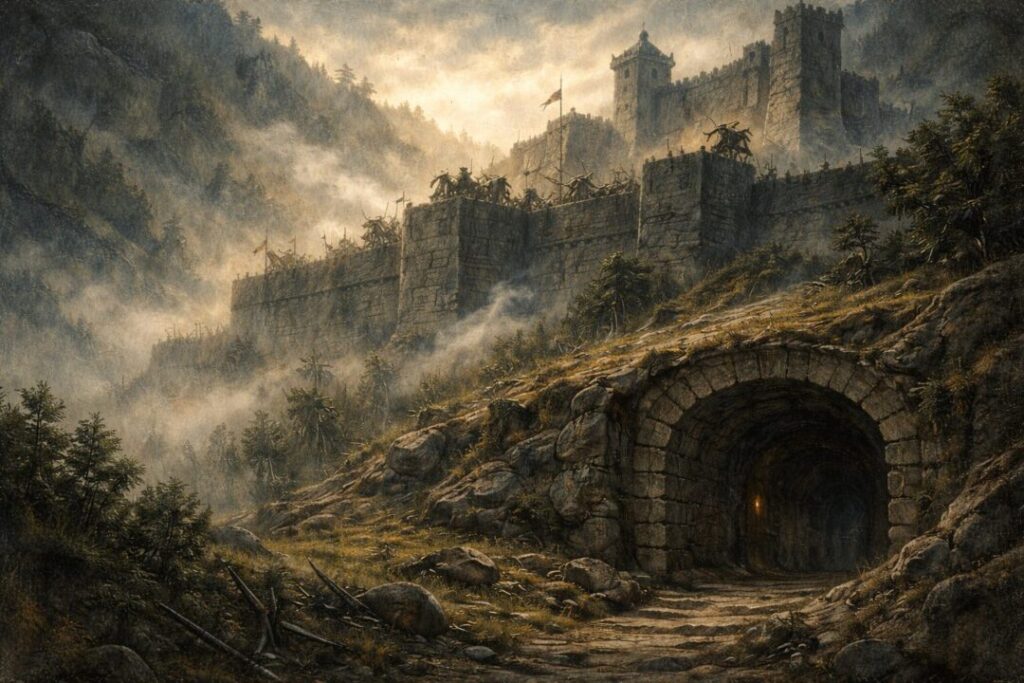
By dawn, when Gandalf arrives and the Hornburg still stands, history has already been decided below the stone.
No songs are sung for the tunnel-guards.
No monuments mark the passages that held.
But without them, Helm’s Deep would not be remembered as a turning point.
It would be remembered as an ending.