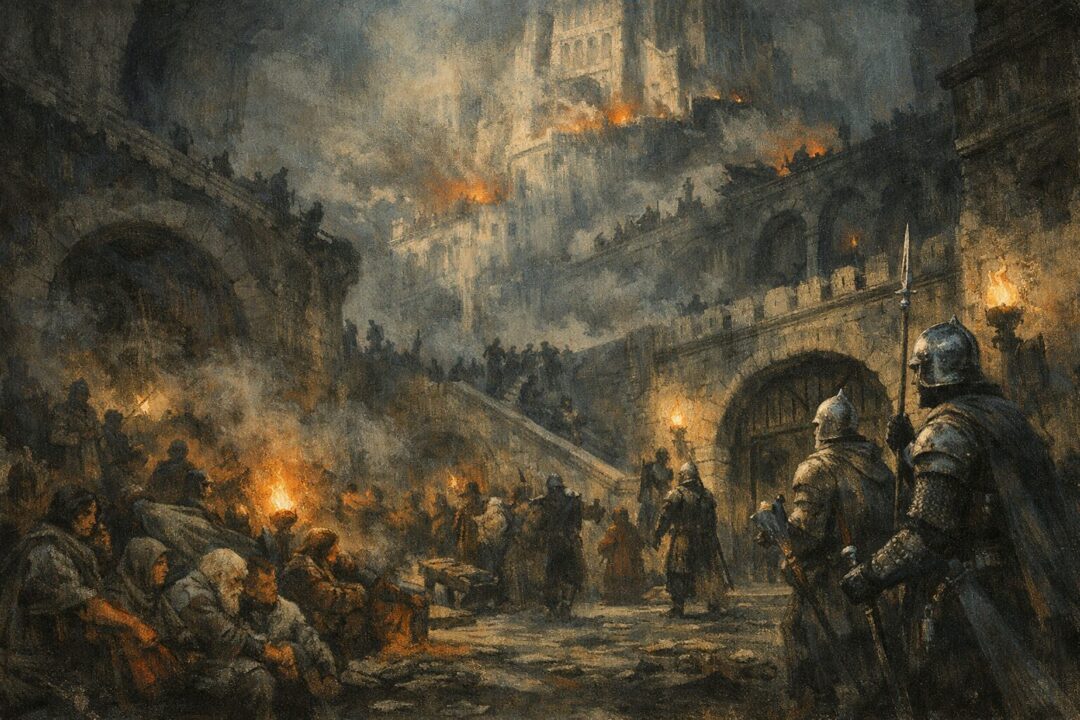
When we think of the Battle of the Pelennor Fields, we picture open ground, fell beasts in the sky, and the charge of the Rohirrim shaking the earth. Tolkien’s narrative pulls us outward—to banners, horns, and prophecy fulfilled.
But during those same hours, Minas Tirith was fighting a different kind of war.
Not a war of swords—but of will.
By the time the first stones from Grond struck the Great Gate, Gondor was already under siege long before the enemy breached its walls.
The Witch-king’s Real Strategy
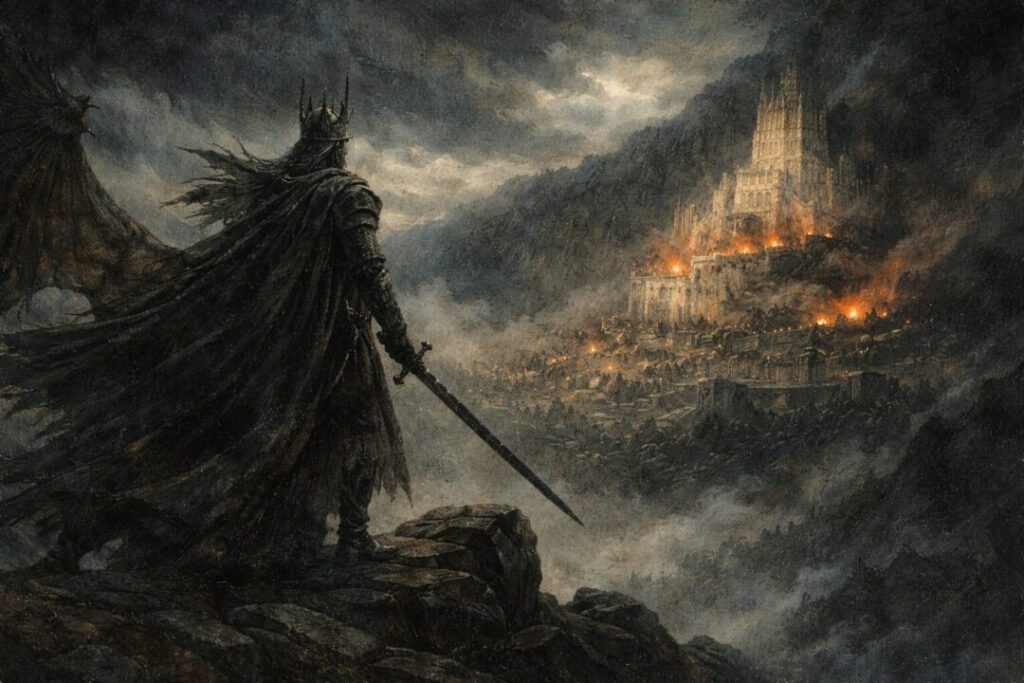
The Witch-king of Angmar was not merely the commander of armies. He was a master of terror, and Minas Tirith was uniquely vulnerable to him.
The City was crowded beyond reason. Refugees filled every level, packed into courts, stairways, and abandoned halls. Supplies were strained. Command structures were stretched thin. And above all—hope was fragile.
Rather than storming every wall at once, the Witch-king allowed fear to do much of the work.
Throughout the siege, panic spread in uneven waves. Certain districts burned while others remained untouched. Messengers failed to return. Orders contradicted one another. Some companies held fast. Others broke without ever seeing the enemy.
This was not coincidence.
Fear as a Weapon
Tolkien makes clear that the presence of the Nazgûl alone could unman even veteran soldiers. Horses reared. Men faltered. Courage drained away like water through cracked stone.
The Witch-king amplified this effect across the City.
Guards abandoned posts not because they were attacked—but because they felt watched. Doors were barred prematurely. Fires were lit too early, wasting fuel. Water stores were mishandled. Signals were misread or ignored entirely.
Gondor was not collapsing outward—it was collapsing inward.
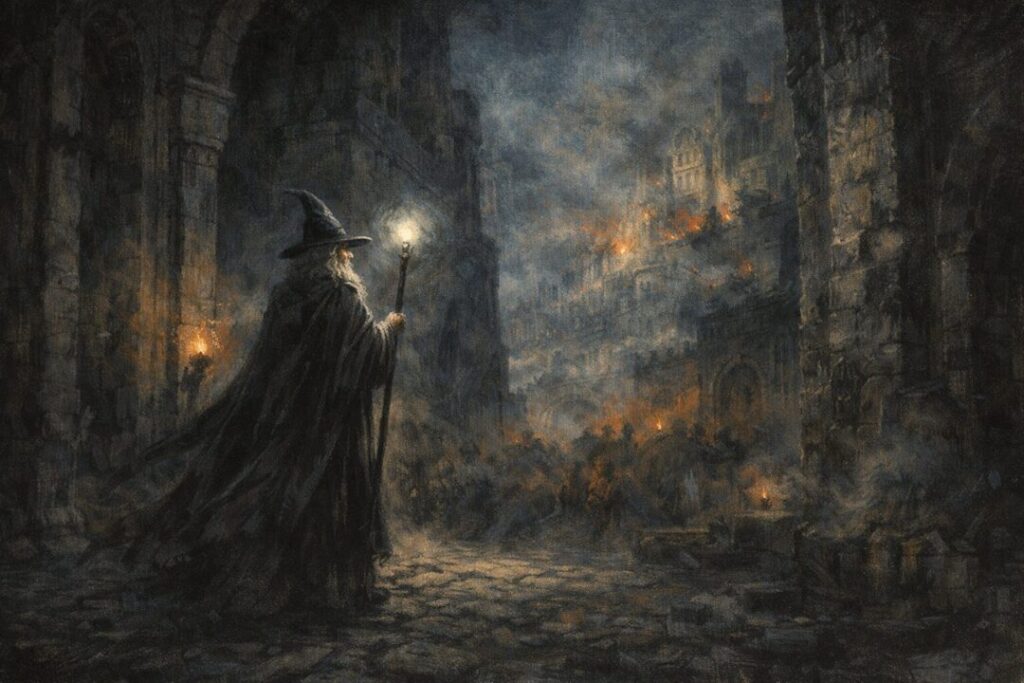
This is why Gandalf’s presence mattered so much. He wasn’t only defending the Gate. He was anchoring the City’s morale, moving constantly, seen at moments when despair threatened to tip into chaos.
Without him, Minas Tirith would likely have fractured before the walls ever fell.
The Pressure of the Crowded City
One of the most overlooked elements of the siege is just how many people were inside Minas Tirith when it began.
This was not a city prepared for a long, clean defense. It was a city swollen with fear. Families from the Pelennor had fled behind the walls. The sick and wounded were already filling houses of healing. Food had to be rationed not just for soldiers, but for thousands of civilians.
Every explosion, every Nazgûl cry, echoed through narrow stone corridors packed with people who had nowhere else to go.
In that environment, panic was contagious.
A single rumor—true or false—could send entire levels into disorder. A single failure of leadership could unravel hours of discipline. The Witch-king did not need to breach the City everywhere. He needed it to doubt itself.
Denethor and the Crumbling Center
No account of this unseen battle is complete without addressing Denethor.
The Steward of Gondor was not a coward. He was intelligent, proud, and deeply invested in his city’s survival. But he was also exhausted, grieving, and—most dangerously—isolated.
Under the weight of the siege and the influence of despair, Denethor became another fault line within the City. Orders slowed. Decisions became erratic. Hope was treated as weakness rather than necessity.
This mattered.
Because in a siege like this, morale flows downward. When leadership falters, it doesn’t fail loudly—it erodes quietly.
Had Denethor’s despair spread unchecked just a little longer, Gondor’s internal cohesion might have failed before the enemy ever took the walls.
Why the Fall Almost Came Early
At several points during the siege, Gondor stood on the brink of internal failure.
Had the Great Gate fallen even an hour sooner…
Had Denethor’s despair spread unchecked…
Had Gandalf been drawn away from the City’s heart…
The Rohirrim might have arrived to a city already lost.
The Witch-king understood this. His goal was never just conquest—it was collapse.
And for a time, it nearly worked.
The Moment That Changed Everything
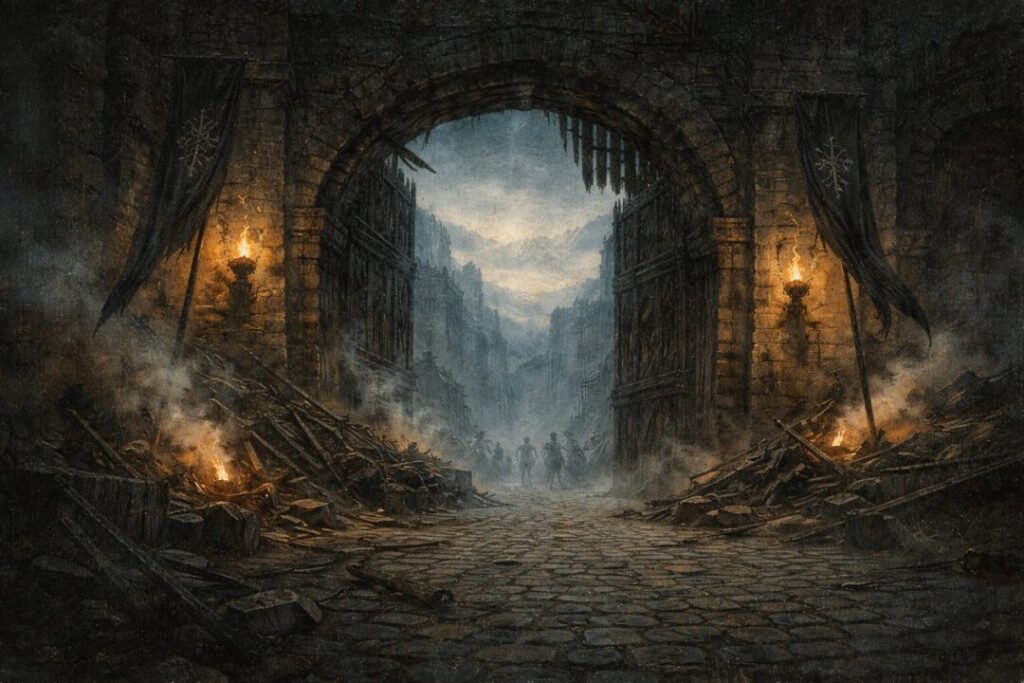
When the Witch-king rode through the broken Gate and confronted Gandalf, it wasn’t just a clash of power—it was a turning point in the unseen war.
This was the embodiment of terror meeting the embodiment of resistance.
Even then, the outcome was not sealed by force alone. It was sealed by timing.
The arrival of the Rohirrim shattered the spell of inevitability the Witch-king had woven. Hope returned faster than fear could follow. Soldiers who had been moments from breaking found themselves standing again. The City breathed.
Minas Tirith did not fall because it did not break from within.
Why This Moment Is Often Forgotten
Tolkien doesn’t dwell on this internal struggle. There are no long descriptions of riots, mass desertions, or screaming civilians. Instead, the danger is implied—woven between glances, silences, and sudden decisions.
But once you notice it, the siege reads differently.
The Battle of the Pelennor Fields wasn’t just won by cavalry charges and prophecy. It was won because Gondor endured long enough not to lose itself.
The Battle Beneath the Battle
While the world remembers the clash on the fields, Minas Tirith remembers the hours when no enemy blade was in sight—yet defeat felt certain all the same.
It remembers the silence after a Nazgûl’s cry.
The moments when no orders came.
The seconds when courage was a choice, not a certainty.
That is the battle most people never see.
And it may have been the most important one of all.