When readers think of Gondor’s decline, they usually point to external threats.
The Witch-king of Angmar.
The fall of Minas Ithil.
The long, grinding watch against Mordor.
The slow fading of Númenórean blood and longevity.
All of these are real. All are firmly grounded in the texts of The Lord of the Rings, especially its Appendices.
But none of them fully explain why Gondor entered the War of the Ring already diminished—struggling to defend borders it once ruled easily, dependent on allies, and led by stewards rather than kings.
To understand that weakness, we must look inward.
Long before Sauron openly moved again, Gondor fought the most destructive war in its history against itself. Tolkien calls it the Kin-strife, and although it occupies only a few pages in the Appendices, its consequences echo through every later chapter set in the South-kingdom.
This was the civil war Gondor never truly recovered from.
What the Kin-strife Was—and What It Was Not
The Kin-strife was not a minor rebellion, nor a brief dispute between rival claimants.
According to Appendix A of The Lord of the Rings, it was a full civil war that lasted sixteen years, from Third Age 1432 to 1448, beginning shortly after the death of King Valacar.
Its causes were political, cultural, and deeply rooted in Gondor’s understanding of identity.
Valacar’s son, Eldacar, was his lawful heir. There is no ambiguity in the line of succession. Yet Eldacar’s mother was not of Númenórean descent. She was a woman of the Northmen of Rhovanion—Gondor’s long-standing allies, but not a people regarded as equal in lineage.
This mattered deeply to Gondorian nobility.
By this point in the Third Age, Gondor had already internalized the belief that Númenórean blood was inseparable from authority, wisdom, and legitimacy. Long life, command, and even moral fitness to rule were increasingly associated with descent rather than law.
Eldacar’s mixed heritage therefore became a focal point for opposition.
This opposition was led by Castamir, a member of the royal house with significant support in the southern provinces. Tolkien does not describe Castamir as a foreign usurper or outsider. He was Gondorian, noble-born, and powerful—making the conflict not an invasion, but a fracture along lines already present within the realm.
Fear, Not Just Prejudice
It is tempting to describe the Kin-strife purely as xenophobia, but Tolkien’s account suggests something more complex.
The resistance to Eldacar was driven by fear as much as disdain. Gondor had already begun to decline in population, territory, and vitality. Many nobles believed that intermarriage with “lesser” Men would accelerate that decline, weakening the royal house both physically and symbolically.
Whether this belief was justified is never stated as fact. Tolkien does not endorse it. But he does show how strongly it shaped political reality.
In this sense, the Kin-strife reflects a recurring pattern in Tolkien’s histories: fear of decline leading to choices that hasten it.
Gondor Turns Its Sword on Itself
When Valacar died, the fragile balance collapsed.
Civil war broke out almost immediately. Eldacar was driven from Osgiliath, the ancient capital, and Castamir seized the throne.
What followed was not a stabilizing reign.
Tolkien is unusually explicit about Castamir’s brutality. Eldacar’s supporters were hunted down and executed. Most shockingly, Eldacar’s own son was captured and burned alive. This detail, recorded without embellishment, signals how personal and unforgiving the conflict had become.
This was no clean transfer of power. It was terror used as policy.
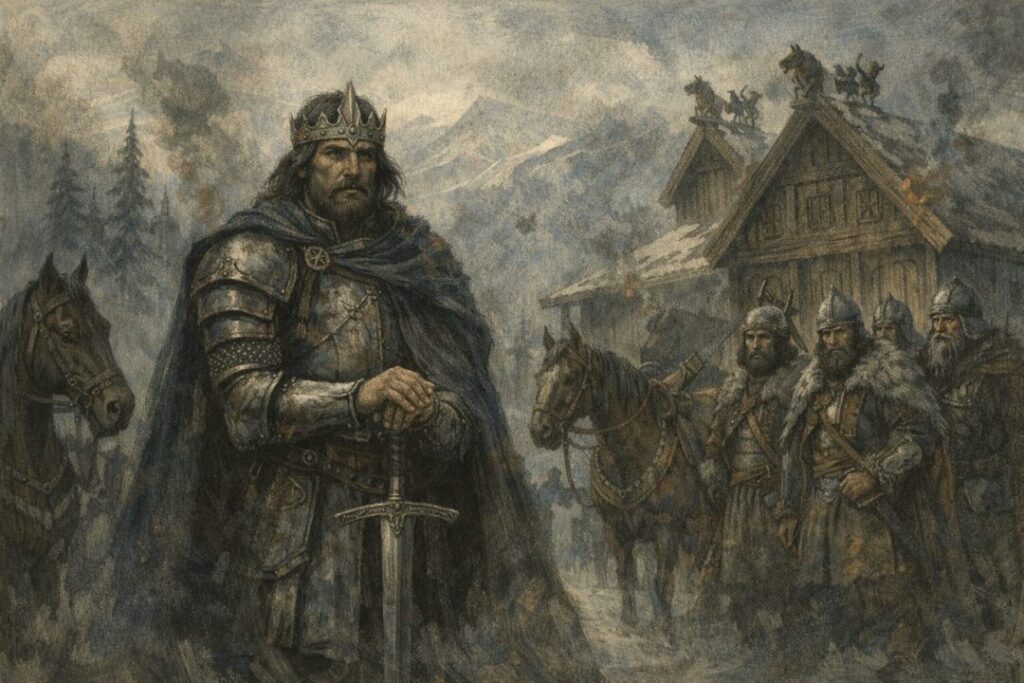
Eldacar fled east to Rhovanion, where he found refuge among his mother’s people. Years passed. He did not vanish or abandon his claim. Instead, he gathered strength, allies, and eventually an army.
When he returned, Gondor faced itself on the battlefield.
The Battle of the Crossings of Erui
The decisive confrontation came at the Crossings of Erui.
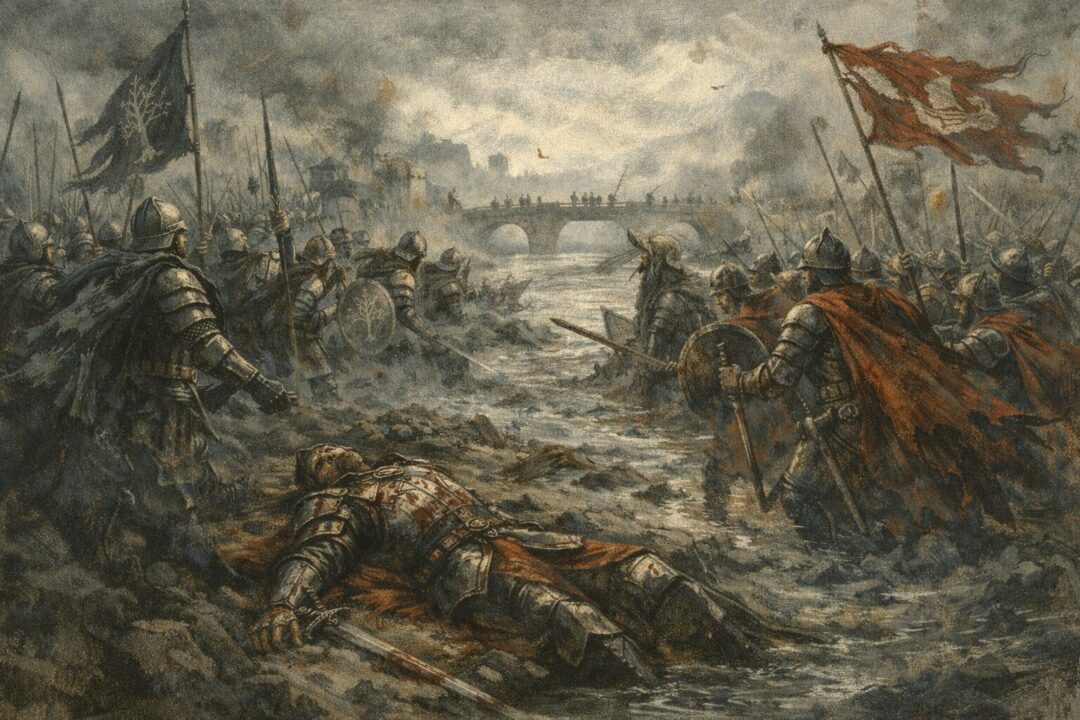
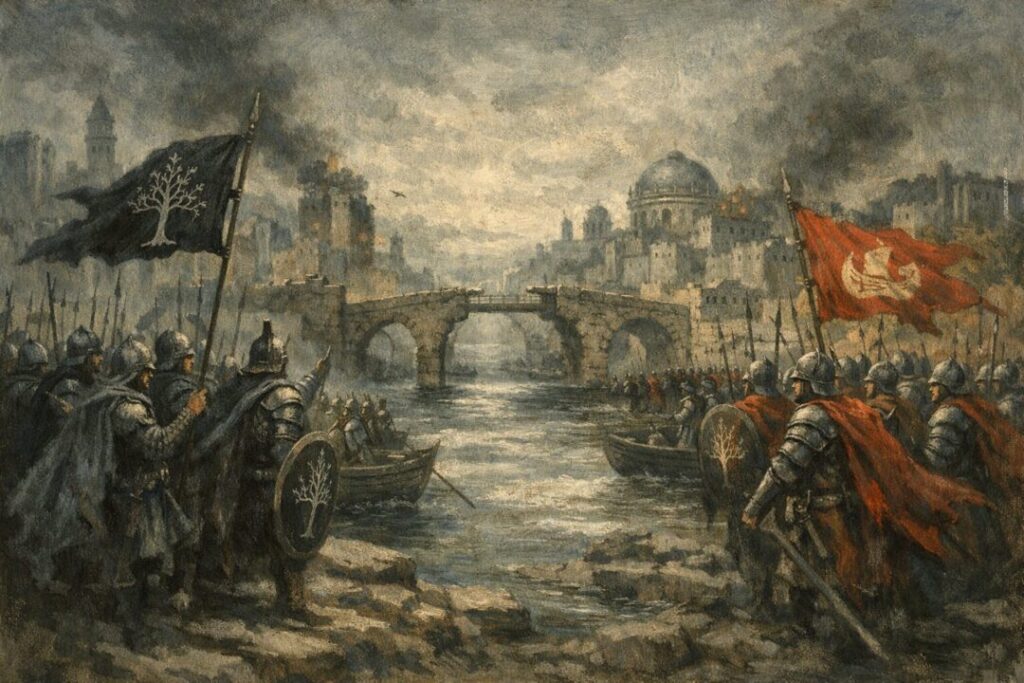
This battle is one of the bleakest episodes in Gondor’s history because of what it represents. Gondorian soldiers, trained in the same traditions, bearing the same heraldry, killed one another in large numbers. No Orcs marched. No foreign banners flew.
Castamir was slain in the fighting, and Eldacar reclaimed the throne.
On paper, the rightful king had been restored.
In reality, Gondor had been broken.
Victory Without Restoration
Eldacar’s return did not undo the damage of sixteen years of civil war.
Tolkien is clear that the consequences were severe and lasting.
Castamir’s surviving sons fled south to Umbar, where they established themselves as the leaders of the Corsairs. These descendants would remain Gondor’s enemies for generations, raiding its coasts and disrupting trade.
Even more devastating was the loss of Gondor’s fleet.
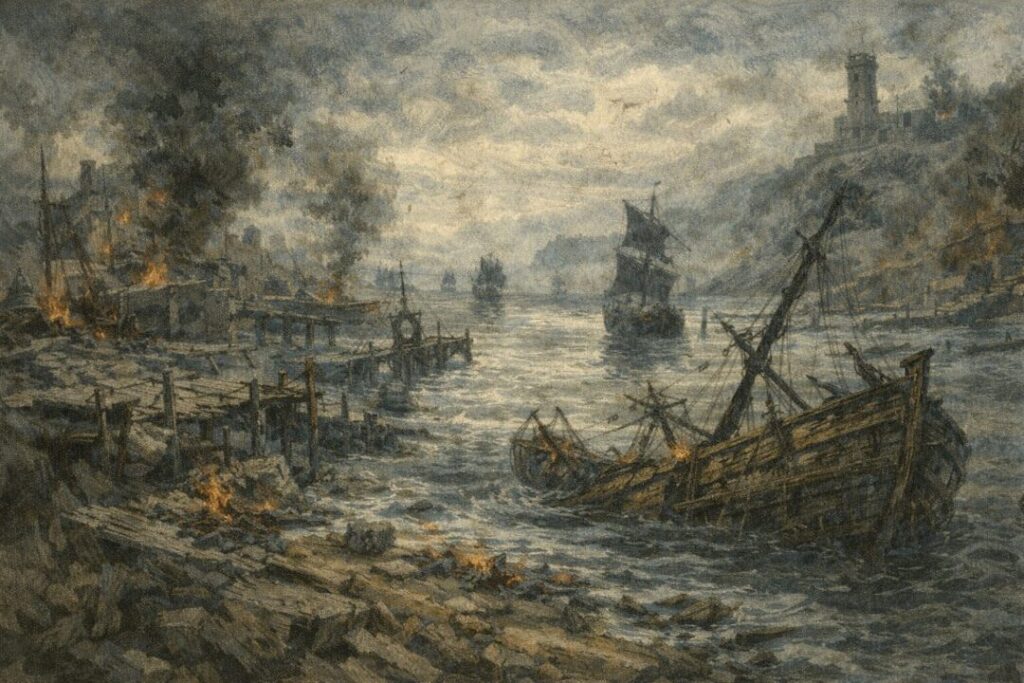
During the Kin-strife, much of the navy was destroyed—by Gondorians, against Gondorians. The realm that once dominated the seas never fully recovered maritime supremacy. From this point onward, Gondor’s southern and coastal defenses remained exposed.
Beyond military losses, deeper damage set in.
The southern provinces never entirely regained their loyalty to the crown. Population losses were significant. Trust between regions was eroded. Royal authority, once assumed, now had to be asserted cautiously.
Most importantly, Gondor lost unity.
From this point on, the realm increasingly reacted to threats rather than shaping events. It defended. It endured. It no longer commanded.
The Appendices mark the Kin-strife as a turning point—the moment after which Gondor’s long decline visibly accelerates.
The Shadow That Followed Gondor Into the War of the Ring
By the time of Denethor II, the effects of the Kin-strife are still present, though centuries have passed.
Gondor’s armies are smaller than in earlier ages.
Its borders have contracted.
Its leadership bears immense strain.
Its line of kings has failed, leaving the rule in the hands of Stewards.
This is not solely because Sauron is strong.
It is because Gondor never fully healed from fighting itself.
When the War of the Ring comes, Gondor survives—but only just. It relies on Rohan, on ancient oaths fulfilled by the Dead Men of Dunharrow, and on unexpected aid from the North.
Had Gondor entered this final war united, populous, and secure in its southern territories, the balance might have looked very different.
Instead, it stands as a realm holding together by discipline and memory rather than strength.
A Pattern Tolkien Repeats Quietly
The Kin-strife fits a broader pattern in Tolkien’s legendarium.
Internal division is always more destructive than external assault.
It is pride that destroys Númenor.
Oath-breaking that ruins the sons of Fëanor.
Fear of decline that fractures Gondor.
Evil, in Tolkien’s world, often does not need to strike immediately. It waits while its enemies weaken themselves.
The Kin-strife is easy to overlook because it unfolds away from the central narrative.
There is no Fellowship.
No Ring-bearer.
No Dark Lord openly revealed.
Yet its consequences shape everything that follows.
Gondor’s Quiet Tragedy
Gondor’s tragedy is not that it fell.
It did not.
It endured longer than almost any realm of Men in Middle-earth.
Its tragedy is that it diminished itself long before the final war arrived.
By the time the darkness returned in full, Gondor was already scarred—its strength spent not only on defending the world, but on destroying itself from within.
And once you see the Kin-strife clearly, Gondor’s story becomes more than a tale of fading glory.
It becomes a warning, written quietly into the history of Middle-earth:
That no enemy is more dangerous than fear turned inward—and no victory more hollow than one won against your own people.