Why the Council of Elrond Refuses to Command Frodo
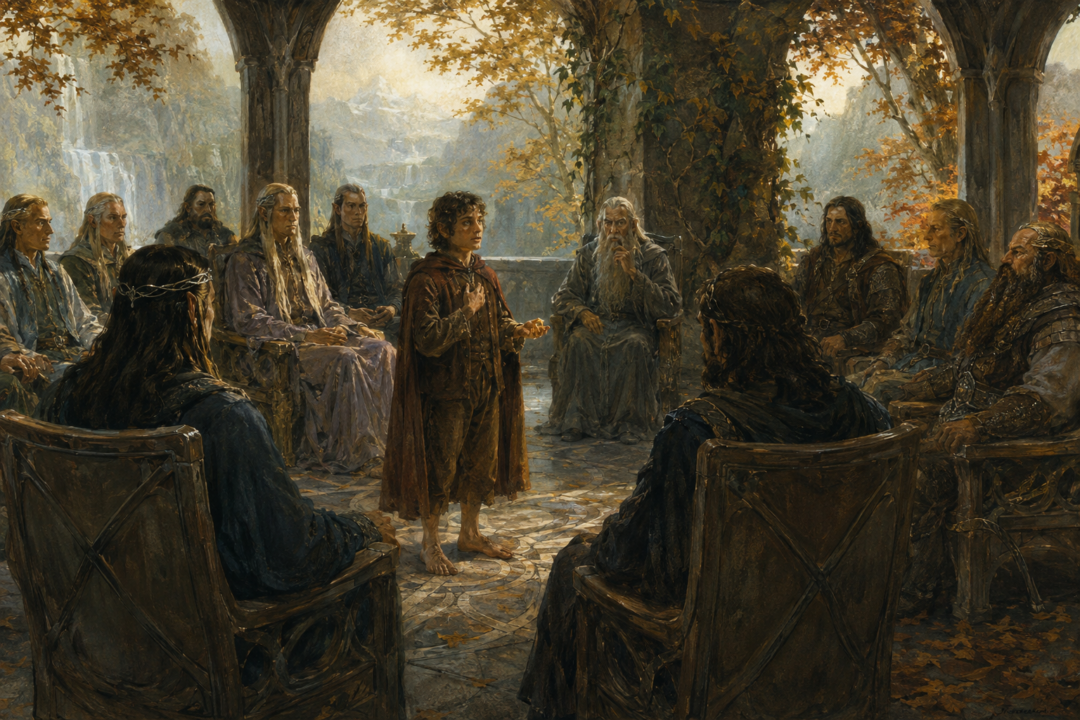
The One Ring is sitting in Rivendell, Sauron is searching for it, and some of the most powerful people in Middle-earth are gathered in one place. They know what must ultimately happen: the Ring cannot safely be used, hidden indefinitely, or surrendered. It must be taken into Mordor and destroyed in the fire where it was made.
Yet when the decisive moment comes, Elrond does something striking.
He does not order Frodo to go.
He does not declare that the needs of Middle-earth give the Council the right to sacrifice one hobbit. He does not convert wisdom, rank, necessity, or military emergency into authority over Frodo’s will. Instead, Frodo speaks first: “I will take the Ring, though I do not know the way.”
Only afterward does Elrond acknowledge that the task appears to have fallen to him.
This is not merely courtesy. The Council of Elrond reveals one of the deepest distinctions between the Free Peoples and the powers they oppose: the difference between recognizing a terrible duty and claiming the right to impose it.
The Council Is Not a Government of Middle-earth
Calling the gathering the “Council of Elrond” can make it sound more formally political than the scene actually is.
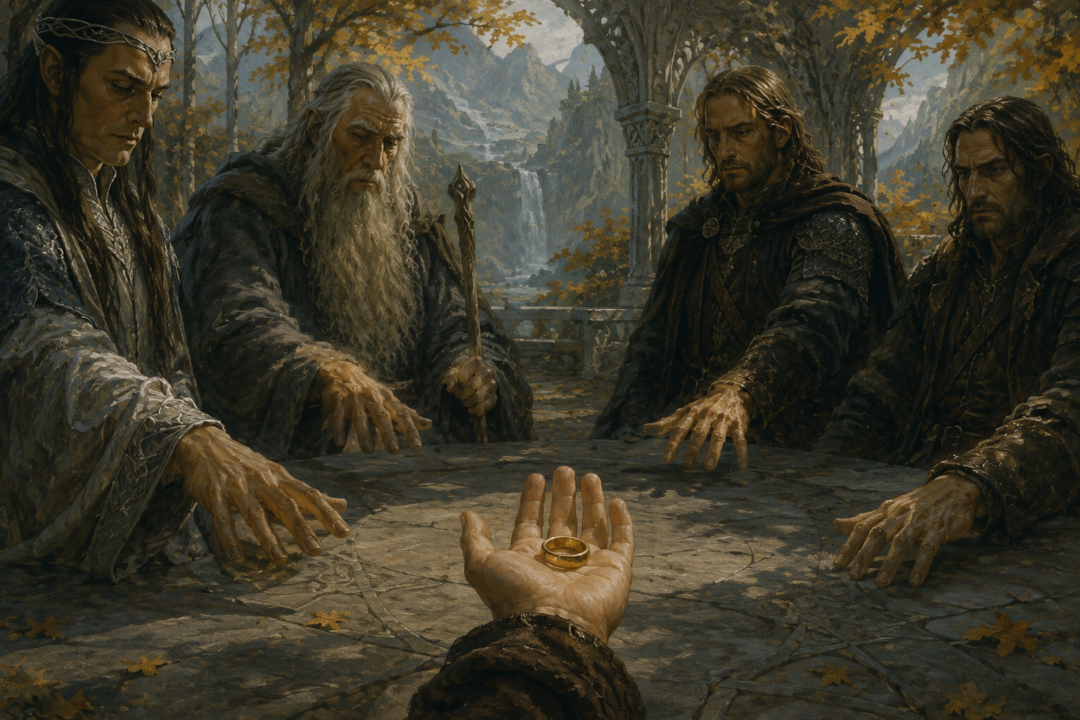
Elrond is unquestionably the master of Rivendell and one of the greatest surviving Eldar in Middle-earth. Gandalf possesses enormous wisdom and authority of another kind. Aragorn is Isildur’s heir. Boromir represents the ruling house of Gondor. Glóin and Gimli have come from Erebor, while Legolas brings news from Thranduil’s realm.
But these people have not assembled as members of a recognized supreme government with jurisdiction over all the Free Peoples.
Indeed, one of Elrond’s remarkable observations is that those present have been “called” even though he himself did not summon them all for this purpose. Their separate roads and concerns have converged upon Rivendell.
The Council therefore possesses immense knowledge and moral weight, but Tolkien never presents it as a legislature or court empowered to conscript a Ring-bearer.
That distinction becomes crucial once they determine what must be done.
They can judge that the Ring ought to be destroyed.
That does not automatically mean they can compel a particular person to destroy it.
Everyone Can See the Need, but No One Can Transfer the Cost
The Council gradually eliminates the alternatives.
The Ring cannot simply be given to Sauron. Using it against him would invite corruption and eventually produce another tyrant. Sending it across the Sea is not offered as an available solution. Entrusting it to Tom Bombadil is rejected because even if the Ring has little hold upon him, he would not necessarily guard it with the seriousness required. Hiding it only postpones the crisis while Sauron’s power grows.
The road to Orodruin becomes the dreadful conclusion.
Yet knowing the necessary destination does not answer the question of who must carry the burden.
This is where Elrond refuses to cross a moral line.
After Frodo volunteers, Elrond tells him that he believes the task is “appointed” for him. That word matters. Elrond is interpreting events: Bilbo’s finding of the Ring, Frodo’s inheritance of it, his escape from the Shire, and his arrival in Rivendell. The Wise repeatedly sense patterns in events that they did not design.
But Elrond does not turn that perception into a command.
He immediately qualifies it by saying that the burden is so heavy that no one could lay it upon another. He explicitly tells Frodo that he does not lay it upon him. Only if Frodo takes it freely will Elrond affirm his choice.
Middle-earth may desperately need Frodo.
Need is still not treated as ownership of Frodo.
“Appointed” Does Not Mean Ordered by Elrond
The language can seem paradoxical.
How can Elrond believe a task has been appointed for Frodo while simultaneously insisting that Frodo must accept it freely?
That tension runs through much of The Lord of the Rings.
Earlier, Gandalf tells Frodo that Bilbo was “meant” to find the Ring, and consequently that Frodo may also have been meant to receive it. Gandalf does not claim to fully understand the purpose behind events. He recognizes a design beyond Sauron’s intentions without pretending that this eliminates personal choice.
At the Council, Elrond speaks with similar caution: “If I understand aright…”
He is not issuing a decree from some known divine mandate. He is interpreting the extraordinary chain of events before him.
Frodo’s freedom remains real precisely because Elrond refuses to substitute his own will for whatever larger purpose may be unfolding.
The Wise may perceive.
They are not therefore entitled to dominate.
Gandalf Had Already Treated Frodo the Same Way
This principle does not begin in Rivendell.
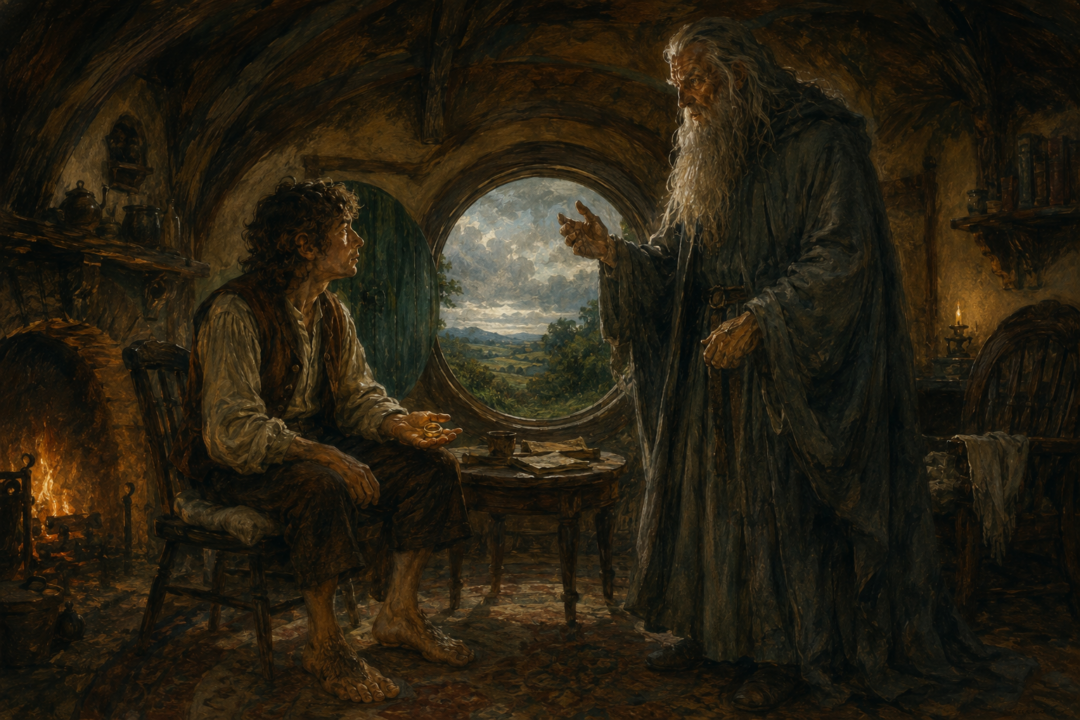
At Bag End, after explaining the danger of the Ring, Gandalf refuses Frodo’s desperate attempt to give it to him. Gandalf knows that possessing the Ring would expose him to a terrible temptation: the desire to use overwhelming power for apparently good purposes.
Then comes another important moment.
Gandalf tells Frodo that the decision lies with him.
He advises. He warns. He explains that the Enemy is moving and that delay is dangerous. But he does not simply seize the Ring and dictate Frodo’s future.
This creates a consistent pattern.
Those wiser and stronger than Frodo give him knowledge he could never have gathered alone. They help him understand the consequences. They offer guidance and protection.
What they repeatedly avoid doing is reducing him to an instrument.
That restraint is especially significant because using people as instruments is exactly what the Ring encourages.
The Enemy’s Model of Power Is the Opposite
Sauron does not persuade equals and wait for voluntary cooperation.
His entire system depends upon domination.
The One Ring was created as a mechanism of control, particularly over the bearers of the other Rings of Power. His servants are driven by fear, enslavement, corruption, or the desire for power. The Nazgûl are the ultimate demonstration of what happens when independent persons become extensions of another will.
Saruman moves in the same direction.
He begins with arguments, persuasion, and promises, but beneath them lies the desire to command. He wants Gandalf to join him because Saruman believes the Wise should seize power and impose order upon events.
The temptation is especially dangerous because domination can disguise itself as necessity.
Someone must govern.
Someone must defeat Sauron.
Someone must decide for those who do not understand.
The Council faces a version of that temptation with Frodo. They are stronger, older, more knowledgeable, and aware of dangers he cannot fully imagine.
It would be easy to argue that they therefore have the right to decide for him.
They refuse.
Even the Fellowship Is Not Bound by an Oath
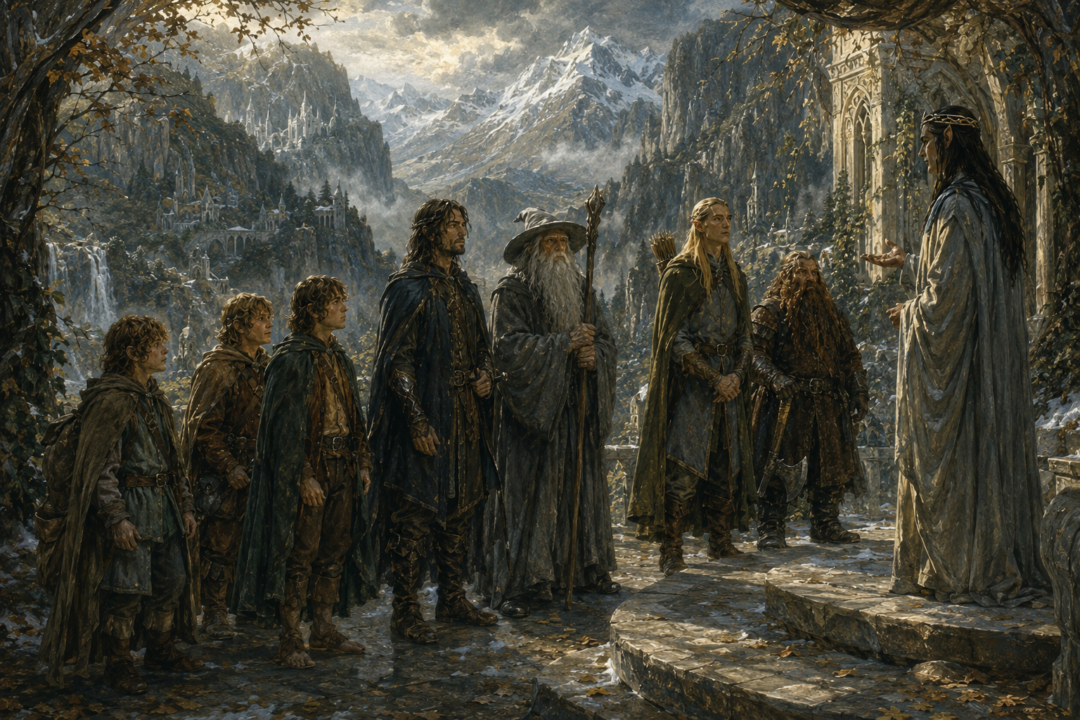
The same principle appears again when the Company finally leaves Rivendell.
Elrond does place a specific charge upon the Ring-bearer concerning the Ring. Frodo must neither cast it away nor surrender it to the Enemy, and its handling is tightly restricted.
But the other members of the Fellowship are described as free companions.
Elrond deliberately refuses to bind them by an oath requiring them to continue to Mount Doom regardless of circumstances. They may turn back or take another road as events demand.
When Gimli suggests that loyalty should endure when the road becomes dark, Elrond does not condemn loyalty. Instead, he warns against swearing blindly to circumstances that cannot yet be understood.
That warning has enormous historical resonance in Middle-earth.
The Elder Days contain catastrophic examples of oaths becoming traps, most famously the Oath of Fëanor and the violence that follows from the determination of Fëanor’s sons to fulfil it at any cost.
Elrond has lived within the consequences of that history.
The Fellowship will require extraordinary loyalty, but Rivendell does not manufacture that loyalty through binding words.
Frodo’s Smallness Is Part of the Point
There is another reason the voluntary character of Frodo’s decision matters.
The Council contains figures who seem far better suited to an epic quest.
Glorfindel is among the mighty Eldar. Aragorn is a seasoned Ranger and heir of kings. Boromir is a renowned warrior. Gandalf is one of the Istari.
Frodo is a hobbit who openly admits that he does not even know the road to Mordor.
If the Quest were merely an exercise in institutional command, Frodo would be an improbable choice. The Council could select the strongest available champion and send him under orders.
But strength is exactly what makes the Ring so dangerous.
Those who imagine themselves capable of mastering great power are among those most vulnerable to wanting to use it.
Frodo does not volunteer because he expects glory or because he believes himself uniquely capable. His words emerge from fear, uncertainty, and nevertheless a willingness to carry what has come to him.
Elrond honors that choice rather than manufacturing it.
Freedom Does Not Make the Burden Less Terrible
None of this means Frodo’s decision occurs in comfortable circumstances.
His freedom is surrounded by necessity.
Sauron is rising. The Shire is no longer safe while the Ring remains there. Rivendell cannot preserve it forever. Every alternative discussed by the Council carries enormous danger.
Frodo is therefore not choosing between an easy life and an adventurous journey under ordinary conditions.
He is choosing inside a crisis he did not create.
That makes Elrond’s restraint more significant, not less.
The Council cannot remove the terrible realities shaping Frodo’s decision. What it can refuse to do is add another form of coercion.
Frodo will already face the will of Sauron through the Ring.
He does not also need the wills of the Wise imposed upon him from the opposite direction.
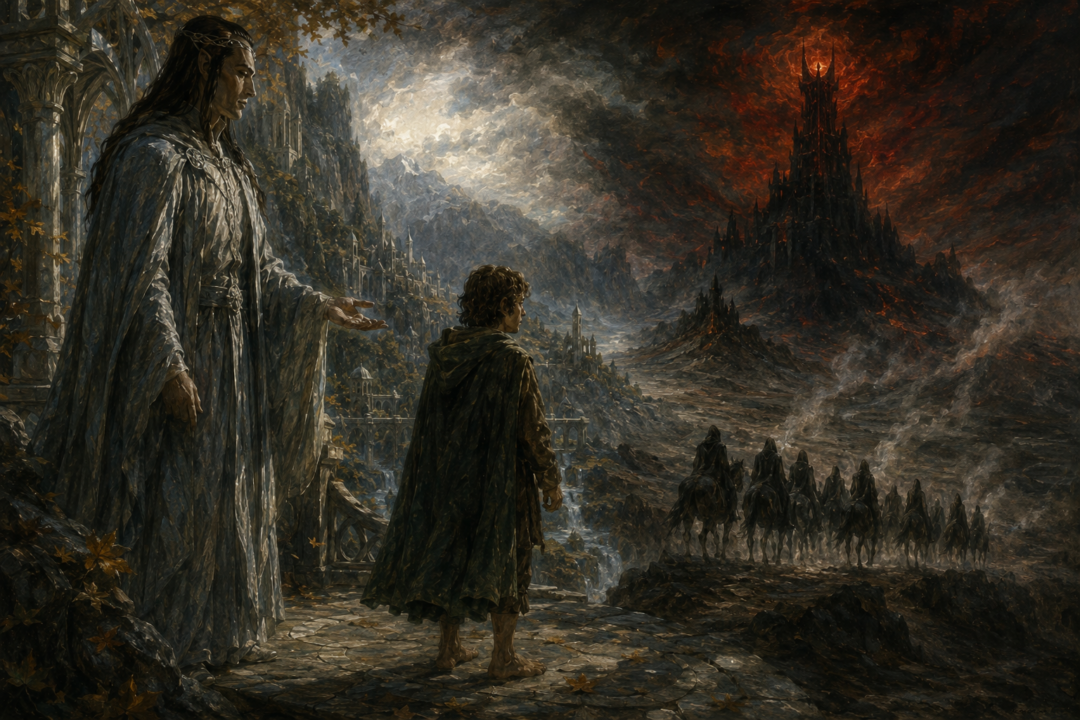
The Free Peoples Win Without Becoming What They Fight
The Council of Elrond is often remembered for revealing the Ring’s history and deciding that it must be destroyed.
But its method is almost as important as its conclusion.
The West cannot defeat domination by becoming a more benevolent version of domination.
Elrond gives counsel rather than claiming ownership of another person’s will. Gandalf offers help without seizing control. The Fellowship travels as companions rather than as servants chained by an oath. Frodo accepts the burden voluntarily even though the forces surrounding his choice are immense.
This does not amount to a formal constitutional rule stated anywhere in the legendarium. Tolkien never describes the Council in modern legal terminology, and it would go too far to claim that Elrond is consciously applying a defined law against conscription.
The textual pattern, however, is unusually clear.
Elrond knows what must be done.
He may even believe that Frodo has somehow been brought to the moment in which he must decide.
Still, he refuses to say: therefore I command you.
In a story dominated by a Ring whose purpose is to bend other wills, that refusal is not a minor courtesy.
It is part of what separates the Council from the Dark Lord.
Sources & Notes
- https://tolkiengateway.net/wiki/Council_of_Elrond — Chapter and event reference for the delegates’ unsummoned convergence, the rejection of alternatives for the Ring, Frodo’s voluntary offer, and Elrond’s response.
- https://tolkiengateway.net/wiki/Quest_of_the_Ring — Overview of the quest formed at Rivendell, including Frodo as Ring-bearer and the Fellowship’s purpose.
- https://tolkiengateway.net/wiki/Frodo_Baggins — Biographical reference for Frodo’s inheritance of the Ring, journey to Rivendell, acceptance of the quest, and role as Ring-bearer.
- https://tolkiengateway.net/wiki/The_Shadow_of_the_Past — Chapter reference for Gandalf’s account of the Ring and his distinction between providential purpose and the choices available to Frodo.
- https://tolkiengateway.net/wiki/Free_Peoples — Context for Tolkien’s collective term for the peoples opposing Sauron, whose cooperation at Rivendell differs from the Enemy’s domination.
Sources document the Council’s composition and decision, Frodo’s voluntary acceptance, the Quest, providence and choice, and the Free Peoples context.