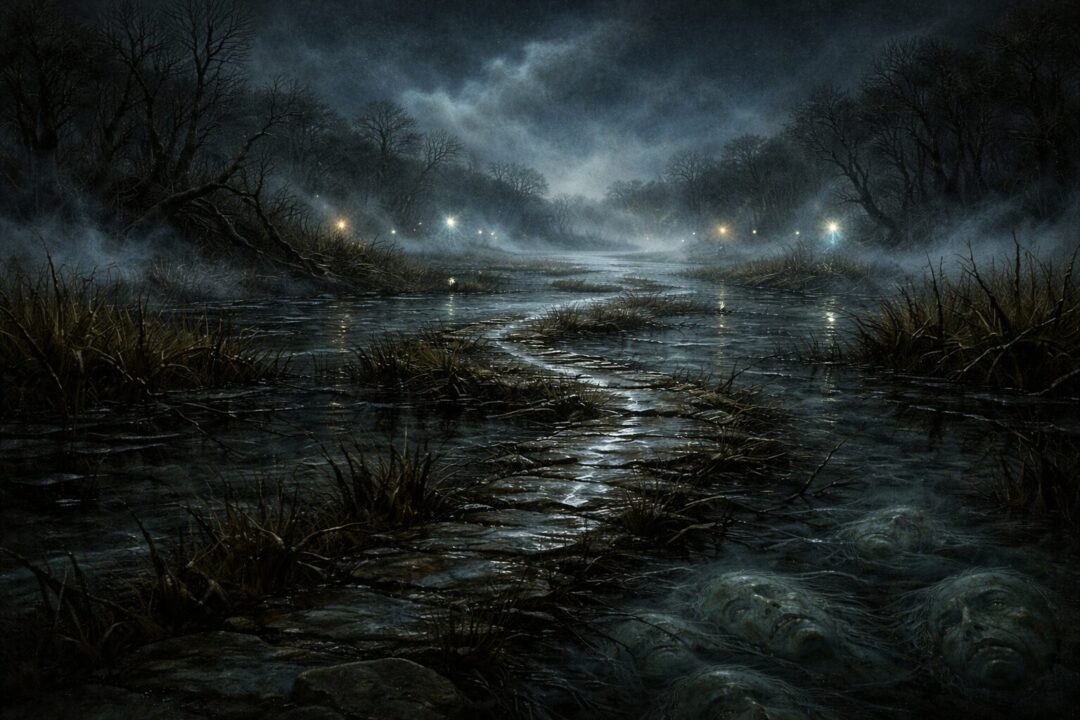
Few locations in The Lord of the Rings feel as quietly disturbing as the Dead Marshes.
There are no towers looming on the horizon.
No armies clash.
No great enemy steps forward to bar the way.
And yet, the memory of this place clings to readers more stubbornly than many scenes filled with fire and steel.
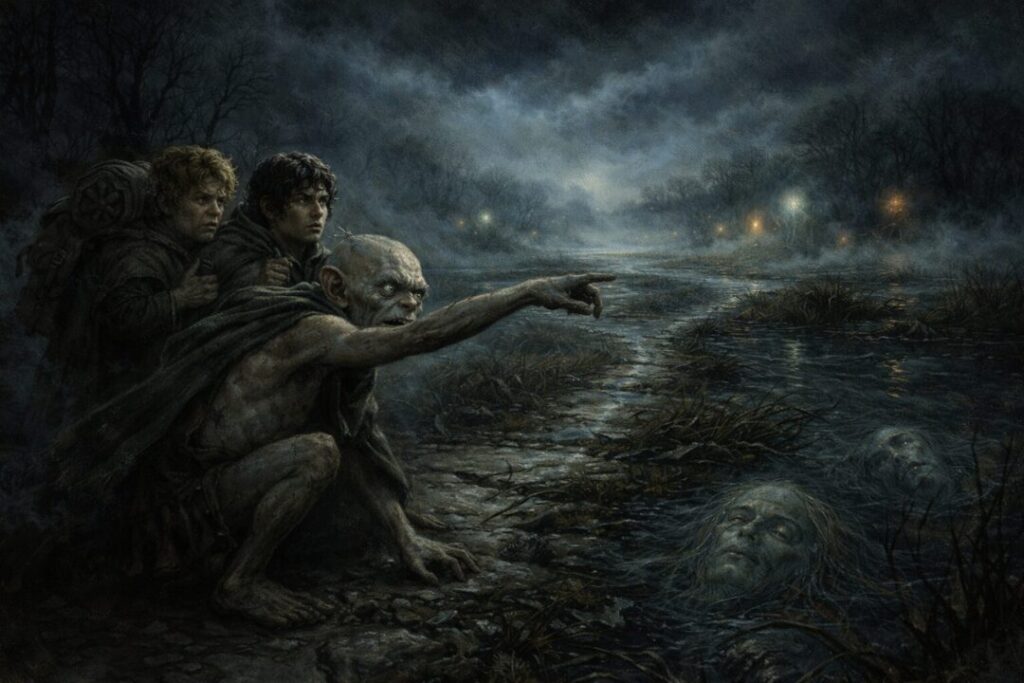
As Frodo Baggins, Samwise Gamgee, and Gollum cross the marshes, the danger does not announce itself. It seeps. The ground softens. The air feels stale and heavy. Narrow paths wind between pools of black water that reflect the sky like broken glass.
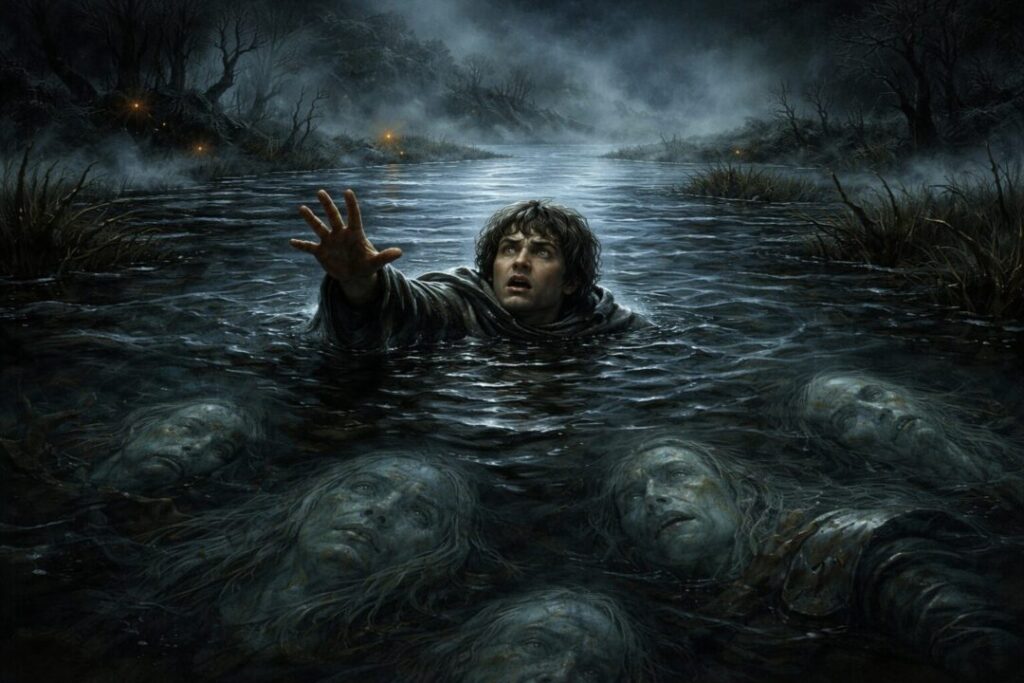
Then Frodo slips.
For a moment, he is submerged. The water closes over him. And when he looks down, he sees faces staring back.
Dead faces.
Men.
Elves.
Orcs.
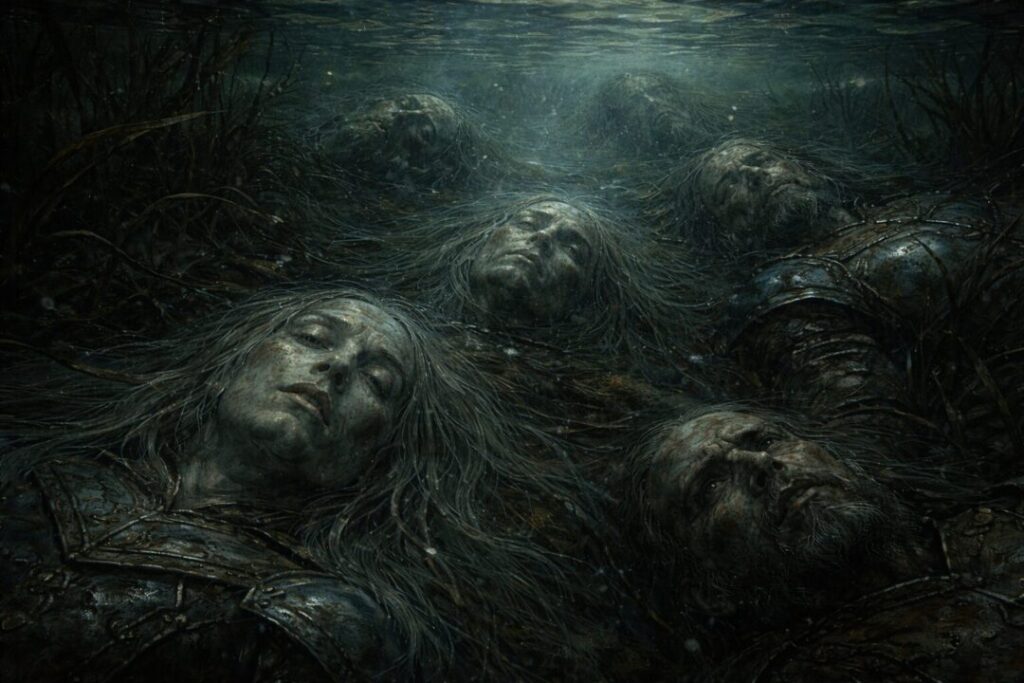
They lie beneath the surface, pale and unmoving, preserved with a terrible clarity. Some appear almost peaceful. Others seem twisted in agony. A few look as though their eyes are open, watching from the depths. When the water ripples, it almost feels as if they move.
They are unmistakably dead.
At first glance, the moment feels supernatural — like a ghost story intruding into the journey. Even Sam believes that some dark sorcery must be at work. Frodo himself is shaken in a way that goes beyond fear.
But Tolkien is careful here. The horror of the Dead Marshes does not come from restless spirits or curses laid upon the land.
It comes from history.
A Battlefield That Never Healed
The Dead Marshes lie near the site of the Battle of Dagorlad, where the Last Alliance of Elves and Men fought Sauronat the end of the Second Age.
This was not a small conflict. It was one of the greatest battles Middle-earth ever witnessed — a war fought on a scale that reshaped the land itself. Elves and Men marched east in vast numbers. Sauron’s forces answered in kind. The ground before Mordor became a killing field.
When the battle ended, victory came at a terrible cost.
Thousands upon thousands lay dead. Armor was shattered. Weapons were broken and abandoned. The earth was churned into mud by marching feet and spilled blood. And when the armies moved on — to the Siege of Barad-dûr and the final confrontation — the dead were left where they fell.
Over the centuries that followed, the land changed.
Water spread slowly across the battlefield. Marsh plants took root. The ground softened and sank. Pools formed where once there had been solid earth. The dead were not buried. They were covered.
But they were never truly hidden.
The marshes swallowed the battlefield without digesting it. Bodies remained trapped beneath shallow water and layers of silt, preserved by cold and stagnation. Faces remained visible, pale and distorted, staring upward through the dark.
Tolkien describes them plainly as corpses, not spirits — “dead faces, cruel and fair, and noble and evil.” This is not a realm of the undead.
They are not walking.
They are not haunting.
They are simply there.
Unburied.
Unreleased.
Unforgotten.
Why the Dead Are Still Visible
In Middle-earth, burial is not a small matter. It is an act of respect, remembrance, and closure. To bury the dead is to acknowledge their place in the world and to allow both the living and the land to move forward.
The Dead Marshes represent a place where that process never occurred.
No songs were sung for these fallen.
No cairns were raised.
No rites were spoken over them.
The land simply closed over the bodies, sealing them into the earth without ceremony or mercy.
This is why the faces remain visible centuries later. The marsh preserves them in a way that feels unnatural, blurring the boundary between past and present. They are not alive — but neither have they fully passed from the world.
To walk through the Dead Marshes is to walk across a wound that was never allowed to heal.
Why Frodo Feels Their Pull
Sam is horrified by what he sees, but he is not drawn toward it. He sees danger and revulsion — and instinctively pulls away.
Frodo reacts differently.
By this point in the journey, the Ring has already changed him. It has sharpened his perception, thinning the veil between the seen and unseen worlds. He feels more deeply, suffers more intensely, and senses things others cannot.
Where Sam sees a marsh, Frodo feels weight.
Where Sam sees corpses, Frodo feels memory.
The Ring does not make the dead speak to him — but it makes him vulnerable to the sorrow and gravity of the place. The Dead Marshes press on him in a way they do not press on Sam. They echo the burden he already carries.
This is why he slips.
Not because the dead call to him — but because the land itself leans on his spirit.
The Lights That Lure the Living
Above the marsh float pale, flickering lights. They drift just out of reach, hovering over deep water and treacherous ground.
These are not the spirits of the fallen. They are not guides. And they are certainly not benevolent.
They are deceits.
Gollum knows them well. Again and again, he warns Frodo and Sam not to follow the lights. He has seen what happens to those who do.
The lights lure travelers off the narrow safe paths. Those who follow them step into deep water, lose their footing, and drown. Their bodies sink into the marsh — and they join the countless dead beneath the surface.
The marsh does not chase.
It does not strike.
It waits.
This is one of Tolkien’s quiet horrors: evil that requires no violence, only patience and misdirection. The lights promise something — escape, guidance, relief — but they deliver only silence.
Why It Feels Like the Dead Reach for Frodo
When Frodo falls into the water, the moment feels almost personal — as though the dead are reaching for him, trying to pull him down among them.
But this is not hunger or malice.
It is gravity.
The deepest water lies where the dead are thickest. Step off the path, and the earth gives way. Frodo’s heightened perception turns a physical danger into a psychological and spiritual terror.
The dead are not calling him.
The world is reminding him of its cost.
These bodies are the remains of an earlier attempt to defeat the same darkness Frodo now walks toward. Their presence is not accusation — it is testimony.
A Warning Written in the Landscape
The Dead Marshes are not meant to frighten in the way monsters do.
They are meant to warn.
This is what great wars leave behind.
This is what victory costs.
This is what happens when evil is defeated — but not erased.
As Frodo moves toward Mordor, he is literally walking over the remains of a previous age’s struggle. The faces beneath the water are a reminder that defeating darkness once does not prevent it from rising again.
History, in Middle-earth, does not vanish.
It settles.
It sinks.
It waits beneath the surface.
The marshes do not hate the living.
They remember.
And in Tolkien’s world, memory can be one of the most dangerous forces of all.
Because memory weighs.
Memory endures.
And memory reminds the living that every choice leaves something behind.