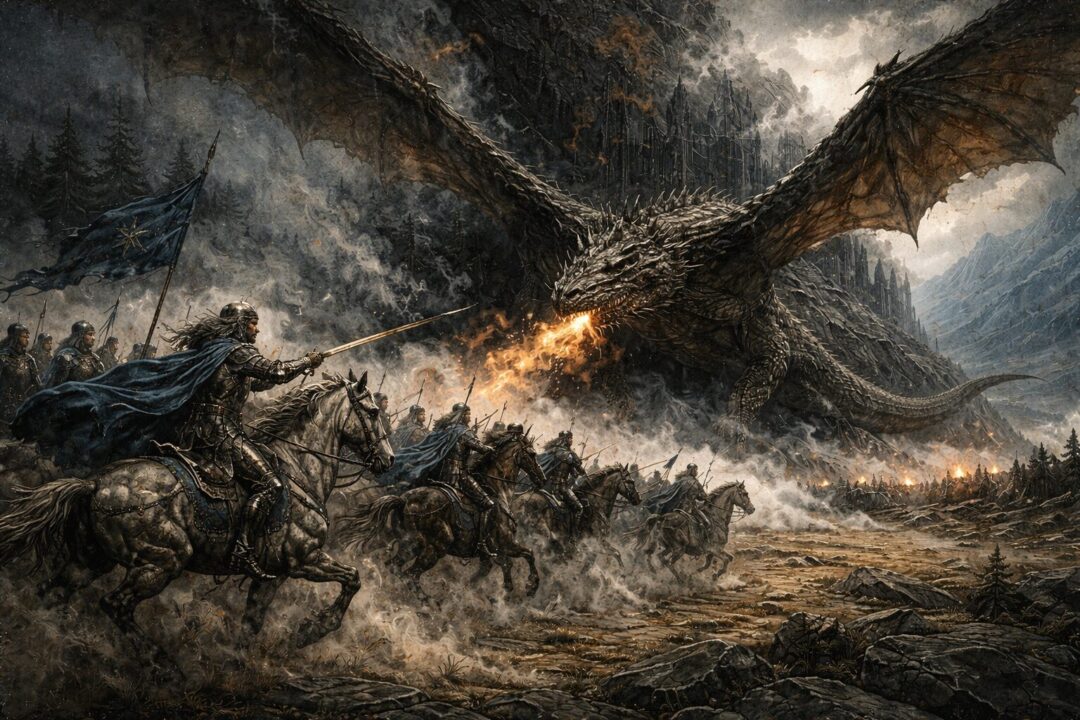
When people remember the great wars of the First Age, they usually remember the names that sound like catastrophe: the Nirnaeth Arnoediad, the fall of Gondolin, the ruin of Doriath, the War of Wrath. The Siege of Angband rarely gets the same attention. That is strange, because in military and narrative terms it is one of the most important stretches in the entire history of Beleriand.
For nearly four hundred years, Morgoth’s fortress was contained.
Not destroyed. Not cleansed. Not truly conquered.
Contained.
That distinction matters. The texts do not describe the Noldor and their allies as having the strength to storm Angband and finish the war. Quite the opposite: after the Dagor Aglareb, they had enough strength to hold Morgoth in, to watch the northern frontier, and to make large open assaults into Beleriand difficult for him. But they did not have the force to take his underground stronghold by direct attack. That one limitation explains both the success and the tragedy of the siege.
What the Siege of Angband actually was
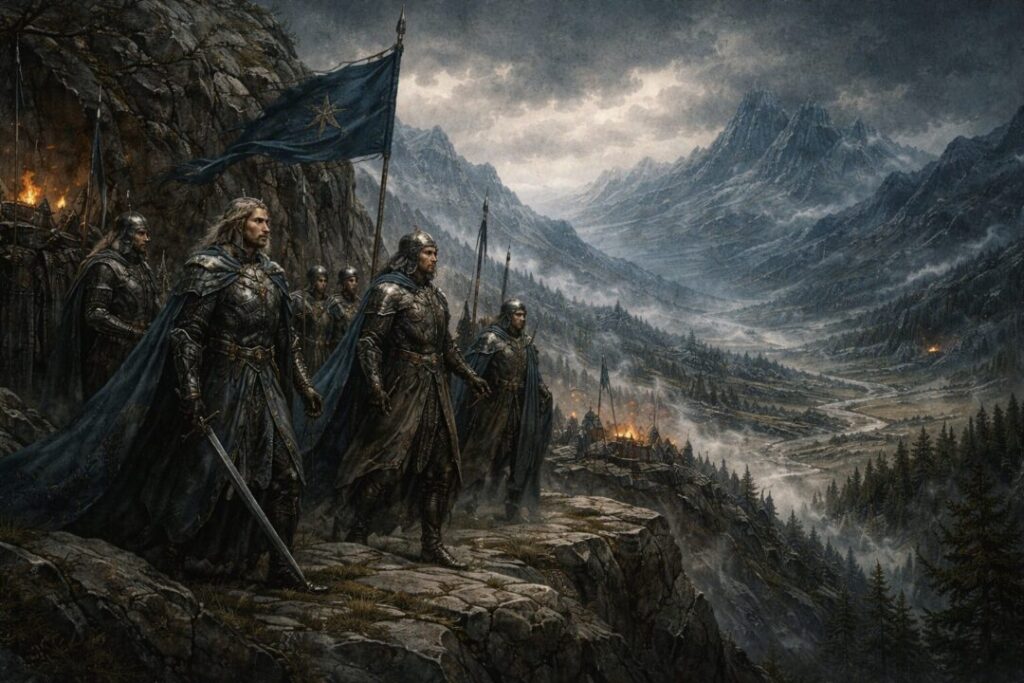
The Siege of Angband began after the Dagor Aglareb, the Glorious Battle, in F.A. 60. Morgoth’s forces came out in strength, but Fingolfin and Maedhros, together with other Elven powers, drove the Orc-hosts back across Ard-galen and destroyed them almost under the shadow of Angband itself. From that victory came the long leaguer.
But “siege” can be misleading.
This was not a perfect ring of soldiers pressed tight around every wall and gate. The sources make clear that the watch was broad, regional, and strategic. Elven rulers held key approaches, passes, and northern marches. Fingolfin and Fingon guarded the western pass over Ered Wethrin into Hithlum from Barad Eithel. Finrod and Orodreth held the Pass of Sirion from Minas Tirith on Tol Sirion. Angrod and Aegnor watched the northern slopes of Dorthonion toward Aglon. In the east, the sons of Fëanor held Himring, the Marches, and the hills and plains beyond.
So Angband was “surrounded” in the sense that Morgoth’s obvious roads outward were watched and resisted. But it was not sealed like a trapped city in a conventional medieval siege. That is why the term containment is often more useful than conquest.
Why the Elves could contain Angband, but not take it
The canon summaries are blunt on this point: the Noldor and their allies did not possess sufficient force to assault Angband directly. That should immediately reframe how we imagine the First Age. Even after a major victory, and even with some of the greatest Elven princes in Beleriand holding the north, Angband remained too formidable.
That makes sense inside the world of the story.
Angband was not just a fortress with outer walls. It was a vast underground stronghold beneath Thangorodrim, with deep vaults and hidden reaches. Any army that reached its gates still faced the problem of entering a dark, defended depth shaped by Morgoth’s own power and his countless servants. The texts support the picture of Angband as a fortress whose terror and scale went far beyond an ordinary citadel.
So the Elves adopted the only strategy that matched their real strength: deny Morgoth easy freedom of movement, break his armies when they emerged, keep pressure on the north, and preserve the lands of Beleriand long enough for their realms to grow.
For a very long time, this worked.
The geography of the containment
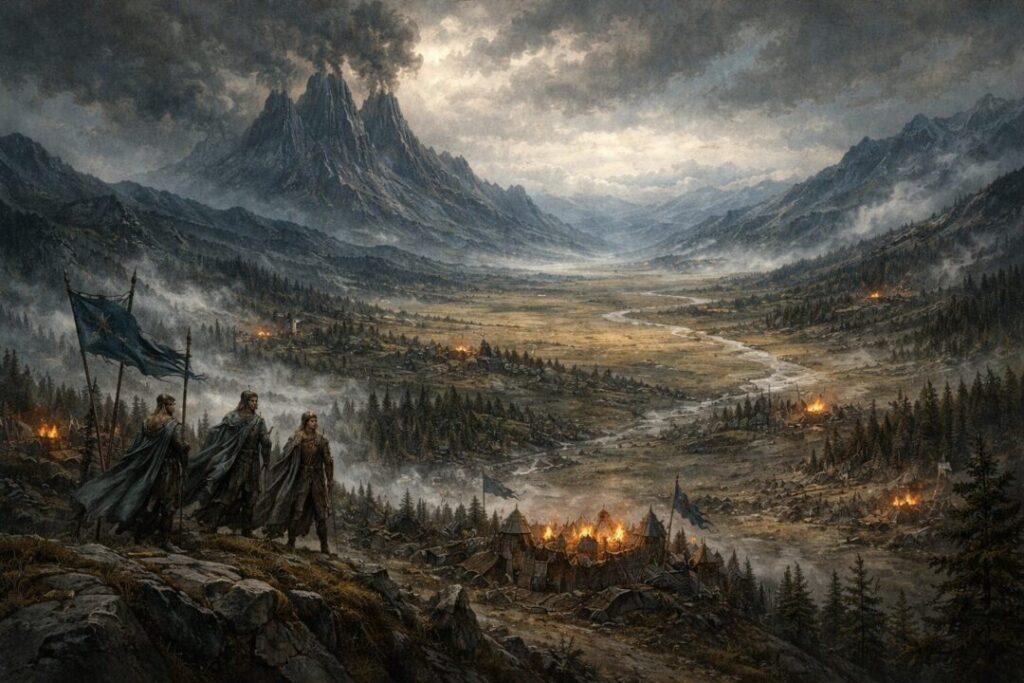
One reason the siege lasted so long is that it was tied to geography rather than to one exposed camp. The northern edge of Beleriand had natural choke points, and the Noldor anchored their watch to them.
In the west, Hithlum and the Ered Wethrin formed a guarded barrier. In the center, Tol Sirion and the Pass of Sirion helped control one of the most important northern routes. Dorthonion stood like a high northern shieldland. In the east, Himring and the Marches guarded the more open approaches toward East Beleriand.
This matters because the siege was not simply a military line; it was a political map. The Noldorin kingdoms were arranged in ways that also functioned as a defensive system. What readers often remember as separate realms were, for centuries, parts of one pressure network against Angband.
That is also why the breakdown of the siege later becomes so devastating. When Morgoth finally breaks the northern guard, he is not just defeating armies. He is unraveling the entire strategic arrangement of Beleriand.
The Long Peace was not the same thing as total safety
Another easy mistake is to imagine the siege as a static age of calm. The texts do not support that.
The containment was incomplete from the start. Morgoth could still send out forces to harass the Elves. One source notes attacks such as the assault on Hithlum during the siege, though these were not yet major existential threats to the Noldor at that stage.
Then came one of the clearest warning signs: Glaurung’s first emergence in F.A. 260. He was not yet full-grown, but his appearance caused terror. Fingon, however, rode against him with mounted archers and drove him back into Angband. After that came what later tradition calls the Long Peace.
That sequence is important. The Long Peace does not mean Morgoth had become harmless. It means that after this failed test, he did not yet break the leaguer openly. In other words, the quiet years should not be read as proof that Angband had been reduced to helplessness. They can just as easily be read as years in which Morgoth prepared more carefully.
That is interpretation, but it is cautious interpretation grounded in the pattern of events. The texts do show that Angband remained active, dangerous, and capable of producing new horrors even while outward pressure held.
What the siege allowed Beleriand to become
For all its limits, the Siege of Angband gave Beleriand something priceless: time.
During the years of the siege, major realms strengthened or took shape. Turgon’s people left Nevrast to build Gondolin. Finrod’s realm of Nargothrond flourished. The Falas settlements are associated with this broader period of relative northern restraint. Later, the Houses of the Edain entered Beleriand during the larger age secured by Morgoth’s inability to burst southward in overwhelming force.
This may be the siege’s most overlooked consequence. It did not merely prevent defeat for a while. It created the conditions in which some of the most important peoples, realms, and alliances of the First Age could emerge.
Without that containment, Beleriand would have looked very different, very quickly.
The irony, of course, is that this success may also have encouraged hope beyond what the actual military reality justified. The Noldor had built a durable frontier. But they had not solved the central problem of the war: Morgoth still held Angband.
Why the siege failed in the end
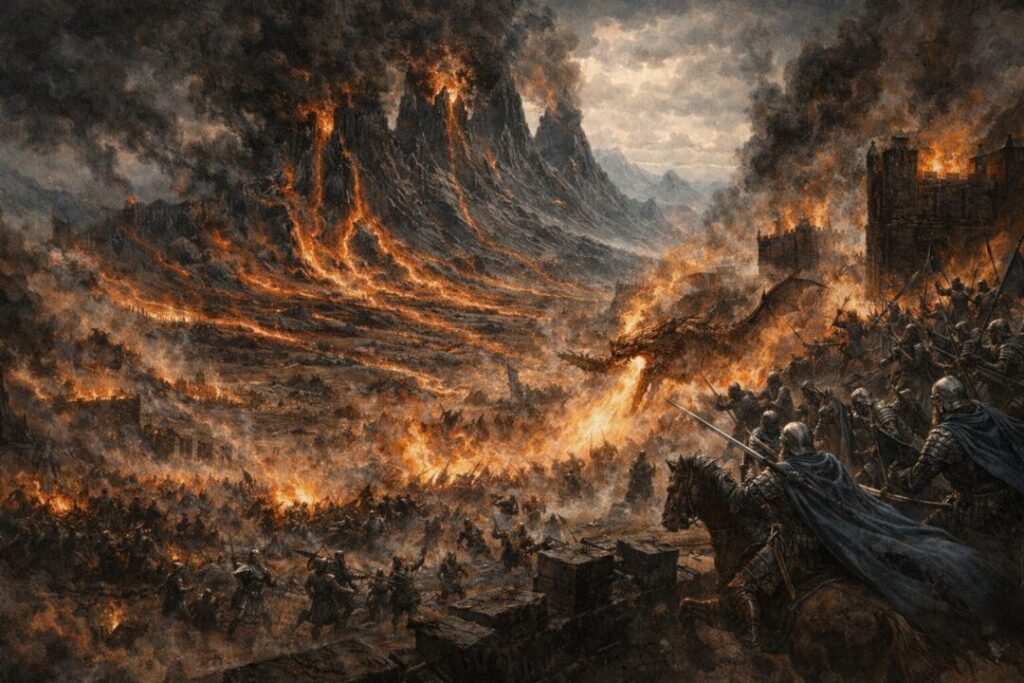
The Siege of Angband ended in F.A. 455 in the Dagor Bragollach, the Battle of Sudden Flame. Morgoth did not merely send out another Orc-host. He transformed the battlefield. Fires poured forth from Thangorodrim, Ard-galen was burned and remade into Anfauglith, and Glaurung, now in greater might, led the assault alongside Balrogs and vast armies of Orcs. The long northern watch was broken.
This was not just a defeat caused by one bad decision. It was the exposure of the siege’s deepest weakness.
The Elves had been able to contain what came out of Angband under old conditions. Morgoth changed those conditions.
A static or semi-static containment can look invincible right up until the moment the enemy introduces a new form of war. That is essentially what happens here. Fire, dragons, smoke, terror, and coordinated assault shattered a system that had endured for centuries. The “sudden” in Sudden Flame is not just poetic. It captures the shock of a strategic world collapsing almost at once.
Why this chapter feels forgotten
The Siege of Angband may be forgotten partly because it lacks the emotional simplicity of a great last stand or a final victory. It is not one battle. It is a long condition. It sits in the background while kingdoms rise, friendships form, hidden cities are built, and Beleriand seems for a time almost stable.
But that is exactly why it deserves more attention.
It is the hinge between the Noldor’s early military success and their later disasters. It explains how Beleriand had time to become the world readers remember from the great First Age tales. It also explains why that world was more fragile than it looked.
The siege was real. It was effective. It lasted astonishingly long.
And yet from the beginning it contained the seed of its own failure, because holding Morgoth in place was never the same as defeating him.
The real lesson of the Siege of Angband
If there is one thing this long episode reveals, it is that in the First Age, survival could look deceptively like victory.
For centuries, the Elves did something extraordinary. They took the greatest dark fortress in Middle-earth and made it wary. They checked its armies, guarded its exits, and gave Beleriand room to breathe. That should not be minimized.
But the texts also refuse to flatter that achievement into a final triumph. Angband endured. Morgoth endured. New evils grew behind the barrier. And when the break came, it proved that the long peace had been exactly that: peace under siege conditions, not the end of the war.
That is what makes the Siege of Angband so fascinating.
It is not the story of why Morgoth was defeated for centuries.
It is the story of how he was held, why that mattered, and why in the end it was never enough.