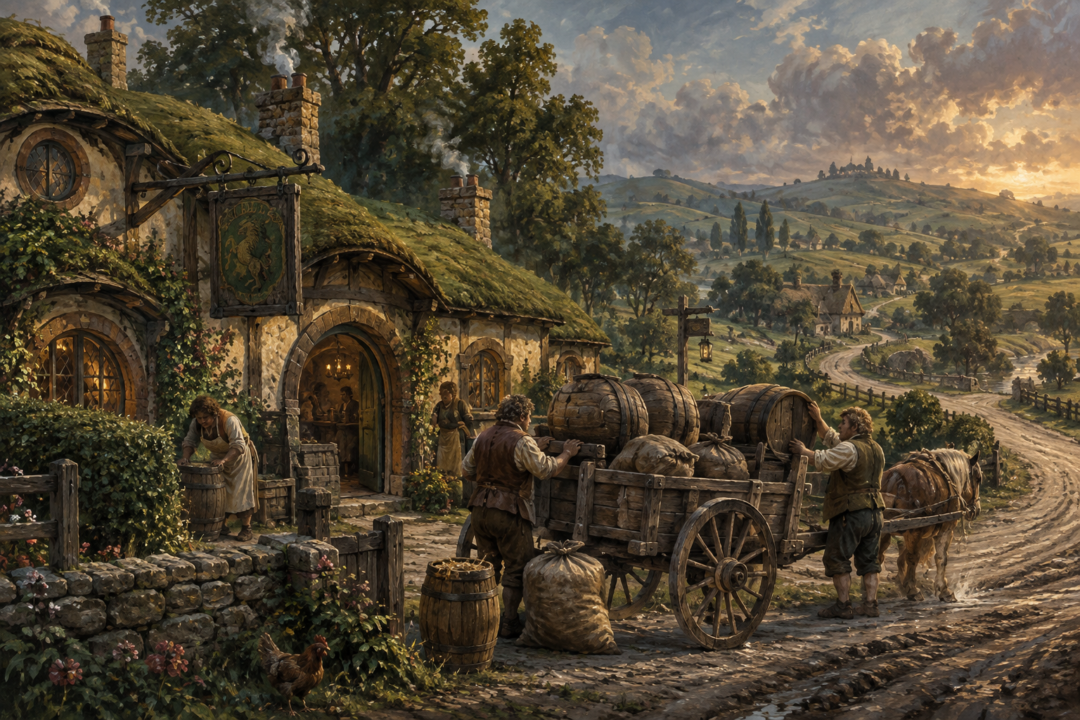
The Green Dragon feels like one of the most comfortably local places in Middle-earth. It stands in Bywater, close enough to Hobbiton that Sam Gamgee can spend an evening there arguing about strange news and still belong unmistakably to the small world of gardens, mills, farms, and familiar neighbors.
Yet an inn cannot live on conversation alone.
Someone must bring the drink. Someone must grow the leaf smoked beside the fire. Food must reach the kitchen, barrels must be made and moved, and whatever cannot be produced in Bywater itself must arrive from somewhere else.
The texts never provide an inventory of the Green Dragon’s cellar, nor do they explain its suppliers. We cannot say which brewery filled its barrels or reconstruct a delivery schedule. But the wider picture of the Shire makes something important clear: Hobbiton and Bywater were not isolated villages living entirely from what grew within walking distance.
They belonged to a network of roads.
And those roads connected even the Green Dragon’s quiet common-room to a much larger Middle-earth.
The Green Dragon Was Already a Place for Travellers
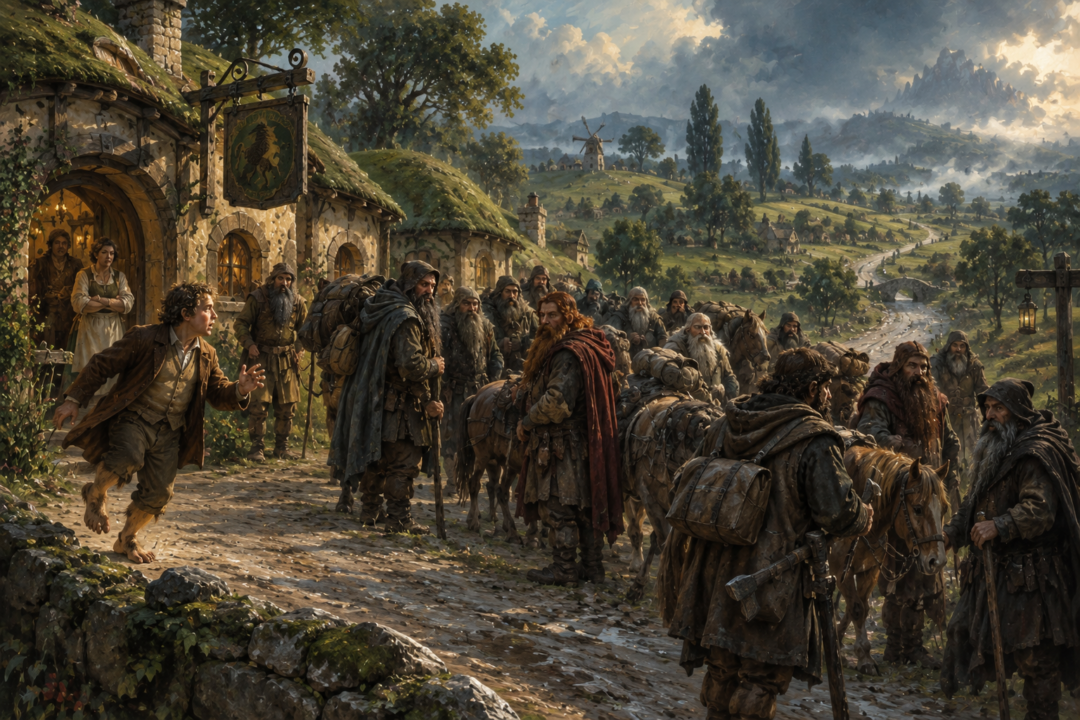
The Green Dragon appears at a crucial moment in The Hobbit. After Bilbo discovers the note left by Thorin and Company, he races from Bag End without even stopping for a proper breakfast and meets the Dwarves at the inn before their departure.
That detail is easily treated as little more than a convenient rendezvous. But it tells us something about the Green Dragon’s place in the local landscape.
Thorin’s company are not residents of Bywater. They are travellers preparing for a long eastward journey, with ponies and baggage. An inn beside a road is precisely the sort of recognizable meeting point such travellers would use.
Decades later, the Green Dragon remains a gathering place for local hobbits. In “The Shadow of the Past,” Sam remembers a conversation there involving Ted Sandyman and reports of strange happenings beyond the Shire.
So the inn occupies two worlds at once.
It is intensely local, filled with familiar voices and village gossip. But it also stands beside routes along which travellers, stories, and potentially goods can move.
That tension is characteristic of the Shire itself.
The Shire Was Sheltered, Not Sealed
Hobbits famously preferred other people to conduct their adventures somewhere else. Their suspicion of outsiders can make the Shire seem almost economically sealed from the surrounding world.
It was not.
The Prologue to The Lord of the Rings describes a settled country with roads, villages, inns, farms, workshops, and a remarkably effective postal service. The East Road crossed the Shire, continuing beyond its borders. Bree lay eastward along that great route, and travellers passed through the wider region.
Dwarves were particularly important to this picture. The narrative makes clear that Dwarves travelled the roads through the Shire, especially in the years before the War of the Ring. Bilbo’s association with Dwarves made him unusual among his neighbors, but Dwarves themselves were not mythical strangers whom no hobbit had ever seen.
The road system therefore had two functions.
For most hobbits it connected familiar places: farms, villages, markets, inns, relatives, and neighboring Farthings. But the same physical network continued outward into Eriador.
The road that carried a farmer’s produce toward Bywater was ultimately part of a world in which Dwarves, Rangers, merchants, messengers, and other travellers could move much farther.
The Green Dragon sat inside that system.
Even “Local” Goods Could Travel a Long Way
There is no canonical Green Dragon menu, so claims about particular ales, foods, or suppliers should be treated cautiously. What we can establish is that the Shire contained regional specialization.
Pipe-weed is the clearest example.
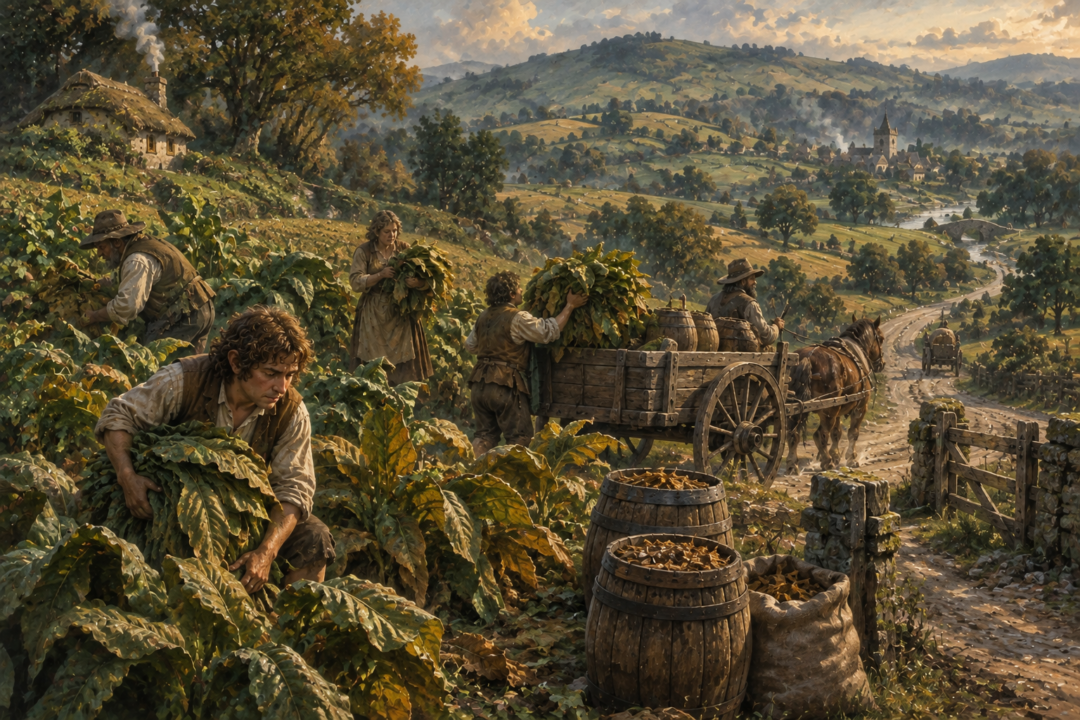
The most famous varieties were associated with the Southfarthing, particularly Longbottom. The Prologue credits Tobold Hornblower with first growing true pipe-weed in the Shire around Shire-reckoning 1070. Longbottom Leaf, Old Toby, and Southern Star became celebrated varieties.
That means a hobbit smoking Southfarthing leaf in Bywater was already enjoying a product that had travelled within the Shire.
And pipe-weed reveals an even larger network.
Its history did not begin in Hobbiton. The plant itself had come from lands farther south, and the practice of smoking was associated with Bree before Tobold Hornblower established its cultivation in the Shire. From Bree the custom spread among people who travelled the roads, including Dwarves, Rangers, and Wizards.
The history of one supposedly quintessential hobbit pleasure therefore crosses borders repeatedly.
A plant from outside the Shire becomes a Southfarthing specialty, while the habit associated with it spreads outward again.
The Green Dragon’s patrons lived in a culture that was more connected than their conversations might suggest.
The East Road Connected the Shire to a Larger Economy
The most important road in this story is the great East Road.
It ran across Eriador through the Shire and Bree-land and continued eastward toward lands with much older histories than any hobbit village. By the end of the Third Age, much of the country surrounding that road had become sparsely populated and dangerous, but the road remained a surviving artery through the ruins of Arnor.
Bilbo’s own adventure demonstrates its significance. Leaving the comfortable country around Bywater, Thorin’s company travels eastward into increasingly wild lands.
Bilbo eventually returns by the same broad geographical corridor, but he comes home changed—and not empty-handed.
Later connections with Erebor also show that the Shire was not beyond the reach of distant craftsmanship. For Bilbo’s great birthday party, presents included remarkable toys that had come from Dale and the Mountain. These were exceptional goods rather than ordinary village supplies, but that is precisely why they matter: physical objects could travel from the restored communities far east of the Shire all the way to Hobbiton.
Not every mug or barrel at the Green Dragon had crossed half of Middle-earth. Most everyday provisions were probably much more local, though the texts do not give enough evidence to reconstruct their origins.
The important point is simpler.
The routes existed.
Roads Brought Trouble as Easily as Goods
The same openness that made movement possible also created vulnerability.
This becomes painfully obvious during Saruman’s interference in the Shire.
By the time Frodo and his companions return, the familiar country has been subjected to controls, confiscations, destruction, and the rule of outsiders. The returning hobbits hear bitter complaints about goods being gathered up and carried away. Produce is no longer simply circulating through ordinary local relationships; much has been taken under the new regime.
Pipe-weed provides the most striking earlier warning.
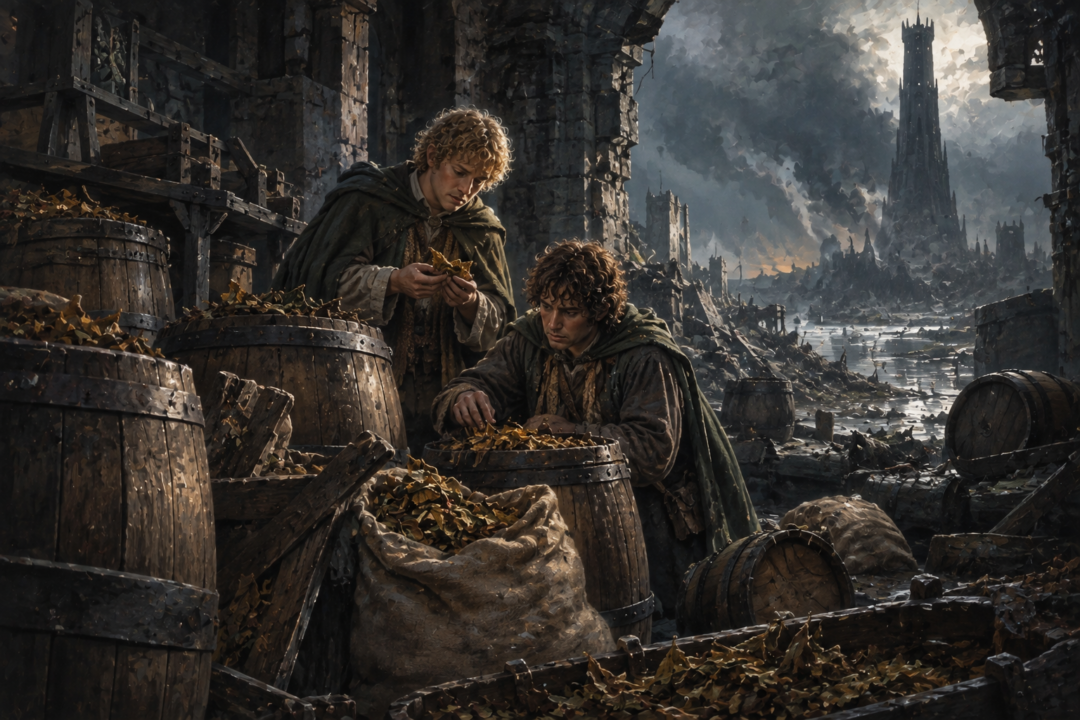
At Isengard, Merry and Pippin discover barrels of Longbottom Leaf. Its presence there astonishes them. The precise chain by which those particular barrels reached Isengard is not fully narrated, but Saruman had taken an interest in the Shire and maintained connections with people there. During the later takeover, Lotho Sackville-Baggins is accused of sending goods away while the Shire-folk themselves went short.
The implication is uncomfortable.
A road network has no morality of its own.
The road that allows useful things to reach a community can also allow its wealth to be extracted. The route that brings travellers can bring ruffians. Connections that support ordinary prosperity can be exploited by someone with greater power.
The Shire’s isolation had always been partly an illusion.
What Happened to the Green Dragon Shows the Cost
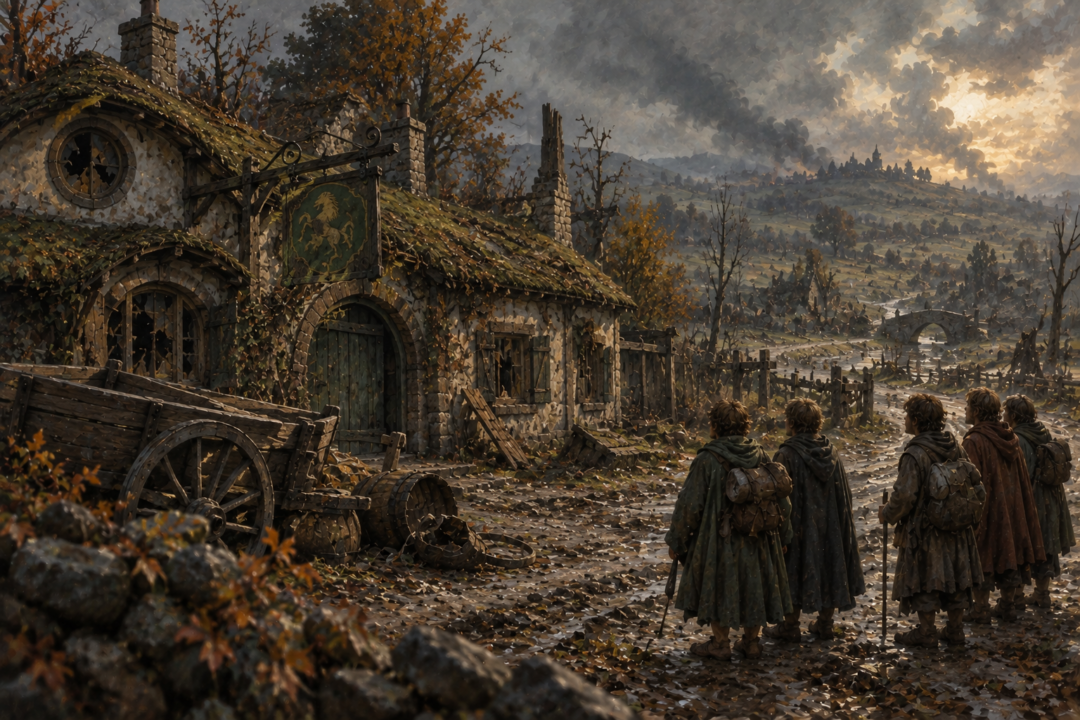
When the four travellers finally reach Bywater after the War of the Ring, the Green Dragon is no longer the welcoming landmark they remember.
It is shut up and lifeless.
This matters because the Green Dragon had represented ordinary hobbit society at its most recognizable: drink, news, arguments, neighbors, and stories exchanged around a common table.
Its decline is therefore more than damage to a single building.
The social network around it has been attacked too.
Trees have been cut down. Houses have been damaged or replaced. Goods have been controlled. Rules have multiplied. Traditional patterns of local life have been disrupted by an authority interested in extraction and domination rather than fellowship.
The Green Dragon cannot remain untouched simply because it is small.
That may be one of the sharpest lessons hidden inside the Scouring of the Shire. A peaceful community does not exist separately from the systems that sustain it. Farms, roads, mills, inns, households, and markets form a web. Damage enough of that web and the common-room eventually goes dark.
The Shire’s Comfort Was a Collective Achievement
It is tempting to imagine hobbit life as effortless abundance: gardens overflowing, beer permanently available, pantries mysteriously full.
The books give us something more believable.
Hobbits farm. They mill grain. They keep livestock. They grow crops. They trade, inherit property, send parcels, travel between villages, operate inns, use roads, and maintain public institutions. Some districts become associated with particular products. Goods move between households and regions.
Behind the famous comfort of the Shire is work.
And behind that work is connection.
The Green Dragon does not need to import exotic luxuries from distant kingdoms to illustrate the point. Even if much of what it served came from nearby farms and producers, those supplies still depended upon functioning paths and roads, peaceful countryside, reliable movement, and communities able to exchange their surplus.
The texts never tell us exactly what arrived at the Green Dragon on a wagon.
They tell us enough to understand why wagons mattered.
The Road Outside the Inn Was Part of the Story
There is a quiet irony in the Green Dragon being associated with the beginning of Bilbo’s adventure.
Bilbo rushes there because he is about to leave the ordered world of the Shire for the dangerous road beyond it. The inn appears to stand at the boundary between comfort and adventure.
But the boundary was never absolute.
The outside world had always touched the Shire through roads, travellers, plants, craftsmanship, news, and trade. Later, Saruman would exploit those same connections and prove how quickly distant power could intrude upon local life.
That does not make the Shire less special.
It makes its peace more remarkable.
The mugs on the tables, smoke above the hearth, food in the pantry, and gossip among neighbors were possible because thousands of ordinary relationships continued to function: growers, makers, carriers, innkeepers, farmers, millers, and travellers moving along safe roads.
The Green Dragon looked like the center of a tiny world.
In reality, the road outside its door led all the way into Middle-earth.
Sources & Notes
- Tolkien Gateway, “Green Dragon” — https://tolkiengateway.net/wiki/Green_Dragon
- Tolkien Gateway, “Great East Road” — https://tolkiengateway.net/wiki/Great_East_Road
- Tolkien Gateway, “Pipe-weed” — https://tolkiengateway.net/wiki/Pipe-weed
These secondary reference entries identify the relevant Tolkien texts and document the characters, events, and objects discussed. Explanations of motives and practical consequences remain interpretation unless explicitly stated in the cited texts.