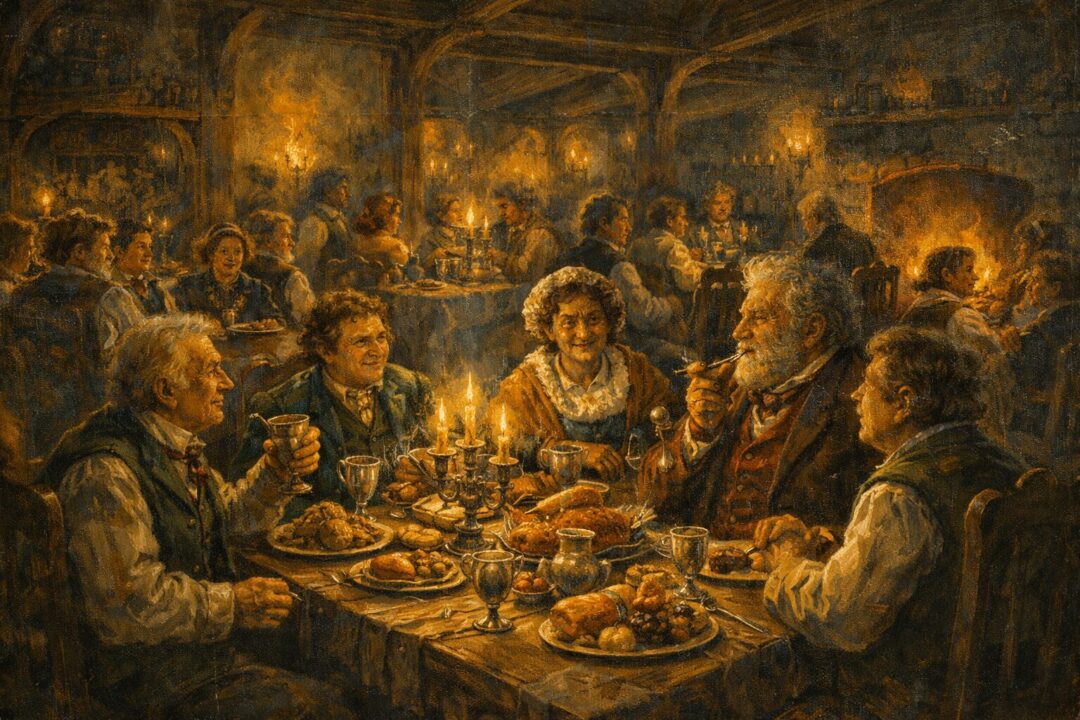
At first glance, the Shire seems like the least hierarchical place in Middle-earth.
It is small, rural, comfortable, and deliberately unheroic. Its people prefer meals to manifestos, gardens to grandeur, and old habits to ambition. Compared with Gondor, Rohan, or even the halls of the Dwarves, Hobbit society appears almost free of rank.
And that appearance is part of its charm.
But only part.
Because the books quietly reveal something that many readers overlook: the Shire is not socially flat. It is not a land of identical households living in cheerful sameness. It has prestige, inherited standing, wealthy families, offices of honor, local authority, and visible differences between those who own, those who farm, those who trade, and those who work for others.
The point is not that the Shire has a harsh class system in the modern sense.
The texts never present it that way.
But they do show a social order that is far more layered than the Shire’s peaceful surface first suggests.
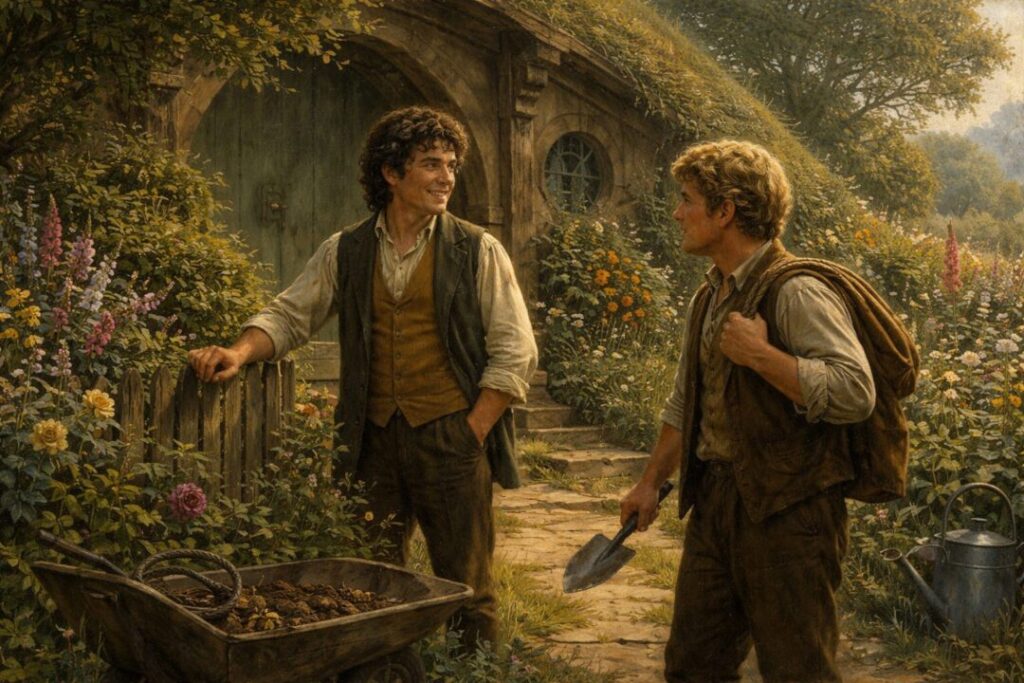
The Shire Is Not Classless
One of the easiest mistakes to make is to confuse peace with equality.
The Shire has little government. That much the prologue makes plain. Families largely manage their own affairs, and most hobbits are occupied with growing food and enjoying life. Estates, farms, workshops, and small trades tend to remain stable across generations.
That is an important detail.
The very language used to describe the Shire assumes a society with different forms of property and livelihood. Not everyone lives the same way. Some households are associated with estates. Some with farms. Some with workshops. Some with trade. The Shire is orderly and local, but it is not economically uniform.
And once that is noticed, the social texture of Hobbit life becomes clearer.
This is not a place where power is displayed through armies or crowns. It is displayed through family names, land, wealth, custom, and the quiet expectation that some hobbits will naturally be treated with more respect than others.
Bilbo Is Introduced as a Hobbit of Position
The clearest signal comes before The Lord of the Rings even begins.
Bilbo is not introduced merely as a hobbit in a hole. He is introduced as a well-to-do hobbit, and the Bagginses are described as respectable, in part because most of them are rich and predictably conventional.
That matters.
It tells us that wealth and social standing are recognized categories in Hobbit society from the very first page. Respectability is not only moral. It is also social. The Bagginses are not just liked. They are established.
Bag End itself reinforces this. It is not a modest burrow barely fitted to daily life. It is large, comfortable, well-furnished, and placed prominently on the Hill above Bagshot Row. Even before the story says anything else, geography does some of the work. There are hobbits higher up and hobbits lower down, both literally and socially.
This does not mean Bilbo is a nobleman in a human kingdom.
But it does mean he belongs to the upper layer of Shire life.
And Frodo, as heir to Bag End, begins in that same world.
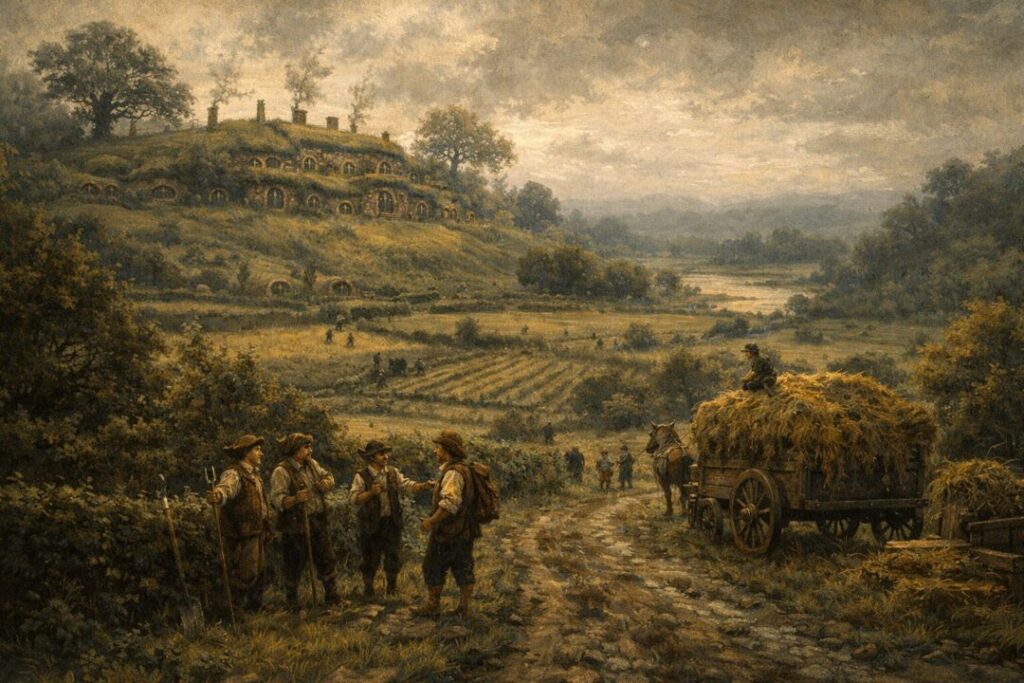
The Great Families Carry More Than Just Famous Names
The Shire also preserves old family prestige in a way that goes beyond simple wealth.
The prologue says plainly that the Took family had long been pre-eminent. The office of Thain had passed to them centuries earlier, and although the title had become mostly nominal in peaceful times, the family still received special respect. They remained numerous, exceedingly wealthy, and socially important.
That is not casual description.
It means the Shire recognizes something very close to a local aristocracy, even if it avoids grandeur and formal court life. The Tooks are not kings. But they are more than ordinary neighbors.
The same is true, in a different way, of the Brandybucks.
In Buckland, the Master of the Hall is not merely a private householder. His authority is acknowledged by the farmers in the surrounding region. Again, the text does not turn this into feudal drama. But authority is authority all the same. Some families do not just possess land or reputation. They function as centers of local order.
That is why Merry and Pippin matter before their heroism ever begins.
They are not random young hobbits from nowhere. They come from the highest-ranking circles the Shire possesses.
Wealth Shapes What Society Will Forgive
One of the sharpest lines in the prologue is also one of the easiest to miss.
The Tooks are said to produce, in many generations, strong characters of peculiar habits and even adventurous temperament. But those qualities are described as being tolerated in the rich rather than generally approved.
That line opens the whole subject.
Because it tells us that the same behavior is judged differently depending on who displays it.
Adventure, eccentricity, odd habits, and strong will are not universally admired in the Shire. They are tolerated when attached to wealth and family prestige. In other words, social standing buys room for deviation.
That is exactly the kind of detail one expects in a real class society.
Not an official legal distinction, perhaps. But certainly a cultural one.
Bilbo’s oddness is survivable partly because Bilbo is Bilbo Baggins of Bag End. A poorer hobbit with the same habits would not carry them in quite the same way.
The text never needs to explain this openly. It simply assumes the reader can feel it.
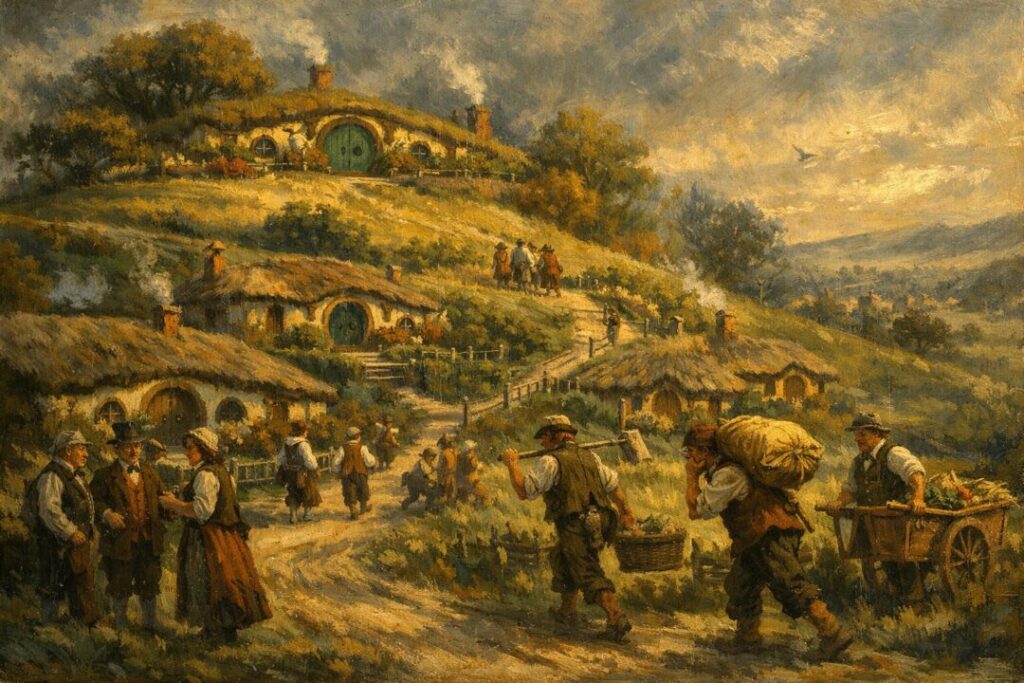
Sam Shows the Other Side of the Social Order
If Bilbo, Frodo, Merry, and Pippin show the upper layers of the Shire, Sam shows something lower and more grounded.
At the beginning of the story, Sam is not Frodo’s social equal. He is the son of Hamfast Gamgee, the Gaffer, and belongs to the world of practical labor. He listens, learns, works, gardens, and speaks with a different kind of authority: not the authority of rank, but of rootedness and plain sense.
This is one reason Sam matters so much.
He allows the story to include a hobbit who is admirable without beginning from inherited prestige. Yet even here, the social boundary is visible. Frodo is his master in a real and recognizable sense at the start of the tale, even though affection and loyalty eventually deepen the relationship far beyond that.
The books never reduce Sam to class alone.
But they do not erase class either.
His rise in honor after the War becomes more meaningful precisely because he began from a humbler place in the Shire’s social order.
Farmers, Millers, Tradesmen, and Local Reputation
The wider Shire is also full of quieter distinctions.
There are millers and farmers, landholders and tradesmen, innkeepers and gardeners. Farmer Cotton carries the kind of local weight that comes from property, steadiness, and reputation. The Gaffer carries the authority of an old working hobbit whose opinions are worth hearing, though not because he is wealthy. Ted Sandyman, by contrast, is connected to trade and the mill, and his role in the story shows that economic place does not automatically produce virtue.
What emerges from all of this is not a fantasy parliament of equal peasants.
It is a small rural society in which people know who the great families are, who owns what, who works for whom, who commands respect, and who can be dismissed as odd, dangerous, low, or dependable.
That is social structure, even if it is wrapped in comfort.
Why Readers Miss It
The main reason the Shire’s hierarchy is easy to miss is that it is gentle.
Middle-earth gives us obvious power elsewhere. Kings, stewards, lords, captains, Dark Lords, wizardly orders. Next to those, the Shire looks almost structureless.
But the absence of spectacle is not the absence of rank.
The Shire has no throne room. It has family houses.
It has no palace guard. It has Bounders and Shirriffs.
It has no court nobility. It has pre-eminent families, inherited offices, and old local deference.
And because hobbits dislike display, their hierarchy is hidden under manners, meals, and habit.
That makes it more believable, not less.
Real social systems often work best when they do not need to announce themselves.
The Scouring of the Shire Reveals the Structure More Clearly
Ironically, one of the best ways to see the Shire’s hidden order is to watch it break.
When the Travellers return, the Shire has been distorted by Lotho and Sharkey. Property is seized, rules multiply, outsiders dominate, and local custom is violated. The outrage is not only moral or aesthetic. It is social. The normal web of household authority, local standing, and inherited familiarity has been torn apart.
That is why the restoration matters so much.
The Scouring is not simply about driving out ruffians. It is about recovering the proper shape of Hobbit life. And that shape includes distinctions the Shire ordinarily carries so lightly that they are almost invisible.
Merry and Pippin take command naturally.
Farmer Cotton becomes a point of local strength.
Frodo speaks with moral authority few others possess.
Sam returns not merely as a servant who came home, but as someone enlarged by suffering and action.
The crisis does not erase the Shire’s social structure.
It exposes it.
So Does the Shire Have a Class System?
Not in the sense of a fully formalized caste order.
The books do not present fixed legal classes with rigid barriers, and it would be inaccurate to impose that language too harshly.
But if by “class system” we mean a society shaped by wealth, lineage, local office, inheritance, property, and social deference, then the answer is plainly yes.
The Shire has upper families.
It has respectable households.
It has landholders, farmers, tradesmen, and workers.
It has authority that rests partly in office and partly in custom.
And it judges the same behavior differently depending on who displays it.
That is not modern theory imposed onto the text.
That is what the text quietly shows.
Why This Matters
The hidden hierarchy of the Shire matters because it changes how we read the hobbits.
Frodo is not simply Everyhobbit.
Neither is Bilbo.
Merry and Pippin are not merely cheerful friends who stumble into greatness.
They begin from comfort, education, family standing, and inherited security.
Sam does not.
That contrast gives the Fellowship of hobbits much of its depth.
It also makes the Shire more convincing. A world of total sameness would feel artificial. The Shire feels real because it contains gradations of status without losing its warmth. It has privilege without grandeur, rank without pomp, and class without open cruelty.
That is why its order is so easy to overlook.
And that may be the most revealing thing about it.
The Shire hides its hierarchy the same way it hides almost everything important:
under ordinary life, until someone finally looks closely enough to see it.