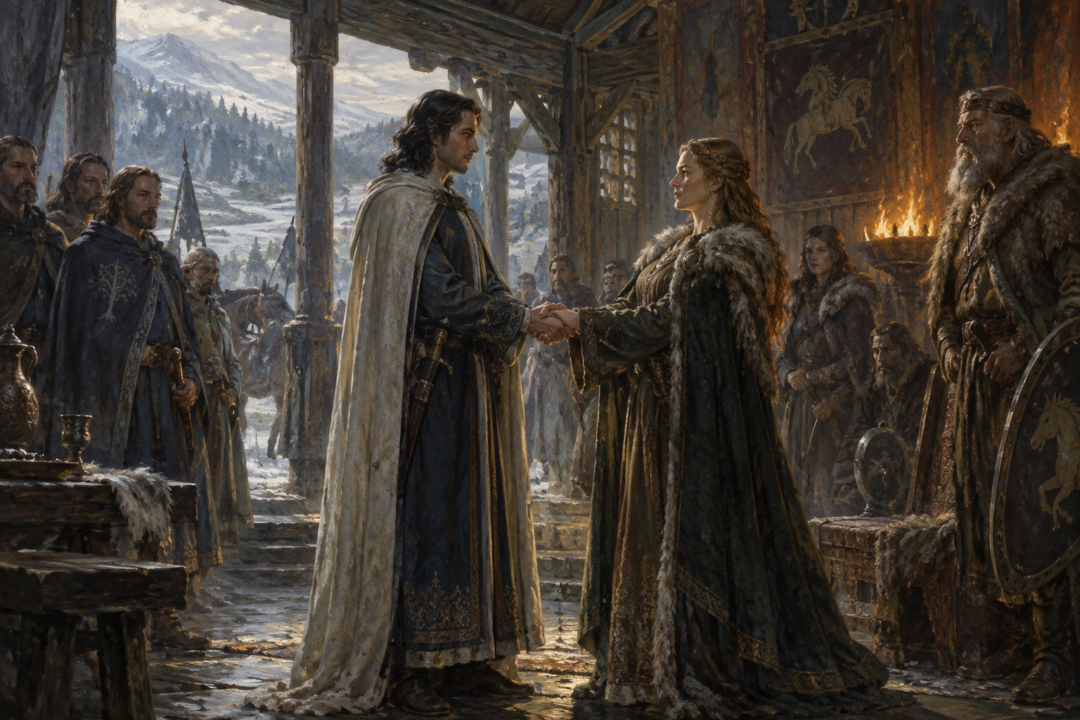
The Kin-strife of Gondor began with a marriage.
That sounds almost absurd beside what followed: rebellion, a starving king trapped in Osgiliath, the burning of the ancient capital, the loss of its palantír, the execution of a royal heir, and eventually a battle in which some of Gondor’s finest blood was spilled by Gondorians fighting Gondorians.
Yet the marriage of Valacar and Vidumavi exposed a question that Gondor could no longer avoid. What made a king legitimate? Was it descent from the Númenórean royal house alone? Did the ancestry of his mother matter? Could generations of political cooperation with other Men become actual kinship without changing the identity of Gondor?
The civil war later called the Kin-strife turned those questions into military realities. A royal marriage created competing ideas of ancestry; those ideas helped determine political allegiance; and political allegiance ultimately determined which armies marched for which claimant.
The Marriage That Became a Political Crisis
The roots of the conflict went back to Rómendacil II, one of Gondor’s powerful kings during the middle Third Age.
Gondor had important relations with the Northmen of Rhovanion. Rómendacil strengthened these ties and sent his son Valacar to live among them so that he might learn their language, customs, and policies.
Valacar did considerably more than observe them.
He married Vidumavi, daughter of Vidugavia, the ruler whom the records describe as the most powerful of the princes of the Northmen. Their son was known among his mother’s people as Vinitharya and in Gondor as Eldacar.
Politically, the marriage could be understood as an extraordinary strengthening of Gondor’s relationship with useful northern allies. Dynastically, however, it frightened part of Gondorian society.
The concern recorded in Appendix A was specifically about the royal succession and the perceived purity of Númenórean blood. Some Gondorians feared that Eldacar, having a mother who was not of the Dúnedain, would be short-lived and would diminish the majesty of the Kings of Gondor.
Their fear would prove false.
But it was politically explosive long before Eldacar had the opportunity to disprove it.
Ancestry Became an Argument About Legitimacy
The opposition was not simply claiming that Eldacar lacked royal descent. He plainly possessed it through Valacar and belonged to the line of Anárion.
The dispute concerned what kind of ancestry Gondor believed its king ought to possess.
That distinction matters. Gondor was not debating whether Eldacar was Valacar’s son. It was confronting the consequences of defining Númenórean identity too narrowly in a kingdom whose history increasingly involved other peoples.
Valacar’s marriage made the issue unavoidable because the supposedly dangerous mixture of ancestry now stood directly in the succession.
The opposition grew during Valacar’s reign. When Eldacar became king in Third Age 1432, the simmering dispute finally became open rebellion.
The strongest rebel claimant was Castamir, later remembered as the Usurper. He also belonged to the royal house, being descended from Calimehtar, the younger brother of Rómendacil II.
Thus both principal rivals possessed royal ancestry.
The Kin-strife was not a struggle between a legitimate dynasty and an unrelated outsider. It was a civil conflict inside the extended royal kindred, made more destructive because rival ideas of legitimate descent could attach themselves to rival members of the same house.
Blood Alone Did Not Give Castamir His Army
Castamir had something more practical than genealogy.
He was Captain of Ships, and his greatest support lay among the people of Gondor’s coasts and great havens, especially Pelargir and Umbar.
That geographical pattern is essential to understanding the war.
The rebellion was therefore not merely an abstract dispute over ancestry. Castamir’s position connected his dynastic claim to an existing concentration of naval and regional power.
Eldacar likewise possessed relationships that could become military strength.
His maternal ancestry, condemned by his enemies as a weakness in his claim, connected him directly to Rhovanion.
The irony is severe. The marriage used to portray Eldacar as less fit to rule Gondor eventually helped give him the human network from which he could rebuild his cause after losing the kingdom.
Marriage, ancestry, and military support had become impossible to separate.
Osgiliath Revealed the Cost of the Argument
Eldacar resisted his enemies courageously, but Castamir’s faction proved too strong.
In 1437 Eldacar was besieged in Osgiliath. Hunger and the superior strength of his enemies eventually forced him to abandon the city and flee.
The catastrophe inflicted damage far beyond the immediate contest for the crown.
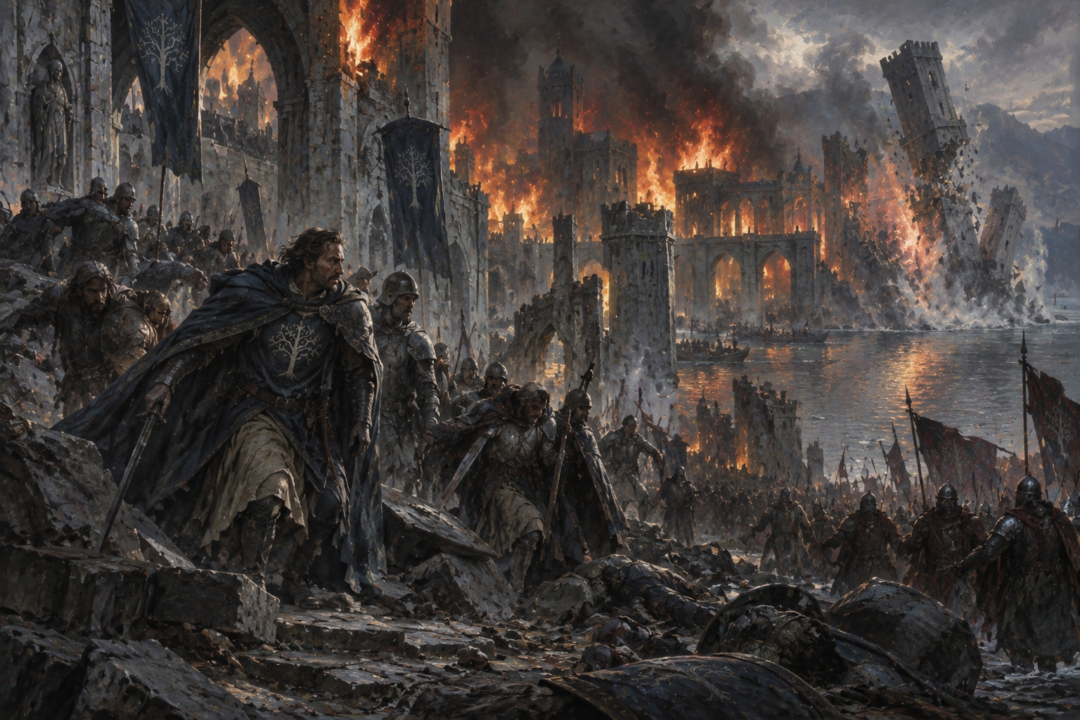
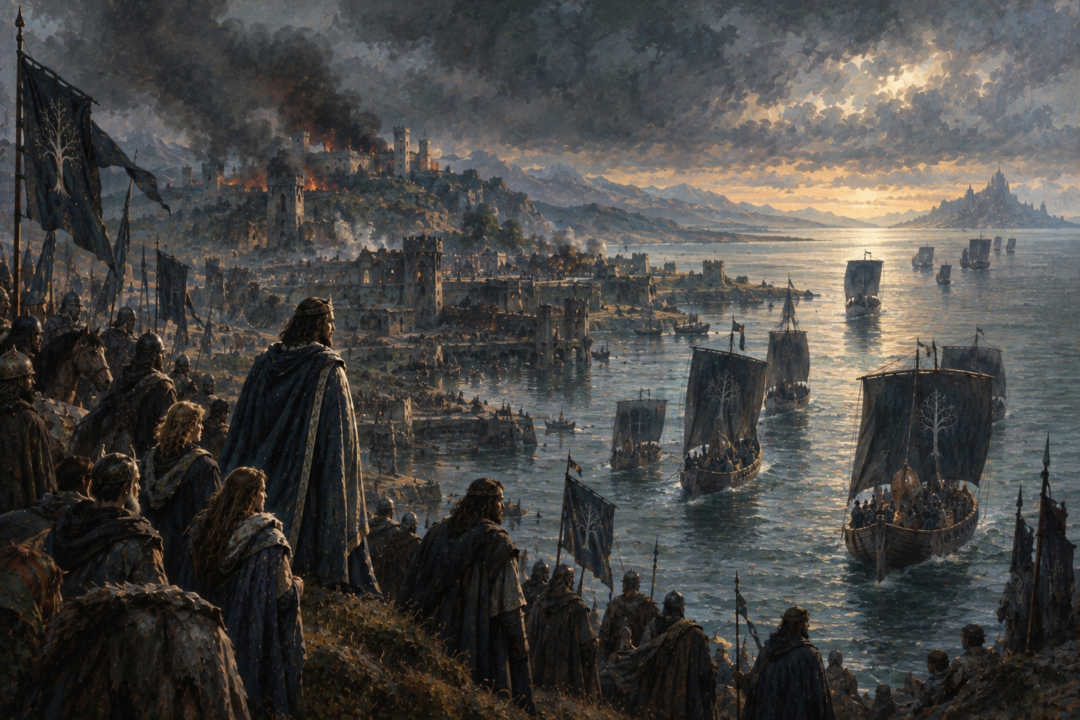
Osgiliath was burned. The Tower of the Stone was destroyed, and the great palantír of Osgiliath was lost in the waters of Anduin. Castamir also ordered the death of Ornendil, Eldacar’s son.
The royal family had argued over blood and inheritance until the struggle literally destroyed part of the inheritance both factions claimed to defend.
That is one of the central ironies of the Kin-strife.
A movement concerned with preserving the greatness of Gondor contributed to the devastation of Gondor’s ancient capital and the loss of one of the Seeing-stones inherited from the Númenórean past.
Castamir won the throne, but his victory exposed the difference between possessing a genealogical claim and inspiring durable loyalty.
Eldacar’s Supposed Weakness Became His Refuge
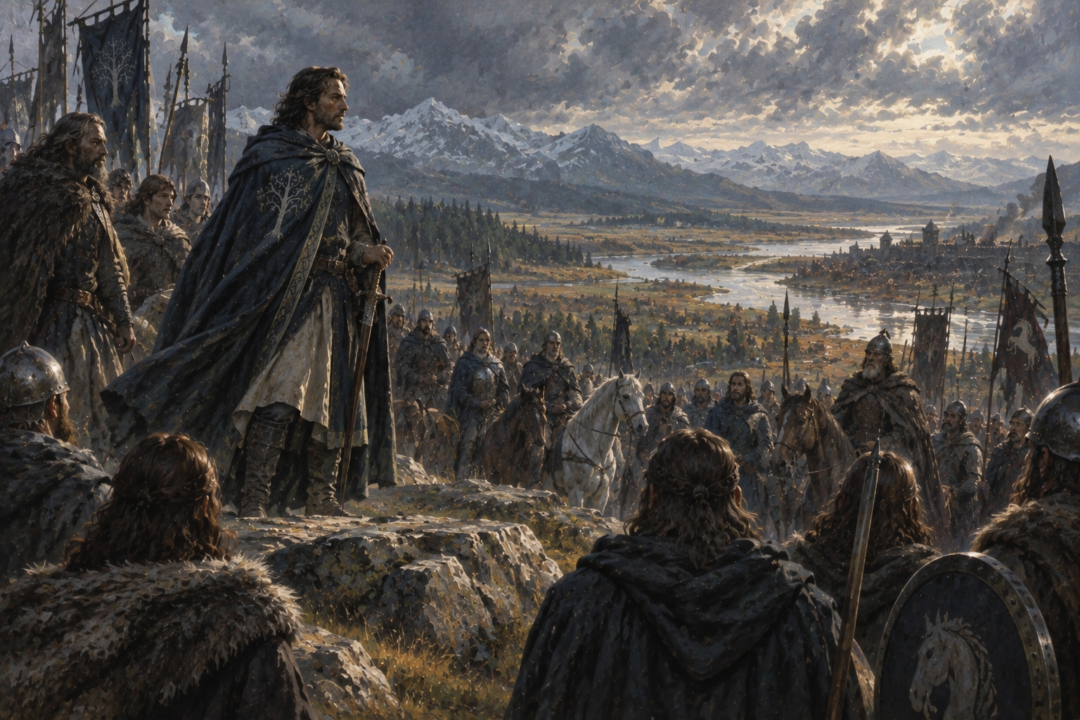
Eldacar escaped northward to Rhovanion.
There the ancestry that his opponents had used against him became politically decisive.
His mother’s people were his kin. Northmen who had been in Gondor’s service gathered to him, and he was also joined by Dúnedain from the northern parts of Gondor.
This should not be simplified into a clean ethnic war between Northmen and Númenóreans. The surviving account gives a more complicated picture.
Eldacar himself had Númenórean and Northman ancestry. Dúnedain supported him. Northmen supported him. Meanwhile Castamir drew much of his strength from Gondorian coastal populations.
Political loyalty crossed the categories that had supposedly justified the rebellion.
The texts therefore suggest a profound contradiction. Eldacar’s enemies attempted to make ancestry a reason to exclude him, while his mixed inheritance helped create a broader coalition capable of restoring him.
Castamir Discovered That Descent Was Not Enough
Castamir ruled for ten years, but his behavior steadily damaged his position.
He had already displayed cruelty during the taking of Osgiliath. His killing of Ornendil became especially hated. As king he was remembered as haughty and ungenerous.
His political priorities also mattered.
Castamir was strongly attached to the fleet and intended to move the royal seat to Pelargir. This alienated people in regions such as Minas Anor and Ithilien.
The man who had benefited from arguments about legitimate blood therefore found that blood could not substitute for political legitimacy.
A king still had to rule a kingdom.
By the time Eldacar returned, Castamir’s regional power base had become a vulnerability. People from Calenardhon, Anórien, and Ithilien joined Eldacar as he advanced south.
The rival coalitions had become visible on the landscape of Gondor itself.
At the Erui, Family Politics Became Battlefield Geography
In 1447 Eldacar marched south with a great army.
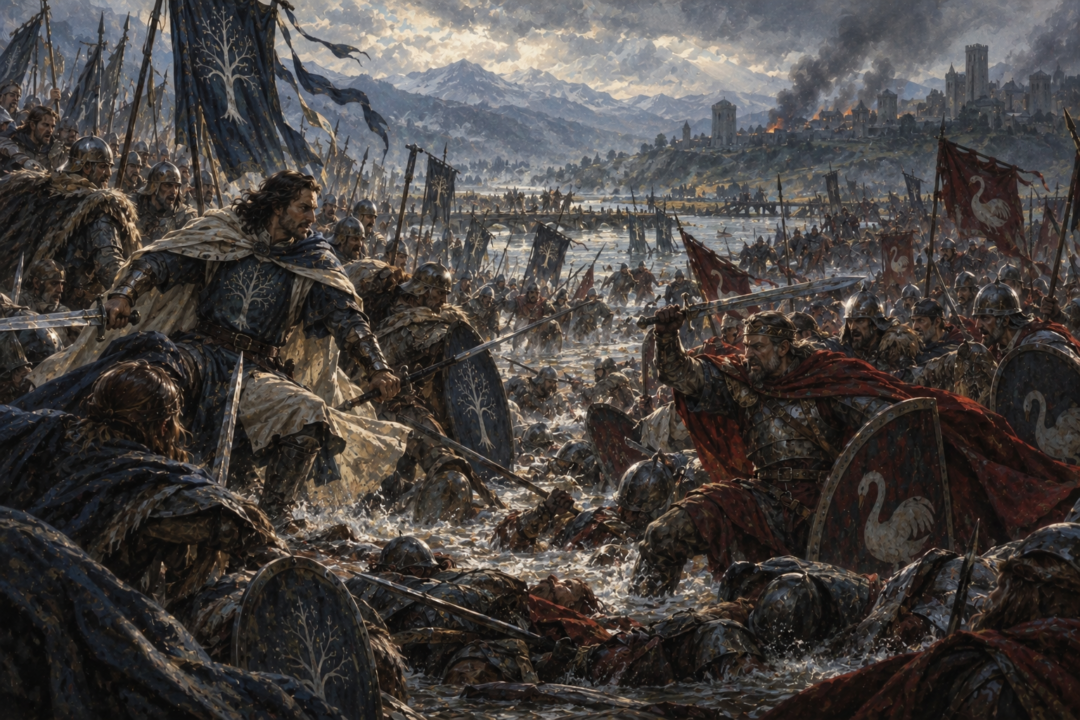
The decisive struggle came at the Crossings of Erui in Lebennin.
Here the accumulated tensions of generations finally became a direct military collision. Eldacar’s host included Northmen and supporters gathered from northern and central regions of Gondor. Castamir remained associated especially with the southern coastal strength that had originally helped place him on the throne.
The battle was devastating.
The annals emphasize that much of the best blood of Gondor was shed there. Eldacar personally killed Castamir and recovered the kingship, avenging Ornendil in the process.
But victory did not restore the old political order intact.
Castamir’s sons survived.
They withdrew with their followers to Pelargir, where Eldacar besieged them by land. His inability to defeat them at sea proved consequential. In 1448 they sailed away to Umbar.
There they established a power hostile to Gondor.
The civil war had exported itself beyond the kingdom.
The Kin-strife Did Not Truly End at the Erui
The sons of Castamir and their followers transformed Umbar into a refuge for enemies of the king, and their descendants remained dangerous opponents of Gondor.
That outcome reveals the strategic damage caused by the Kin-strife.
Before the rebellion, Castamir’s maritime support had helped him challenge the throne. After his defeat, that same maritime network allowed his faction to survive the loss of the mainland war.
The political geography of the rebellion became the geography of Gondor’s future enemies.
A dispute about who possessed the right ancestry to rule had therefore helped produce a hostile power on Gondor’s southern flank.
And the conflict had consumed many of the very Dúnedain whose blood the rebels had claimed to value so highly.
Eldacar Was the Living Refutation of the Original Fear
There is a final irony in Eldacar himself.
One fear behind the opposition to his succession was that his Northman ancestry would shorten his life compared with the descendants of Númenor.
It did not.
The record specifically notes that Eldacar showed no sign of aging more quickly because of his mother’s ancestry. He lived a long life and reigned for many decades after his restoration.
The biological assumption underlying part of the rebellion had failed.
But Gondor could not undo what had been destroyed while testing it.
Osgiliath had suffered grievously. Its palantír was gone. Ornendil was dead. Great numbers of Gondor’s people had killed one another. Castamir’s descendants had established themselves in Umbar, creating a danger that would endure long after the men who began the conflict were dead.
That is why the Kin-strife is more than a succession crisis.
It shows how easily an argument about identity can become a system of alliances. Valacar’s marriage joined two peoples. Eldacar’s ancestry turned that union into a political controversy. Castamir transformed the controversy into rebellion by combining a competing dynastic claim with powerful regional and naval support. Eldacar survived because his own kinship ties and his reputation among Gondorians produced another coalition.
In the end, neither genealogy nor marriage remained private matters.
They determined where a king could flee, who would shelter him, which soldiers would answer his call, which provinces would change allegiance, and which defeated rebels possessed the ships necessary to escape.
The Kin-strife began with men worrying that foreign blood might weaken Gondor’s royal house.
Instead, Gondor was weakened because its own people went to war over the question.
Sources & Notes
- Tolkien Gateway, “Kin-strife” — https://tolkiengateway.net/wiki/Kin-strife
- Tolkien Gateway, “Eldacar (King of Gondor)” — https://tolkiengateway.net/wiki/Eldacar_(King_of_Gondor)
- Tolkien Gateway, “Castamir” — https://tolkiengateway.net/wiki/Castamir
These secondary reference entries identify the relevant Tolkien texts and document the characters, events, and objects discussed. Explanations of motives and practical consequences remain interpretation unless explicitly stated in the cited texts.