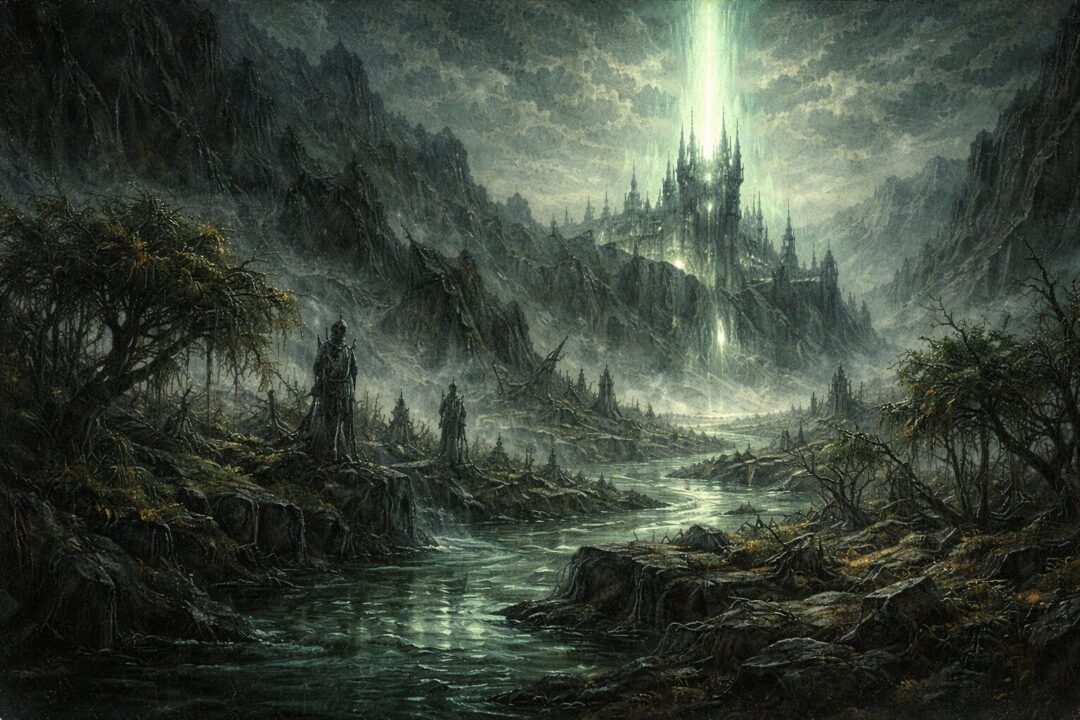
When the armies of Mordor finally march in force, one image dominates the memory of the War of the Ring: the pale, corpse-like light rising from Minas Morgul, stabbing upward into the darkened sky.
It is easy—almost instinctive—to read this moment as spectacle. A visual cue that the war has begun. A dramatic signal meant to look ominous and nothing more. In many fantasy worlds, that would be enough.
But Middle-earth does not use magic that way.
In this world, light is never just light. It is language. It is power made visible. And when that light is twisted, corrupted, and cold, it tells us far more about intent than any shouted command ever could.
The beam from Minas Morgul is not there to impress the viewer. It is there to do something.
Minas Morgul Is Not a Normal Fortress
To understand the meaning of the light, we first have to understand the place it comes from.
Minas Morgul was once Minas Ithil, a sister-city to Minas Anor, built to guard Gondor’s eastern approaches. It was a city associated with moonlight, watchfulness, and beauty—an outpost meant to hold back darkness, not become part of it.
Its fall is one of the great silent tragedies of Middle-earth.
By the time of the War of the Ring, Minas Morgul is no longer merely occupied by evil forces. It has been remade. The city itself has become an instrument of terror. The valley is described as sickly and oppressive. The air weakens resolve. Courage drains away simply by entering the Morgul Vale.
This matters, because in Middle-earth, places absorb history. Corruption does not sit on the surface; it sinks in.
Nothing that emanates from Minas Morgul is neutral. The walls, the light, the very atmosphere are shaped by domination and fear. The city is not a base of operations—it is a psychological weapon.
So when light pours out of it, we should already know better than to treat it as a mere signal.
A Light That Does Not Inspire
The descriptions of the beam are careful and deliberate. It is pale. Cold. Corpse-like. It does not resemble fire, sunlight, or the white brilliance associated with hope or renewal.
This immediately sets it apart from the lights of the West.
In Middle-earth, true light is almost always connected to preservation, memory, and resistance against decay. Even when it is subtle, it strengthens rather than drains. Morgul-light does the opposite. It chills the spirit. It presses down rather than lifting up.
That tells us something crucial: this is not a rallying cry.
It does not call allies to courage.
It does not stir loyalty.
It does not inspire sacrifice.
It enforces obedience.
The Light as Command, Not Communication
This distinction is vital.
Sauron does not rule the way kings of the West rule. He does not depend on shared values or freely given loyalty. His power is rooted in domination of will. Fear is not a side effect of his rule—it is the foundation of it.
His armies reflect this. Orcs loathe their masters and one another. They obey because disobedience is worse. Many Men who march under the Dark Lord’s banners do so through coercion, despair, or the hope of survival and reward in a world already bent toward darkness.
Such forces are not motivated by speeches or banners.
They are motivated by certainty.
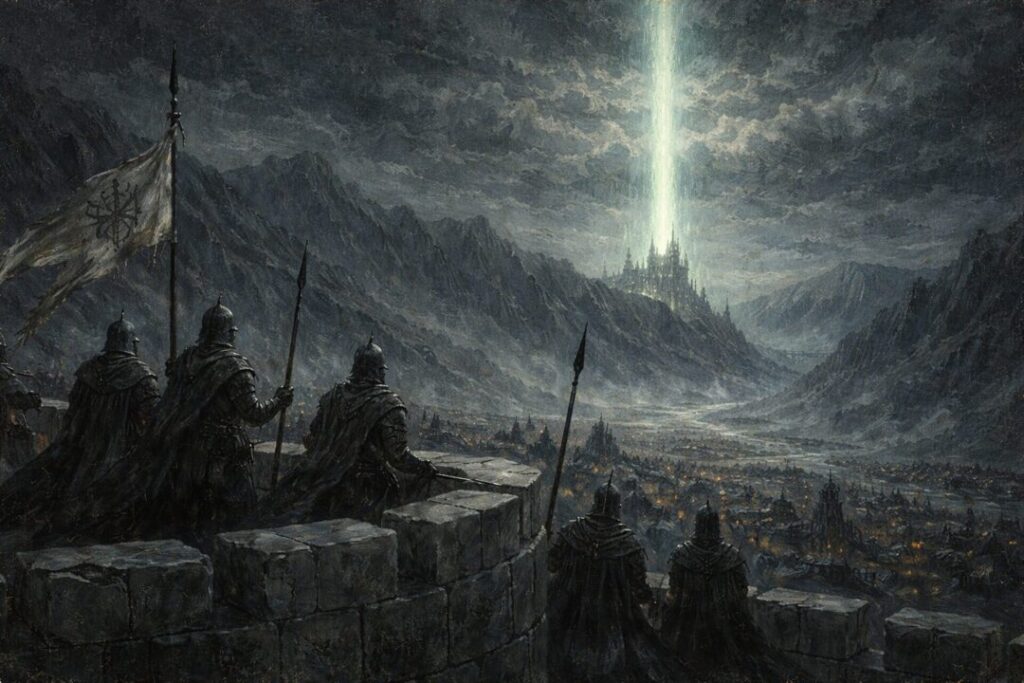
The beam from Minas Morgul functions as a binding command. It is the moment when hesitation ends—not because everyone suddenly believes in victory, but because refusal has become impossible. The last barrier of delay is removed.
This is the instant when restraint is lifted.
The Witch-king Unleashed
Minas Morgul is ruled by the Witch-king, the chief of the Nazgûl and Sauron’s most terrible servant. His role is not merely military. He is an extension of his master’s will, especially in matters of fear.
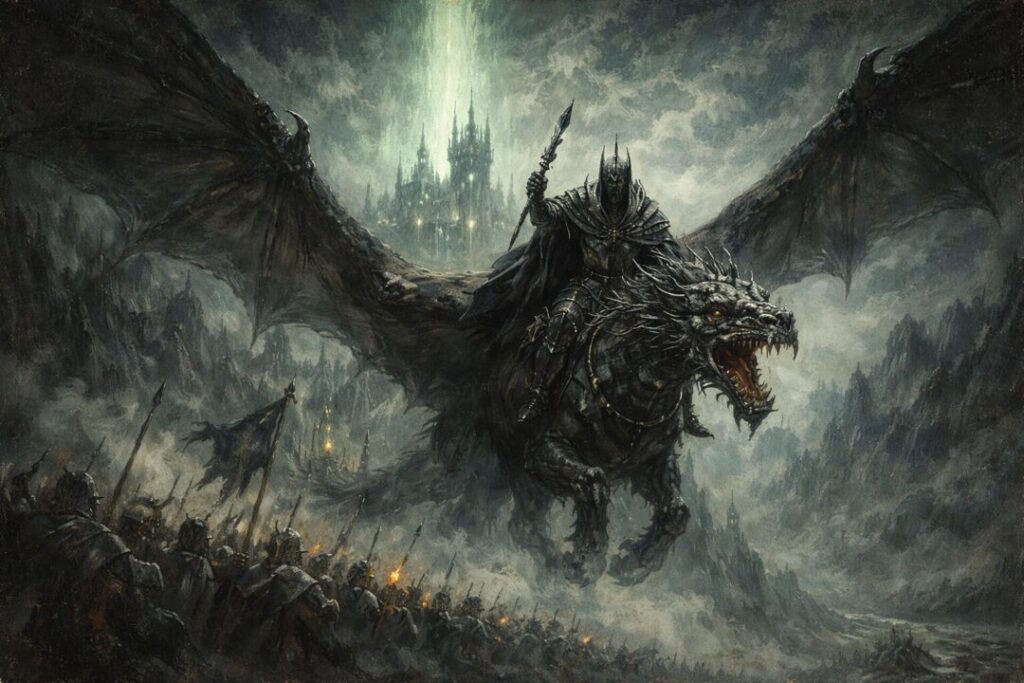
When the light rises, it marks the moment when the Witch-king is released to act openly.
Before this, secrecy and timing mattered. The war was being prepared, measured, aligned with other movements across Middle-earth. After the beam, that careful pacing ends. The attack on Gondor is no longer theoretical. It is underway.
The light announces that the Witch-king’s authority is now absolute and active. What follows—terror, despair, the breaking of spirits—is not collateral damage. It is the point.
Psychological Warfare on a Continental Scale
The beam is visible from Gondor. That matters—but it is not the primary audience.
The true power of the light lies in what it communicates to everyone at once.
To Gondor, it says: the enemy is no longer hiding. There will be no more uncertainty about whether the assault will come. The waiting is over, and waiting is often the last refuge of hope.
To allies of Gondor, it confirms the worst fears. Aid must come now—or not at all.
To Sauron’s own forces, it creates an environment where fear becomes energizing rather than paralyzing. Orcs march more readily when terror saturates the air. Cruelty sharpens their resolve. The light is a reminder of the power behind them, and of the punishment waiting for those who falter.
This is not morale-building in the human sense. It is morale enforcement.
Why the Light Is Cold, Not Bright
One of the most revealing aspects of the beam is its temperature—spiritually, if not physically.
It is not warm. It does not blaze. It does not resemble the Sun or the fire of Anor. Instead, it is described as sickly and unnatural, like the glow of something that should not exist.
This is a recurring pattern in corrupted power throughout Middle-earth.
Evil does not create. It imitates. It takes forms that once had meaning and hollows them out. Morgul blades look finely made, but they poison the soul. Morgul-light looks like illumination, but it spreads despair.
This is domination disguised as revelation.
The light pretends to clarify the world—this is the moment, this is the truth—while actually stripping away the ability to resist that truth.
A Declaration of No Return
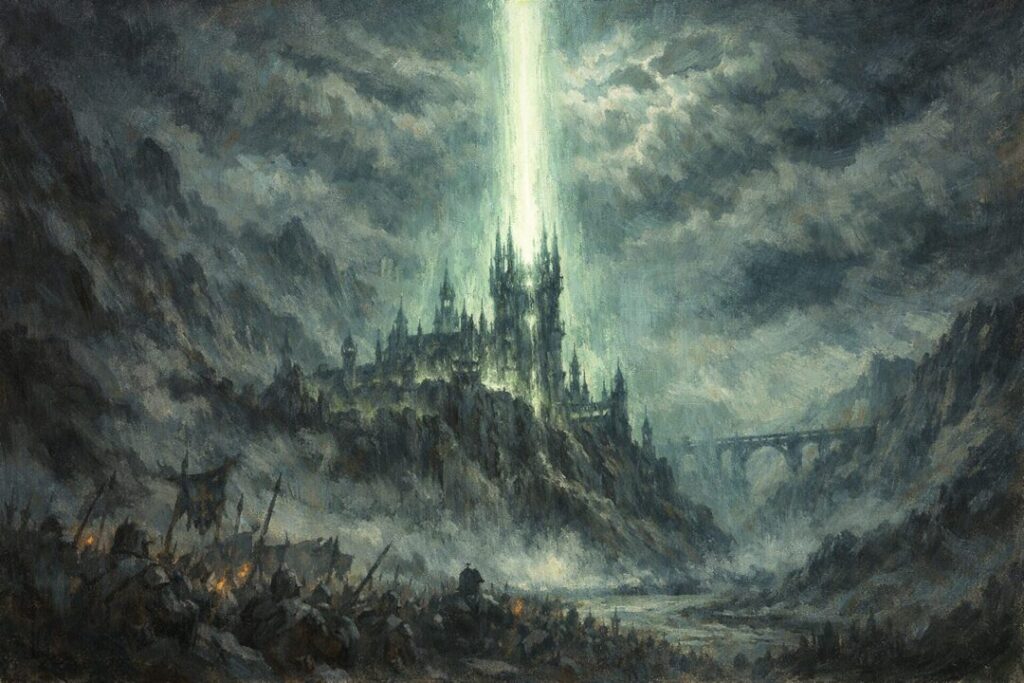
Once the beam rises, the war enters its final phase.
There is no longer any pretense of balance, negotiation, or containment. Sauron has committed fully. His greatest servant rides forth. His armies move in the open. The last long preparation snaps into action.
For Gondor, this is the end of anticipation. The city is no longer watching the horizon and wondering when. It is enduring what it already feared.
Importantly, this does not mean the beam starts the war. Battles have already been fought. Blood has already been spilled. But it marks the moment when the conflict becomes unavoidable for everyone who remains.
From here on, something will break—either the defenses of the West, or the power that seeks to crush them.
Why the Image Endures
The beam from Minas Morgul lingers in the imagination because it is not just dramatic—it is conclusive.
It represents the moment when darkness stops whispering and begins to speak plainly. When fear is no longer a threat but a presence. When delay ends and consequence begins.
It is not flashy.
It is not triumphant.
It is not beautiful.
It is final.
And in Middle-earth, that kind of finality is far more terrifying than any explosion or battle cry—because it tells you that whatever comes next is already in motion, and nothing remains untouched by it.