This post may contain affiliate links, and I may earn a small commission at no extra cost to you. Learn more.
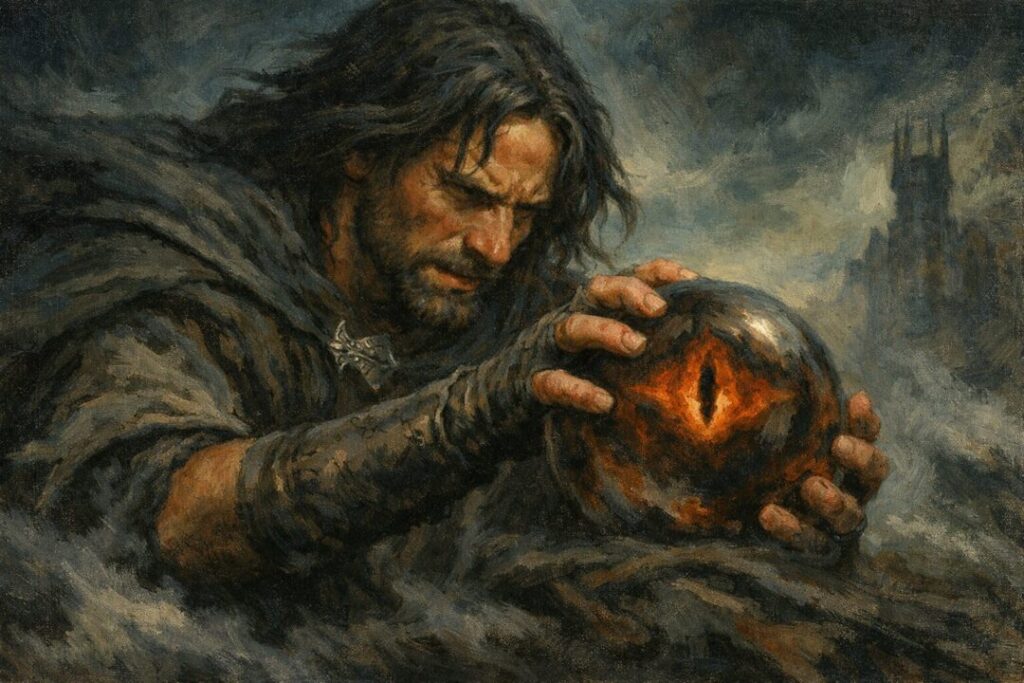
When Aragorn takes the palantír of Orthanc and reveals himself to Sauron, it feels like one of the most reckless decisions in The Lord of the Rings.
He knows what the palantíri are.
He knows Sauron can see through them.
He knows the Dark Lord has spent centuries hunting the line of Isildur.
And yet Aragorn chooses to step directly into Sauron’s sight.
At first glance, this makes no sense.
Why would the rightful king of Gondor announce himself before his throne is secure? Why draw the Eye of Mordor onto himself—especially when the Ring-bearer’s survival depends entirely on secrecy and misdirection?
The usual answer is simple: Aragorn is asserting his claim. Declaring himself openly so Sauron will fear him.
But that explanation only scratches the surface.
Because Sauron doesn’t just notice Aragorn.
He takes the bait.
The Obvious Reading: A King Challenges a Dark Lord
If we stay strictly inside the main narrative, Sauron’s response looks perfectly rational.
The Heir of Isildur has returned.
The sword that once cut the Ring from Sauron’s hand has been reforged.
A king is rising in Gondor, rallying Men to his banner.
From Sauron’s perspective, this looks like the beginning of a story he understands very well: a powerful enemy stepping forward, claiming authority, gathering strength, and preparing to challenge him openly.
That is the kind of war Sauron has fought before.
And every time, overwhelming force has carried the day.
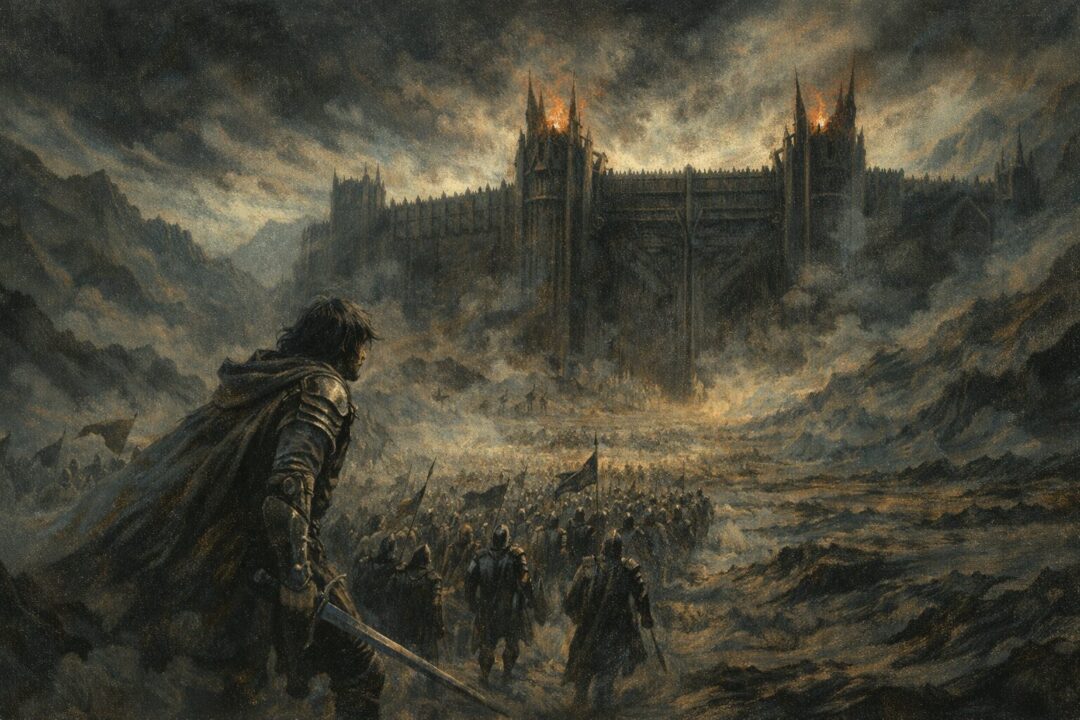
So Sauron reacts exactly as expected. He accelerates the war. He unleashes his armies. He prepares Minas Tirith for destruction. His attention shifts west—toward kings, banners, cities, and armies—and away from anything small, quiet, or easily overlooked.
This is the straightforward reading.
The “1983 version” of the story.
Aragorn reveals himself.
Sauron moves to crush him.
Simple.
Except it isn’t.
The Palantír Isn’t About Strength — It’s About Assumptions
What Aragorn really does when he uses the palantír is not challenge Sauron’s power.
He challenges Sauron’s imagination.
Sauron cannot imagine victory without domination. He does not believe humility can win wars. And most importantly—he does not believe anyone would willingly reject the Ring once they have the power to claim it.
This is not a flaw of intelligence. It is a flaw of worldview.
Sauron’s entire existence is built around control, mastery, and hierarchy. In his mind, power is something you take, wield, and impose. The idea that someone might possess the Ring and refuse to use it is not just unlikely—it is incomprehensible.
So when Aragorn reveals himself openly, Sauron draws what seems to him the only possible conclusion:
Aragorn must have the Ring.
Why else would the Heir of Isildur show himself?
Why else would he dare to provoke the Dark Lord directly?
Why else would he step into the Eye’s gaze unless he believed he could win?
In Sauron’s mind, Aragorn’s revelation can only mean one thing: the Ring has passed into the hands of a new master, and that master is preparing to challenge him.
That single assumption reshapes the entire war.
Why Aragorn Looks Like the Perfect Successor
This is where the parallel to Palpatine becomes especially clear.
Palpatine tempts Luke because Luke fits the role he expects: powerful, emotionally driven, descended from a mighty lineage. Killing the Emperor would be both an act of domination and a symbolic passing of the torch.
Sauron reads Aragorn the same way.
Here is the heir of the man who once defeated him.
Here is a king stepping forward at the head of armies.
Here is someone who looks exactly like the kind of ruler who would seize the Ring and use it to impose order.
In other words: Aragorn looks like someone playing Sauron’s game.
And that is precisely why the deception works.
The March on the Black Gate Is the Final Confirmation
Everything culminates at the Black Gate.
Aragorn does not sneak.
He does not hide.
He does not attempt subtlety.
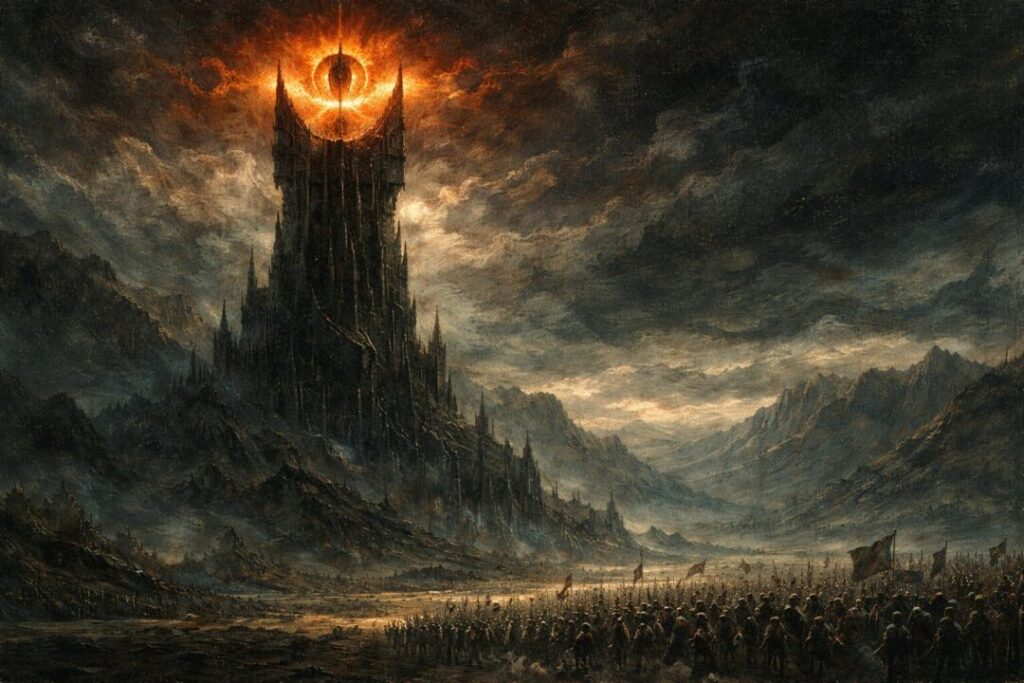
Instead, he leads a hopelessly small army straight to the gates of Mordor and challenges Sauron openly.
From the outside, this looks suicidal.
From Sauron’s point of view, it looks like absolute certainty.
No one would attempt this without supreme confidence. No one would march on the Dark Lord’s own gates unless they believed they possessed a weapon capable of overturning the world.
The Ring.
This is the moment Sauron fully commits to his mistake.
He empties Mordor.
He pulls forces away from guarding Mount Doom.
He pours everything into crushing Aragorn in open battle.
Just as Palpatine funnels Luke toward a single decisive choice—kill me, take your place—Sauron funnels Aragorn into a war of domination, where strength meets strength and the strongest will rule.
And Aragorn lets him believe it.
Why This Is Sauron’s Version of “Strike Me Down”
Palpatine’s throne room trap works because every outcome benefits him.
If Luke kills him in anger, the Sith live on through Luke.
If Luke refuses, Palpatine continues to torment him through his friends until he breaks.
Sauron’s strategy follows the same logic.
If Aragorn truly has the Ring, Sauron will defeat him and reclaim it.
If Aragorn does not—but Sauron believes he does—then Sauron still wins by focusing all his attention on the wrong enemy.
Either way, Sauron believes he is in control.
The flaw is identical in both villains.
They cannot imagine someone choosing not to rule.
The Small Thing Sauron Never Sees
While Sauron watches Aragorn, something else is moving.
Quiet.
Insignificant.
Unworthy of notice.
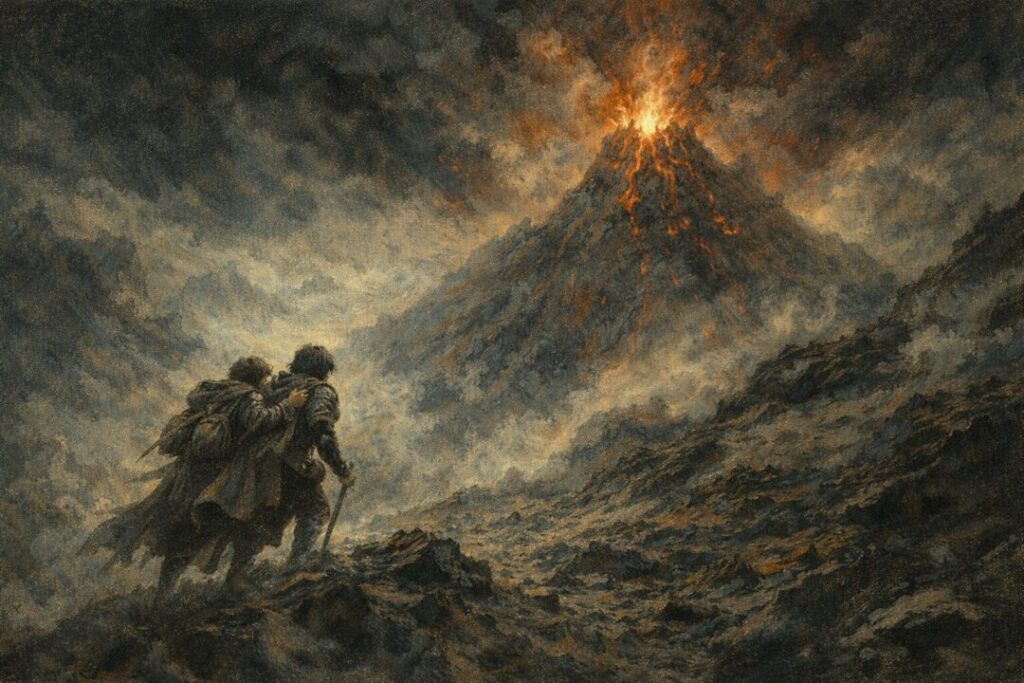
A hobbit and his gardener climbing a mountain that does not matter—because Sauron has already decided where the real battle is.
This is not an oversight. It is the natural consequence of Sauron’s worldview.
He sees kings.
He sees armies.
He sees power.
What he cannot see is refusal.
Misdirection, Not Pride
Aragorn’s revelation through the palantír is often read as a moment of boldness or pride—a king stepping into his destiny.
But in the broader logic of the story, it is something far colder and more precise.
It is misdirection.
Aragorn presents himself as exactly the enemy Sauron expects, so that the enemy Sauron cannot imagine can succeed.
And just like Palpatine, Sauron builds a plan where every “wrong” move should benefit him—only to discover that the one choice he never planned for is the one that destroys him.
Not strength.
Not domination.
But refusal.
That is why Sauron wanted Aragorn to reveal himself.
And that is why, in the end, it cost him everything.