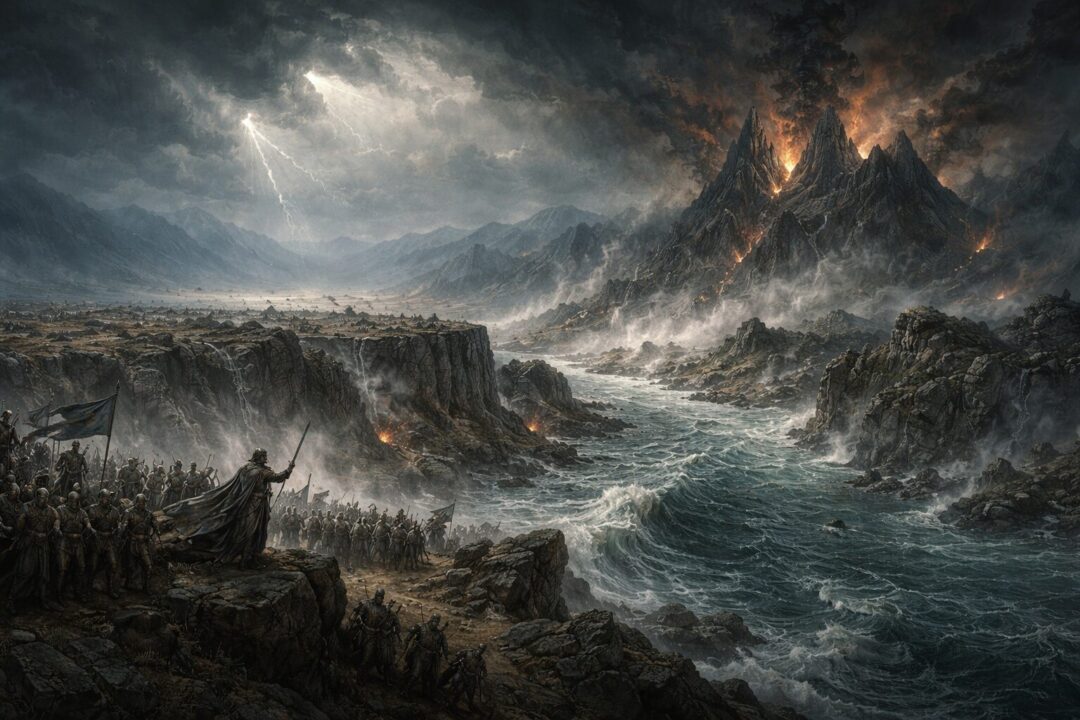
When Beleriand sank, it did not fade.
It broke.
At the end of the First Age, during the War of Wrath, the conflict between Morgoth and the Host of Valinor reshaped the physical structure of the northwestern world. The Silmarillion states plainly that “the northern parts of the western world were rent asunder,” and that Beleriand was “broken and destroyed.”
That phrasing matters.
It does not say Beleriand gently submerged. It does not describe a gradual drowning beneath rising tides. It describes rending—fracture—catastrophe on a continental scale.
And yet, the popular imagination often replaces that violence with a quieter image: intact elven cities resting beneath clear waters, preserved like a lost Atlantis of Middle-earth.
The texts are more restrained.
What the War of Wrath Actually Did
The War of Wrath lasted decades. It ended with the defeat of Morgoth, the breaking of Thangorodrim, and the casting of Morgoth into the Void. But its geographical consequences were enormous.
The Silmarillion tells us that “so great was the ruin of Beleriand that in after days no man could say where was the land that had once been.” Much of it sank beneath the Sea.
But not all.
The coastline of Middle-earth in the Second and Third Ages still preserves fragments of that older world.
Lindon—the realm ruled by Gil-galad—was part of eastern Beleriand. It did not sink. Instead, it became the westernmost land remaining above the Sea.
The Blue Mountains (Ered Luin) still stood.
And several islands mark places that were once high ground.
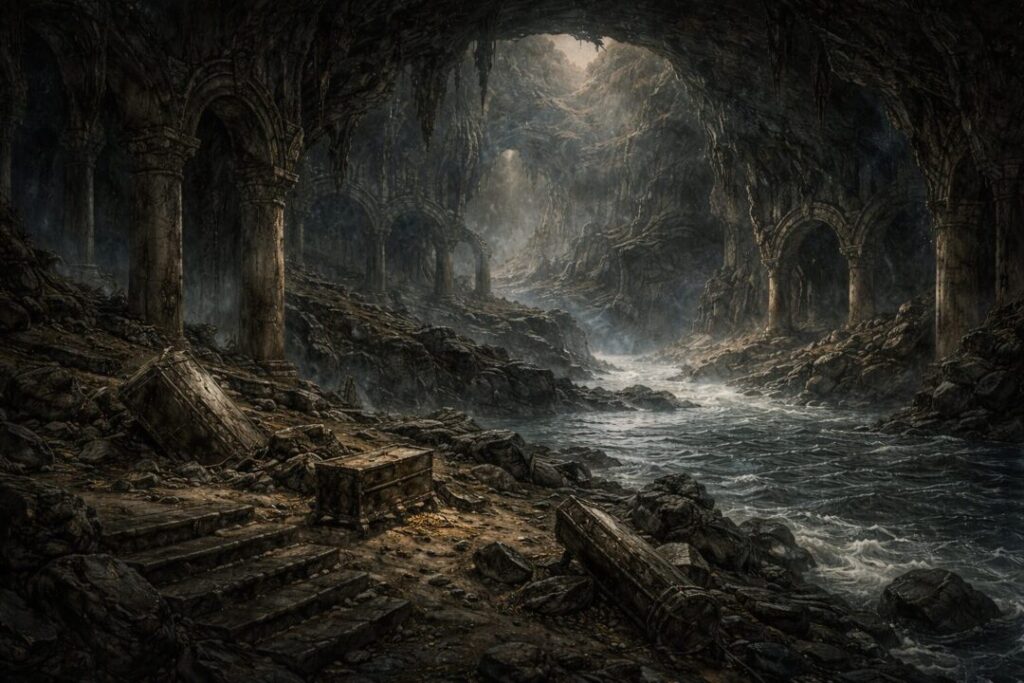
Tol Morwen: A Grave Above the Waves
One of the clearest survivals is Tol Morwen.
In the narrative following the ruin of Doriath and the tragedy of Túrin, Morwen’s grave was set upon a hill. After the drowning of Beleriand, that hill remained above the waters as a solitary island.
The Silmarillion explicitly identifies Tol Morwen as “the stone of the hapless,” still visible in later ages.
This is not rumor.
It is geographic continuity.
A grave that once stood inland now stood surrounded by sea.
That tells us something important: parts of Beleriand were not pulverized. They were submerged.
High ground became islands.
Lower ground vanished.
What of the Great Cities?
Now the harder question: what became of the great realms?
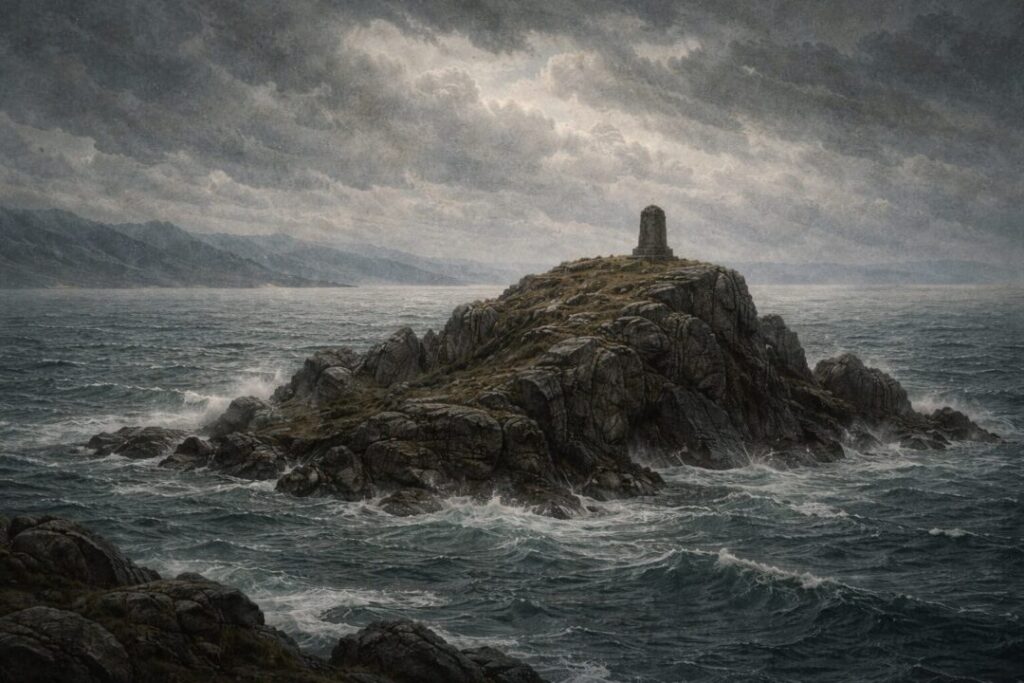
Menegroth, the Thousand Caves, was already ruined before the War of Wrath. The Dwarves of Nogrod sacked it; later conflicts further damaged Doriath. The caves themselves were carved into stone beneath forested land.
When Beleriand sank, those lands went with it.
But do the texts ever describe their remains beneath the Sea?
No.
Nargothrond, too, had fallen long before the end of the First Age. Glaurung’s coming led to its sack and desolation. By the time the War of Wrath began, it was already an empty and broken stronghold.
Gondolin had been destroyed even earlier, cast down after Maeglin’s betrayal. Its valley was laid waste; its towers broken.
In other words: none of the great Elven kingdoms were intact when Beleriand sank.
They had already been shattered by war.
So if their foundations lie beneath the Sea, they do so as ruins of ruins.
Is There Evidence of “Underwater Ruins”?
Here the texts grow silent.
There is no passage describing mariners seeing spires beneath the waves. No account of Númenórean ships passing over visible remnants of Gondolin. No legend of divers retrieving relics from drowned Nargothrond.
This silence is important.
Middle-earth is not Atlantis mythology. When Númenor sank in the Akallabêth, we are told explicitly that it was overwhelmed by the Sea and that its memory became a warning. But even there, there are no canonical descriptions of intact cities visible underwater.
For Beleriand, the silence is even stronger.
We are told it was broken and largely drowned. We are told fragments remained above water. But the idea of preserved underwater kingdoms is never stated.
If one imagines them, it must be labeled as interpretation.
The texts neither confirm nor deny the physical survival of buried stonework. They simply do not describe it.
The Shape of the Surviving Coast
Maps included with The Lord of the Rings show the western coastline in the Second and Third Ages. Comparing these with earlier maps of Beleriand reveals continuity.
The Gulf of Lune corresponds roughly to the ancient River Lune flowing through the Blue Mountains.
Lindon occupies what was once the eastern portion of Beleriand.
Himring, the hill of Maedhros, is said in later notes to have remained above the Sea as an island.
These survivals suggest that the drowning was uneven. Higher elevations endured. Lowlands vanished.
It was not a smooth submersion but a catastrophic restructuring.
The Psychological Loss
There is another dimension to the sinking of Beleriand that the texts emphasize more than physical ruins: memory.
By the Second Age, Beleriand is already a lost land in song.
Elrond, who was born in the Havens of Sirion, would have remembered it. So would Galadriel, who had walked its forests.
But for Men of later ages, Beleriand was legend.
Its rivers—Sirion, Narog, Gelion—were names from ancient lays.
This matters because Middle-earth consistently treats loss not as an archaeological curiosity but as a moral and historical weight.
The drowning of Beleriand is not framed as a mystery to explore.
It is framed as the cost of war against Morgoth.
So What Lies Beneath?
If we remain strictly within the texts, we can say this:
• Much of Beleriand sank beneath the Sea at the end of the First Age.
• Some high places remained as islands (Tol Morwen, Himring).
• Lindon and the Blue Mountains endured as remnants of that world.
• The great kingdoms were already ruined before the drowning.
• No canonical text describes visible underwater ruins.
Could broken stone still lie beneath the bent seas west of Lindon?
Physically, it is plausible.
Textually, it is unconfirmed.
The legendarium does not give us divers, or clear-water visions of towers below.
Instead, it gives us something quieter: a coastline shaped by loss, and islands that are not beginnings—but endings.
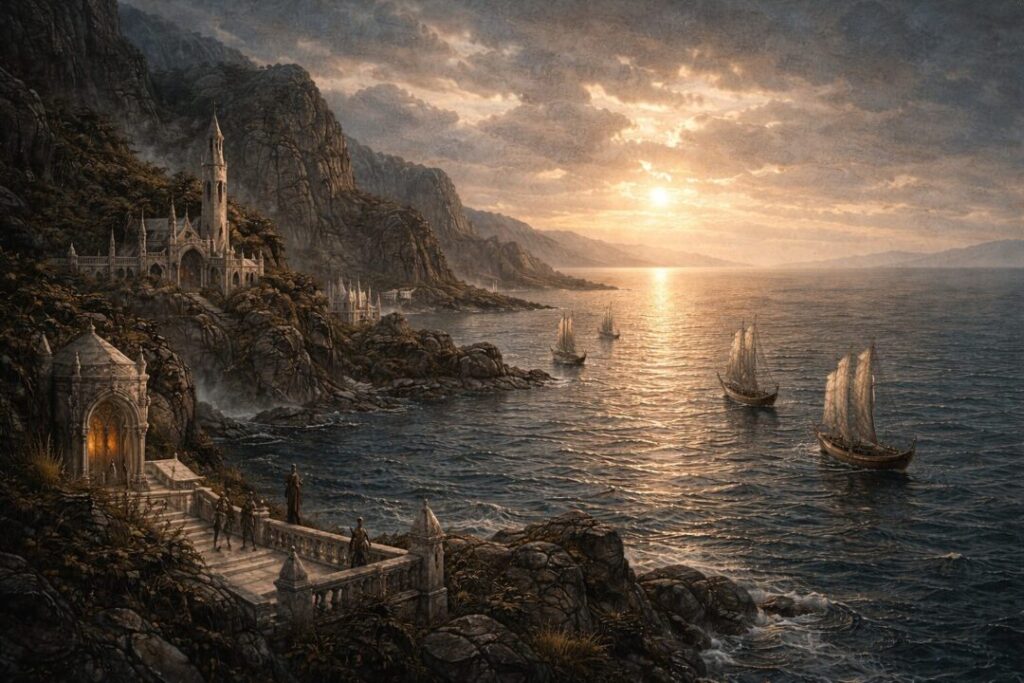
When ships departed from the Grey Havens in the Third Age, they sailed westward over waters that covered the lands of their ancestors.
Beneath those waves lay not a preserved Atlantis—but the shattered remains of the First Age.
Not displayed.
Not visited.
Not reclaimed.
Only remembered.
And in Middle-earth, memory is often the only monument that endures.