Ungoliant is easy to misremember.
In later tales, most readers meet only the descendants: webs in dark passes, poison in tunnels, hunger crouched in stone. But behind those later horrors stands an older name—one the texts treat with unusual caution, as though even the tradition-bearers are reluctant to pretend they understand it.
The question “Who (or what) was Ungoliant?” is not a modern puzzle forced onto an otherwise tidy mythology. The mystery is built into the way the sources speak.
The Elves themselves confess uncertainty.
What the texts state plainly
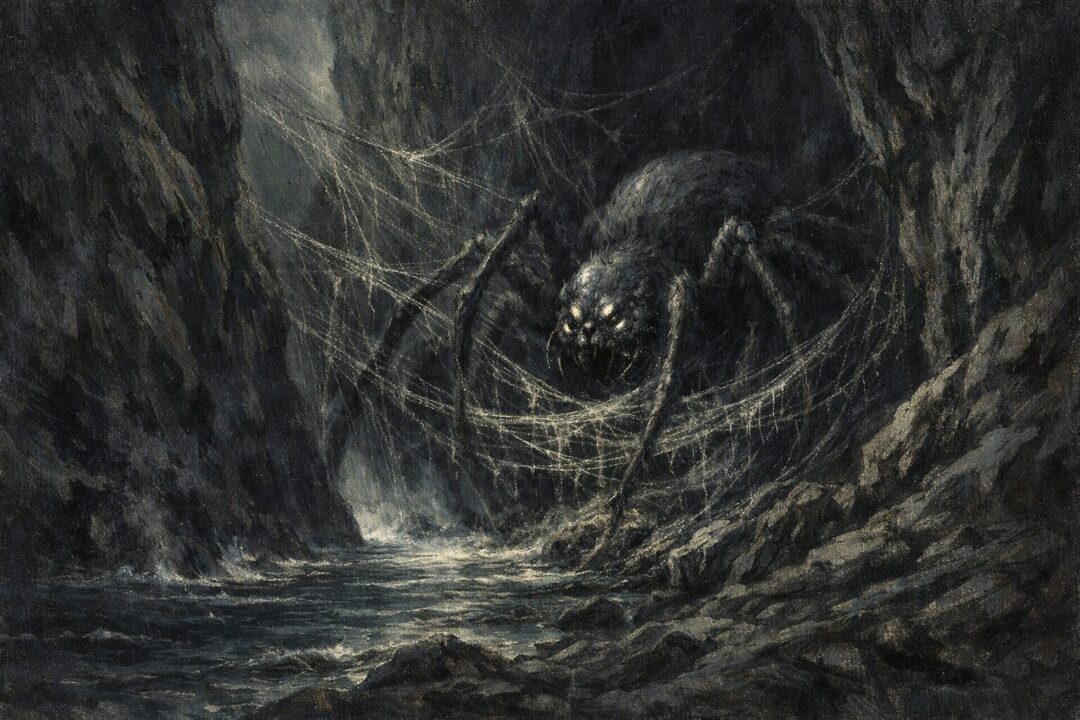
Ungoliant is introduced not as a spider that became wicked, but as a being that took the shape of a monstrous spider and made her dwelling in deep shadow.
The description is precise in its effects: she sucks up what light she can find and then spins it forth again in “dark nets” of strangling gloom, until no light can reach her abode and she is still “famished.”
That last word matters. Ungoliant is not defined by strategy or ideology, and not even primarily by hatred—though the texts do say she “hungered for light and hated it.” She is defined by need without satisfaction, by appetite that grows faster than it can be fed.
This appetite is not treated as metaphor only. It reshapes history.
When Melkor flees the vigilance of the Powers, he seeks her out in the shadowed south and persuades her to aid him, promising to satisfy her lust.
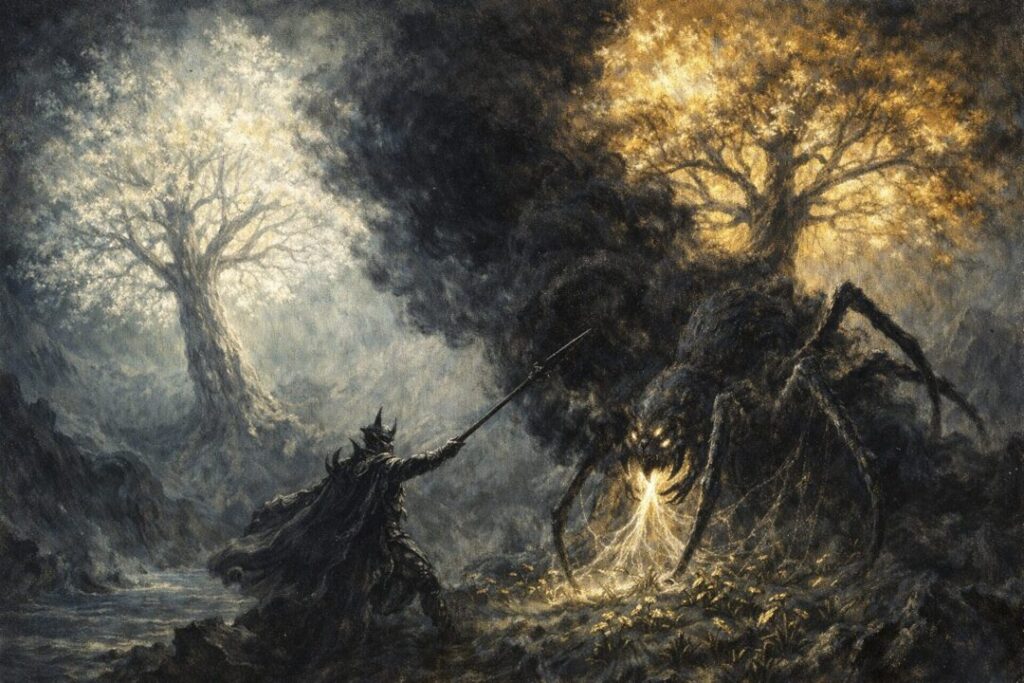
Together they come upon the Two Trees. The tale credits Ungoliant with producing an Unlightthat rises to the very roots, while Melkor strikes the Trees and Ungoliant drains them, setting her beak to their wounds until they are emptied and withered.
Then, “still she thirsted,” and she drinks the Wells of Varda dry—belching black vapours as she drinks, swelling into a shape “so vast and hideous” that even Melkor is afraid.
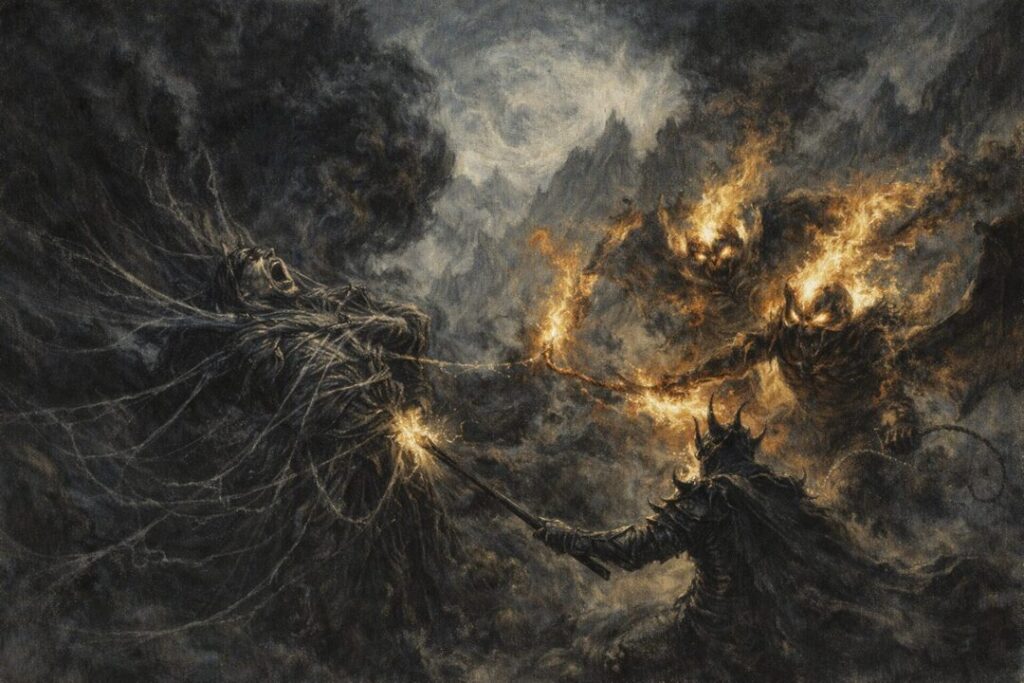
After this, the partnership collapses. Ungoliant demands more payment—gems, and then the Silmarils—until she rises against Melkor, enmeshes him in web and cloud to strangle him, and he cries out in desperation. The cry is so dreadful the land is named Lammoth, and it is heard even deep under Angband, where Balrogs lurk awaiting their lord. They come like a tempest of fire, smite her webs with whips of flame, and she flees, belching vapours to cover her flight.
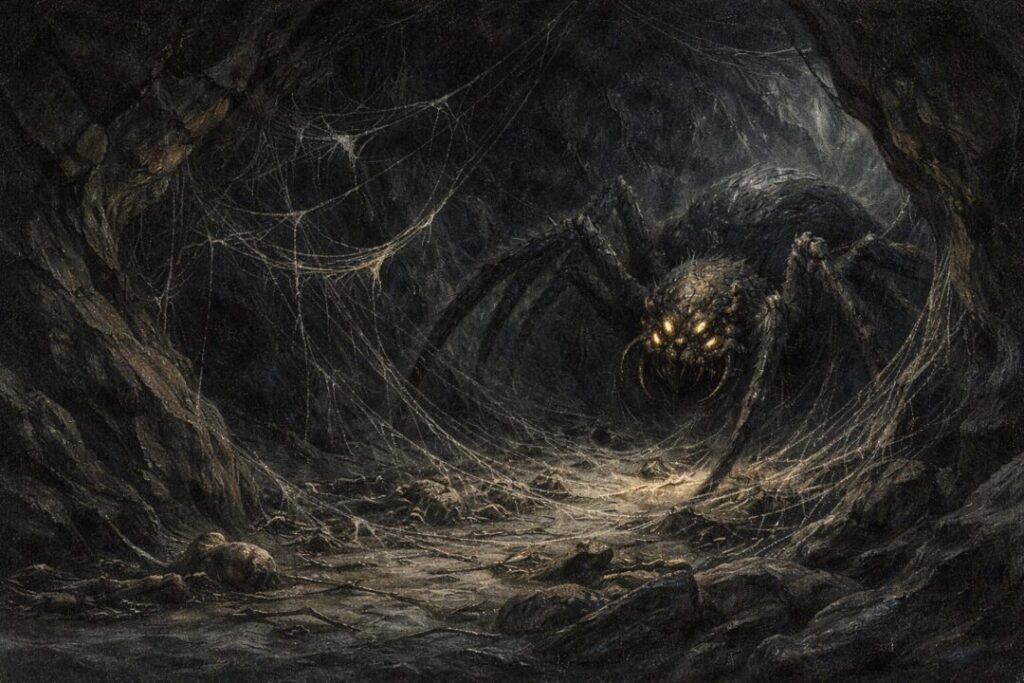
She goes down into Beleriand, dwelling beneath Ered Gorgoroth in the valley later called Nan Dungortheb “because of the horror that she bred there.” And then the record breaks off again: “Of the fate of Ungoliant, no tale tells,” though “some have said” she ended by devouring herself in her uttermost famine.
Those are the firm narrative stones: lair, bargain, Unlight, the Trees, the quarrel, the flight, the silence.
The origins are something else.
The origin problem is in the wording
The key line is not a tidy genealogy. It is a confession:
“The Eldar knew not whence she came.”
Everything that follows is framed as report, not certainty: some have said that long before she descended from the darkness that lies about the world, “in the beginning” she was one of those Melkor corrupted to his service.
This is the single most important “clue,” and it is deliberately fragile.
It means at least three things the reader has to hold at once:
First, the tradition does not claim eyewitness knowledge. The Eldar are repeating what has been said.
Second, it suggests a connection to Melkor’s earliest corruptions—but does not specify what kind of being was corrupted. It does not name her among the Maiar, nor list her among the Valar.
Third, it implies she came from outside ordinary mapped history: she “descended from the darkness that lies about” the world. The text does not define that phrase further, and it is careful not to equate it explicitly with any other named domain (such as the Outer Darkness).
The upshot is that the primary texts give permission for interpretation, but deny clean confirmation.
What Ungoliant’s behaviour implies (and what it does not)
Because her classification is unclear, readers often reach for a solution: “She must be a Maia” (or: “She must be older than the world”).
The safest approach is to separate what the texts show from what they name.
The texts show Ungoliant as a being with will and agency. She makes bargains, chooses to abandon a master, seeks her own satisfaction, and turns violently on an ally when denied.
They also show her as capable of taking form (“took the shape as a spider of monstrous form”), and of producing Darkness that is not merely the absence of light, but something with a suffocating, invasive power.
Those features resemble the way other powerful “spirits” operate in the legendarium. But resemblance is not identity, and this is where many summaries overstep.
The primary texts do not explicitly call her “Maia.” They do not explicitly place her among the Ainur by name. Instead they preserve the uncertainty: the Eldar did not know, and only “some have said” she was among the corrupted.
So any firm claim—“she was a Maia,” or “she predates the world”—goes beyond what is directly stated.
What we can do, responsibly, is map the interpretive options the texts allow.
The corrupted Maia theory (interpretation)
This is the most common attempt to make the story fit familiar categories.
Why readers propose it is understandable: the tradition says she may have been “one of those” corrupted by Melkor, and she is described in ways that feel closer to a fallen spirit than to a mere beast.
Under this interpretation, Ungoliant would be a spirit-beeing (potentially of the Maiar) who turned to darkness, then broke away—“disowning” her master to become mistress of her own lust.
The key problem is that the text never seals the identification. Even the strongest wording is indirect and traditional (“some have said”), and it never uses the technical label.
So “corrupted Maia” can be presented as a reasonable interpretation, but not as settled fact.
The older-than-the-world theory (interpretation)
The other major proposal takes its cue from the phrase “descended from the darkness that lies about” the world.
Readers note the directional language: she descends from a surrounding darkness, as though from beyond the world’s borders.
But again the text refuses to define this darkness with a formal cosmological label. It does not explain whether the phrase should be taken geographically (a region outside the inhabited world), metaphysically (a kind of primeval darkness), or poetically (a way of saying “from no place we can name”).
This theory is therefore also best held as interpretation: the words suggest an origin beyond mapped histories, but do not confirm a separate order of being.
A rarer reading: Ungoliant as “hunger” made person (interpretation)
This reading focuses less on taxonomy and more on pattern.
In the story of the Darkening, the text describes the Darkness made in that hour as “more than loss of light,” as though it had “being of its own,” and power to pierce eye and heart and strangle will.
Ungoliant is inseparable from that moment: she turns light into something oppressive, feeding on splendour and converting it into bondage.
From here, some readers infer that she is less a “character with a species” and more a narrative embodiment of devouring negation: consumption that cannot be satisfied, appetite that consumes even itself.
It is a powerful thematic reading—but it remains a reading. The text never explicitly defines her as personification, only as an agent who desires, hates, bargains, and consumes.
The Third Age proof that the line endures
Even if Ungoliant vanishes from the Elder Days, the later narrative treats her as a true ancestral shadow.
In The Two Towers, the narrator pauses to give a history of Shelob: an “evil thing in spider-form” who has dwelt in her lair for ages, who “served none but herself,” and who was there before Sauron and before Barad-dûr was raised.
The same passage calls her “the last child of Ungoliant to trouble the unhappy world,” and says her “lesser broods” spread as far as Dol Guldur and the fastnesses of Mirkwood.
This matters for the Ungoliant question, because it confirms at least two things the Silmarillion already implies:
Ungoliant’s “horror” is generative—it breeds, multiplies, leaves offspring behind.
And the hunger-for-self is a family trait. Shelob is explicitly described as serving no master, even when she is occasionally “used” as a guard by the Dark Lord of Mordor—like a cat that cannot truly be owned.
Ungoliant’s mystery is not only in where she came from, but in what she represents as a kind of evil: not merely domination, but consumption.
Why the uncertainty may be the point (interpretation)
The texts give many villains clear origins. They are fallen among known orders of being, or corrupted from known peoples. Ungoliant is different.
Her introduction is framed as hearsay; her end is framed as hearsay; her central power is to turn light into Unlight and appetite into history.
In other words, she is one of the rare presences in the legendarium who resists classification even by those who preserve the lore.
The result is not a broken mythology, but a deliberate sensation: that some terrors in the world are not fully “explained” because they are not fully containable—either by maps, by taxonomies, or by the reader’s desire to label.
Ungoliant is known by what she does:
She makes Light into a thing that can strangle.
She devours splendour and is still empty.
She turns even on the first Dark Lord when denied.
And, if the rumour is true, she is the final proof of her own theme: hunger so absolute it consumes itself.
That is why she remains one of the most unsettling figures in Middle-earth lore: not because we know too little, but because the little we know is enough.