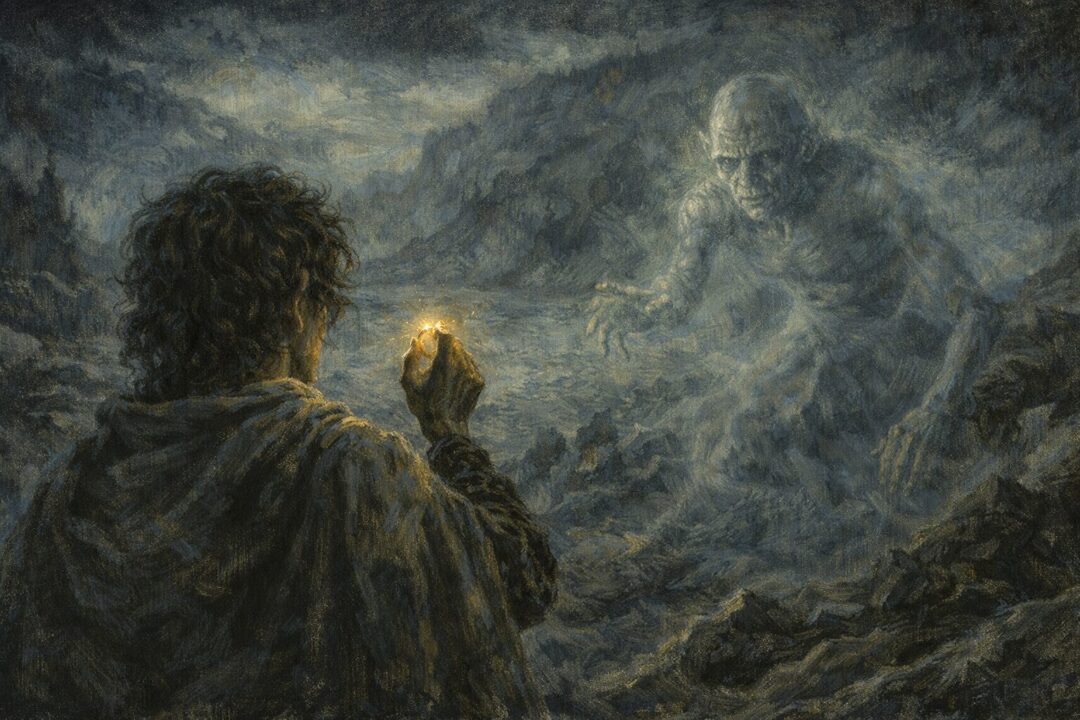
Ringwraiths are usually imagined as fallen kings—great Men undone by ambition, pride, and the promise of power. Cloaked riders, once rulers of realms, now reduced to shadows bound to a darker will.
That image is accurate.
But it is incomplete.
Because the being who came closest to joining their ranks was not a lord, a warrior, or a ruler of Men.
He was a Hobbit.
Sméagol, later known as Gollum, represents one of the most disturbing truths about the One Ring: it does not require greatness to destroy someone.
It only requires time.
Sméagol Before the Ring
Before his corruption, Sméagol was an ordinary member of a small river-Hobbit community, related to Déagol. He was not heroic, but neither was he monstrous. Like many Hobbits, he enjoyed secrets, possessions, and small comforts. He was curious, perhaps more than was healthy, and he harbored resentments.
But he was still recognizably one of his people.
This matters, because the Ring did not invent Sméagol’s flaws.
It exploited them.
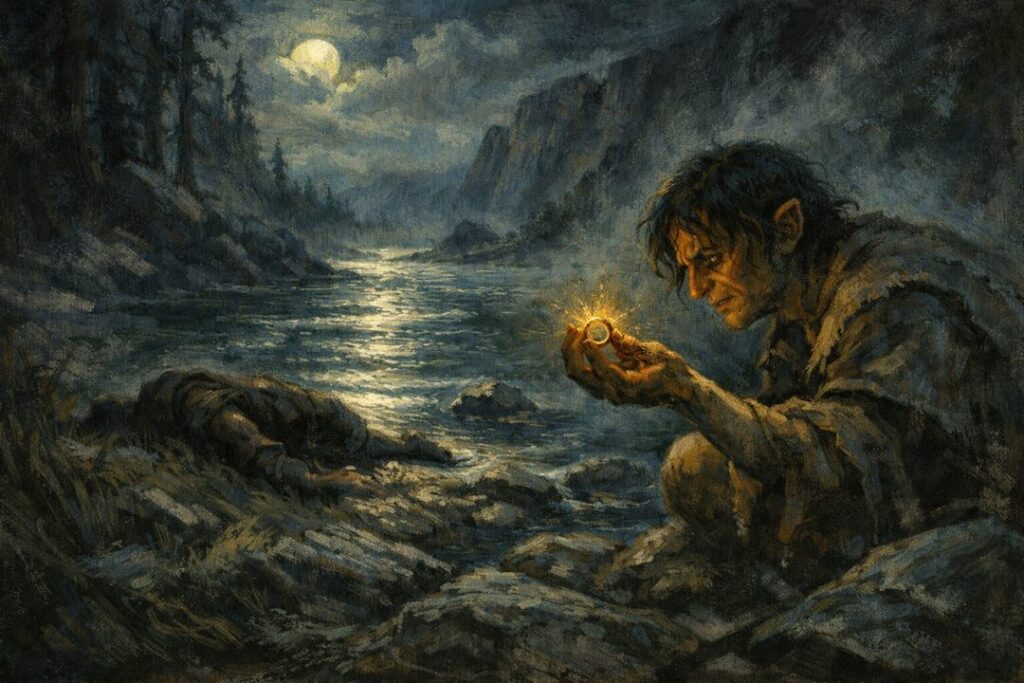
When Déagol found the Ring in the riverbed on his birthday, Sméagol saw it—and wanted it. The desire was immediate and overwhelming. Within moments, kinship, custom, and morality collapsed. Sméagol strangled Déagol and took the Ring for himself.
This act marks a crucial distinction between Sméagol and every later Ring-bearer we meet.
Sméagol did not inherit the Ring.
He did not receive it in trust.
He did not stumble into it by chance.
He claimed it through murder.
From that moment onward, the Ring’s hold on him was deeper and more intimate than it ever was with Bilbo or Frodo. The Ring was not merely something he possessed. It became something he believed he had earned.
Exile and Isolation
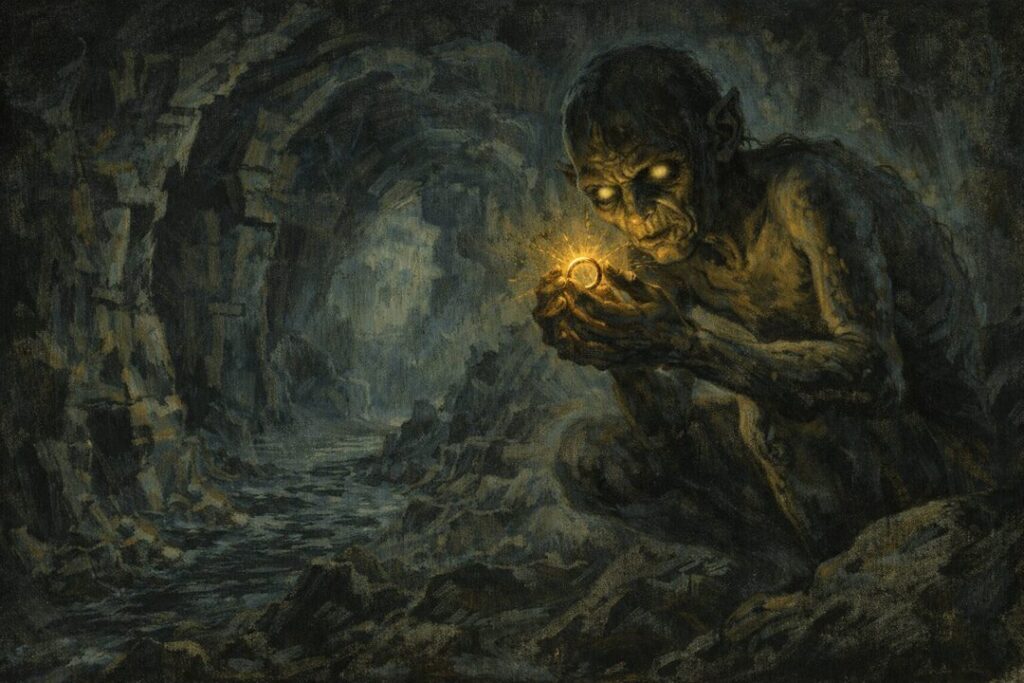
Sméagol’s crime did not go unnoticed. His unnatural longevity, his secrets, and his increasingly malicious behavior led to his exile. Driven from his community, he retreated into darkness—first into caves, and eventually beneath the roots of the Misty Mountains.
This exile is not incidental.
One of the Ring’s most consistent effects is separation. It does not merely corrupt; it isolates. Over time, Ring-bearers lose connection to ordinary life, ordinary time, and ordinary relationships.
Sméagol’s withdrawal from society was not sudden. It was gradual, reinforced by the Ring’s power of invisibility, which allowed him to spy, steal, and survive without being seen.
He became a creature who existed apart from the world—watching it, but no longer part of it.
This is the same trajectory followed by the Nine.
How Ringwraiths Are Made
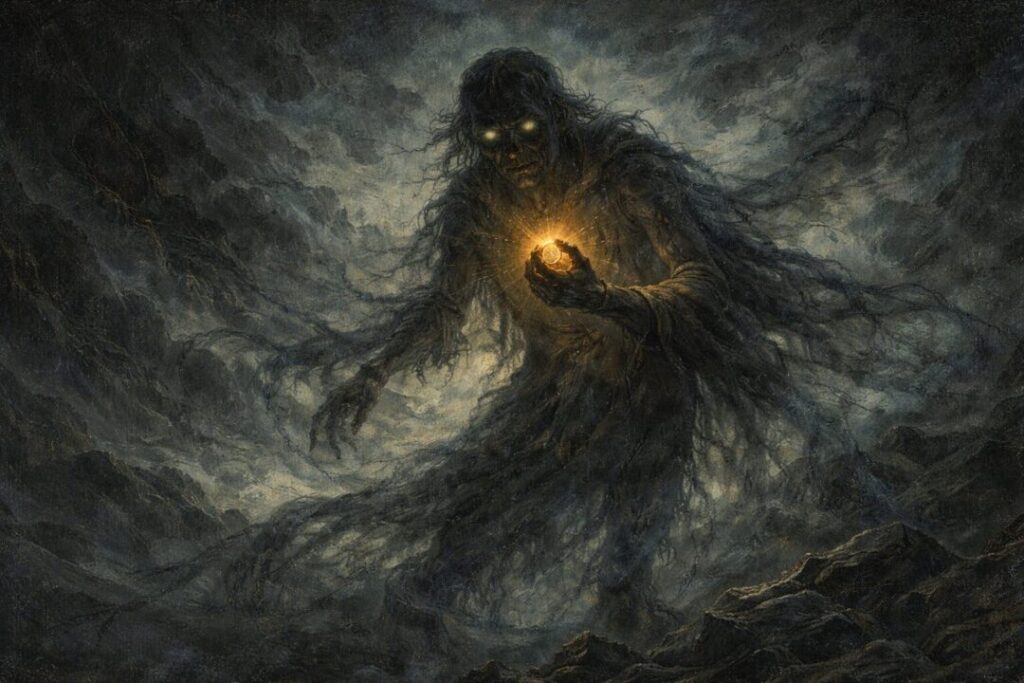
The Nazgûl were not transformed overnight. Their rings granted them long life and great power, but at a terrible cost. Over many years, their physical forms faded, drawn increasingly into the unseen world until little remained but shadow and will.
This process required three conditions:
- Prolonged possession of a Ring of Power
- Dependence on that Ring for identity and purpose
- Gradual separation from ordinary life and physical reality
Sméagol meets all three conditions with alarming precision.
He possessed the One Ring longer than any of the Nine held theirs before fully fading. He relied on it not only for survival, but for meaning. He shaped his entire identity around it, referring to it as “my precious” and structuring his thoughts, fears, and hopes around its presence.
And he lived almost entirely cut off from sunlight, companionship, and the rhythms of the outside world.
By any reasonable standard, Sméagol was already walking the same road as the Ringwraiths.
Five Hundred Years of Possession
Sméagol held the One Ring for nearly five centuries—longer than the mortal lifespan of any Man, and longer than the period over which the Nazgûl themselves faded.
During this time, his body was stretched and warped. His lifespan was unnaturally extended, but not preserved. His physical form deteriorated even as it endured. His mind fractured under the strain of guilt, fear, and obsession.
By the time Bilbo Baggins encounters him beneath the Misty Mountains, Sméagol is no longer fully present in the physical world. He avoids light, speaks to himself in divided voices, and reacts to the Ring not merely with desire, but with existential need.
Later, Frodo Baggins perceives something even more revealing.
When Frodo wears the Ring, he sees Gollum as he truly is: pale, shrunken, and stretched thin—partly in the wraith-world, partly in the physical one.
This is not metaphor.
It is direct evidence that Sméagol is already halfway through the same transformation that created the Nazgûl.
Why Sméagol Never Became a Ringwraith
The crucial difference lies in control.
The Nine were given Rings by Sauron, and through those Rings, they were gradually enslaved. Their identities were overwritten, their wills bent, and their existence bound to another power.
Sméagol’s relationship to the Ring is different.
He possesses the One Ring itself, not a lesser ring, and for much of his life he possesses it without direct domination. The Ring corrupts him, but it does not yet fully claim him.
That process is interrupted when Bilbo takes the Ring.
From that moment on, Sméagol continues to deteriorate—but without possession, the Ring can no longer complete its work. His body no longer sustains itself through the Ring’s power. His fading stalls, leaving him suspended between worlds.
Instead of becoming a wraith, Sméagol becomes something else entirely: a being consumed by longing, but no longer preserved by the object of that longing.
Had he retained the Ring indefinitely, the outcome might have been very different.
The Uncomfortable Parallel with Frodo
This is where the story becomes unsettling.
Frodo follows the same path as Sméagol—just more slowly, and with far greater resistance. He bears the Ring, feels its weight, and begins to fade. By the time he reaches Mordor, he is visibly altered, wounded in ways that never fully heal.
The difference is not immunity.
It is mercy, support, and timing.
Frodo has Sam.
Frodo has guidance.
Frodo does not begin with murder.
And most importantly, the Ring is destroyed before it can finish its work.
Sméagol receives no such mercy.
Why This Matters
Sméagol proves that the Ring does not seek kings alone. It consumes according to proximity, not status. Hobbits are resilient—but they are not invulnerable.
The tragedy of Sméagol is not that he was weak.
It is that he endured too long.
And in another age, under slightly different circumstances, the shadows might not have gained a ninth rider—but a tenth.
One small enough to be overlooked.
One patient enough to last.
And one proof, above all others, that the Ring’s greatest danger lies not in power—but in persistence.