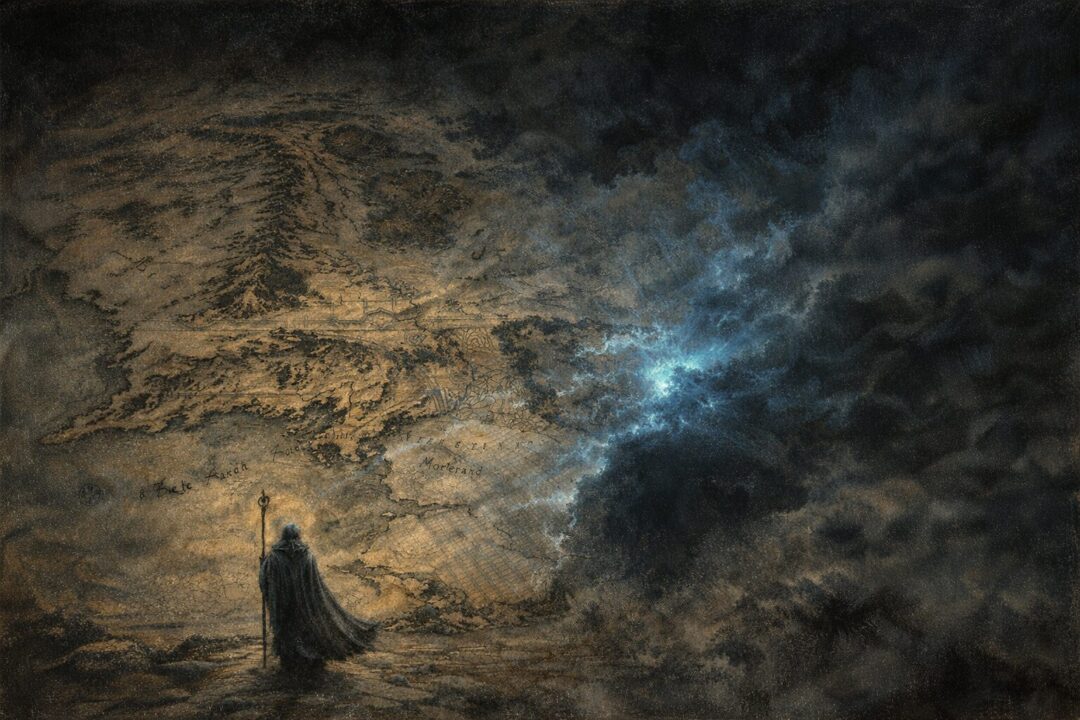
The Blue Wizards are not a rumor.
They are not a fan invention.
They are not a forgotten draft mistake.
They are real figures within Tolkien’s world—sent by the Valar, clothed in blue, and dispatched to Middle-earth during the Third Age with a task no less significant than that given to Gandalf himself.
And yet, within The Lord of the Rings, they might as well not exist.
No council speaks their names.
No chronicle records their deeds.
No character pauses to wonder what became of them.
For decades, readers have tried to explain this silence from inside the world itself. But the real answer does not lie in secret betrayals or lost battles. It lies in how the story of The Lord of the Rings is constructed—and, just as importantly, in what that story deliberately refuses to show.
Who the Blue Wizards Actually Were
Tolkien tells us that five Istari were sent to Middle-earth in the Third Age. We come to know three of them well: Gandalf, Saruman, and Radagast. The other two are mentioned far more briefly: Alatar and Pallando, known collectively as the Blue Wizards.
Like the others, they were Maiar—spirit beings sent in humble, aged forms. Their mission was not conquest or domination, but resistance: to oppose Sauron by guidance, counsel, and the slow strengthening of free peoples. They were forbidden from matching power with power, from revealing their true nature, or from ruling openly.
In other words, their task mirrored Gandalf’s almost exactly.
The crucial difference is direction.
While Gandalf and Saruman remained in the West, the Blue Wizards journeyed east—far beyond the borders of the lands the story follows. And that single choice explains almost everything about their disappearance.
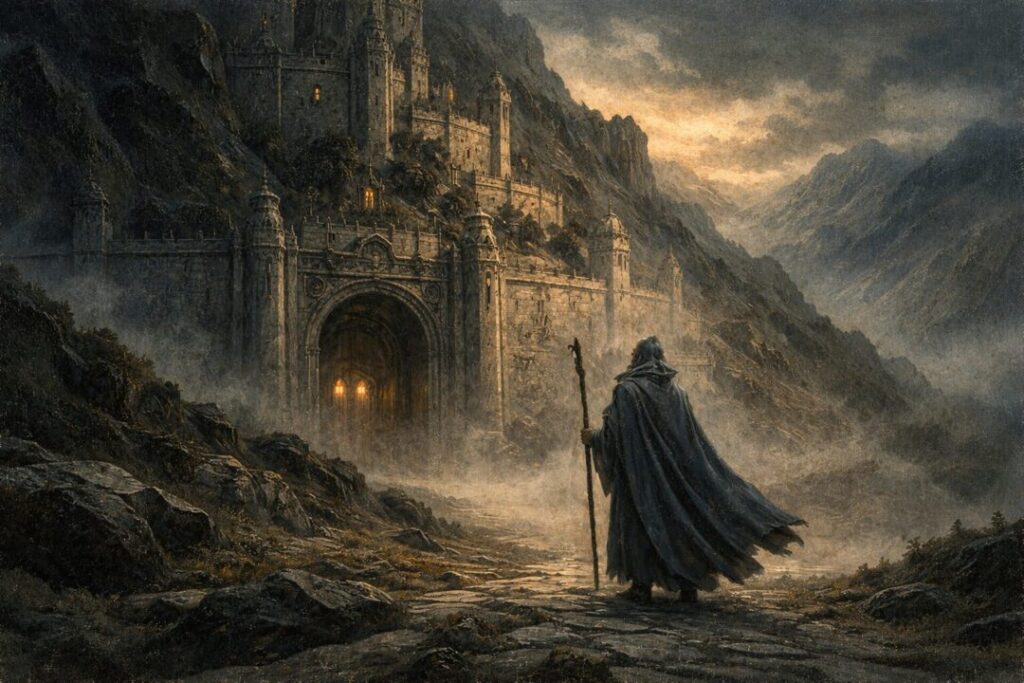
The Popular Theories—and Why They Miss the Point
Most discussions of the Blue Wizards eventually settle into three familiar explanations.
The first claims they failed completely and fell into darkness.
The second suggests they were corrupted, founding cults or shadowy traditions that echoed Sauron’s power.
The third argues the opposite: that they succeeded quietly, weakening Sauron’s influence in the East and preventing vast armies from ever reaching the West.
All three ideas have some support in Tolkien’s later notes. But none of them explains why the Blue Wizards vanish so completely from The Lord of the Rings itself.
Because their absence is not a mystery of events.
It is a consequence of narrative scope.
The Lord of the Rings Is Not a World History
One of the most important things to understand about The Lord of the Rings is what it is not. It is not a comprehensive history of Middle-earth. It is not a balanced account of every front in the war against Sauron. And it is not interested in showing us everything that matters.
It is a story about the West at the edge of collapse.
Everything we see is filtered through hobbits, Men of Gondor and Rohan, and Elves who are already fading from the lands they once ruled. The East and the South appear mostly as rumor—vast, threatening, and largely unknowable. We hear of Haradrim and Easterlings not through their own voices, but through the fear and confusion of those who face them on the battlefield.
This is not an accident. Tolkien deliberately keeps the horizon narrow.
If the narrative had followed the Blue Wizards eastward, the story would have changed fundamentally. We would have needed new cultures, new histories, new languages, and new political struggles. Entire empires would rise and fall offstage, demanding attention and explanation.
And most importantly, the War of the Ring would no longer feel small enough for hobbits to matter.

Why Smallness Is Essential to the Story
The power of The Lord of the Rings lies not in spectacle, but in vulnerability. Victory does not come from overwhelming force or perfect strategy. It comes from exhaustion, mercy, and moral failure narrowly avoided.
That fragile tone depends on the sense that everything is at risk.
If the Blue Wizards were shown succeeding elsewhere—toppling Sauron’s allies, organizing vast resistance movements, or quietly winning a parallel war in the East—then the struggle in the West would feel supported and inevitable. The reader would know, even subconsciously, that Sauron was being undone from multiple sides.
Tolkien did not want inevitability.
He wanted doubt.
Why Gandalf Had to Stand Alone
This is why Gandalf’s role is so carefully constrained. He does not dominate events. He arrives late. He misjudges people. He fails to prevent tragedy. He even dies.
His authority comes not from power, but from wisdom—and even that wisdom is limited. He never fully understands Gollum. He cannot foresee Frodo’s breaking point. He does not control the outcome of the quest.
That only works if he is not one of many visible agents achieving success elsewhere.
If the Blue Wizards were active characters in the narrative, Gandalf would become one wizard among several. His restraint would feel like a choice rather than a burden. His uncertainty would seem unnecessary rather than tragic.
The story requires him to be isolated.

What Tolkien Later Suggests—Carefully
In writings outside The Lord of the Rings, Tolkien does revisit the Blue Wizards briefly. His tone shifts over time. Early notes suggest they may have failed or fallen. Later reflections soften that judgment.
He begins to imagine that they may have done important work in the East: disrupting Sauron’s control, encouraging resistance, and preventing the formation of a single overwhelming force that could have crushed Gondor and Rohan outright.
But notice what Tolkien does not do.
He never integrates this into the main narrative. He never rewrites The Lord of the Rings to include them. He never gives them scenes, dialogue, or climactic moments.
Because doing so would have broken the story he had already perfected.
Disappearance as Design, Not Loss
The Blue Wizards disappear because they are doing exactly what the story requires of them.
They exist beyond the frame.
They make Middle-earth feel vast and only partially known. They remind us that the War of the Ring was not the whole struggle—only the part that intersected with hobbits, broken kings, and fading Elves.
Their silence is not evidence of failure.
It is evidence of restraint.
Why This Still Matters
Modern fantasy often feels compelled to explain everything. Every mystery must be resolved. Every powerful figure must be shown in action. Every unanswered question becomes an invitation for expansion.
Tolkien resisted that impulse.
The absence of the Blue Wizards teaches a quieter lesson: not every thread is meant to be pulled. Not every power is meant to be displayed. Not every victory is meant to be witnessed.
Some forces hold the world together precisely because they remain out of sight.
And that may be one of the most quietly radical choices in all of The Lord of the Rings.
So what do you think?
Did the Blue Wizards fail…
or did they succeed too far away for history to remember?