When people describe the One Ring, they usually describe it as an object of temptation.
That is true, but it is incomplete.
The Ring does tempt. It offers power, greatness, mastery, and the fantasy that the world can finally be forced into order. Yet when the story shows how that temptation actually works on living people, something more precise begins to appear.
Again and again, the Ring finds its way in through fear.
Not crude fear alone.
Not mere panic.
But a deeper and more respectable kind of fear: fear of helplessness, fear of defeat, fear of watching good things perish because one lacked the strength to save them.
That is one of the most overlooked patterns in The Lord of the Rings.
The Ring does not simply prey on the wicked. It preys on the frightened, especially on those who can justify their fear as responsibility.
And that is why it is so dangerous.
Fear Is Not Separate From the Ring’s Temptation
The One Ring was made for domination. Its whole nature is bound up with power, submission, and the extension of one will over others. The text and later explanatory material are consistent on that point: even when someone imagines using the Ring for good, the Ring does not cease to be itself. It remains an instrument of mastery, and its corruption is not accidental.
But the crucial detail is how that domination first presents itself to the mind.
It does not always appear as naked tyranny.
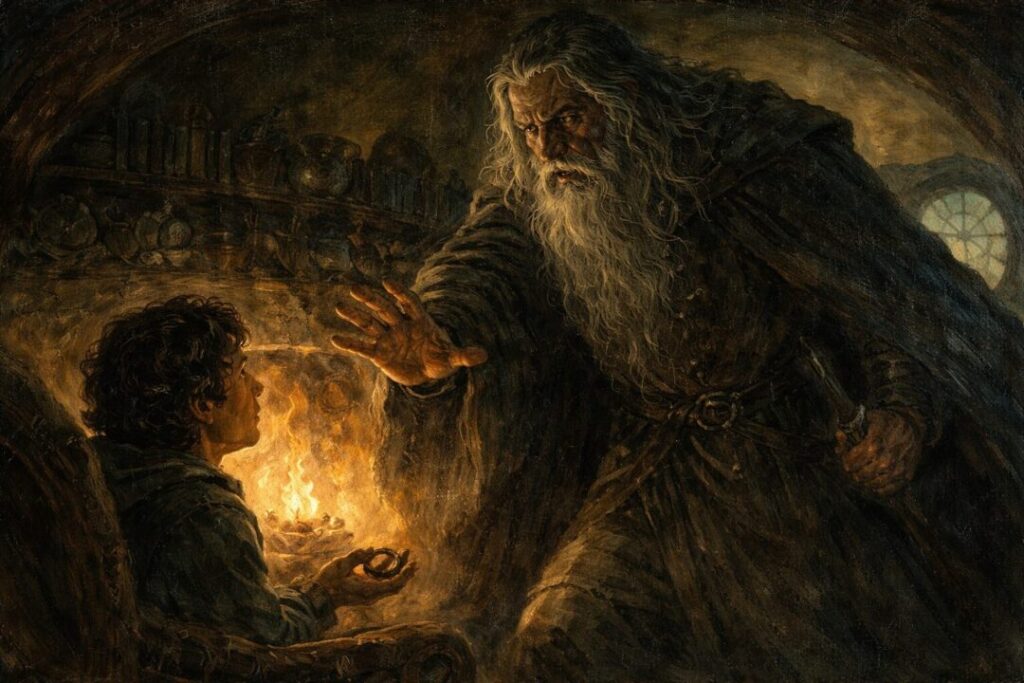
In one of the clearest statements anywhere in the legendarium, Gandalf explains exactly how the Ring would approach him. He does not say that it would reach him through cruelty or selfishness. He says the way to his heart would be “through pity, pity for weakness and the desire of strength to do good.” That is one of the most important Ring-passages in the entire story, because it reveals that good intentions are not outside the danger. They are one of its preferred entrances.
That line matters because pity is not itself evil.
Nor is the desire to defend others.
Nor is the longing for strength when real darkness is rising.
The Ring’s power lies partly in the fact that it does not ask its victims to stop caring. It asks them to care so much, and fear loss so intensely, that they begin to believe control is justified.
Gandalf Understands the Real Danger
Gandalf’s refusal is often remembered as a general warning about power.
It is more specific than that.
He knows the Ring would not turn him by offering some petty private reward. It would come to him clothed in mercy and necessity. He would want to protect the weak. He would want the strength to resist Sauron. He would want to set things right. And from that beginning, he knows he would become “too great and terrible.”
That is a profound clue to how the Ring functions.
The Ring does not merely promise power. It reframes fear.
It takes the fear that evil may triumph, that innocent people may suffer, that delay may be fatal, and it converts that fear into a case for domination. If one becomes strong enough, decisive enough, terrible enough, then perhaps disaster can be prevented. That is the lie.
And it is a particularly effective lie because it is not entirely irrational on the surface.
Sauron is real. War is real. Ruin is real.
The danger is not imagined.
What is false is the conclusion that the Ring can be used without becoming an extension of the same evil it was made to serve. Elrond’s council rejects exactly that logic, and later commentary makes the point even clearer: imagining oneself able to wield the Ring to victory is part of its “essential deceit.”

Boromir Shows the Pattern Most Clearly
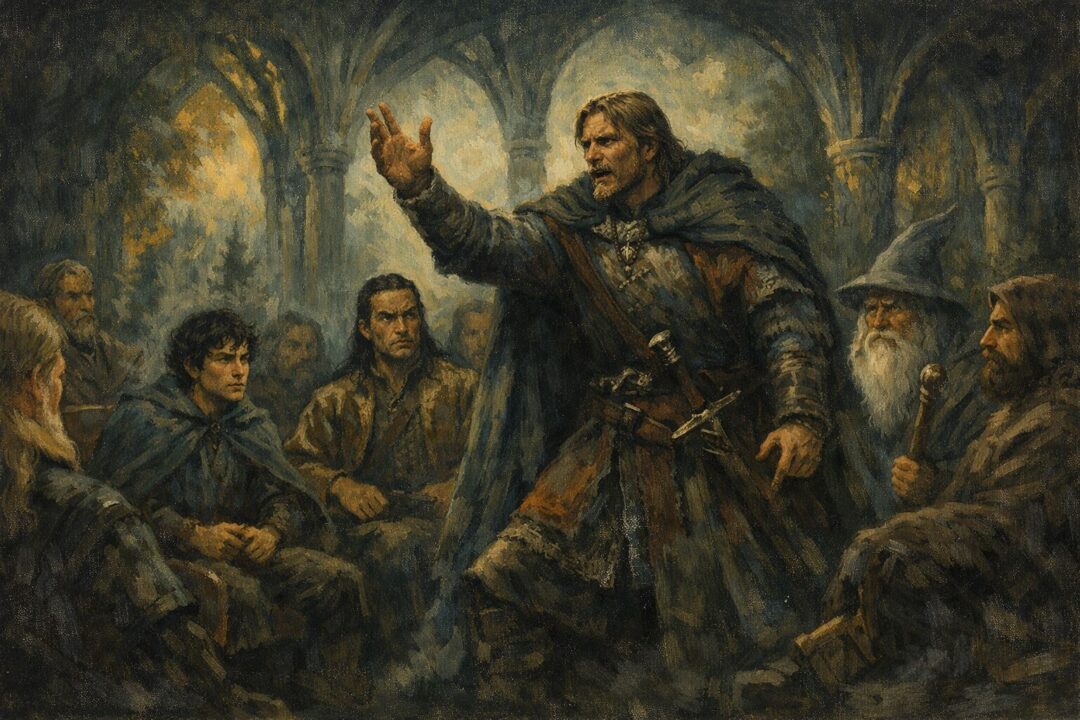
No character reveals this pattern more clearly than Boromir.
Boromir is not introduced as corrupt. He is valiant, honorable, and deeply committed to Gondor. His failure is tragic precisely because it arises from recognizable virtues under pressure. He comes from a city that has borne the main burden of Sauron’s war for generations. He has watched the long defense. He has seen how desperate the situation is.
When he argues for using the Ring, he does not begin by talking like a conqueror.
He begins by talking like a defender.
He insists that the men of Minas Tirith do not desire “the power of wizard-lords,” only the strength to defend themselves in a just cause. That wording matters enormously. Boromir presents the Ring first not as an object of domination, but as an answer to fear: fear that Gondor will fall, fear that caution will become surrender, fear that refusing power when it lies within reach is itself a kind of betrayal.
Only after that does the fantasy expand.
Then come the visions of command, banners, armies, victory, and Boromir as a mighty ruler.
The progression is telling.
His temptation does not start with “I want to rule.” It starts with “my people are in danger.” The desire to save Gondor becomes the emotional bridge by which the Ring moves him toward mastery. The text even shows his speech intensifying as he goes, until what began as defensive reasoning becomes something much darker and more possessive.
That is not an accident in the writing.
It shows the Ring at work in one of its most recognizable forms: making fear sound like duty.
Galadriel Reveals the Same Truth at a Higher Level
Galadriel’s temptation confirms that this pattern is not limited to Men under military pressure.
When Frodo offers the Ring, Galadriel imagines herself as a Queen “beautiful and terrible,” one before whom all would “love” and “despair.” The scene is grand, but it is not merely a revelation of hidden vanity. It is also a revelation of what the Ring does to the mind of even the wise: it magnifies the possibility of ordering the world by overwhelming power.
Just before that, Galadriel openly admits that she has long pondered what she might do if the Ring came into her hands. Later commentary states that such imaginations of supreme power belong to the Ring’s essential deceit, and that her rejection rested on previous thought and resolve. In other words, this was not a random passing fantasy. It was a danger she had already recognized and resisted.
What would she have feared losing?
The text does not reduce that to one single motive, and it would go too far to invent one. But it is plainly connected to preservation, to resistance against Sauron, and to the fate of Lórien and the wider world. Her temptation, like Gandalf’s and Boromir’s, is not separate from care. It grows out of care under pressure.
That is what makes the moment so unsettling.
The Ring does not only corrupt selfish longing.
It can attach itself to the very wish to preserve beauty from destruction.

Even Sam’s Brief Temptation Follows the Pattern
Sam’s case is brief, but it may be the clearest miniature version of the whole mechanism.
While carrying the Ring in Mordor, Sam is tempted by visions of “Samwise the Strong,” a heroic figure overthrowing Barad-dûr and turning Gorgoroth into a garden. This is one of the strangest temptations in the book because it is both absurd and revealing. Sam is not tempted by gold, luxury, or courtly rank. He is tempted by heroic rescue and by restoration.
Even here, the Ring offers power as the answer to fear and devastation.
Mordor is a wasteland. Frodo is in peril. The quest is near collapse. And the Ring responds by offering Sam a vision in which overwhelming force can rescue the world and make it bloom.
Sam rejects it, in part because he retains proportion. He is too rooted in simple loyalties and real limits to mistake himself for a universal ruler. But the episode still exposes the Ring’s method with unusual clarity. It does not always flatter a person with what they most desire in comfort. Sometimes it flatters them with what they most fear they cannot save.
Why This Matters for the Whole War
This pattern helps explain one of the most important strategic truths in the War of the Ring.
Sauron expects others to think as he does. He assumes that if the Ring is found, someone powerful will eventually attempt to use it against him. That expectation shapes his decisions late in the war, including the misreading that Aragorn may have taken the Ring and is moving rashly toward open challenge.
Why does that seem plausible to him?
Because it is plausible in the moral psychology of the Ring.
The pressure of war, fear of ruin, and the presence of a weapon of enormous power would naturally drive most rulers toward the thought of using it. That is exactly what Boromir argues. It is exactly what Gandalf fears in himself. It is exactly the line of temptation the Wise have already had to reject.
So the quest succeeds, in part, because it does something Sauron struggles to imagine.
It refuses fear’s logic.
It does not deny fear. Middle-earth is full of dread, exhaustion, and impending catastrophe. But the quest refuses the conclusion that salvation must come by seizing absolute control. That refusal is one of the deepest moral victories in the story.
The Ring’s Most Reliable Weapon Is Not Simple Greed
Greed matters.
Pride matters.
The desire for mastery matters.
But if we only speak of those, we miss the way the Ring does some of its most persuasive work.
It teaches people to experience fear as authorization.
It tells them that because the danger is real, domination is now necessary.
It tells them that if they are strong enough, ruthless enough, and willing enough to take command, then loss can finally be prevented.
That is why the Ring is so much more frightening than a mere magical object that makes bad people worse.
It can approach the noble through responsibility.
It can approach the merciful through pity.
It can approach the loyal through love of home.
It can approach the wise through the wish to preserve what is beautiful.
And once it has done that, fear begins to sound like wisdom.
That may be the most overlooked thing the Ring ever does.
It does not only tempt people to want power.
It tempts them to believe that power has become their duty.
And once that happens, the line between defense and domination becomes far more fragile than it first appears.