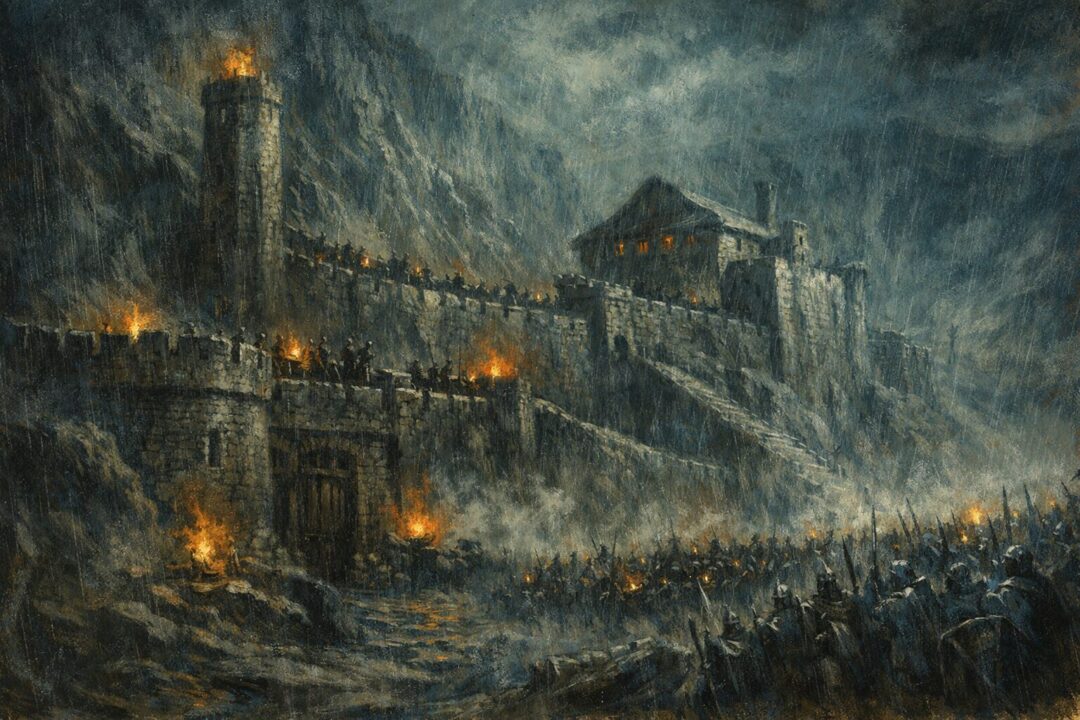
When people talk about The Two Towers, Helm’s Deep usually comes up as the great proving ground of Men. A fortress under siege. A last stand against overwhelming numbers. A moment where courage is measured not in glorious charges, but in how long one can endure fear, exhaustion, and loss.
It is remembered as one of the defining battles of the Third Age — and rightly so.
Yet one element of the battle often goes almost completely unexamined: the rain.
From the moment the host of Isengard advances, the night is wet, cold, and heavy with storm. Rain falls without pause, soaking stone and flesh alike, flattening banners, choking torches, and turning the ground below the walls into a mire. This is not decorative atmosphere or cinematic flourish. It is a deliberate choice that shapes the entire encounter, both practically and thematically.
Helm’s Deep is not a battle fought in fire and light. It is fought in water, darkness, and fatigue.
A Battle Designed to Wear Men Down
Rain is not dramatic in the way fire or thunder is. It does not inspire awe. It drains.
Anyone who has stood watch through the night, marched in armor, or worked for hours in cold rain understands this instinctively. Mail grows heavier as water seeps into every link. Leather stiffens. Cloth clings to skin and chafes. Hands lose warmth and dexterity. Vision blurs. Sounds distort.
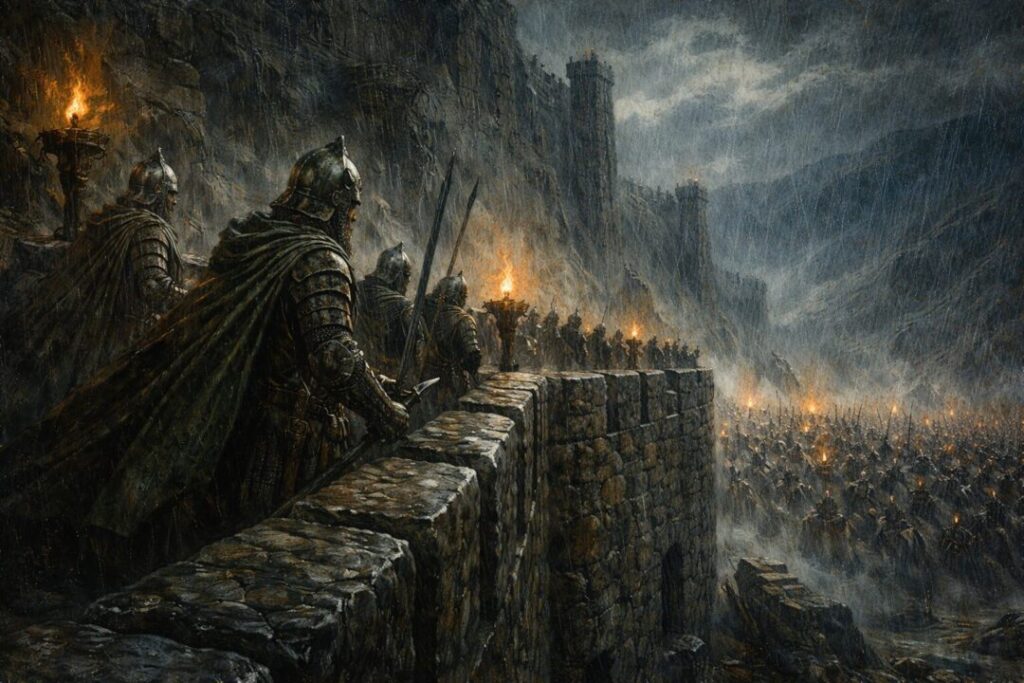
At Helm’s Deep, the defenders are already fighting from a position of disadvantage. They are outnumbered. Many are too old for war, others barely past childhood. The strength of Rohan has been scattered, misled, or destroyed in earlier fighting. This garrison is not an elite force — it is what remains.
The rain turns that imbalance into something crueler.
This is not a heroic test of strength, where the stronger warrior prevails. It is a test of endurance. Of how long men can stand in fear and discomfort before their bodies begin to fail them. Every hour spent on the wall is heavier than the last.
That weight is the point.
The Uruk-hai and the Unequal Burden of the Storm
The storm does not affect both sides equally.
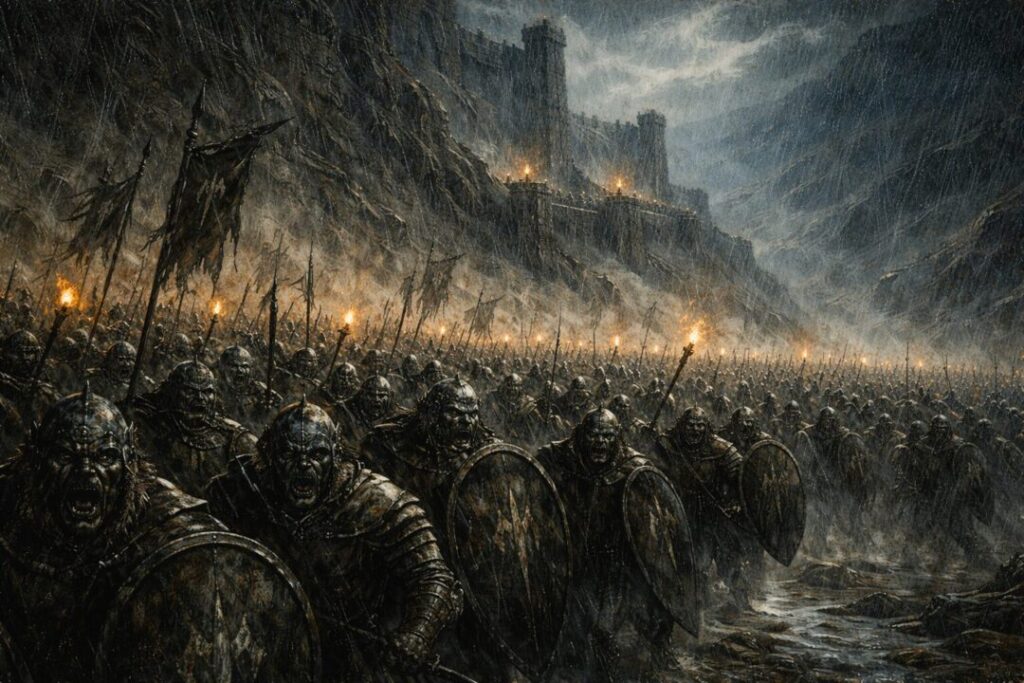
The Uruk-hai of Isengard are bred for war. They march without rest. They do not fear the dark. They advance in tight formation, shields locked, drums beating through the rain. Their armor is crude but functional, their discipline relentless.
Where the defenders wait, exposed to the elements, the Uruk-hai advance.
Rain that saps the strength of Men barely slows creatures designed to endure punishment. The contrast reinforces one of the central truths of the battle: this is not a fair fight, and it was never meant to be.
Helm’s Deep is not a test of who deserves to win. It is a test of whether ordinary people can survive long enough for hope to arrive.
Fire, Powder, and the Limits of Nature
The rain also creates a quiet, unsettling irony in the battle’s most infamous moment.
Throughout the night, fire struggles. Torches sputter. Arrows dipped in flame fail to burn. Nature itself seems hostile to light and warmth. The defenders cannot rely on fire as a weapon or a comfort.
And then Saruman’s new device is revealed.
The blasting fire that shatters the Deeping Wall is not hindered by rain or stone. It burns regardless of weather. It does not flicker or fail. It does not behave like ordinary fire at all.
This moment matters far beyond its tactical impact.
The storm strips away the comforting idea that nature itself will resist evil. Rain does not quench Saruman’s weapon. Stone does not stop it. The world does not intervene.
Middle-earth does not offer easy miracles.
Victory, when it comes, will not come because the storm changed its mind. It will come because people chose to stand, suffer, and endure long enough for something else to happen.
Darkness Without Moral Clarity
Unlike many legendary battles, Helm’s Deep is not fought under clear stars or blazing sunrise. For most of the night, no one can see the full shape of the conflict.
The defenders on the wall cannot see how many enemies are advancing. The Uruk-hai below cannot see the fear on the faces above them. Orders are shouted into the rain and half-lost. Signals fail. Confusion spreads.
This darkness mirrors the moral uncertainty of the age itself.
The world is not ending in a single, dramatic catastrophe. It is eroding — slowly, relentlessly — like rain wearing stone smooth over centuries. The danger is not always obvious. The enemy does not always announce itself with fire and banners. Sometimes it comes disguised as delay, doubt, and exhaustion.
Even Théoden enters the battle burdened by regret. His courage is real, but it is quiet and human. He does not ride out in youthful confidence. He stands because there is nowhere left to retreat.
The rain emphasizes this truth. No one at Helm’s Deep feels certain. They feel cold, afraid, and very tired.
Time Stretched Thin
The storm also distorts time.
Battles fought in daylight feel fast. Movements are visible. Progress is measurable. At Helm’s Deep, hours bleed into one another. The rain erases landmarks. The dark swallows distance. Men fight without knowing whether they have held the wall for minutes or an eternity.
This stretching of time is part of the siege’s psychological weight.
The defenders are not simply trying to win. They are trying not to break.
Every moment becomes a negotiation with despair. Can we hold a little longer? Can we survive one more assault? Can we believe that help is still possible?
Why the Dawn Matters So Much
When the rain finally lifts, it does not fade gently.
It breaks.
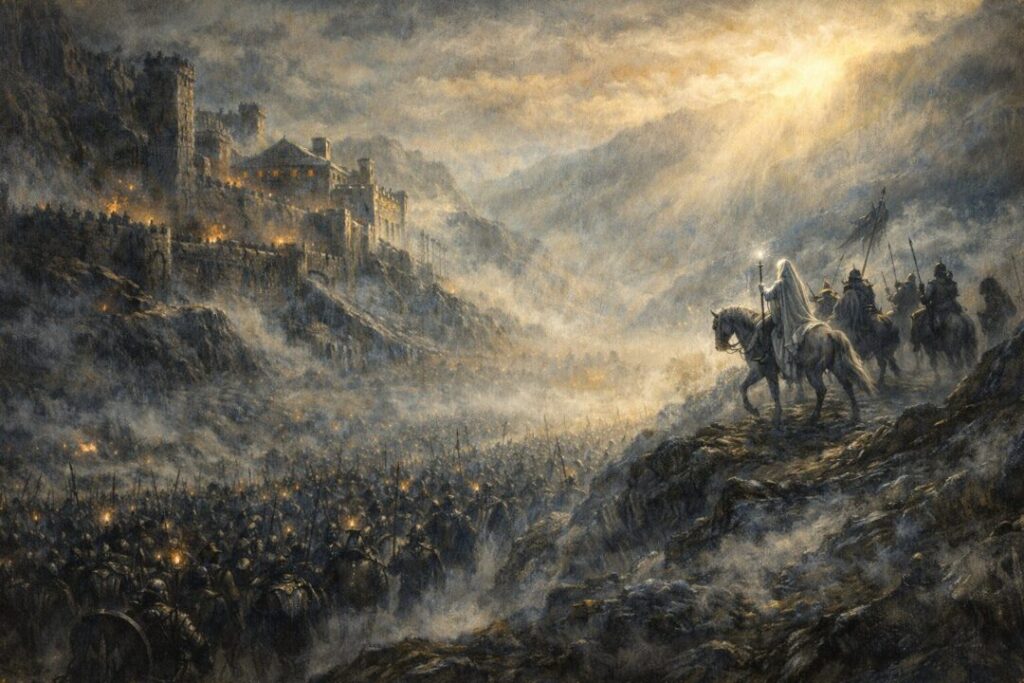
The arrival of Gandalf at sunrise is not merely a cavalry charge timed for dramatic effect. It is the first time light has truly touched the battle at all.
For hours, Helm’s Deep has existed in a closed world — a pocket of darkness, rain, and suffering cut off from the rest of Middle-earth. The storm has held everything in suspension, as if the world itself were holding its breath.
When the sun rises, it feels earned because it has been withheld.
Hope does not arrive easily or early. It arrives after endurance has been tested to its limit.
That is why the dawn matters.
Not Glory, But Survival
Helm’s Deep is remembered not because it is beautiful, but because it is endured.
The rain ensures that no one emerges untouched. Armor is dented. Walls are broken. Lives are lost. Victory does not cleanse the night or undo its cost. It simply ends it.
There is no triumphal celebration in the aftermath — only relief, grief, and the knowledge that this was not the final battle.
And that may be the most honest portrayal of war anywhere in Middle-earth.
Not a shining victory beneath clear skies, but survival in darkness and water — and the quiet understanding that endurance itself can sometimes be enough.
Once you notice the rain, it becomes impossible to imagine Helm’s Deep without it.
And that is exactly the point.