
Most readers first meet the One Ring as an object that makes its wearer disappear.
Bilbo uses it that way.
Frodo uses it that way.
The effect seems simple enough to name.
Put it on, and you become invisible.
But that explanation, while not false, is incomplete.
The deeper texts of Middle-earth point to something far stranger. Invisibility is not the Ring’s real power in the narrow sense most people imagine. It is a visible consequence of something more metaphysical: a shift in the bearer’s relation to the Seen and Unseen parts of the world.
Once that distinction becomes clear, many scenes in The Lord of the Rings stop looking like isolated magical moments and begin fitting together.
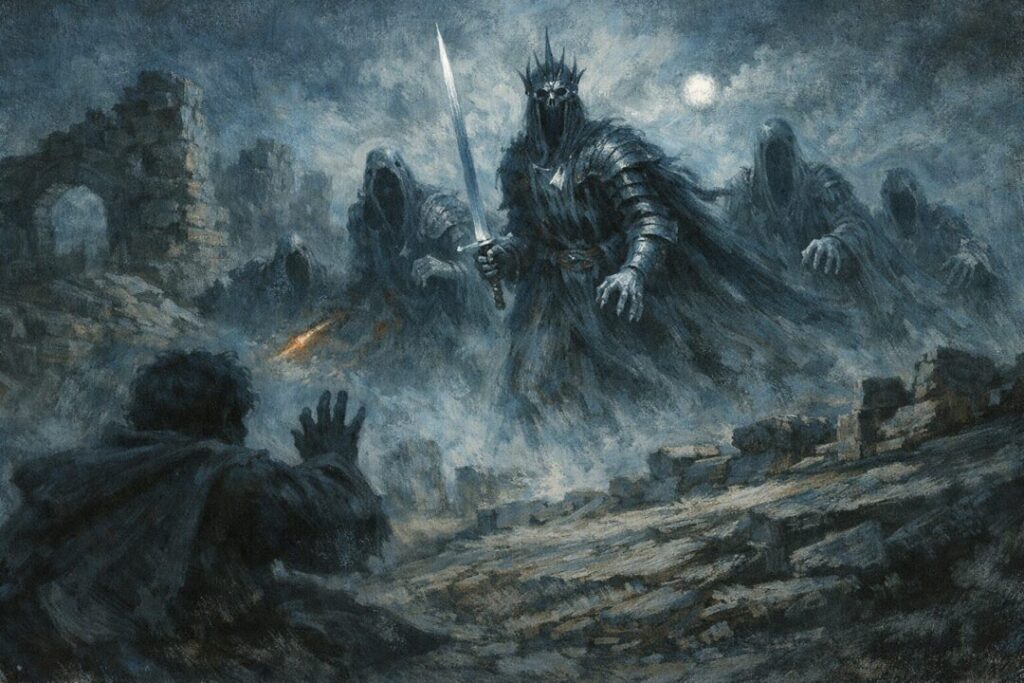
Frodo at Weathertop.
The Nazgûl themselves.
Glorfindel at the Ford.
Tom Bombadil in his house.
All of them point to the same truth.

Invisibility Is the Surface Effect
The most direct explanation comes from Gandalf early in The Fellowship of the Ring.
He tells Frodo that a mortal who keeps one of the Great Rings does not truly gain more life. Instead, he continues unnaturally, until life becomes a burden. Then Gandalf adds the crucial detail: if such a bearer often uses the Ring to make himself invisible, he fades, and in the end walks in the twilight under the eye of the Dark Power.
That wording matters.
Gandalf does not describe invisibility as a harmless optical trick. He treats it as part of a process of fading. The wearer is not merely hidden from ordinary sight. He is being drawn into another mode of existence, one in which he is less fully present in the ordinary visible world.
That is why “the Ring makes you invisible” is true only at the shallowest level.
The more precise statement would be this:
For embodied mortals, the Ring can pull them partly out of the normal visible world, and that displacement appears to others as invisibility.
The Nine Make the Pattern Explicit
What Gandalf says is strongly reinforced elsewhere.
In The Silmarillion, the account of the Nine Rings gives one of the clearest descriptions of what happened to the Men who bore them. They could walk unseen “by all eyes in this world beneath the sun,” and they could see things in worlds invisible to mortal men.
That sentence is one of the most important in the entire question.
It joins the two ideas together.
They are unseen in the ordinary world.
They become perceivers of another world normally hidden from mortals.
So invisibility and access to the Unseen are not separate powers awkwardly bundled together. They are two sides of the same condition. The bearer is no longer standing in the world in quite the same way.
The Nazgûl are the final result of that process.
They are not simply invisible men wearing cloaks. They are Men who have been permanently drawn into wraith-existence through the long corruption of the Rings. Their clothing makes them seem embodied, but their natural state has become one of faded presence.
The Unseen Is Not Just Evil Darkness
It is important to be careful here.
The Unseen world is not identical with evil.
The texts and lore references describe it as a real dimension of being in Arda, one that includes both dark and bright spiritual realities. Frodo’s glimpses of it do not only reveal horror. They also reveal glory, as in his perception of Glorfindel near the Ford.
So the danger is not that Frodo is merely looking into a spooky shadow realm.
The danger is that a mortal is being dragged out of his proper condition and toward wraithhood. That process exposes him to beings and forces not normally perceived by ordinary bodily sight.
The Unseen, then, is broader than the Ring and broader than Sauron.
But the Ring weaponizes a mortal’s relation to it.
Why Frodo Sees More Than Other Hobbits
Frodo’s experiences on the road become much clearer once this framework is in place.
At Weathertop, putting on the Ring does not rescue him from the Nazgûl. Quite the opposite. It makes him more exposed to them. Reliable lore summaries note exactly this: wearing the Ring there made him more visible to the Ringwraiths, not less.
That only makes sense if the Nazgûl themselves chiefly operate in the same Unseen condition into which the Ring is pulling Frodo.
To ordinary eyes, Frodo vanishes.
To the Nazgûl, he becomes easier to perceive.
The same logic explains what happens after he is wounded by the Morgul-knife. As the splinter works inward, Frodo begins to slip further toward wraithhood. Gandalf later says that if the shard had not been removed, Frodo would have become a wraith under the command of the Dark Lord.
That is why Frodo’s sight changes.
At the Ford, he sees Glorfindel differently from the others. Later Gandalf confirms that Frodo saw him “as he is” on the other side: a bright figure that did not fade like the others.
This is one of the clearest demonstrations in the story that entry into the Unseen does not only reveal horror. It can also unveil spiritual splendor.
Frodo is not hallucinating.
He is perceiving beyond ordinary mortal sight because he is in real danger of no longer belonging fully to that ordinary mode of sight at all.
Why Tom Bombadil Changes the Whole Question
Then the story introduces the great complication.
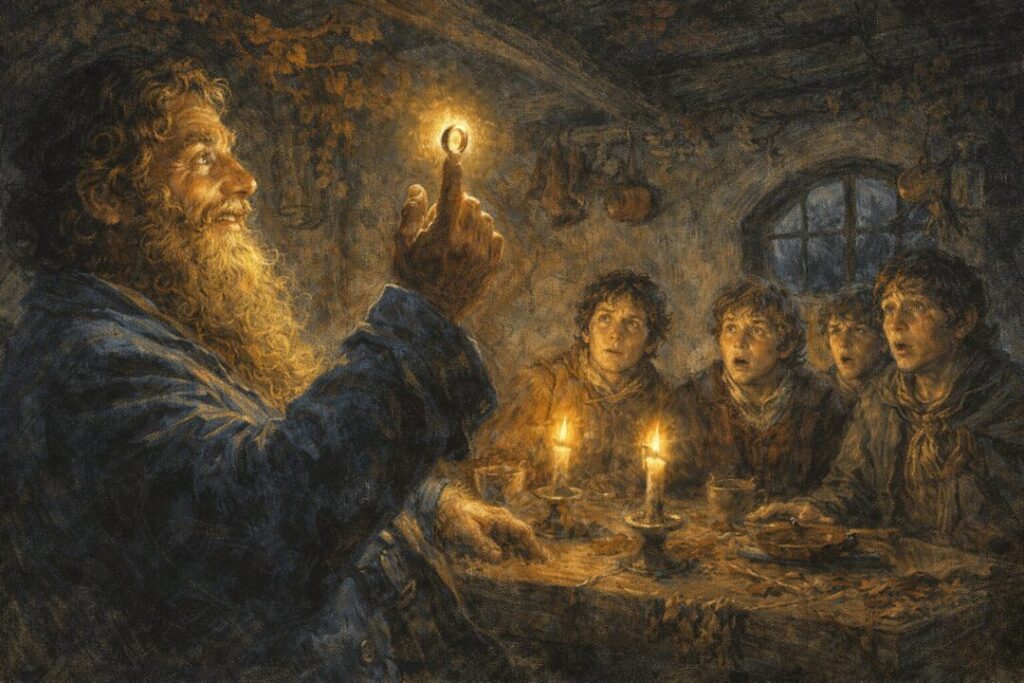
Tom Bombadil puts on the Ring and does not disappear. Frodo even tests the matter further by putting it on himself, expecting to vanish from Tom’s notice, and Tom still sees him.
This is one of the strangest moments in The Fellowship of the Ring, because it proves something important at once:
The Ring’s ordinary visible effect is not universal.
Later, at the Council of Elrond, Gandalf explains the matter with unusual precision. He does not say Tom is stronger than the Ring in a simple contest. He says: “the Ring has no power over him. He is his own master.” But Gandalf immediately limits the conclusion: Tom cannot alter the Ring itself, nor break its power over others.
That distinction is essential.
Bombadil is not the master of the Ring.
He is not its counter-force.
He is not a secret solution to the War.
He is simply outside the Ring’s normal line of operation.
And that tells us something about invisibility.
If invisibility were just a mechanical spell cast on any wearer, Bombadil should vanish.
He does not.
The better explanation is that invisibility happens when the Ring affects a being in a particular way: by shifting an embodied mortal’s presence relative to the Seen world. Tom does not undergo that shift. The texts do not fully explain why, and any theory beyond that must remain interpretation. But the canon does make the limit clear: the Ring’s usual effect simply does not take hold of him.
The Ring Does Not Reveal the Same Thing in Everyone
This also helps explain why readers should be cautious about assuming the Ring works identically on every being.
The canon evidence is strongest for mortals: Men, Hobbits, and ultimately the Nazgûl. Gandalf’s explanation is specifically about a mortal bearer, and the Silmarillion’s clearest developed example is the Nine.
For beings of a different order, the situation is less direct.
The texts imply differences. Frodo perceives Glorfindel in unveiled brightness while slipping into the wraith-world. Tom Bombadil remains visible with the Ring on. Tolkien’s later reflections also connect true mastery of the Ring with beings of much greater inherent spiritual stature, such as Gandalf or perhaps Galadriel, not with ordinary mortal invisibility alone.
But this is where careful phrasing matters.
The books do not give a full mechanical chart of how every order of being would appear while wearing the One Ring. So the safest reading is not to over-systematize. The texts strongly support one main pattern: invisibility is the characteristic effect on embodied mortals as they are pulled toward fading and the Unseen.
Why This Distinction Matters
At first glance, the difference between invisibility and the Unseen world can seem technical.
It is not.
It changes the entire moral and metaphysical meaning of the Ring.
If the Ring merely hid people, it would be dangerous mainly because it aided stealth.
But if the Ring draws mortals out of their proper place in the world, then its danger is much deeper. It does not just conceal. It unhouses. It thins. It pulls the bearer toward a state in which the Dark Power can more fully dominate him.
That is why the Nazgûl are terrifying.
They are not people who stayed invisible too long in some casual sense.
They are the final evidence of what “fading” means.
And that is why Frodo’s use of the Ring is always more perilous than it first appears. Every temptation to vanish is also a temptation to move further into a condition from which return becomes harder.
The Real Difference
So what is the real difference between invisibility and the Unseen world?
In the texts, invisibility is usually the outward effect visible to ordinary observers.
The Unseen world is the deeper plane of being into which a mortal Ring-bearer is being drawn.
One is how the change looks.
The other is what the change is.
That is why Frodo’s disappearances are never as simple as they seem.
That is why the Nazgûl are more than hidden figures.
And that is why Tom Bombadil not disappearing is not a small curiosity, but one of the sharpest clues the story gives us.
The Ring does not merely take someone out of sight.
It begins, little by little, to take him out of the ordinary world.