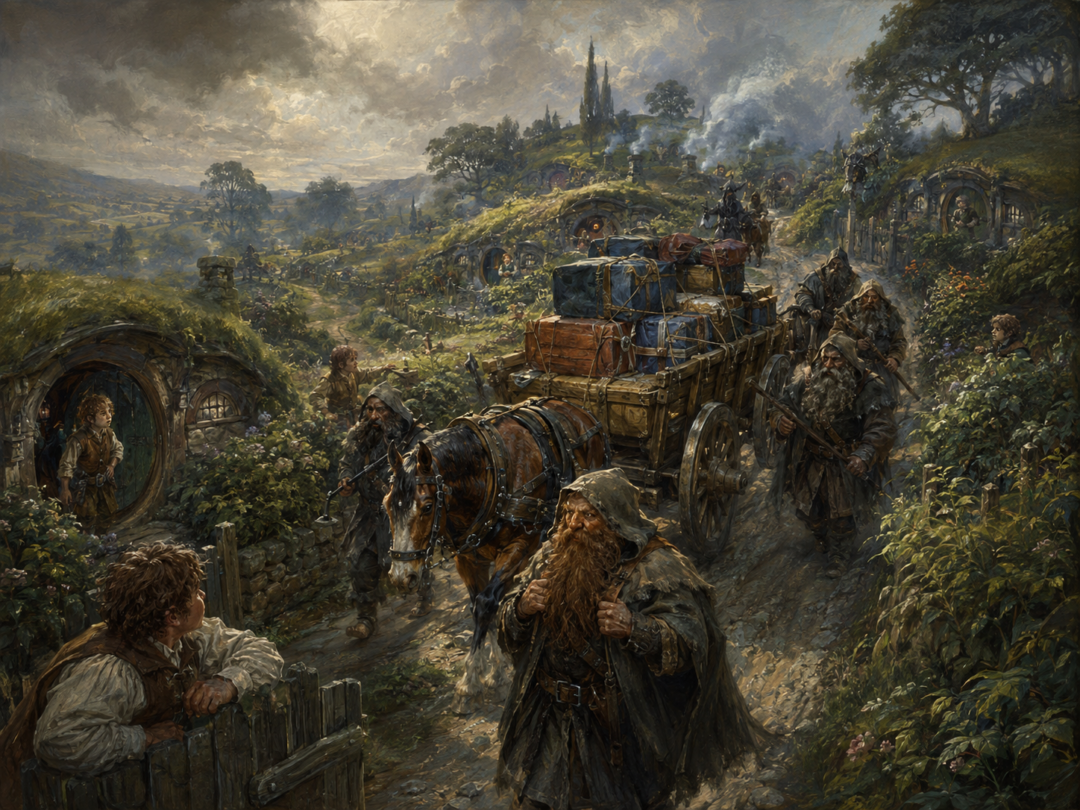
The Shire feels like the last place in Middle-earth that should need imports.
Its fields are fertile. Its orchards, mills, farms, inns, breweries, gardens, and kitchens suggest a society capable of supplying most of what hobbits actually care about. The wider world barely enters ordinary conversation except as rumor. Foreigners are treated with suspicion, distant lands with indifference, and even Bree can seem adventurous to hobbits who have never crossed the Brandywine.
Yet there is a revealing detail almost at the beginning of The Lord of the Rings: when Bilbo Baggins prepares his famous birthday party, remarkable toys arrive from far beyond the Shire. They have been ordered from the Lonely Mountain and Dale and are products of Dwarven craft.
That small detail changes the picture.
The Shire was culturally secluded, but it was never completely cut off. An ancient international road ran straight through it. Dwarves regularly travelled that road. Goods could cross enormous distances to reach Hobbiton. Bree preserved connections with travellers and news from outside. The Southfarthing eventually sent its own produce beyond the borders.
The isolation of the Shire, then, was not the isolation of a sealed economy.
It was something stranger: a people living beside one of the great surviving roads of the North while largely choosing not to care where it led.
The Great Road Running Through Hobbit Country
The most important fact about Shire trade is geographical.
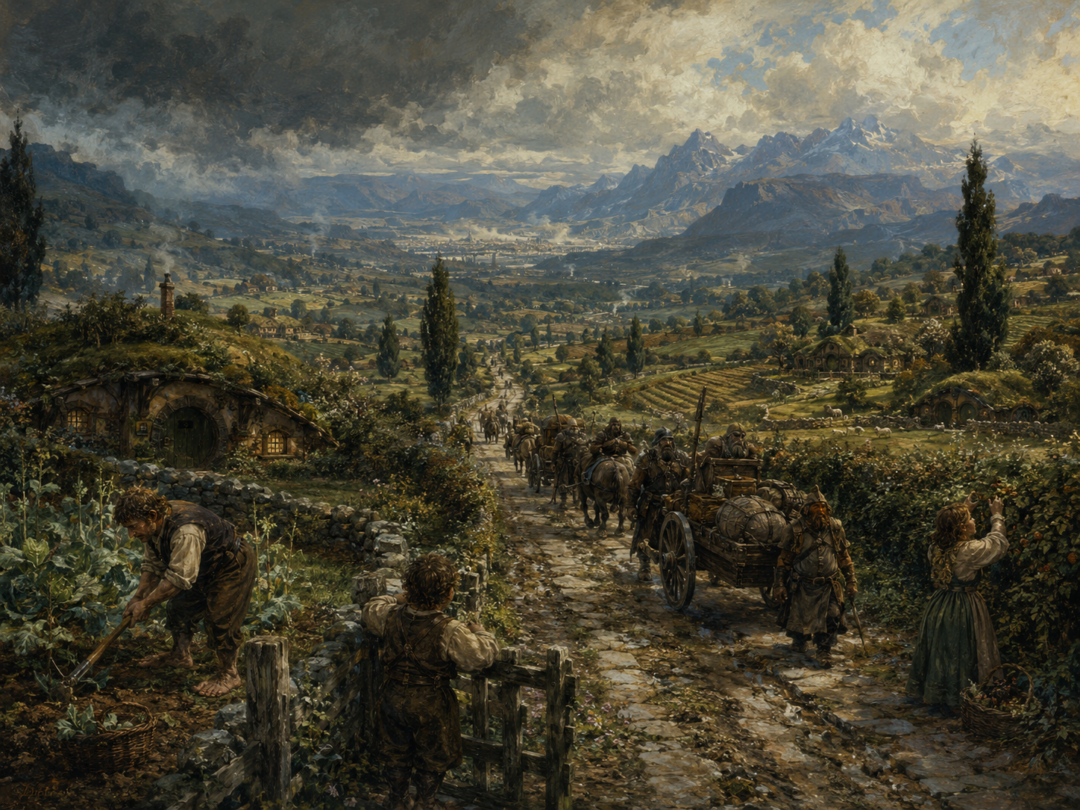
The Great East Road, also called the East-West Road, crosses the Shire. It was an ancient road running westward toward the Grey Havens and eastward through Bree toward Rivendell and lands beyond. Long before the hobbits settled the Shire, it had belonged to the larger history of Eriador.
By the end of the Third Age, much of that older world had faded. Kingdoms had fallen. Populations had diminished. Roads that once joined powerful realms carried far less traffic than they had in earlier centuries.
But the East Road never became irrelevant.
In “The Shadow of the Past,” the narrative specifically notes that Dwarves had long used the road while travelling to their mines in the Blue Mountains. They were among the chief sources through which news of the outside world reached the Shire.
That alone makes absolute economic isolation unlikely. Travellers need food and lodging. Communities beside heavily used routes encounter objects, stories, services, and opportunities that originate elsewhere.
The texts do not provide anything resembling a Shire import ledger, and it would be wrong to invent one. We cannot confidently list imported metals, cloth, tools, spices, or household goods merely because such trade sounds economically reasonable.
What we can say is more limited and more interesting: the infrastructure for exchange unquestionably existed, and foreign travellers regularly passed through Hobbit territory.
The Shire was not hidden beyond the end of the road.
The road went through the middle of it.
Bilbo’s Birthday Gives Us the Clearest Proof
The strongest direct evidence for imported manufactured goods appears during preparations for Bilbo’s eleventy-first birthday.
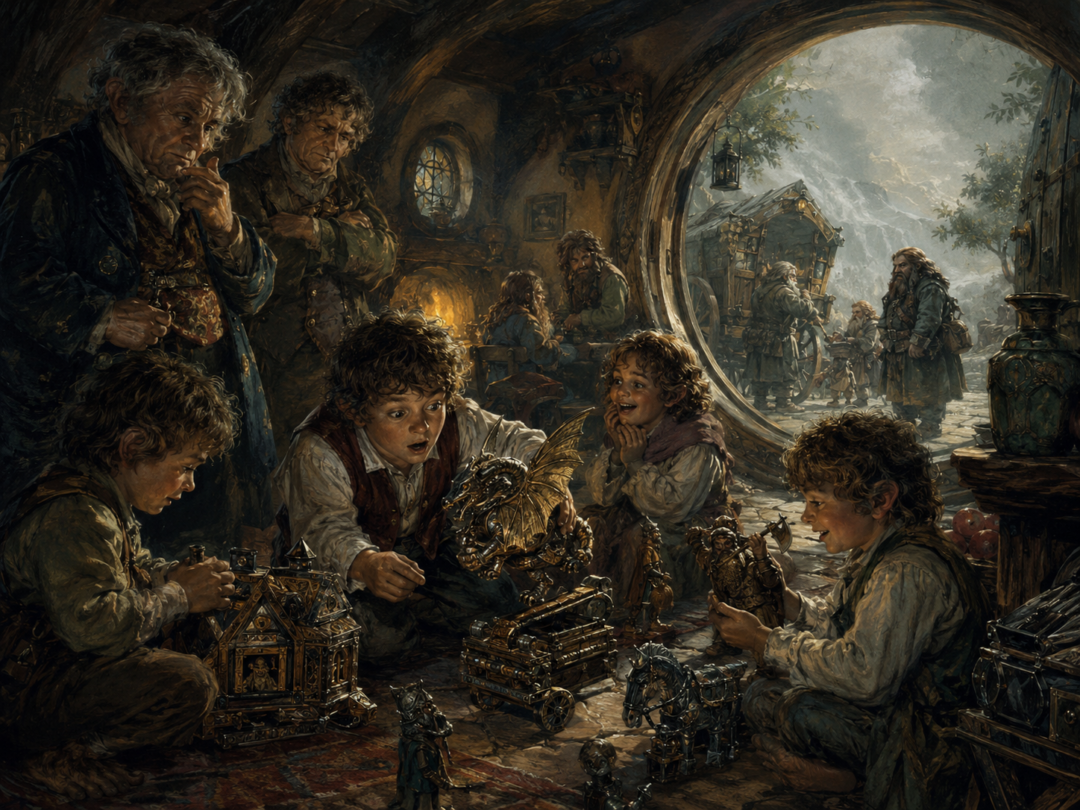
Among the presents for the party are extraordinary toys unlike those normally seen by Hobbit children. Many had been ordered well in advance and had travelled all the way from the Mountain and from Dale. They were genuine Dwarf-made objects.
This is not accidental cargo passing through the Shire.
It is long-distance ordering.
Bilbo—or those acting for him—could commission goods produced hundreds of miles away and have them transported to Hobbiton. The order required some means of communication, craftsmen or merchants capable of fulfilling it, and travellers able to carry the finished goods westward.
Bilbo was exceptionally wealthy and exceptionally well connected, so his purchasing habits should not automatically be treated as normal for every Hobbit family. His friendship with Dwarves makes him an unusual customer.
Even so, the episode proves what was possible.
There was no impassable economic wall around the Shire. A Hobbit with sufficient wealth and connections could obtain sophisticated goods from distant communities.
The arrival of Dwarves with heavily laden wagons before the party reinforces the point. Hobbiton residents regard them as unusual and exciting, but not as creatures who have somehow crossed an impossible frontier.
Foreign commerce was exceptional enough to attract attention while still being possible within the ordinary geography of Middle-earth.
The Dwarves Were a Living Connection to the Outside
Dwarves are crucial to understanding why the Shire could remain provincial without becoming completely disconnected.
Their movements linked western Eriador with other regions.
Some travelled to or from the Blue Mountains west of the Shire. Others moved along the great roads through Bree. Bilbo’s own history created particularly strong connections with Erebor after the restoration of the Kingdom under the Mountain.
The texts do not explicitly describe a permanent Dwarven marketplace in the Shire or tell us precisely what Dwarves regularly sold there. Claims that Hobbit farmers routinely purchased Dwarven metalwork, for example, remain plausible speculation rather than established fact.
What is explicit is continued contact.
Dwarves pass through. Hobbits hear news from them. Bilbo receives Dwarven visitors. Dwarf-made goods can reach Hobbiton.
This distinction matters because it reveals the nature of Shire isolation. The hobbits were not geographically inaccessible. They were psychologically inward-looking.
Most simply had little desire to follow the roads themselves.
A wagon might come from lands associated with dragons, kings, ancient ruins, and restored kingdoms, unload its cargo in the Shire, and then leave behind inhabitants who remained perfectly content to discuss gardens, meals, family trees, and local gossip.
That is isolation by habit rather than complete separation.
Bree Was the Shire’s Window onto a Larger World
East of the Shire stood Bree, where the Great East Road met the old North Road, later commonly called the Greenway.
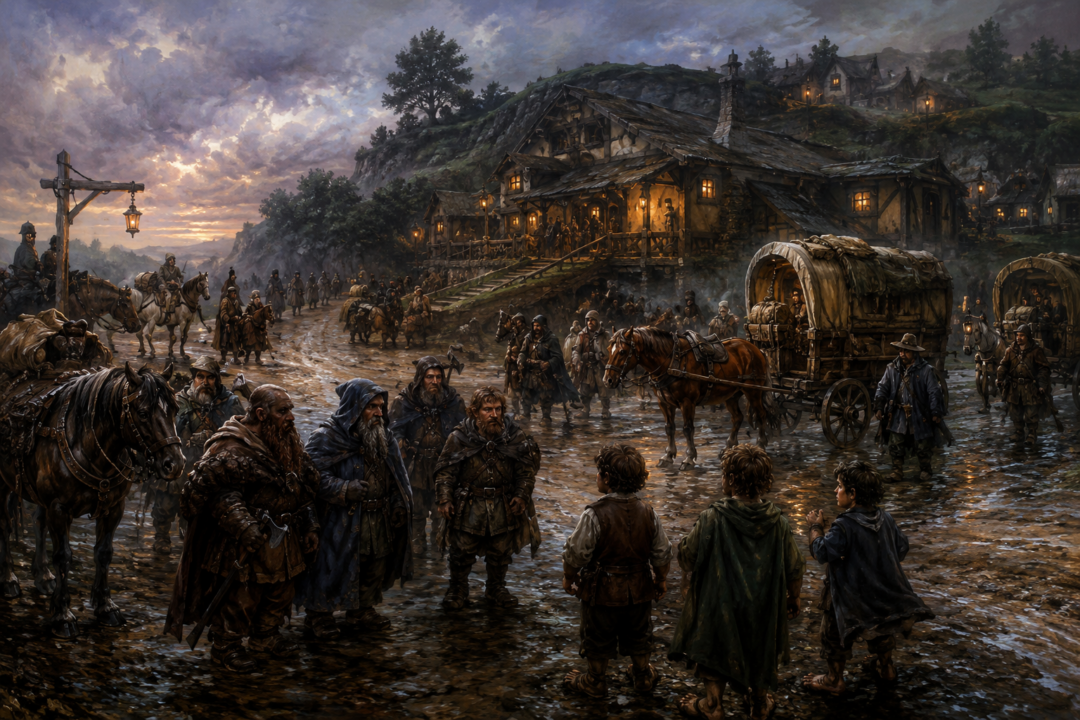
Bree had once experienced far heavier traffic. Even in Frodo’s time, however, the Prancing Pony still received Hobbits, Men, Dwarves, Rangers, and other travellers.
The old Shire expression about strange “news from Bree” preserves the memory of this relationship. Shire-hobbits had once gone there more frequently to hear information arriving from several directions.
Bree therefore helps explain how ideas as well as objects crossed Hobbit borders.
The history of pipe-weed is an excellent example. Meriadoc Brandybuck’s account in the Prologue explains that Tobold Hornblower of Longbottom first grew the plant successfully in the Shire after encountering it outside his homeland, with Bree central to the northern tradition of smoking it.
That is not evidence that late Third Age hobbits continually imported pipe-weed; quite the opposite. The Shire became famous for producing its own varieties.
But it demonstrates how porous cultural boundaries could be. Something encountered beyond the Shire could be adopted, cultivated locally, and eventually become so strongly associated with hobbits that outsiders treated it almost as a defining Hobbit custom.
Isolation did not prevent exchange.
It transformed whatever entered.
The Shire Was Also an Exporter
The economic connection worked in the opposite direction as well.
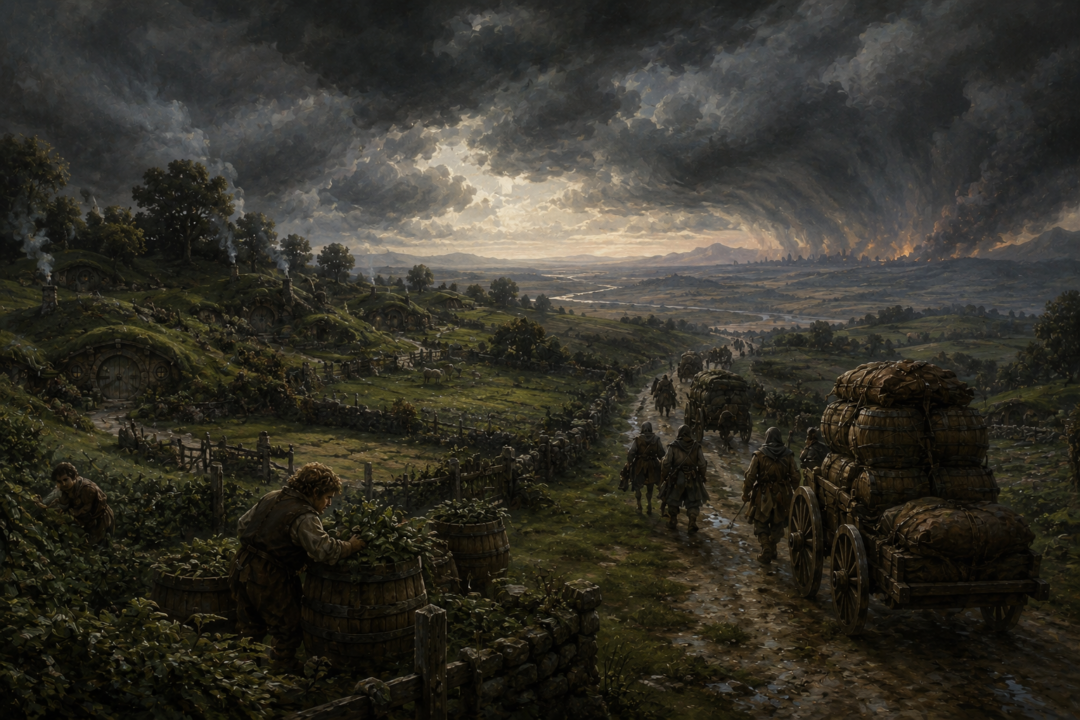
Pipe-weed grown in the Southfarthing travelled far beyond the Shire. Merry and Pippin discover barrels of Longbottom Leaf at Isengard after Saruman’s defeat. Later events reveal that Saruman had established dealings connected with the Shire, and the movement of goods southward becomes part of the darker background to his eventual interference there.
This matters because the Shire cannot be understood merely as a passive rural enclave occasionally receiving foreign curiosities.
At least one celebrated Shire product entered wider networks of exchange.
The exact scale of ordinary Hobbit commerce remains unspecified. We should not imagine a detailed international trading system unsupported by the books. Nevertheless, the combination of travelling Dwarves, the East Road, Bree, Bilbo’s distant purchases, and Southfarthing goods reaching Isengard demonstrates genuine movement across the borders.
And that movement eventually becomes dangerous.
The very channels that can carry toys and news can also carry information, influence, agents, and exploitation.
What the Books Never Tell Us
There is a temptation to reconstruct everything the Shire “must” have imported.
Hobbits use manufactured objects. They eat varied foods. They wear clothing and build houses. One might reasonably ask where every piece of metal, every luxury ingredient, or every specialized tool originated.
But the texts rarely answer those questions.
We are not explicitly told that the Shire imported its tea, coffee, metals, textiles, glass, or other everyday commodities on a systematic basis. Economic plausibility is not the same thing as textual evidence.
The safer conclusion is therefore narrower.
The Shire was highly productive agriculturally and possessed its own craftsmen and local economy. At the same time, it participated at least occasionally in long-distance exchange. Dwarven traffic supplied a continuing link with the outside world, and Bilbo’s birthday purchases provide undeniable evidence that foreign manufactured goods could be ordered and delivered into Hobbit society.
That is already enough to overturn the image of a completely sealed Shire.
The Real Isolation of the Shire Was Cultural
What makes the Shire remarkable is not that nothing entered.
It is that so little of the outside world seemed to change the hobbits’ sense of themselves.
Dwarves could walk their ancient road through Hobbit country. Travellers could bring stories from distant regions. Bilbo could import astonishing creations from Dale and Erebor. Pipe-weed could travel south to Isengard.
Yet the average Hobbit still experienced the world through intensely local concerns.
That provincialism is part of what makes the Shire vulnerable as well as precious.
Its people benefit from centuries of relative safety without fully understanding what preserves that safety. They live among remnants of a larger history while paying little attention to it. Their roads connect them with dangerous places whose names often mean almost nothing to them.
The contradiction is deliberate and powerful.
The Shire is not outside Middle-earth.
It is connected to Middle-earth economically, geographically, and historically while behaving as though the great struggles beyond its hedges belong to somebody else.
That is why the imported Dwarven toys at Bilbo’s party are more revealing than they first appear. They arrive from a kingdom restored after dragon-fire and war, carried across ancient roads into a community where children simply marvel at wonderful presents.
For a moment, the entire history of the wider world reaches Hobbiton in a wagon.
And most of the Shire sees only the toys.
Sources & Notes
- https://tolkiengateway.net/wiki/The_Shire — Tolkien Gateway: the Shire’s borders, roads, settlements, economy, administration, and contacts beyond Hobbit lands.
- https://tolkiengateway.net/wiki/Southfarthing — Tolkien Gateway: the warmer district where pipe-weed and wine-related goods were produced and traded.
- https://tolkiengateway.net/wiki/Longbottom_Leaf — Tolkien Gateway: a named Shire tobacco variety found beyond the Shire in Isengard’s stores.
- https://tolkiengateway.net/wiki/Pipe-weed — Tolkien Gateway: the plant’s introduction, cultivation in the Shire, and movement among Men, Hobbits, and Isengard.
Sources document imported pipe-weed connections, regional production, inns, roads, and the Shire’s external contacts.