When the War of the Ring ends, Tolkien gives readers moments of unmistakable release.
Barad-dûr collapses.
The Ring is unmade.
The Shadow lifts from Middle-earth.
We see Aragorn crowned in Minas Tirith. We witness the cleansing of the Shire. We are shown reunions, farewells, and the slow turning of the world toward peace.
But one place is conspicuously absent from any celebration.
Minas Morgul.
Unlike many locations touched by Sauron’s power, Minas Morgul is not dramatically destroyed, reclaimed, or purified on the page. Tolkien does not describe a victorious army marching through its gates, nor does he record any attempt to cleanse or rebuild it.
Instead, its fate is handled with restraint.
And that restraint is meaningful.
To understand why Minas Morgul fades into silence rather than renewal, we need to look closely at what the texts actually say—and what they deliberately leave unsaid.
From Minas Ithil to Minas Morgul
Long before it was feared, Minas Morgul was a city of beauty.
Originally named Minas Ithil, the Tower of the Moon, it was built by Isildur in the early years of Gondor. Together with Minas Anor, it guarded the western approaches to Mordor and symbolized Gondor’s vigilance over the Dark Land.
The city did not fall suddenly.
During the Third Age, Minas Ithil was captured by the Witch-king of Angmar. Over time, its name changed, its purpose shifted, and its very nature was altered. What had once been a watchful city of Men became a stronghold of terror.
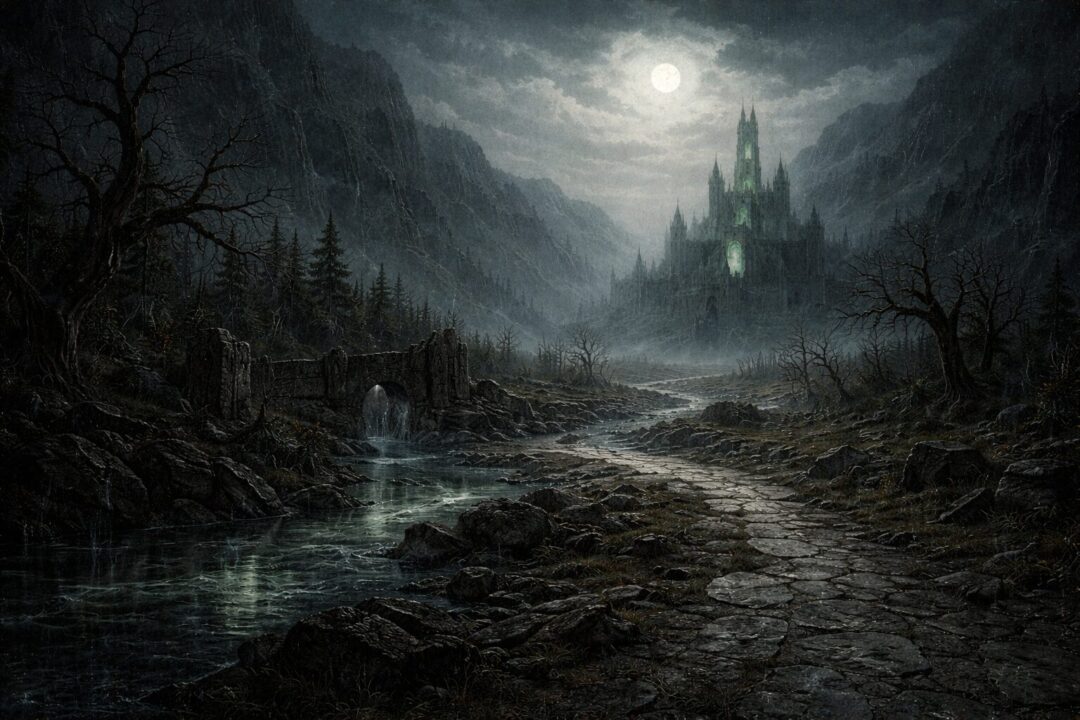
By the time of The Lord of the Rings, Minas Morgul is described as a place of unnatural light, foul waters, and overwhelming dread. Its presence poisons the surrounding valley. Living things avoid it. Even Orcs are uneasy within its walls.
Crucially, Minas Morgul is not merely occupied by evil.
It is reshaped by it.

The Fall of Sauron — And What Does Not Happen
When the One Ring is destroyed, the Nazgûl perish and Sauron’s power collapses. His armies scatter or are destroyed. The structures sustained by his will—most notably Barad-dûr—crumble.
But Tolkien does not describe Minas Morgul being stormed.
There is no passage recounting its capture. No cleansing fire. No reclaiming of its towers.
In The Return of the King, we are told that Aragorn, now King Elessar, leads campaigns to secure Gondor’s borders and remove lingering threats. These actions are purposeful and restorative. Roads are guarded. Cities are renewed. Peace is actively built.
Yet Minas Morgul is treated differently.
The city is emptied, not reclaimed.
The forces of Gondor do not enter it.
No rebuilding is attempted.
No settlement is founded there.
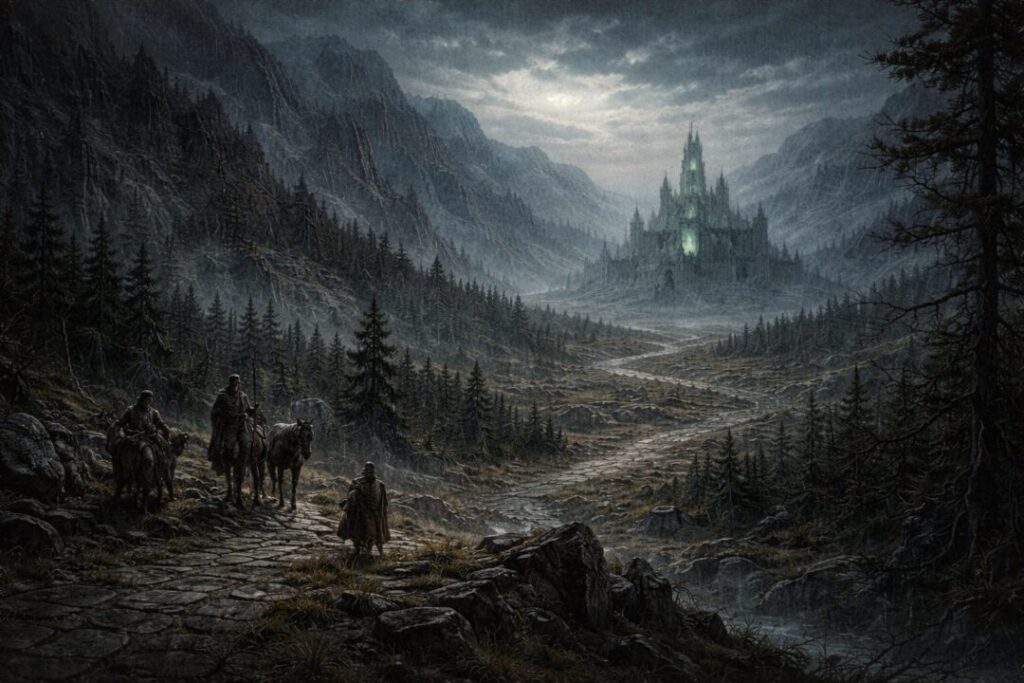
Instead, the valley is abandoned.
This absence is striking—not because Tolkien forgot the city, but because he clearly chose not to resolve it in the same way as other strongholds of evil.
Why Minas Morgul Is Left Behind
Tolkien never provides a single, explicit explanation for why Minas Morgul is abandoned. But the implications in the text are strong.
Minas Morgul was steeped in the sorcery of the Nazgûl. It was a place where fear itself seemed to have substance. The Morgul Vale was associated with poisoned waters, unnatural growth, and a sense of corruption that went beyond physical occupation.
Even before the War, the land was already described as hostile to life.
This strongly implies that the corruption extended beyond walls and towers. The place itself had been altered.
Unlike Minas Tirith—which endures siege, fire, and despair but remains fundamentally itself—Minas Morgul had been transformed over centuries. Its identity as a city of Men was erased long before the War of the Ring began.
Reclaiming it would not simply mean repairing stone and clearing rubble.
It would mean undoing generations of spiritual damage.
And Tolkien is careful, throughout his legendarium, not to suggest that such damage is easily undone—especially within a single age.
Not All Victories Are Restorations
This restraint fits a broader pattern in Tolkien’s world.
Some evils can be overthrown.
Some wounds can be healed.
Others must simply be endured, remembered, or avoided.
The Dead Marshes are not cleansed after Sauron’s fall.
The Barrow-downs remain dangerous.
These places persist as reminders of ancient suffering, long after the powers that created them have passed.
Minas Morgul belongs to this category.
Its abandonment reflects Tolkien’s understanding that history leaves scars. The defeat of Sauron does not reset Middle-earth to an untouched state. It allows healing to begin—but not everywhere, and not all at once.
A City Without a Master
There is also a symbolic dimension to Minas Morgul’s fate.
The city exists almost entirely in relation to Sauron’s will. Its purpose is domination, terror, and control. Once that will is removed, the city has no independent identity to fall back on.
It is not like Minas Tirith, which serves a people and a history beyond war.
Minas Morgul is not a prize worth claiming, because its value was never its own.
In this sense, the city dies not by destruction, but by irrelevance.
Its power evaporates.
Its terror lingers.
And then it is simply left behind by history.
A Quiet, Uneasy End
Tolkien does not linger on Minas Morgul’s fate.
And that silence is deliberate.
The narrative moves forward. The Fourth Age begins. Men rebuild elsewhere—where life can genuinely return.
Minas Morgul becomes a place remembered, but not revisited.
Not every shadow is chased away.
Not every ruin is redeemed.
Some places remain as warnings.
Minas Morgul stands—empty, avoided, and fading—as a reminder that victory does not always mean restoration. And that even when the Shadow is defeated, it leaves behind spaces where life does not return.
That quiet truth may be one of the most unsettling—and most realistic—lessons Tolkien ever left us.