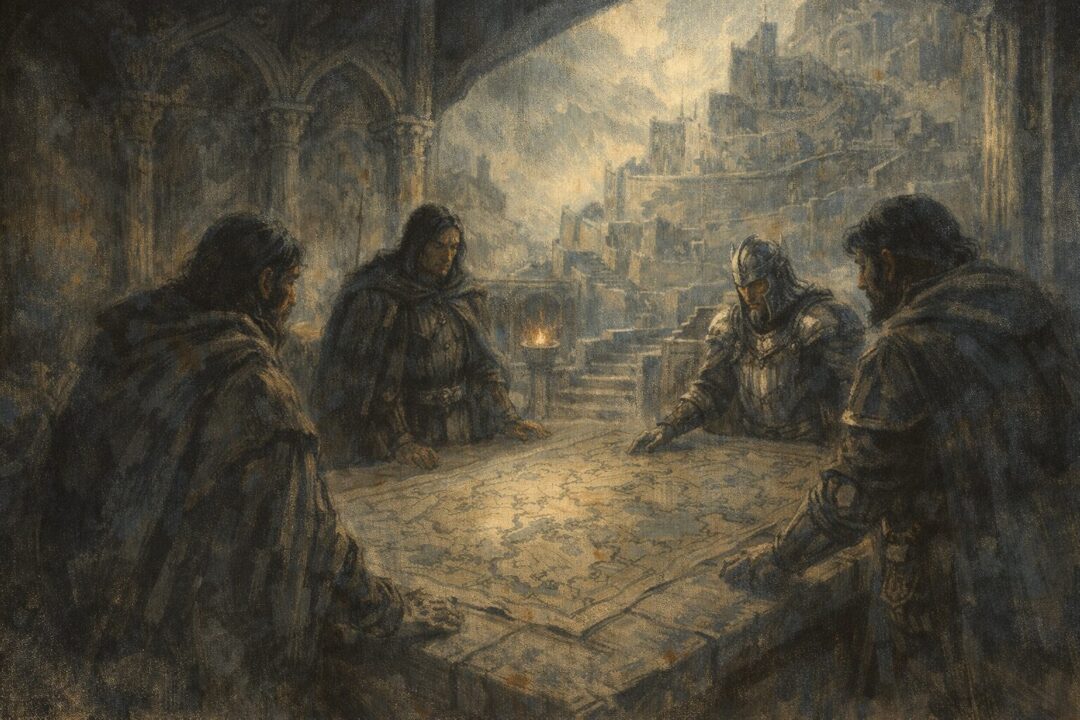
In The Lord of the Rings, there are no glowing consoles, no flickering projections, no obvious instruments of command. And yet, Middle-earth is full of strategy rooms.
They appear quietly—almost modestly. A long table in Rivendell. A war map unrolled in a tent before dawn. Stones etched with borders, roads, and rivers. Light falling just right to make those markings readable to everyone present.
Tolkien’s world doesn’t shout its systems. It assumes them.
Knowledge Made Shared
At the Council of Elrond, the power of the scene doesn’t come from authority or force. It comes from shared understanding. Everyone gathered sees the same map. The same geography. The same distances that must be crossed and the same shadows spreading from the East.
Maps in Middle-earth are not props. They are instruments of alignment.
They turn stories into decisions.
A ranger’s report from the wild means little on its own. But place it on a map—trace a route, mark a border, connect it to another sighting—and suddenly the room understands the danger.
This is how Tolkien shows strategy: not through spectacle, but through clarity.
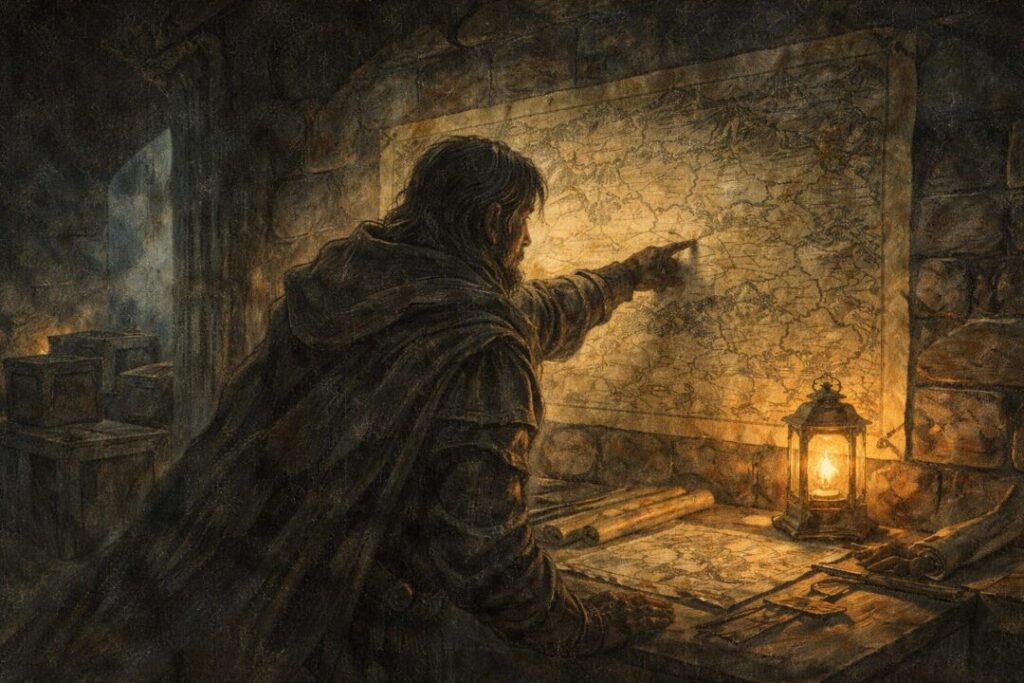
War Rooms Without Machines
When Aragorn leads armies later in the story, we again see this pattern. Plans are made around physical space—tables, parchment, landmarks named aloud. The terrain itself becomes part of the conversation.
The same is true in Minas Tirith, where the city’s layered design mirrors its defensive logic. You don’t need a diagram when the architecture is the diagram.
Tolkien understood something deeply practical: before digital tools, real wars were planned exactly this way. With physical maps. With markers. With people gathered close enough to point, trace, and argue over inches that represented miles.
Middle-earth simply never moved past that stage—because it didn’t need to.
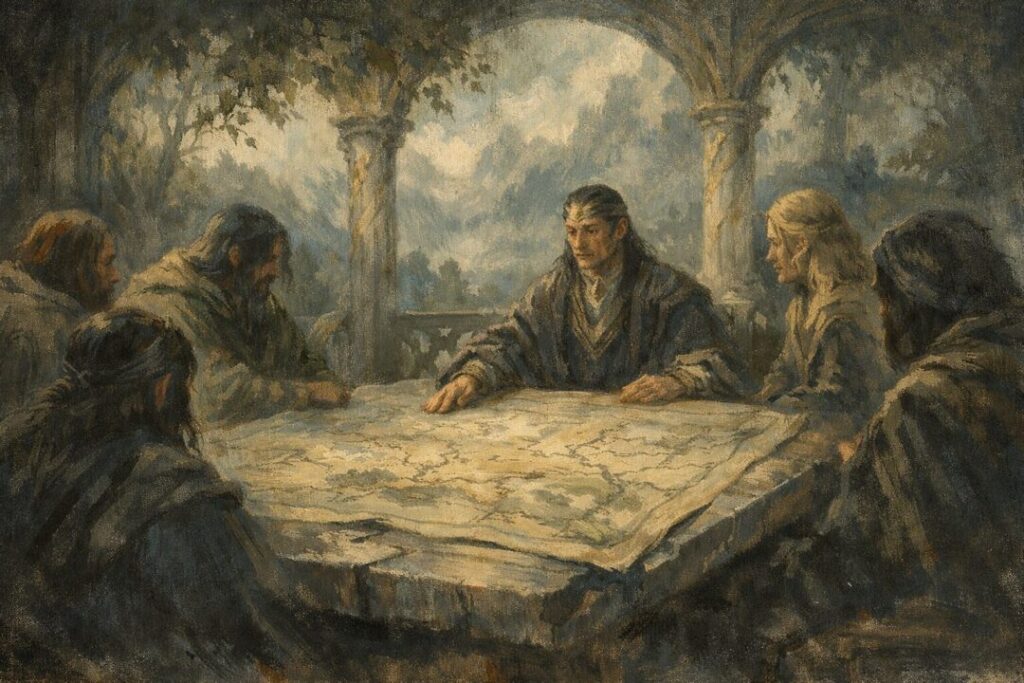
Light as Information
One of the most overlooked elements in Tolkien’s visual language is light.
Light reveals maps. Light catches etched stone. Light moves across rooms as time passes, reminding those present that decisions cannot wait forever.
In Rivendell, daylight filters through leaves and arches, soft but deliberate. It’s not dramatic. It’s functional. You can see. You can think.
Contrast that with darker spaces later in the story, where knowledge is fragmented and vision is limited. The absence of clear light often mirrors the absence of clear strategy.
The Palantíri Are the Exception
Yes, Middle-earth does have something close to advanced surveillance: the palantíri.
But notice how rarely they are used—and how dangerous they are when relied upon too heavily. Unlike maps, which encourage discussion, palantíri isolate the viewer. They show too much, too narrowly, and without context.
This is no accident.
Tolkien consistently favors shared, grounded tools over powerful but distorting ones. Maps invite humility. Seeing-stones invite obsession.
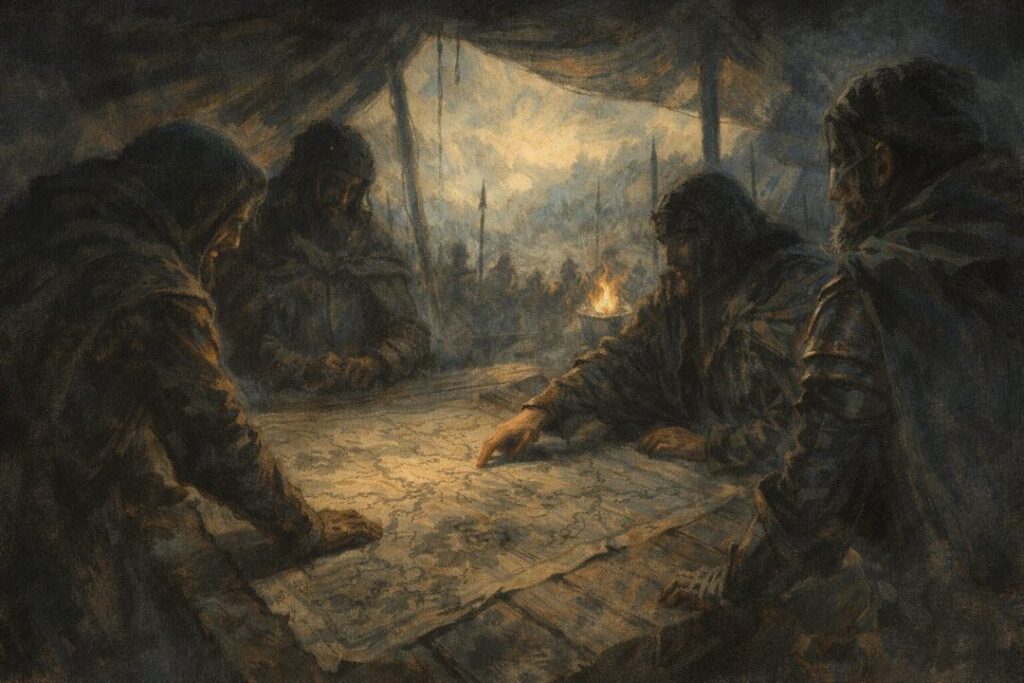
Why This Still Works
Modern fantasy often leans toward spectacle: glowing tables, floating icons, animated displays. Tolkien didn’t need any of that.
His strategy spaces feel believable because they mirror how humans have always made sense of complex situations—by externalizing knowledge into a shared physical space.
That’s why those quiet scenes resonate.
They remind us that wisdom isn’t about having the most advanced tools. It’s about making sure everyone in the room sees the same truth.