The Sons of Fëanor Could Repent — But They Could Not Undo the Oath
At the end of the First Age, the most terrible thing about the Oath of Fëanor is no longer that Maedhros and Maglor want the Silmarils.
It is that they scarcely seem to want them at all.
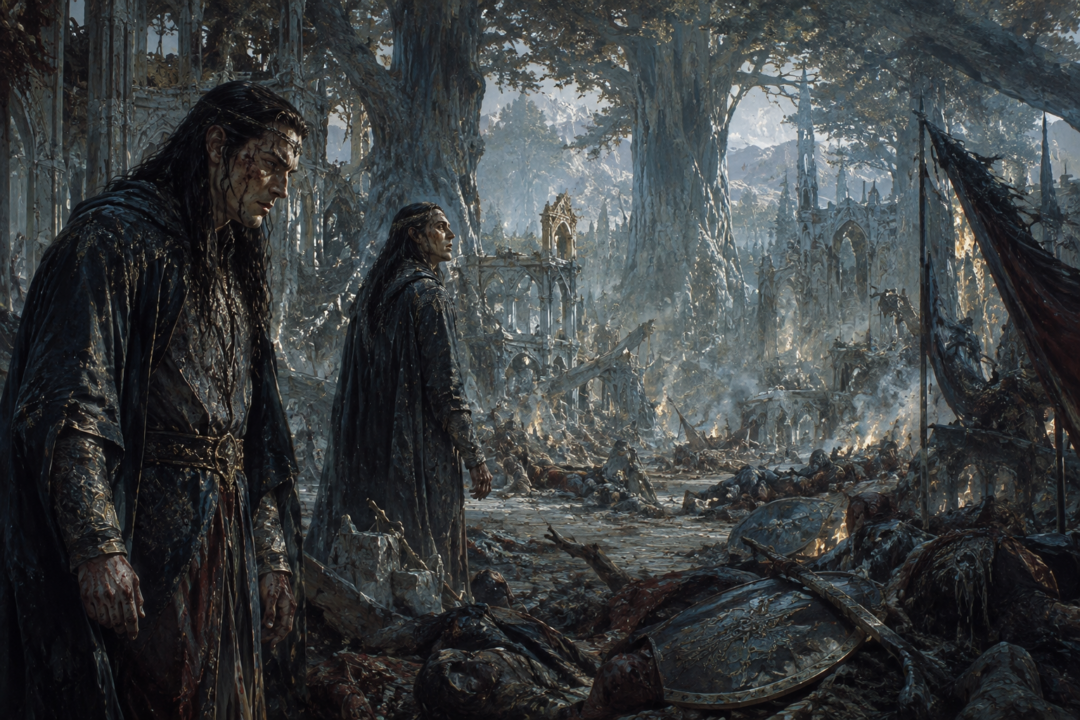
Morgoth has fallen. Beleriand has been shattered. Five of their brothers are dead. The wars surrounding the Silmarils have helped destroy Doriath and the Havens of Sirion. Yet when the two remaining sons of Fëanor learn that the last two Silmarils have been recovered, the old obligation rises again.
The Silmarillion says that Maedhros and Maglor prepare to fulfil their oath with “weariness and loathing.”
That detail changes everything.
These are not simply villains still greedily pursuing treasure. By this point they can recognize the horror of what the oath has produced. Maglor even argues that they should stop.
Yet recognition does not erase consequence.
That is one of the darkest ideas in the story of Fëanor’s house: repentance and escape are not necessarily the same thing.
The Oath Was More Than a Promise to Recover Treasure
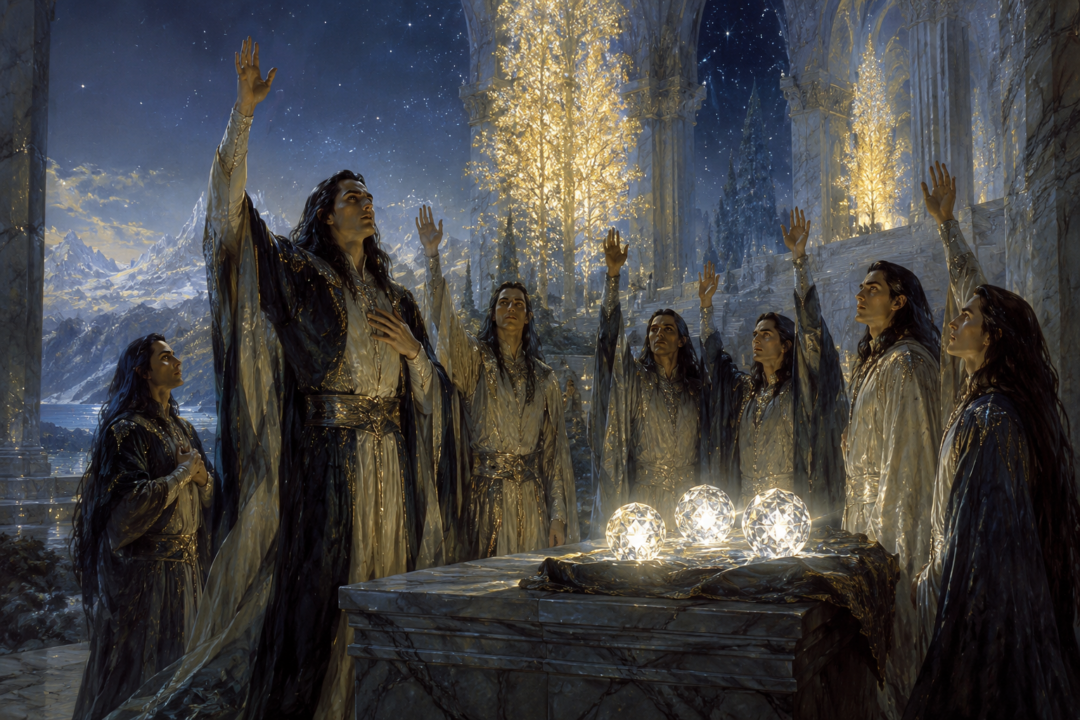
Fëanor and his seven sons swear their oath in Tirion after Morgoth murders Finwë and steals the Silmarils.
Its scope is deliberately terrifying.
They bind themselves to pursue anyone who possesses or withholds a Silmaril, regardless of whether that person is enemy or friend. They invoke Ilúvatar as witness and call the Everlasting Darkness upon themselves if they fail.
The narrative immediately treats this as disastrous. The oath is not presented as a heroic pledge that later happens to go wrong. Its language has already placed possession of the Silmarils above ordinary restraints of loyalty, mercy, friendship, and law.
And the Doom of the Noldor soon foretells the trap at its heart: the oath will drive Fëanor’s sons while continually betraying their purpose.
That pattern defines their history.
When Morgoth possesses the Silmarils, their oath points toward an enemy who must already be opposed. But once a Silmaril leaves Morgoth’s possession, the oath becomes much more destructive.
The person holding it may be innocent.
The sons have sworn to pursue it anyway.
Doriath Reveals What the Oath Has Become
Beren and Lúthien recover a Silmaril from Morgoth’s crown. Eventually it passes to their son Dior in Doriath.
Now the oath confronts the sons of Fëanor with precisely the situation its reckless wording made inevitable.
A Silmaril is held not by Morgoth but by another Elven house.
The sons demand it. Dior does not surrender it. The resulting attack upon Doriath becomes the Second Kinslaying.
Celegorm, Caranthir, and Curufin die there.
Yet the Silmaril escapes.
The oath has therefore achieved something grotesquely opposite to its apparent purpose. Three more sons of Fëanor are dead, another Elven realm is destroyed, more blood has been spilled between the Eldar — and they are no closer to possessing the Jewel.
The pattern repeats at the Havens of Sirion.
Elwing possesses the Silmaril. The surviving sons demand its surrender. When it is refused, they attack.
Amrod and Amras are slain, leaving only Maedhros and Maglor.
And again the Silmaril escapes them.
Elwing carries it into the Sea and ultimately reaches Eärendil. Through Eärendil’s voyage, that very Silmaril becomes part of the chain of events leading to the intervention of the Valar and the overthrow of Morgoth.
The oath has failed even on its own terms. The violence committed in its name has not restored the Silmarils to Fëanor’s house.
It has merely consumed that house.
Repentance Begins Before the Oath Ends
The later portrayal of Maedhros and Maglor matters because neither is depicted as emotionally untouched by what has happened.
At the end of the War of Wrath, when Eönwë possesses the two Silmarils recovered from Morgoth, the surviving brothers once again prepare to demand them.
But the language surrounding them is now radically different from the fiery certainty of Tirion.
They act with weariness, loathing, and despair.
That does not absolve them. Their previous deeds remain their deeds, and they will soon kill again.
But it shows that moral awareness can survive inside someone who remains trapped by earlier choices.
Maglor goes further.
When Eönwë refuses their demand and commands them to return to Aman for the judgement of the Valar, Maglor argues that they should obey.
He hopes that they might receive pardon.
This is perhaps the clearest moment in which one of Fëanor’s sons openly imagines a path other than continued violence.
Maglor Sees the Terrible Logic
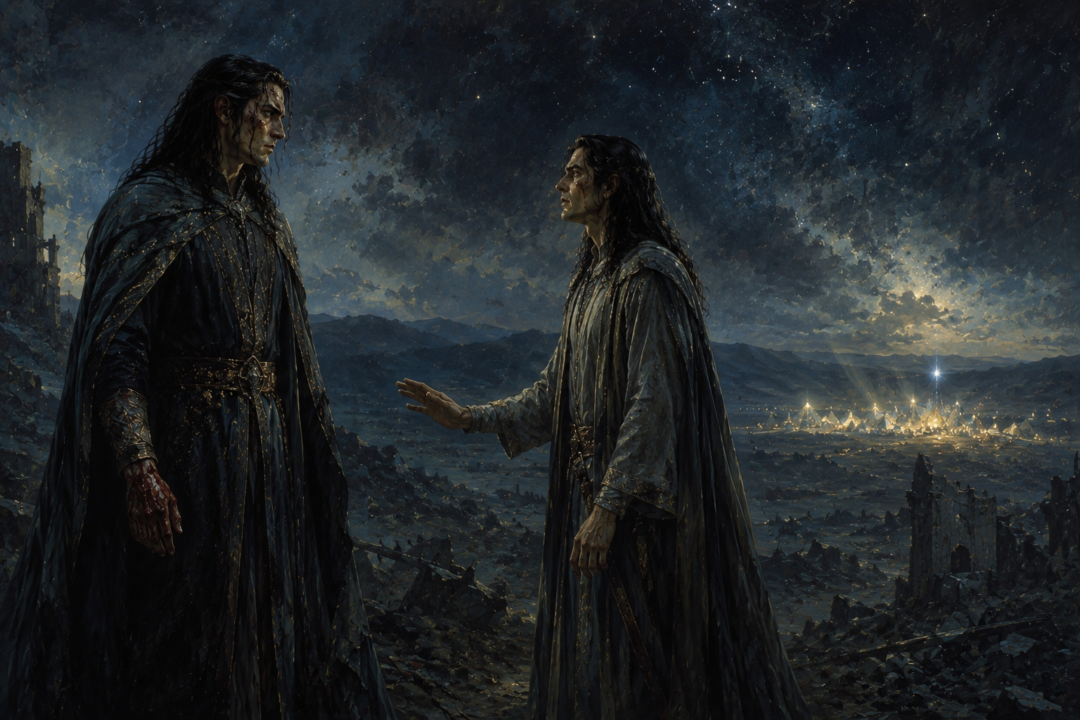
Maedhros answers that their oath was sworn invoking Ilúvatar and that nobody can release them from it.
Maglor then reaches the central moral insight of their entire tragedy.
If the oath truly cannot be released, he argues in effect, then they may be doomed whether they keep it or break it.
Therefore they should break it.
Why?
Because they would commit less evil by doing so.
That distinction is enormously important.
Maglor is no longer arguing primarily about how to win the Silmarils. He is reasoning about what is morally preferable when every available path appears disastrous.
He cannot undo Alqualondë.
He cannot restore Doriath.
He cannot bring back those slain at Sirion.
He cannot unswear words already spoken.
But he can refuse to add another evil deed to the existing ones.
This is repentance in one of its most painful forms: not the belief that the past can be erased, but the recognition that one must stop making the past worse.
The tragedy is that Maglor does not hold to that conclusion.
Maedhros persuades him otherwise.
Eönwë Offers Judgement, Not an Easy Escape
There is another crucial detail in the confrontation with Eönwë.
Eönwë does not tell the brothers that nothing can be done.
He tells them that because of the merciless deeds committed in pursuit of the Silmarils, their former right to the Jewels has been lost. They must return to Valinor and submit to the judgement of the Valar.
This leaves an important uncertainty.
The text does not explicitly establish exactly what would have happened to the oath had Maedhros and Maglor surrendered themselves.
Maglor hopes for pardon. Maedhros fears that the Valar may refuse to release them while simultaneously preventing them from fulfilling the oath.
We are not told which expectation is correct.
That uncertainty should remain uncertainty.
What is clear is that they are offered the possibility of submitting themselves to judgement instead of deciding through violence that the oath must still govern their actions.
They refuse.
That choice matters.
The oath exerts terrible pressure, but their final crime is still portrayed as something they decide to undertake.
The Last Kinslaying Proves Maglor Was Right
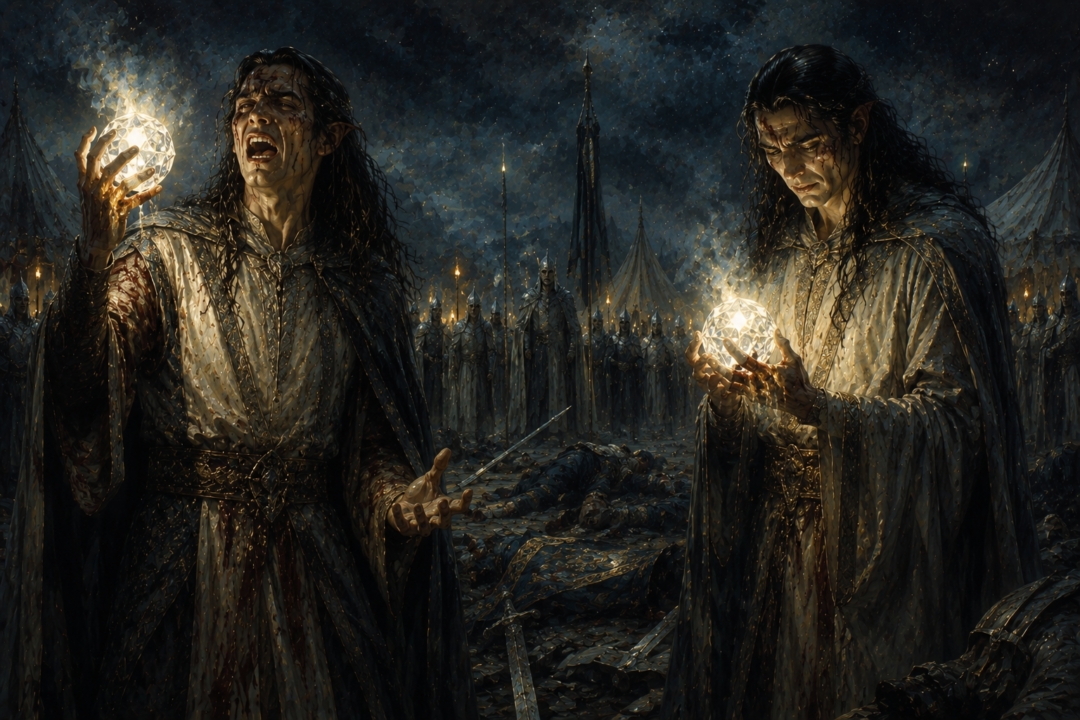
Maedhros and Maglor enter Eönwë’s camp in disguise and seize the Silmarils.
They kill the guards protecting them.
Once again blood is spilled for the Jewels.
The entire host rises against them, and the brothers prepare to fight until they die. Eönwë, however, refuses to permit their deaths, and they escape with one Silmaril each.
For one brief moment, they have apparently accomplished what generations of suffering were meant to accomplish.
The surviving sons of Fëanor finally hold the Silmarils.
And the Silmarils reject them.
The hallowed Jewels burn their hands.
Maedhros then understands that Eönwë had spoken truly: his right to the Silmaril has become void, and the oath is vain.
That word — vain — is the final judgement upon the entire pursuit.
Not merely unsuccessful.
Empty.
The oath demanded everything and, when obeyed to the bitter end, could no longer deliver what it promised.
Maedhros and Maglor Choose Different Ends
Maedhros cannot endure the revelation.
In anguish and despair, he casts himself with his Silmaril into a fiery chasm.
The eldest son of Fëanor therefore dies at the moment when the family’s great obsession is finally physically within his grasp.
Maglor responds differently.
Unable to endure the Silmaril’s burning, he casts his Jewel into the Sea.
Then he wanders the shores, singing in pain and regret, never returning among the Elven people.
The distinction is significant.
Maglor finally does what he had earlier argued they should do: he stops trying to possess the Silmaril.
But he does so only after one last killing.
His regret does not resurrect the dead.
His renunciation does not restore the kingdoms destroyed during the oath’s long history.
And his suffering does not automatically cancel responsibility.
Repentance may change the person who committed an evil act.
It does not make the act unhappen.
The Oath’s Deepest Trap Was Moral, Not Magical
It is tempting to imagine the Oath of Fëanor as though it were a magical compulsion controlling the brothers like puppets.
The text is more troubling than that.
The oath certainly possesses extraordinary seriousness within the moral and spiritual structure of the story. The sons repeatedly feel themselves driven by it, and the narrator treats its consequences as real.
But they still deliberate.
They delay.
They send demands before attacking.
They argue among themselves.
Maglor explicitly proposes breaking the oath.
Those moments matter because they show that the tragedy cannot simply be reduced to enchantment.
The sons of Fëanor are bound by words they should never have spoken, but they also repeatedly choose what those words will mean in practice.
By the end, Maglor understands that distinction better than anyone.
If damnation seems unavoidable, then the remaining question is not how to save oneself at any cost.
It is how much more evil one is willing to commit trying.
That is why the final debate between Maedhros and Maglor may be the true climax of the oath.
The Silmarils are almost secondary.
One brother argues that an obligation must be fulfilled even though fulfilling it requires another crime.
The other recognizes that there comes a point when avoiding personal doom cannot justify harming someone else.
Maglor loses the argument.
And men die because he does.
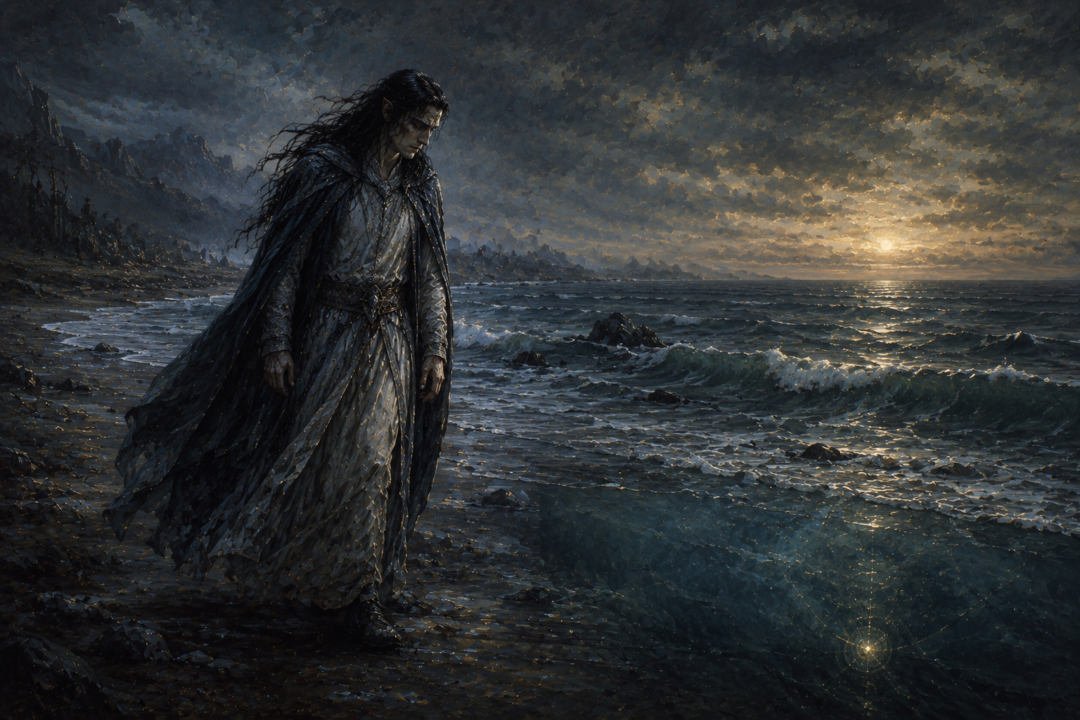
Repentance Cannot Rewrite History
The sons of Fëanor could regret their oath.
They could hate what it had made of their lives.
They could recognize the evil committed in its pursuit.
They could even choose, as Maglor briefly wished, to stop obeying it and submit themselves to judgement.
What they could not do was return to Tirion and become the people they were before they swore it.
That is the lasting horror of Fëanor’s oath.
Some choices create consequences that remorse alone cannot remove.
The past remains real.
The dead remain dead.
Doriath remains destroyed.
The Havens remain stained with kindred blood.
Yet Maglor’s argument still leaves a narrow moral path open.
If the past cannot be repaired completely, one can at least refuse to deepen its evil.
The sons of Fëanor were never offered an easy road back to innocence.
By the end, innocence was impossible.
What remained was the harder choice between continuing the cycle and finally refusing it.
For one moment, Maglor understood.
He simply understood too late.
Sources & Notes
- The Encyclopedia of Arda, “Sons of Fëanor” — https://www.glyphweb.com/arda/s/sonsoffeanor.html
- The Encyclopedia of Arda, “Oath of Fëanor” — https://www.glyphweb.com/arda/o/oathoffeanor.html
- The Encyclopedia of Arda, “Kinslaying” — https://www.glyphweb.com/arda/k/kinslaying.html
Reference entries document the people, places, events, and objects directly discussed in this article.