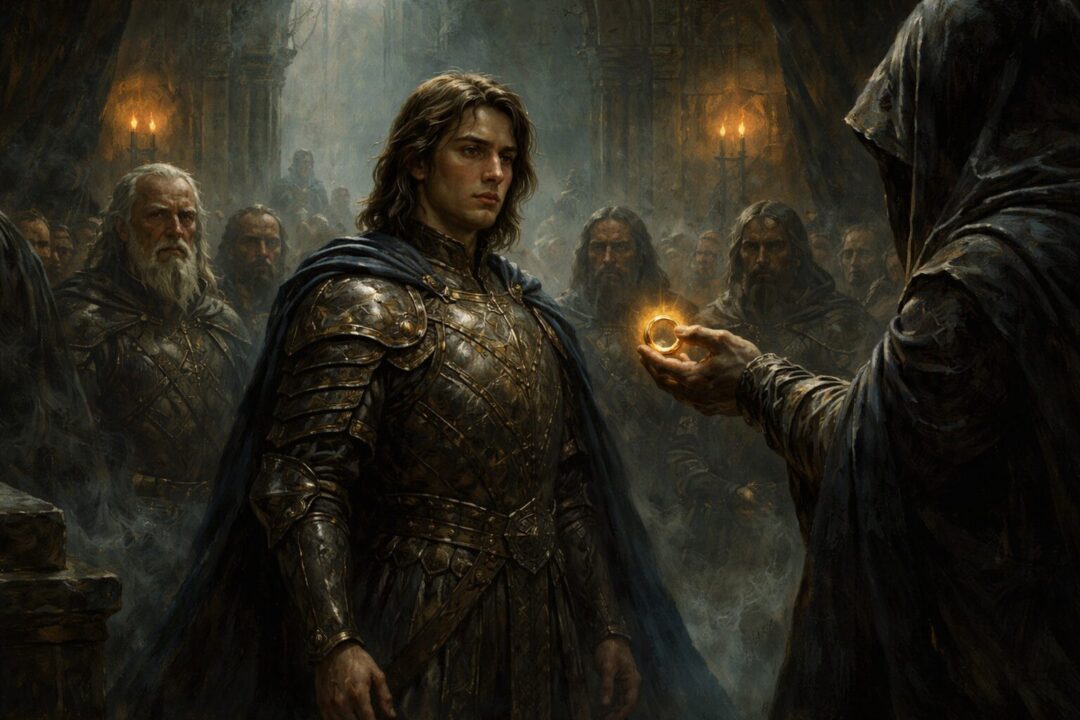
The Nazgûl enter the story already complete. Cloaked. Silent. Terrifying.
They do not speak of who they were. They do not remember aloud what they lost. In the films especially, they feel less like fallen people and more like forces of nature — death given shape, horror without origin.
But that impression is misleading.
Tolkien’s wider legendarium suggests something far more unsettling: the Nazgûl were not created in a moment of catastrophe. They were shaped slowly, deliberately, over centuries. And the greatest of them — the Witch-king of Angmar — is the clearest example of this process.
He was once a man. Not a monster. Not a wraith. A man who ruled, judged, commanded, and made choices. And he did not fall all at once.
A Man, Not a Shadow
Very little is stated outright about the Witch-king’s mortal identity, but what is implied matters. He is repeatedly described as a king, a lord of Men, and likely of Númenórean descent. That alone tells us something crucial: he belonged to a people already obsessed with longevity, legacy, and power over time.
This matters because the Rings of Power did not prey on weakness alone. They preyed on ambition.
The Witch-king was not dragged screaming into darkness. He stepped into it because it promised continuity — rule without decay, authority without an end date, purpose without mortality closing in.
And for a ruler, that is intoxicating.
The Rings Did Not Enslave Through Force
There is a temptation to imagine the Nine Rings as instruments of sudden domination — objects that seize the will and crush resistance. But Tolkien describes something far subtler.
The Rings worked through delay.
They did not take freedom immediately. They postponed consequences.
They granted:
- Longevity without peace
- Authority without rest
- Power without release
A Ring-bearer could continue ruling long after rivals died. Could see plans unfold across generations. Could impose order without fearing personal loss.
At first, nothing feels stolen.
That is the trap.
Chosen Early, Not Late
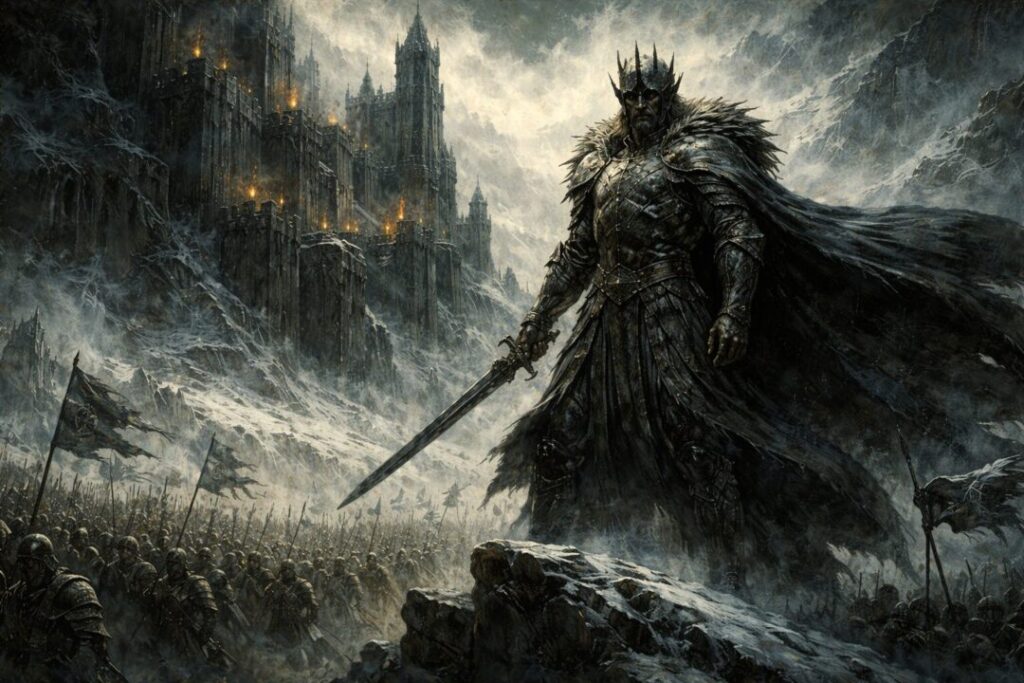
A common misconception is that the Rings were given to old kings desperate to escape death. But the texts suggest the opposite. The Rings required strong wills — minds capable of command, planning, and endurance.
That implies the Witch-king received his Ring while still young enough to grow into it.
This is one of the most uncomfortable implications of the legendarium. Because it means the Witch-king did not merely use the Ring — his entire adult life unfolded under its influence.
Every judgment he made thereafter was filtered through altered stakes. Death retreated. Fear dulled. Mercy became inefficient.
When mistakes no longer cost you time, mercy begins to look like weakness.
And so cruelty does not arrive as evil. It arrives as efficiency.
Learning Obedience
The Witch-king’s relationship with Sauron mirrors something we see elsewhere in Middle-earth: domination masked as order.
Sauron did not rule the Nine with chains. He offered clarity.
Serve — and the world makes sense.
This philosophy is not foreign to Tolkien’s world. Sauron himself once valued order over morality, structure over freedom. In the Witch-king, that worldview found its most successful student.
Submission brought stability. Loyalty brought purpose. Obedience brought power.
And over time, the Witch-king learned that resisting Sauron did not restore freedom — it only reintroduced chaos.
Angmar Was Not Madness — It Was Administration
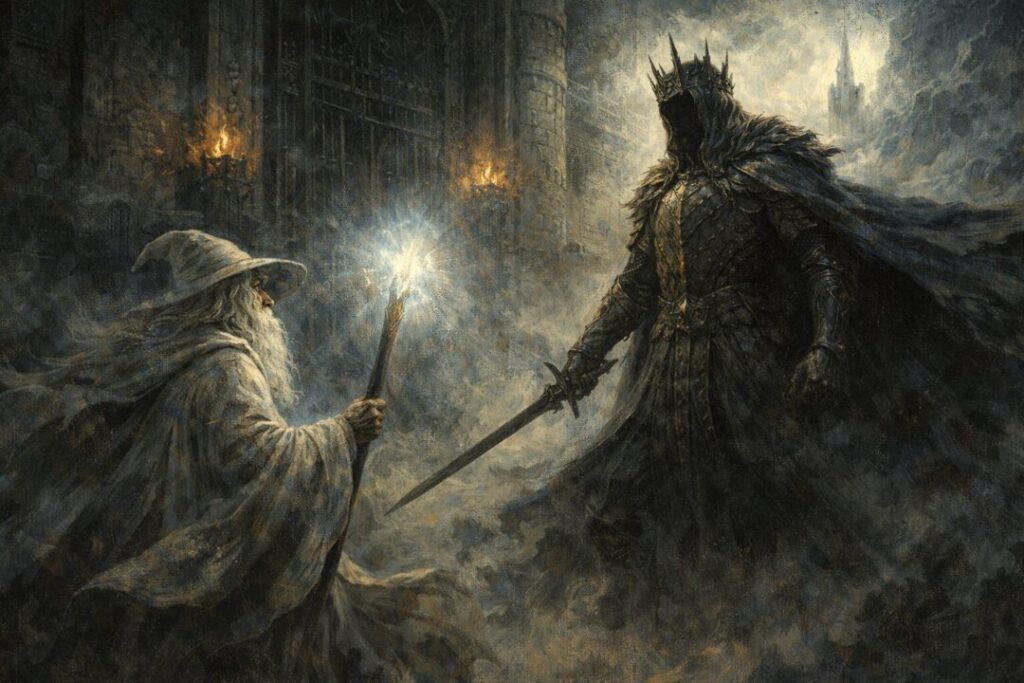
When the Witch-king later ruled Angmar, his cruelty was not erratic. It was systematic.
Angmar was not a kingdom of rage. It was a kingdom of policy.
Fear became law. Terror became structure. Destruction became governance.
This is an important distinction. Madness destroys indiscriminately. The Witch-king destroyed selectively. He targeted kingdoms, bloodlines, hope itself — all with precision.
That is not the behavior of someone who has lost control.
It is the behavior of someone who has refined it.
The Lie of Immortality
The Rings did not grant life.
They postponed death.
And in doing so, they erased everything that gives life meaning.
A mortal life gains urgency from its limits. Choices matter because time is finite. Love matters because it can be lost. Mercy matters because there may not be another chance.
The Witch-king’s Ring dissolved those pressures slowly. Century by century, urgency faded. Identity stretched thin. Purpose narrowed.
Eventually, the man was no longer living a life — he was fulfilling a function.
By the time his physical form faded, there was nothing left to return to.
Why He Could Never Be Redeemed
This is the most uncomfortable truth of all.
The Witch-king was not meant to be saved.
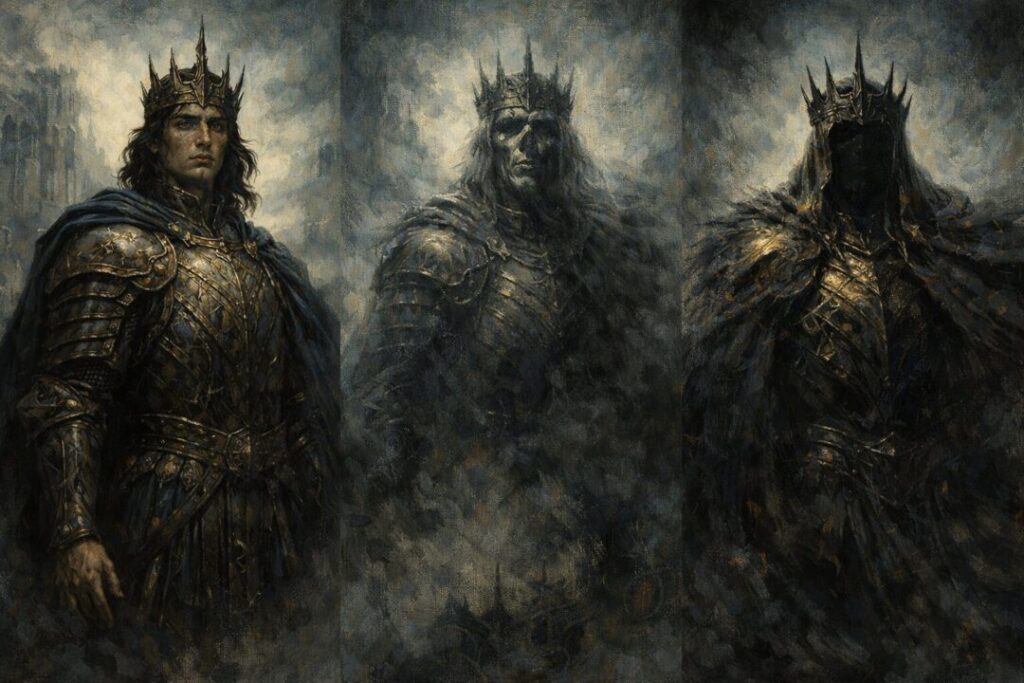
Unlike Gollum, whose corruption clung to a fractured but persistent self, the Witch-king had been hollowed out entirely. Gollum still wanted something. Still feared something. Still loved something, however twisted.
The Witch-king did not.
He was no longer a bearer of a Ring.
He was its outcome.
That is why mercy never reaches him. That is why no voice calls him back. That is why prophecy, not redemption, ends him.
There is no self left to recover.
The Rings Were Never Temporary Tools
This reframes the entire mythology of the Rings of Power.
They were never meant to be borrowed. Never meant to be returned.
They were investments.
Once worn long enough, they always paid out.
Not in loyalty. Not in strength.
But in absence.
And the Witch-king of Angmar stands as the clearest warning of what happens when power outlives the person who wields it.
He was not born a monster.
He was made — patiently, carefully, and permanently.