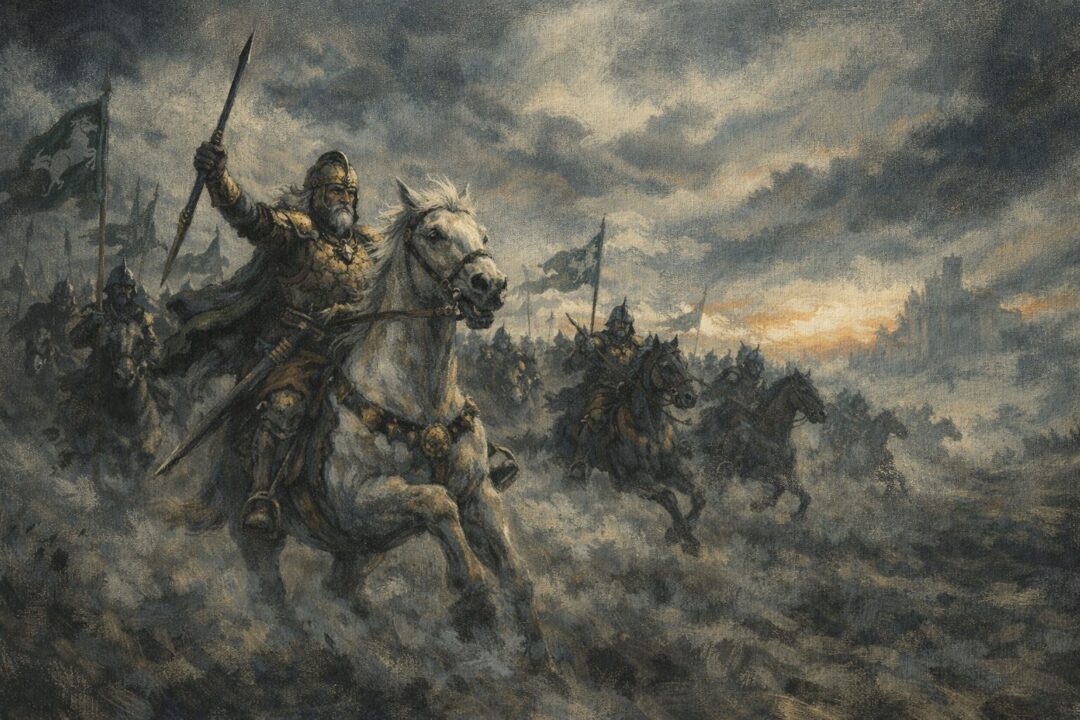
There is a moment in The Return of the King that is often remembered for its sheer spectacle: the horns of Rohan sounding at dawn, the Rohirrim charging across the Pelennor Fields, and the sudden turning of the battle before Minas Tirith.
It is one of the most cinematic passages in the entire legendarium.
But beneath the thunder of hooves and the clash of steel, there is something far quieter happening — something more deliberate, and far more final.
Théoden rides to battle knowing he will not return.
This is not a hidden theory or a romantic reinterpretation. It is written into his character from the moment he is restored, into his age, and into the way he speaks when the end draws near.
By the time Théoden rides from Dunharrow, he is already a man living on borrowed time. The strength that returns to him after the breaking of Saruman’s hold is real — but it is not a reversal of age. The years taken from him by despair, isolation, and manipulation cannot be reclaimed.
He knows this.
And more importantly, he accepts it.
A King Who Understands His Time Is Ending
Théoden’s arc is often misunderstood as a story of recovery — a king restored to power who then rides to glory. But that framing misses something essential.
Théoden is not healed into youth. He is healed into clarity.
When he rises from his chair in Meduseld, when his voice strengthens and his gaze sharpens, what truly returns to him is not vigor, but understanding. He sees his life whole again — not as it once was, but as it now stands.
This is why his decisions after that moment are so striking.
He does not cling to safety.
He does not withdraw to preserve what remains of his life.
He does not try to reclaim lost years.
Instead, he prepares for an ending.
From Helm’s Deep onward, Théoden acts like a man who knows his role is not to endure indefinitely, but to stand correctly when the moment comes.
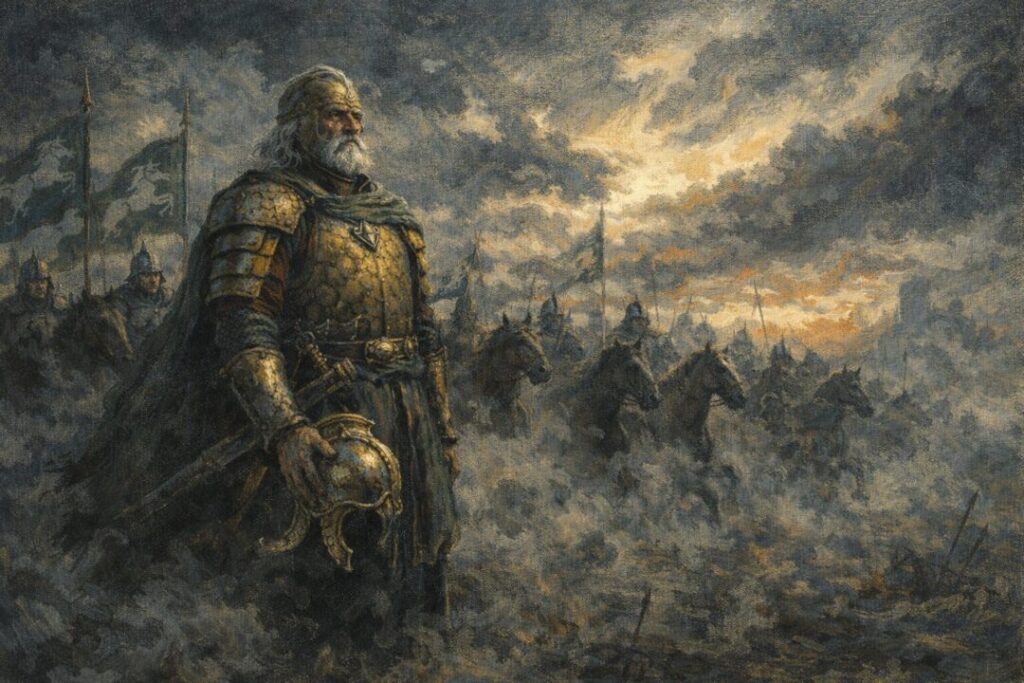
Théoden Is Not a King Chasing Glory
Unlike Aragorn, Théoden does not ride toward a future kingdom that will bear his name.
Unlike Éomer, he does not ride with decades still ahead of him.
Théoden rides as a king who understands that his task is to finish something, not to begin it.
This distinction matters.
Aragorn fights with the weight of destiny before him — a crown not yet claimed, a reign not yet begun. Éomer fights with the fierce hope of survival, with a future he can still imagine living.
Théoden fights with neither of these things.
His words before the charge are not those of a man expecting triumph. They are not tactical. They are not boastful. They are not even hopeful in the usual sense.
When he cries, “Forth, and fear no darkness,” he is not denying death.
He is acknowledging it.
This is courage stripped of illusion — not the courage that believes it will be rewarded, but the courage that acts even when no reward is expected.
The Weight of Age in Middle-earth
Age matters in Middle-earth, and Tolkien never treats it lightly.
Old warriors are not portrayed as useless, but neither are they portrayed as untouched by time. Strength can return, but years still weigh upon the body and the spirit.
Théoden’s restoration does not erase what was done to him. It gives him the clarity to see it — and to understand that what remains of his life must be spent well.
This is why his ride feels different from those around him.
The young may fight hoping to survive.
The old fight knowing survival is uncertain.
Théoden rides anyway.
Not because he believes he cannot die — but because he knows that some moments demand presence, regardless of outcome.
Why the Charge at the Pelennor Feels Different
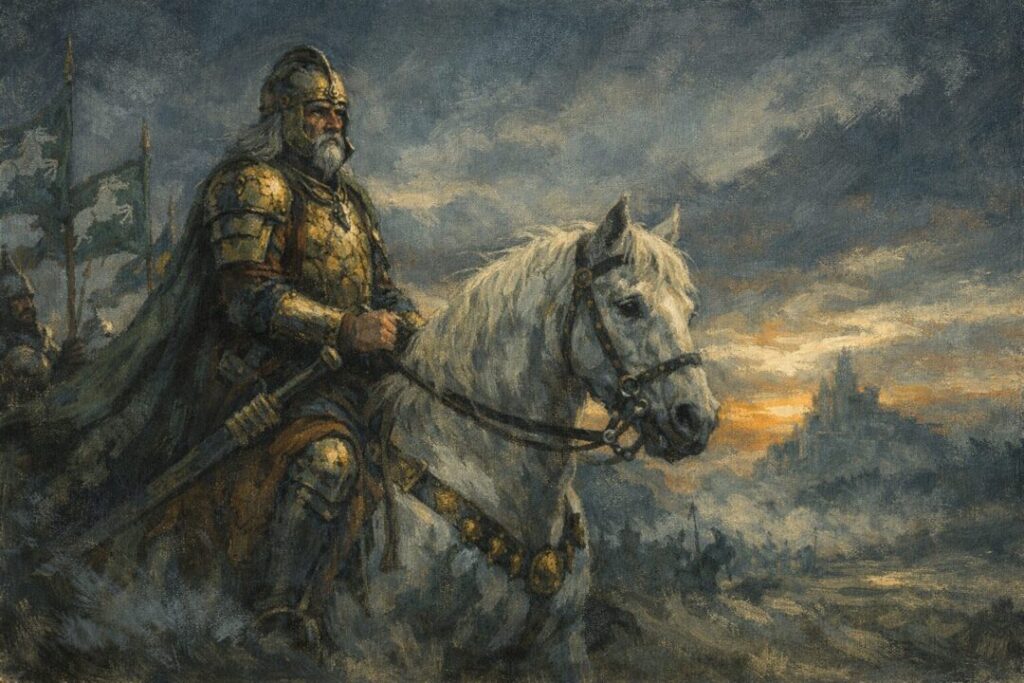
The charge of the Rohirrim is not just a military maneuver. It is an answer.
Minas Tirith stands on the brink of collapse. The night has been long. The defenders are exhausted. Hope has narrowed to a thread.
And then Rohan arrives.
Not cautiously.
Not defensively.
But openly, in full knowledge of the cost.
Théoden does not ride at the rear. He rides at the front.
This is not recklessness. It is leadership of a very particular kind — the kind that says, I will not ask you to go where I will not.
The king does not survive behind his men. He rides where death is most likely to fall.
And when it does, it falls on him.
Why His Death Feels So Different
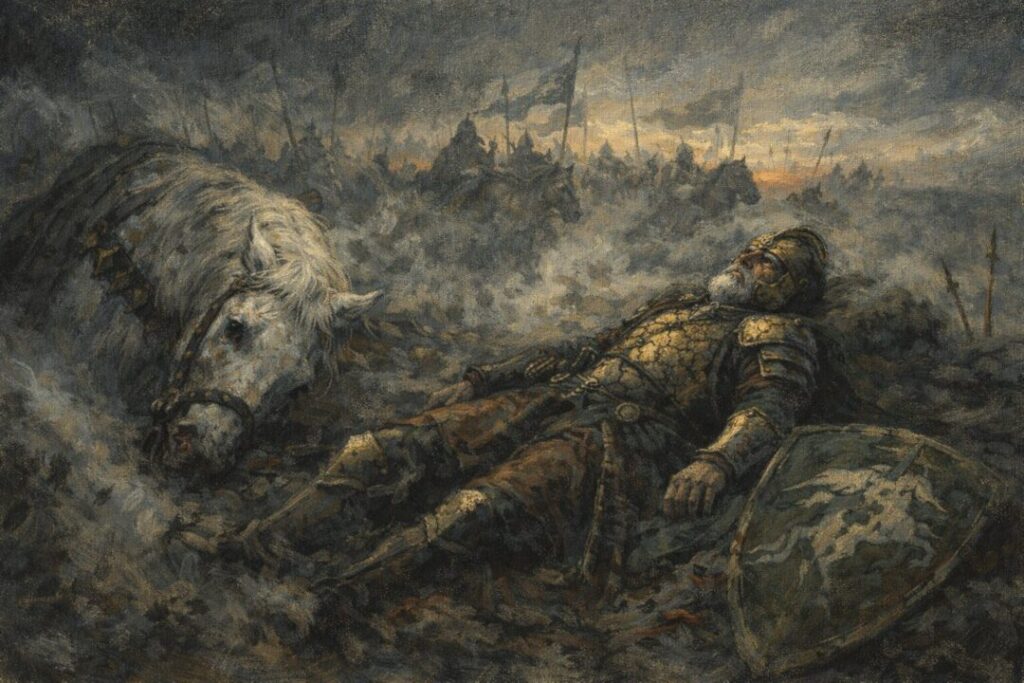
When Théoden falls beneath his horse, crushed and mortally wounded, there is no triumphant speech, no final proclamation of victory.
His last words are quiet. Almost relieved.
He has seen enough.
He has seen his people answer the call.
He has seen the Rohirrim stand when it mattered most.
He has seen courage pass from one generation to the next.
He does not need to see the war’s end.
That is what makes his death feel so heavy — and so complete.
Théoden does not die grasping for reassurance. He dies knowing that what needed to be done has been done.
Courage as Bearing Witness
Théoden’s heroism is not about winning.
It is about bearing witness.
About showing those who ride behind him what it looks like to stand when hope is thin, when victory is uncertain, and when the cost is fully understood.
His presence at the Pelennor is not strategic necessity alone. It is symbolic necessity.
A king of Men stands against the darkness — not because he expects to overcome it by force, but because refusing to stand would mean surrendering something far worse than life.
A King of Men, Not of Legend
Théoden is not immortal.
He does not wield ancient magic.
He does not shape the world through hidden power or prophecy.
He is a Man of Rohan.
And that is precisely why his choice matters.
Middle-earth is not saved by those who expect to live forever. It is saved by those who accept that they will not — and choose to act anyway.
Elves may fade.
Wizards may depart.
Kings of Men must decide how they meet the end of their days.
Théoden meets his not with denial, but with clarity.
Why His Courage Still Echoes
Théoden’s last ride is not tragic because he dies.
It is profound because he chooses the moment to stand.
Long after the clash of arms fades, long after banners fall and songs are sung, what remains is not the victory itself — but the image of a king who understood his time had come, and did not turn aside.
That is why his courage still echoes.
Not as legend.
Not as spectacle.
But as one of the most human acts in all of Middle-earth.