This post may contain affiliate links, and I might earn a small commission at no extra cost to you. Learn more.
We often talk about Thorin Oakenshield as a cautionary tale about greed.
The proud dwarf-king who reclaimed his mountain, only to lose himself to dragon-sickness. The ruler who let gold matter more than lives. The tragic figure undone by obsession at the very moment he should have triumphed.
It’s a simple explanation — and an unsatisfying one.
Because it turns Thorin into a warning sign instead of a person.
Thorin wasn’t destroyed by wealth.
He was destroyed by memory.
A King Shaped by Loss Before the Story Begins
When we first meet Thorin in The Hobbit, his story has already been broken once.
He remembers Erebor as it was before the fire. Before Smaug. Before exile turned a people into wanderers. He remembers the sound of hammers in the forges, the glow of lamplit halls, the sense of permanence that only a mountain can give.
And then he remembers losing it.
His grandfather, Thrór, did not merely lose his kingdom — he lost himself. The dragon-sickness that later touches Thorin first destroyed the king he loved, and then led to Thrór’s murder at the hands of Orcs. Thorin’s father, Thráin, survived longer, but not well. He wandered, broken and diminished, until even his mind was taken from him.
This is the inheritance Thorin grows up with.
Not gold — but grief.
So when Thorin speaks of reclaiming the Lonely Mountain, he is not chasing glory. He is chasing stability. He is trying to undo a wound that never closed.
For Thorin, reclaiming Erebor is not ambition.
It is survival.
The Weight of a Lost Kingdom
Exile teaches a brutal lesson: everything you have can be taken.
Thorin learns early that safety is temporary, that mercy often comes too late, and that once you lose a home, the world never quite stops moving beneath your feet. Every year spent wandering reinforces the same fear — that what was lost will never truly return.
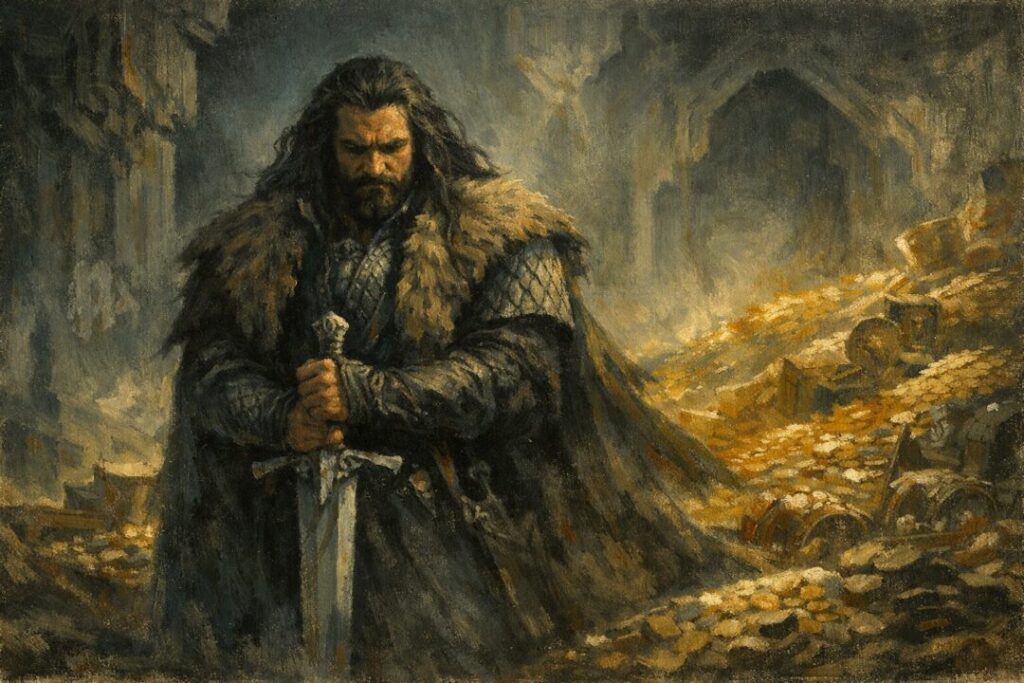
So when Thorin finally stands beneath Erebor again, surrounded by stone and treasure and echoes of the past, he does not feel relief.
He feels terror.
Because now there is something to lose again.
The gold becomes more than wealth. It becomes proof. Proof that the suffering meant something. Proof that the stories were real. Proof that exile was not the final word.
To let go of that treasure feels, to Thorin, like admitting that the years of loss were meaningless.
Why the Arkenstone Matters
The Arkenstone is often misunderstood as a symbol of greed.
But within the story, it represents something far more dangerous: validation.
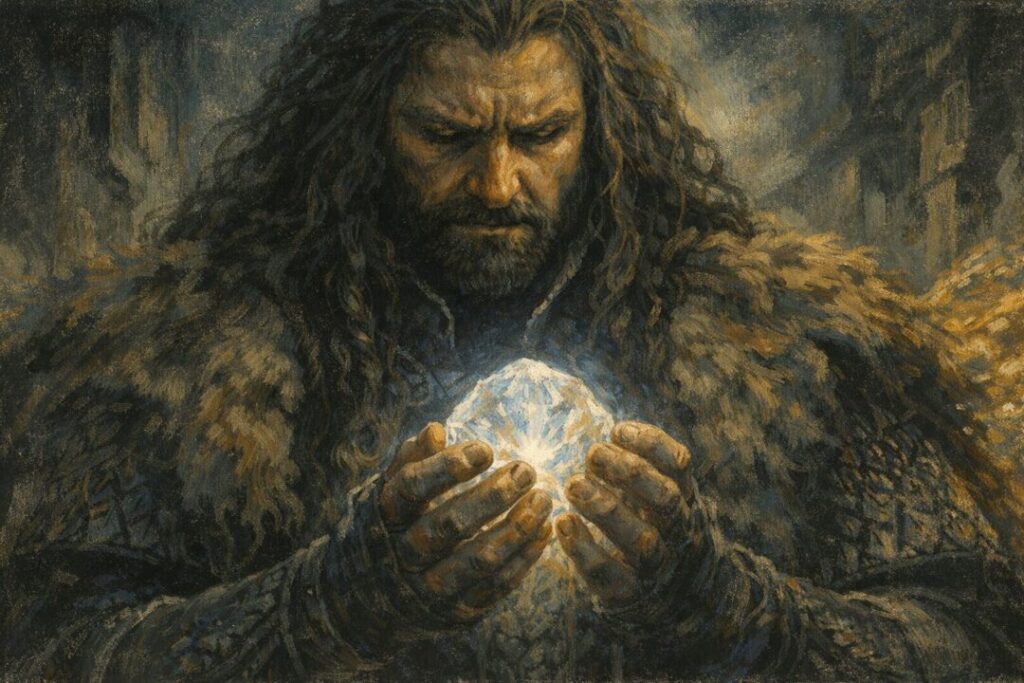
It is the Heart of the Mountain. A symbol of kingship, yes — but also of continuity. The Arkenstone connects Thorin to Erebor as it once was, not as it might become. It is a relic of the past he is desperate to restore perfectly.
This is why its loss strikes him so deeply.
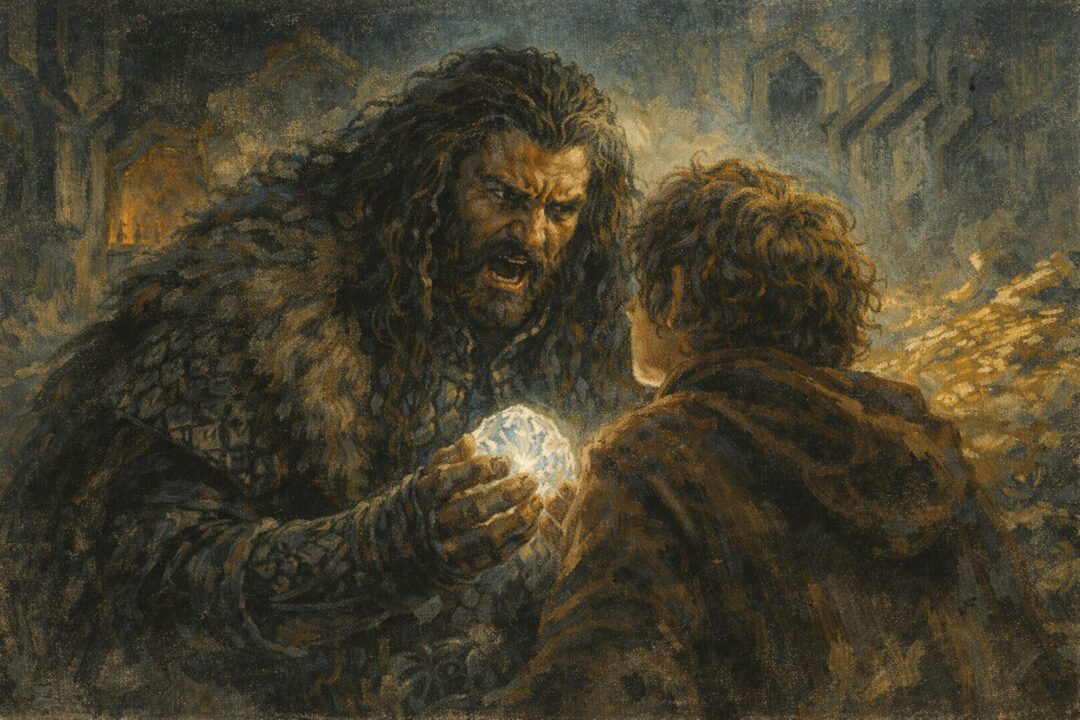
Bilbo’s possession of the Arkenstone is not merely theft in Thorin’s eyes. It is a threat to the narrative Thorin has built for himself — the belief that everything lost can be reclaimed exactly as it was, if only he holds tightly enough.
Dragon-Sickness Isn’t About Gold
Dragon-sickness is often described as greed, but that word flattens what is happening to Thorin.
He does not crave wealth for pleasure. He does not revel in luxury. He clings to the hoard because it feels like the only thing standing between him and another exile.
Every perceived threat feels existential.
Every negotiation feels like surrender.
Every compromise feels like erasure.
Thorin becomes harsh not because he enjoys power, but because he is terrified of being made powerless again.
This fear turns inward. It isolates him. It convinces him that loyalty must be tested, that generosity is weakness, that mercy invites ruin.
And this is why Bilbo’s actions cut so deeply.
Why Bilbo’s “Betrayal” Hurts More Than the Arkenstone
Bilbo’s decision to give up the Arkenstone is not just a political move — it is a moral one. He chooses people over possession. Peace over legacy. The future over the past.
To Thorin, this feels unbearable.
Not because Bilbo took a jewel — but because Bilbo proved that the past does not have to be restored exactly as it was to still matter. That loss does not invalidate meaning. That letting go does not erase history.
That idea threatens Thorin more than any army.
Because if it is true, then all the suffering cannot be “fixed” by gold.
The Moment That Changes Everything
Thorin’s redemption does not come in battle.
It comes in silence.
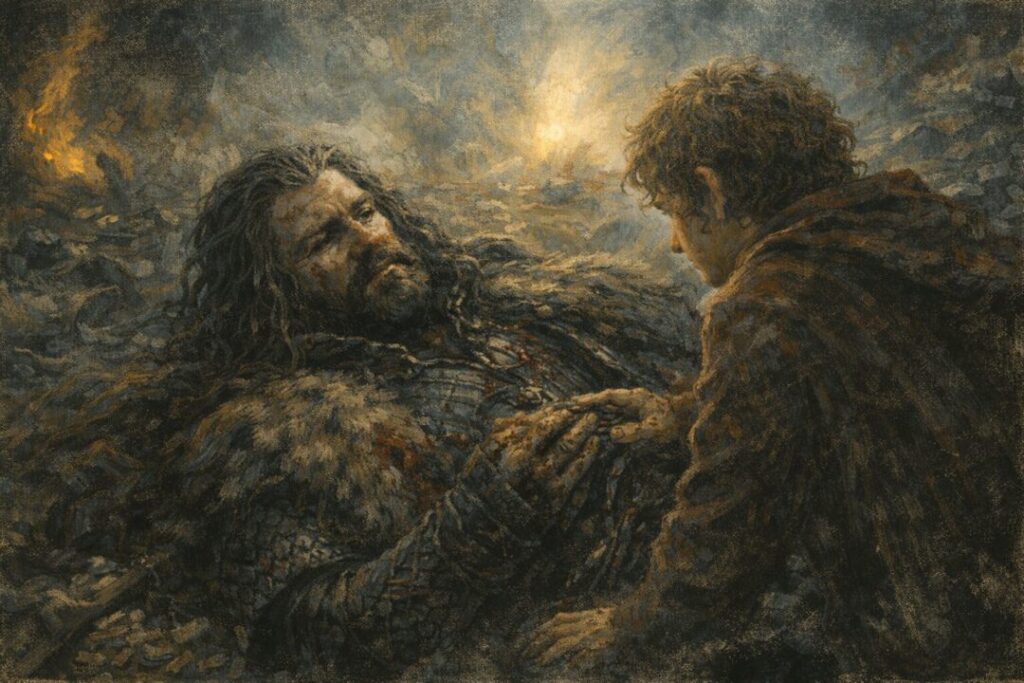
Wounded and dying after the Battle of Five Armies, stripped of power and certainty, Thorin finally has no strength left to cling. And in that stillness, clarity arrives.
He sees the people he pushed away.
He sees the kindness he rejected.
He sees how close he came to sacrificing the future for a perfect version of the past.
And for the first time, he lets go.
Not of Erebor — but of the lie that possession could heal him.
His apology to Bilbo is devastating because it is honest. He does not blame gold. He does not blame others. He recognizes his own fear, his own blindness, and the cost of it.
“If more of us valued food and cheer and song above hoarded gold, it would be a merrier world.”
Those words matter because Thorin did not always believe them.
But he does at the end.
Why Thorin’s Story Endures
Thorin Oakenshield is not tragic because he falls.
He is tragic because his fall makes sense.
He is what happens when grief goes unexamined. When memory hardens into identity. When the past is allowed to dictate every future choice.
And yet, his final act matters.
He does not die clutching gold.
He does not die denying his mistakes.
He does not die alone.
He dies having understood what truly mattered — friendship, loyalty, and a future not chained to loss.
That is why Thorin Oakenshield is remembered not as a villain.
But as a king who learned, too late, what it meant to be whole.