The Voice Was Saruman’s Greatest Weapon, Not Proof of Greater Power
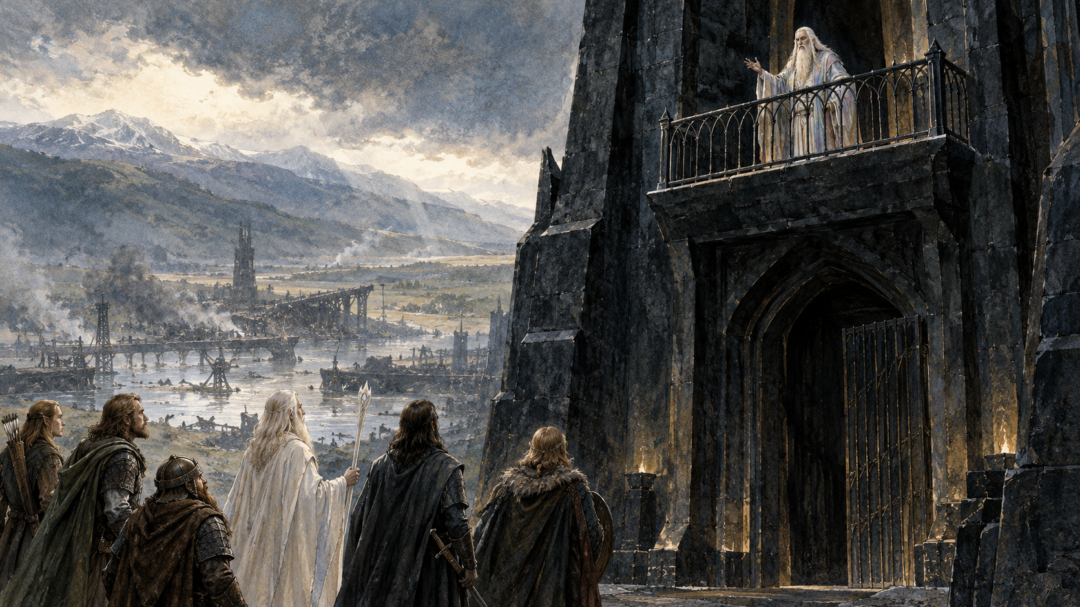
At Orthanc, Saruman wields a power Gandalf does not attempt to match. His voice captivates enemies, makes treachery sound reasonable, and turns listeners against their allies. Yet Gandalf ultimately commands Saruman, removes him from his position, and breaks his staff. The apparent contradiction disappears once persuasive enchantment is distinguished from the wider authority of the two Wizards.
Saruman’s voice is more explicitly depicted as an instrument of supernatural persuasion than Gandalf’s, but that does not make Saruman the more powerful Wizard at Orthanc. Neither does Tolkien attribute his enchantment to centuries of training or physical elevation. Those explanations are plausible speculation, not established canon.
The decisive evidence appears in The Two Towers, Book III, Chapter 10, ‘The Voice of Saruman.’ Tolkien presents no contest between competing magical voices. Instead, a defeated master of persuasion attempts to recover influence after the collapse of his military strength and political credibility.
Saruman’s remaining weapon is formidable because listeners struggle to distinguish the attraction of his speech from its merits. Gandalf’s advantage is different: he understands the enchantment, resists it, and possesses authority to judge its wielder.
Tolkien’s Wizards cannot be ranked by a single measure of magical force. Their native capacities, wisdom, responsibilities, permitted actions, and choices all shape what power means in a particular encounter.
What Saruman’s Enchantment Actually Does
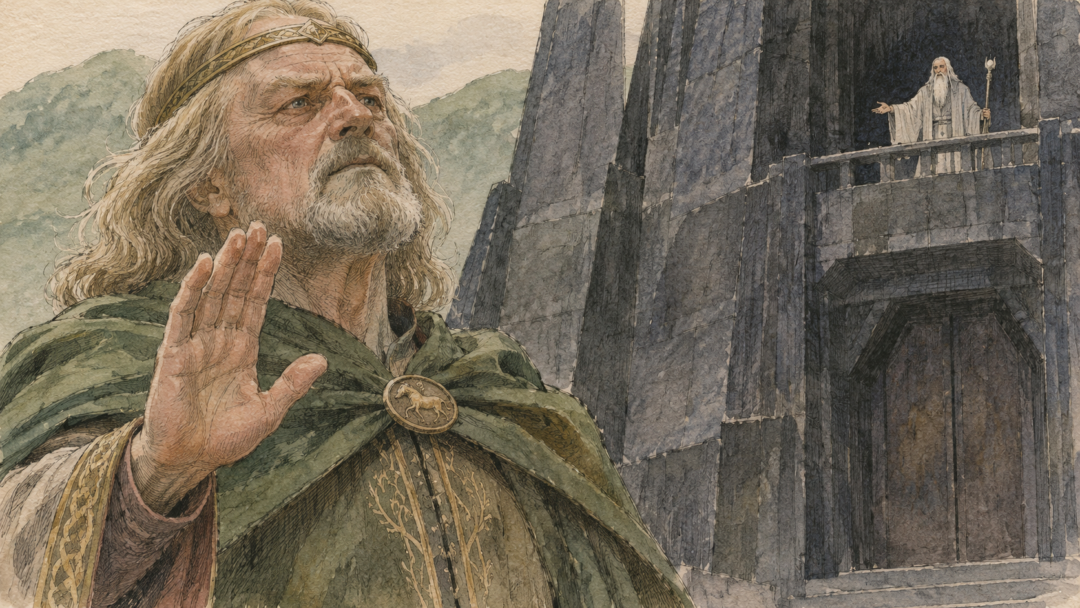
Tolkien describes Saruman’s voice as ‘low and melodious,’ its sound inherently enchanting. Its attraction does not depend simply on eloquence or truthful argument.
Listeners perceive Saruman as reasonable and wise. Contradicting him becomes emotionally difficult; opponents appear foolish or uncivil, while Saruman seems patient and sympathetic. His voice changes how listeners assess both the speaker and those challenging him.
The narrative reveals a telling weakness: people who listen unwarily may afterward struggle to remember what made his arguments compelling. Away from the voice itself, the reasoning can seem much less impressive. This suggests enchantment operating through the experience of hearing Saruman, rather than through permanently irresistible logic.
Its effects vary. Saruman directs attention toward particular listeners, and some remain attracted after his attention shifts, while others recover their judgment. The influence is powerful but neither uniform nor irresistible.
This phenomenon might be called persuasive ‘projection,’ but that is a modern explanatory label, not a defined Tolkienian magical technique. The chapter describes no invisible beam, amplification spell, or measurable field of influence. Saruman’s enchantment works through audible speech, emotional response, and judgment. Its reach is associated with hearing, although its consequences may persist afterward.
It is coercive in tendency without constituting infallible mind control. Saruman can make submission attractive, but cannot guarantee obedience. The confrontation at Orthanc demonstrates that limitation.

Why the Confrontation Does Not Establish Saruman’s Superiority
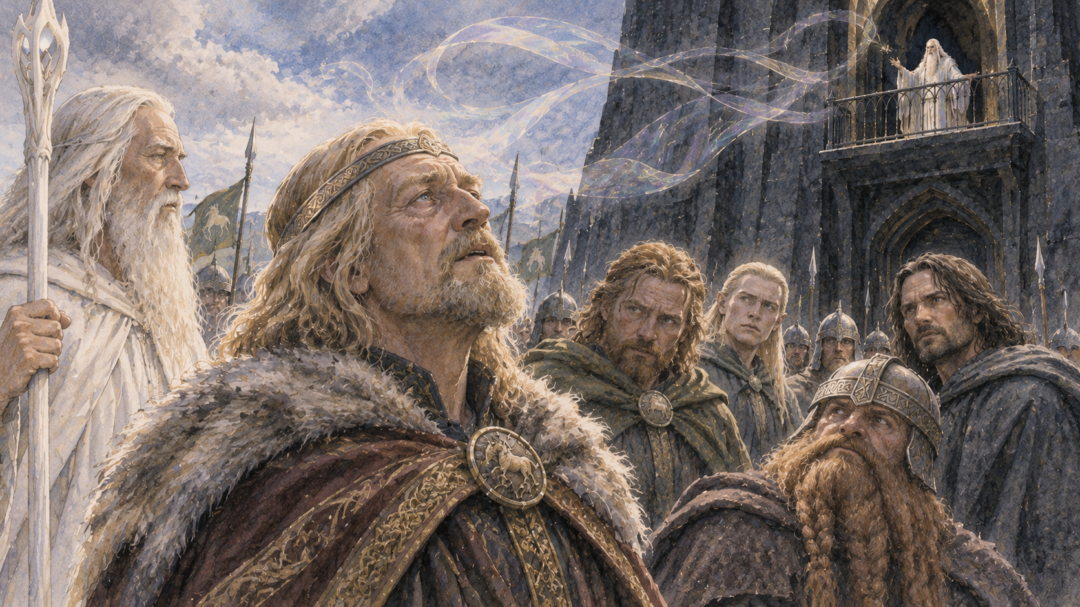
Saruman addresses an audience vulnerable to carefully chosen appeals. Théoden has recently escaped Gríma Wormtongue’s influence, Isengard has suffered catastrophic defeat, and Rohan remains threatened by a greater enemy. Saruman presents himself as an indispensable source of wisdom and assistance.
He offers Théoden renewed relations while encouraging distrust of the companions who helped overthrow his influence. This is political manipulation as well as enchantment: Saruman exploits genuine anxieties about the war.
Théoden nevertheless refuses. He hears the captivating voice but judges Saruman by his actions. His resistance establishes that supernatural persuasion does not eliminate moral choice.
Saruman next approaches Gandalf more conciliatorily, suggesting private discussion and renewed cooperation. He presents their conflict as a disagreement that wiser minds might resolve away from hostile spectators.
Gandalf does not reply with a sweeter voice or any explicitly identified counter-enchantment. He laughs, exposes the absurdity of Saruman’s proposal, and rejects its assumptions. His laughter punctures the solemn authority Saruman seeks to create.
The company remains vulnerable, however. Tolkien records the doubts stirred by Saruman’s words, including fears that Gandalf might abandon his companions. Gandalf’s composure does not mean the enchantment presents no danger.
Nevertheless, Saruman fails to persuade Gandalf, while Gandalf subsequently exercises authority over him.
Saruman demonstrates the more specialized power of seductive speech; Gandalf demonstrates greater effective authority in this confrontation. Tolkien provides no neutral experiment comparing their respective capacities for vocal enchantment.
Gandalf the Grey and Gandalf the White Are Not the Same Comparison
Any comparison must account for Gandalf’s transformation. Saruman originally held the foremost position among the Istari. At the Council of Elrond, Gandalf describes him as the greatest of his order, reflecting Saruman’s acknowledged standing before his treachery became fully apparent.
Unfinished Tales, in ‘The Istari,’ likewise identifies Saruman as head of the Order and emphasizes his fair voice and craftsmanship. These details support the conclusion that Saruman originally possessed important distinguishing capacities.
They do not establish that his persuasive enchantment exceeded Gandalf’s comparable ability. Tolkien never depicts Gandalf using an identical enchantment that would permit direct measurement.
More importantly, the Gandalf confronting Saruman is Gandalf the White. After battling the Balrog and dying, he returns transformed. In ‘The White Rider,’ he identifies himself as Saruman should have been; his changed standing is evident in his encounters with Aragorn, Legolas, and Gimli.
Tolkien’s Letter 156 explains Gandalf’s return through higher authority, not merely private study or newly acquired spells. His restoration follows the exceptional circumstances of his sacrifice and mission.
Consequently, Gandalf’s new authority is not simply the product of accumulating greater experience. His role in opposing Sauron has changed.
Saruman’s earlier pre-eminence cannot automatically determine the balance at Orthanc. That would confuse Saruman’s former standing with Gandalf’s position after his return.
Even if Saruman once exceeded Gandalf in certain capacities, the confrontation does not depict him successfully asserting that superiority over Gandalf the White.
Does Orthanc’s Height Strengthen Saruman’s Voice?
The premise requires correction: Saruman does not address Gandalf from Orthanc’s summit. He appears at a window and balcony overlooking the great entrance, above the assembled company.
He is physically elevated, but nowhere near the tower’s full height. The participants can hear and answer one another; the episode is not a demonstration of magical speech spanning an enormous vertical distance.
Orthanc nevertheless contributes to the encounter’s theatrical force. Built through ancient Númenórean craftsmanship, the imposing tower is Saruman’s last unconquered refuge. From its balcony, he occupies the architectural position of a lord addressing visitors beneath him.
That arrangement creates a striking contrast between apparent status and actual power. Saruman looks down from a fortress but remains imprisoned inside it. Gandalf stands below, yet has the freedom to determine the encounter’s terms.
This symbolism is an interpretation of Tolkien’s staging, not a stated magical principle.
Nothing in the published description establishes that elevation strengthens Saruman’s enchantment, increases its range, or makes it superior to Gandalf’s speech. Orthanc is never identified as a vocal amplifier.
The tower’s extraordinary physical strength must also be distinguished from supernatural power granted to its occupant. Its resistance to destruction does not establish that its stone enhances vocal sorcery.
Saruman’s elevated position may reinforce theatrical dignity and the impression of command. Those are effects of staging and rhetoric, not demonstrated magical advantages.
The scene’s irony is that the man above the doorway possesses less freedom than the Wizard standing beneath it.
Did Centuries of Practice Make Saruman’s Voice Stronger?
The argument from practice has some plausibility because Tolkien portrays Saruman as exceptionally learned and experienced.
Appendix B of The Lord of the Rings places the Wizards’ arrival in Middle-earth around Third Age 1000. Saruman established himself in Isengard in 2759, receiving Orthanc from Gondor’s Steward. By the confrontation in 3019, he had occupied the stronghold for approximately 260 years.
This provided ample opportunity to gather information, cultivate agents, devise schemes, and accumulate political influence. The chronology supports prolonged activity and preparation.
It does not establish a program of vocal training. Tolkien describes no exercises, progressive improvements, or enchantment technique strengthened through repetition. Nor does Saruman’s chronology prove that he possessed more relevant experience than Gandalf, who likewise spent centuries travelling and working among Middle-earth’s peoples.
Learning must also be distinguished from native ability. ‘The Istari’ already characterizes Saruman through his fair voice and exceptional skills. His later enchantment may therefore express capacities belonging to his particular nature, although Tolkien does not specify how far they developed afterward.
Years of intrigue could plausibly have sharpened Saruman’s ability to select arguments, identify vulnerabilities, and exploit fear. That is an interpretation consistent with his conduct, not documented magical training.
Greater age itself proves nothing. The Silmarillion and Unfinished Tales identify both Wizards as Maiar existing before their embodied missions. Their apparent human ages cannot adequately measure their underlying nature.
Saruman’s residence in Orthanc undoubtedly helped him accumulate knowledge and worldly resources. Whether it increased his voice’s intrinsic magical strength remains unknown.
Experience may explain his sophisticated manipulation, but Tolkien never identifies accumulated practice as the source of his enchantment or any superiority over Gandalf.
Gandalf’s Commands Reveal the Real Balance of Authority
The confrontation’s ending provides the clearest evidence against Saruman’s supposed superiority.
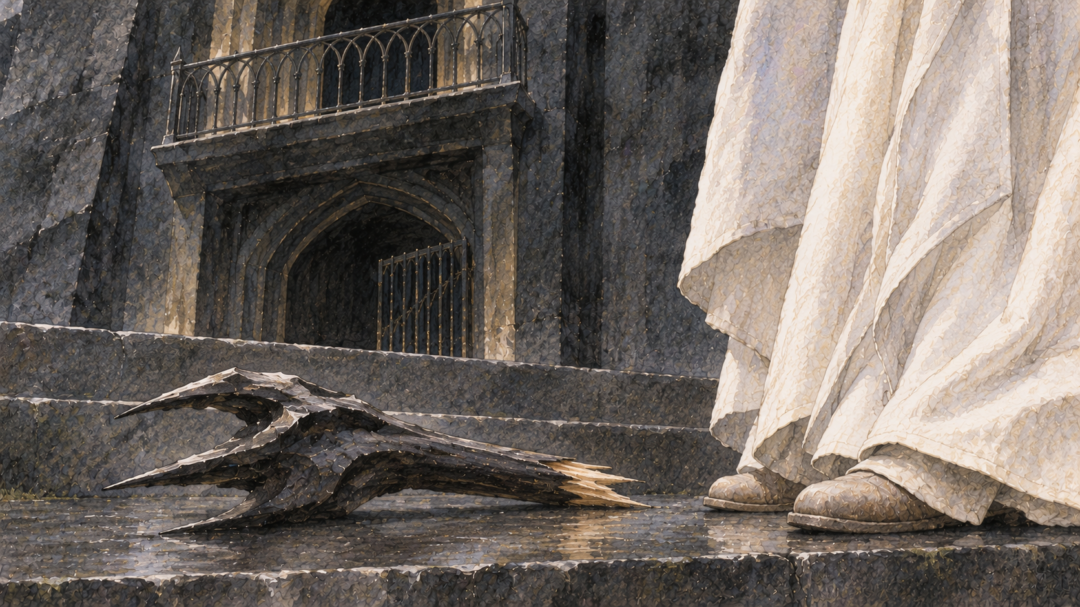
When Saruman retreats from the balcony, Gandalf commands him to return. Saruman obeys against his evident wishes. Gandalf then removes his authority as head of the Council and the Order of Wizards and breaks his staff.
This is more than victory in debate. Gandalf’s words accomplish an extraordinary exercise of power that Saruman cannot resist.
That does not establish that Gandalf could reproduce Saruman’s persuasive enchantment more effectively. Their demonstrated powers serve different purposes. Saruman seeks to capture judgment and redirect allegiance; Gandalf pronounces a sentence removing Saruman’s recognized authority.
Gandalf also offers Saruman a way to change course, involving surrender of Orthanc and cooperation against Sauron. Saruman refuses. His humiliation follows not merely defeat in a contest of wills, but rejection of an offered alternative.
Tolkien makes Saruman’s declining influence explicit: the power of his voice is waning. Yet his subsequent appearance in ‘The Scouring of the Shire’ shows that manipulation and malice have not disappeared.
His loss of authority therefore need not mean the instantaneous extinction of every native capacity. Saruman is profoundly diminished without necessarily losing every quality associated with his former power.
What matters at Orthanc is that Saruman cannot overcome Gandalf’s command. Whatever advantages he once possessed fail to determine the encounter’s outcome.
Gandalf’s victory establishes superior authority in this situation more convincingly than Saruman’s enchanting voice establishes overall superiority.
The Final Distinction: Persuasion Is Not Authority
Saruman’s voice reflects Tolkien’s broader treatment of corrupted power. He seeks to subordinate other wills to his designs, offering wisdom and cooperation while encouraging listeners to surrender independent judgment to someone who has betrayed their trust.
Gandalf represents a contrasting purpose. In Unfinished Tales, ‘The Istari’ explains that the Wizards were sent to oppose Sauron through counsel and encouragement, not by dominating Middle-earth’s peoples. Saruman’s methods increasingly violate that mission.
This does not mean Gandalf’s speech lacks supernatural power. Rather, his authority operates differently. At Orthanc he exposes deception, offers a genuine choice, and acts when Saruman refuses it.
The question of whose voice is stronger therefore depends on what ‘stronger’ means.
If it means the voice most explicitly endowed with supernatural persuasiveness, Saruman is the clearest example. Tolkien describes his enchantment in unusual detail and places it at the chapter’s center.
If it means whose spoken commands prevail, Gandalf is demonstrably superior. Saruman cannot master him, whereas Gandalf’s judgment takes effect upon Saruman.
If it means intrinsic vocal magic measured under identical conditions, the published texts remain silent. Tolkien stages no such comparison and supplies no absolute ranking.
Neither proposed explanation for Saruman’s supposed advantage is established. Centuries of activity provide experience, not documented enchantment training. Orthanc’s balcony provides commanding appearance, not demonstrably increased magical strength.
The scene’s irony is decisive: Saruman can make weakness sound like wisdom but cannot persuade the one person whose recognition might restore him. Gandalf, without matching Saruman’s seductive performance, brings the encounter to its conclusion.
Saruman’s voice is the more dangerous instrument of persuasion; Gandalf’s carries greater authority at Orthanc. Tolkien attributes neither distinction to tower height or centuries of practiced projection.
Sources & Notes
This article is based on close reading and interpretation of Tolkien's published works and related source material where relevant.