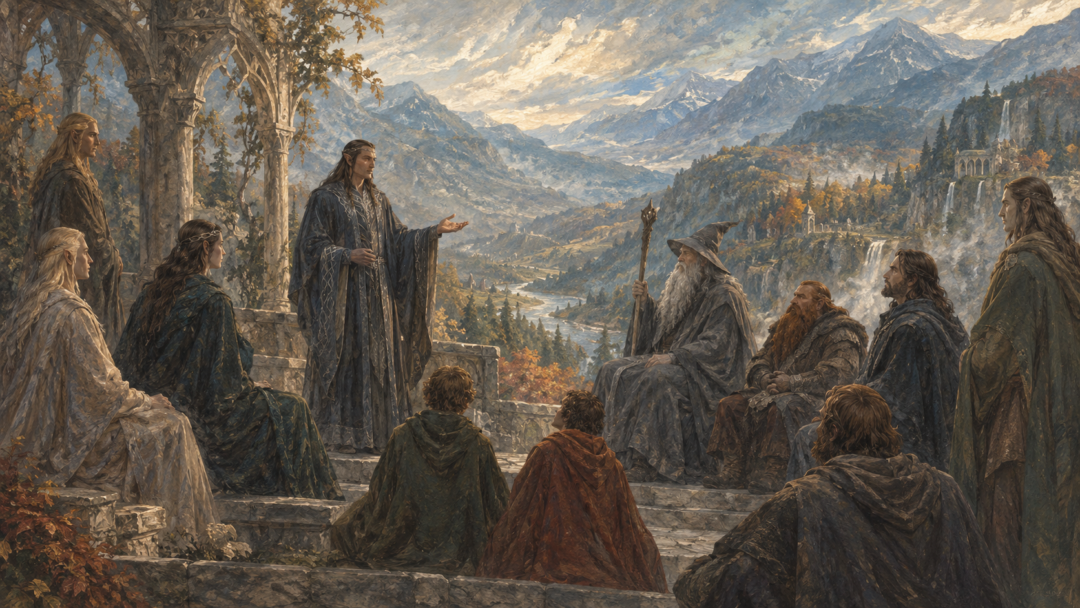
At the Council of Elrond, the old wars refuse to stay buried. Elrond remembers marching beside Gil-galad, seeing Elendil fall, and witnessing the defeat of Sauron himself. Yet the Ring taken from the Dark Lord’s hand has returned to Rivendell, bringing danger with it. The scene invites a strange question: if Elves once stood against Morgoth, the greater evil of the Elder Days, why can their descendants scarcely face Sauron?
The answer begins with a correction. The Elves of Beleriand did not defeat Morgoth on their own; a mighty host from the West finally overthrew him. Sauron, meanwhile, was defeated militarily by the Last Alliance before returning as the threat of the Third Age. Elven losses mattered, but “harder to defeat” describes what each age could muster—and what counted as victory—better than it describes a simple ranking of Dark Lords.
The First Age: Morgoth Fell Only When the West Intervened
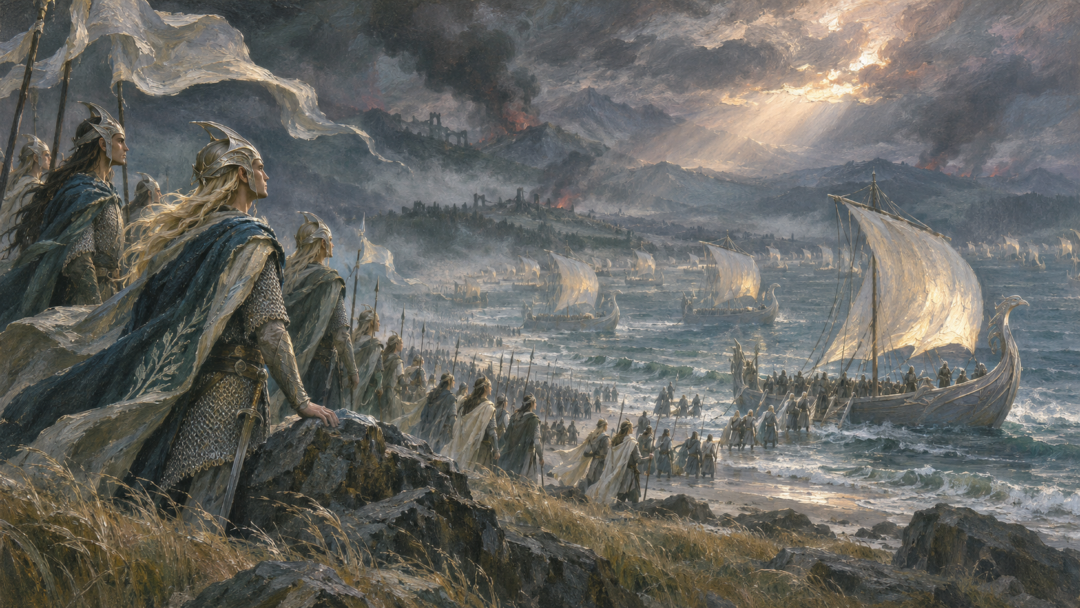
By the end of the First Age, the great Elven realms of Beleriand were shattered. Nargothrond had fallen, Gondolin had been destroyed, and Doriath was gone. The disastrous Battle of Unnumbered Tears had already broken the hope that the kingdoms of Elves and their human allies could defeat Morgoth by force. Courage had not brought victory. The survivors were driven toward the coasts, not assembling for one final triumphant assault on Angband.
The turning point came through Eärendil, who reached the Blessed Realm to plead for the peoples suffering under Morgoth. Chapter 24 of The Silmarillion, “Of the Voyage of Eärendil and the War of Wrath,” describes the host prepared in response. Under the leadership of Eönwë, herald of Manwë, marched the Vanyar and the Noldor who had remained in Aman, including forces under Finarfin. Maiar also took part. This was help from beyond Middle-earth, not renewed strength in the ruined kingdoms.
The War of Wrath was no effortless victory. Morgoth unleashed terrible forces, including his winged dragons; Eärendil’s battle with Ancalagon belongs to this final struggle. The war devastated the land it was fought over, and much of Beleriand was lost beneath the sea. Nor does the published account establish that every Vala personally entered combat. Morgoth’s overthrow required aid unavailable to the peoples who had fought him for generations.
Morgoth was also not an unchanged version of the being who first entered the world. He was a Vala, while Sauron was a Maia, but those origins are not a dependable measure of their battlefield strength at every later date. In the later writings collected in Morgoth’s Ring, Morgoth’s desire to dominate Arda involves pouring his power into the fabric of the world and its corruption. That vast dispersal helps explain why his late condition cannot be equated with his primeval might. It does not make the War of Wrath small, or turn Sauron into the greater original spirit.
The Second Age: A Diminished World Still Defeated Sauron
After Beleriand’s ruin, the map of Elven power changed. Many survivors sailed west, while others established or inhabited realms such as Lindon and, later, Rivendell and Lórien. Yet the Second Age was not a period in which the Elves could only hide. Gil-galad ruled in Lindon, and the Elves resisted Sauron long before the final alliance. They suffered grievously—Eregion was destroyed—but remained a political and military force capable of acting with others.
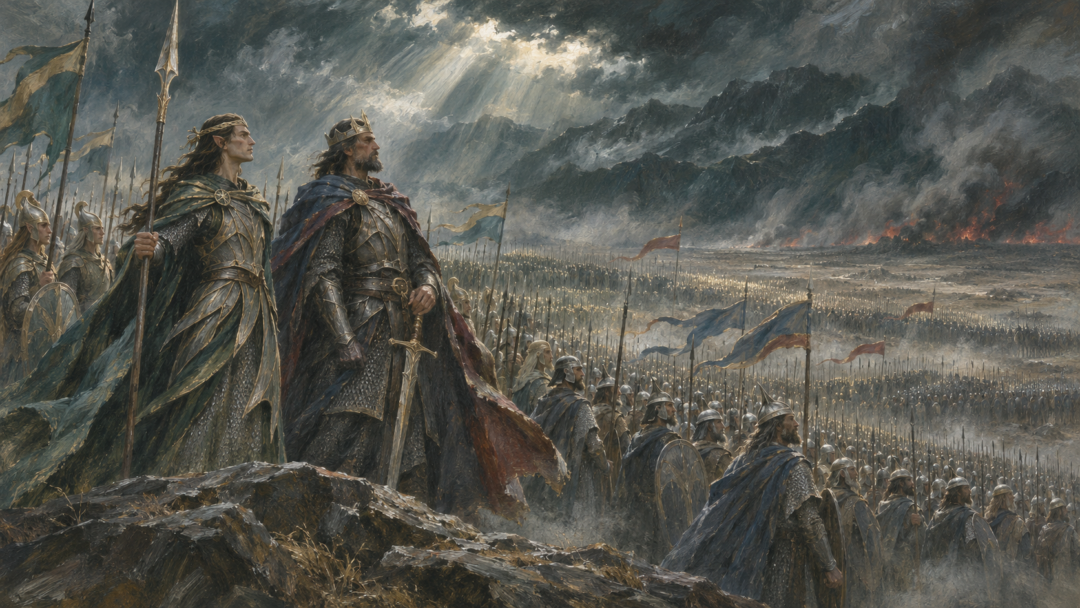
They joined the surviving Númenóreans under Elendil and his sons. Following Númenor’s downfall, Gil-galad and Elendil formed the Last Alliance of Elves and Men. Its armies gathered, marched into Mordor, won at Dagorlad, and besieged Barad-dûr. Elrond, speaking in “The Council of Elrond” in The Fellowship of the Ring, remembers the host as splendid, recalling the glory of ancient Elven armies. Yet he specifically judges it smaller and less fair than the host that broke Thangorodrim at the end of the First Age.
Elrond witnessed the later campaign himself. He was Gil-galad’s herald, not someone reconstructing the event from distant legend. The Last Alliance was magnificent without matching the force that confronted Morgoth. It also succeeded in what its armies set out to do. At the end of the siege, Gil-galad and Elendil fought Sauron on the slopes of Orodruin. Both leaders died, Sauron was overthrown, and Isildur cut the One Ring from his hand with the broken sword Narsil.
The catastrophe lay in what followed. Isildur kept the Ring rather than destroy it, and its survival left Sauron a path back to power. When Isildur was killed and the Ring lost, the chance to end that danger seemed to vanish with him. This was neither an outright military failure nor an enduring liberation. The Elves had lost Gil-galad, the Men had lost Elendil, and both peoples had lost the opportunity for a more final victory. None of this means Sauron was too mighty for the Alliance.
What Had Actually Happened to the Great Elves?
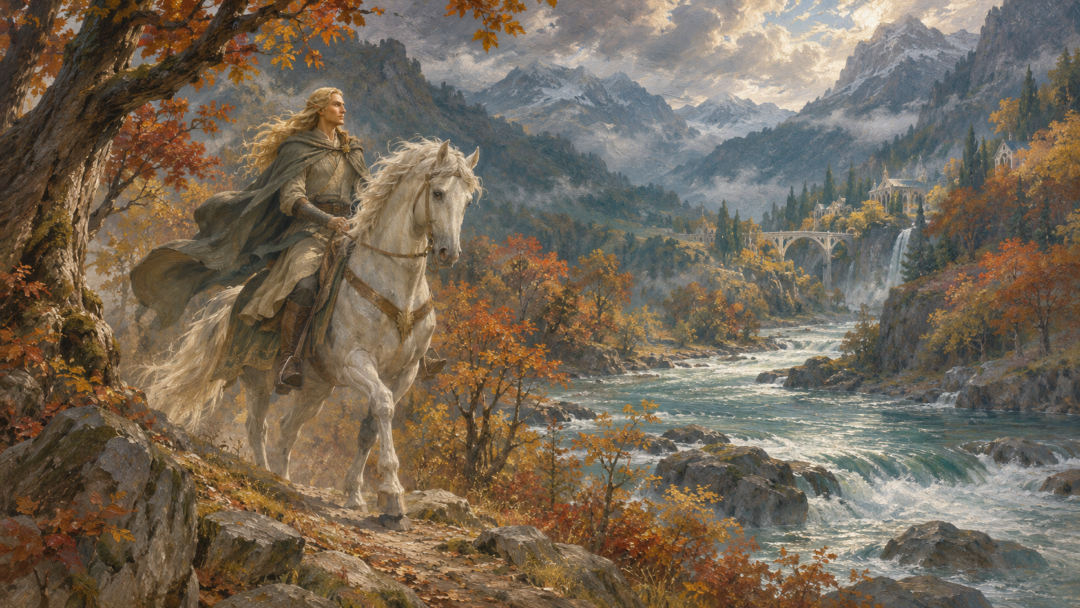
One might mistake Galadriel for the last truly powerful Elf in Frodo’s time. Rivendell itself disproves that picture. In “Many Meetings,” Gandalf explains to Frodo that Glorfindel is one of the mighty Firstborn. Frodo has already seen something of that power at the Ford of Bruinen, where the pursuit of the Nazgûl ends in the river’s flood. Gandalf also recognizes power in Rivendell and elsewhere, even while warning that such strongholds could become isolated under siege.
Elrond, Galadriel, Círdan, and other Elven leaders still possessed knowledge, authority, and formidable abilities. What they no longer possessed was the network of great kingdoms and armies familiar from the First Age. Some of those realms had been annihilated; others were far away across the Sea. A lost kingdom does not mean its lord has lost spiritual strength. A lord may remain extraordinary while having too few warriors, allies, or secure roads to turn that strength into a continent-wide campaign.
There were also different kinds of absence. Fingolfin, Fingon, Finrod, and Turgon had met violent ends during the struggles against Morgoth; Gil-galad fell much later against Sauron. Other Elves departed westward rather than dying. Elven death itself is not identical to human mortality, for their spirits remain bound to the life of Arda, but a fallen hero is still absent from Middle-earth’s battlefield. The cumulative result is unmistakable: famous champions and the societies that supported them were no longer available in the same combinations.
“Fading” names something more specific. In the later account of Elven life discussed in “Laws and Customs among the Eldar,” collected in Morgoth’s Ring, the relationship between an Elf’s spirit and body changes over the vast stretch of Arda’s history. The spirit increasingly predominates, eventually consuming the bodily form. That is a long metaphysical process, not a rule that every surviving Elf loses an equal amount of combat power each century. It cannot be used as an army’s measure of strength.
Indeed, the havens of Rivendell and Lórien reveal how much potency endured. The Three Elven Rings helped sustain places of beauty and resistance against the wearing of time. Yet this achievement carried its own limit: their power was bound to the fate of Sauron’s Ruling Ring. Their bearers could preserve what remained for a while, not simply recreate the vanished armies of Beleriand. Destroying the One would also end the power of the Three, so even victory would change the world the Elves had labored to shelter.
The Third Age: The Way to Win Had Changed
By the War of the Ring, there was no Last Alliance ready to march out of Rivendell. Gondor had endured centuries of war and decline; Rohan could fight beside it, but neither kingdom possessed the strength to conquer Mordor. Sauron’s armies threatened multiple fronts, and his ability to gather and command servants made the military balance grim. The surviving Elven refuges could resist assaults locally, but their continued existence did not give the West the manpower to storm Barad-dûr and repeat the ending of the Second Age.
The Council therefore faced a problem that a stronger sword arm could not solve. Boromir saw the Ring as a possible weapon against its maker. Elrond and Gandalf rejected that course: whoever mastered the Ring through domination risked becoming a new tyrant rather than freeing the world from tyranny. This went beyond fear of one warrior’s corruption. The instrument that offered victory by command was itself shaped to Sauron’s purposes. Taking it up would change the meaning of success.
Instead, the Council chose the nearly impossible road toward Mount Doom. Frodo did not need to overpower Sauron or challenge him to combat. The quest depended on carrying the Ring to the place where it could be unmade while Sauron remained focused on enemies who seemed more intelligible to him. When the Ring was finally destroyed, the power he had invested in it was lost beyond recovery. His effective rule ended in a way that his bodily overthrow by the Last Alliance had not accomplished.
Nor was the quest a clean demonstration that courage alone could make anyone surrender the Ring. At the Cracks of Doom, Frodo claimed it; Gollum’s struggle with him ended in the Ring’s fall into the fire. That difficult ending preserves the story’s understanding of temptation and mercy. Frodo’s long endurance mattered, as did Bilbo’s earlier pity for Gollum, but the result was not a smaller warrior accomplishing a conventional feat of strength against a superior enemy.
Help from the West had not disappeared, either. Gandalf belonged to the Istari, messengers sent by the Valar to aid resistance against Sauron, though not to lead another overwhelming host into battle. His guidance, the resolve of Men, and the protection and gifts offered by Elves all contributed to the quest. Aragorn’s march to the Black Gate drew Sauron’s attention while Frodo and Sam struggled across Mordor. Their battle could only make room for the attempt that might end him.
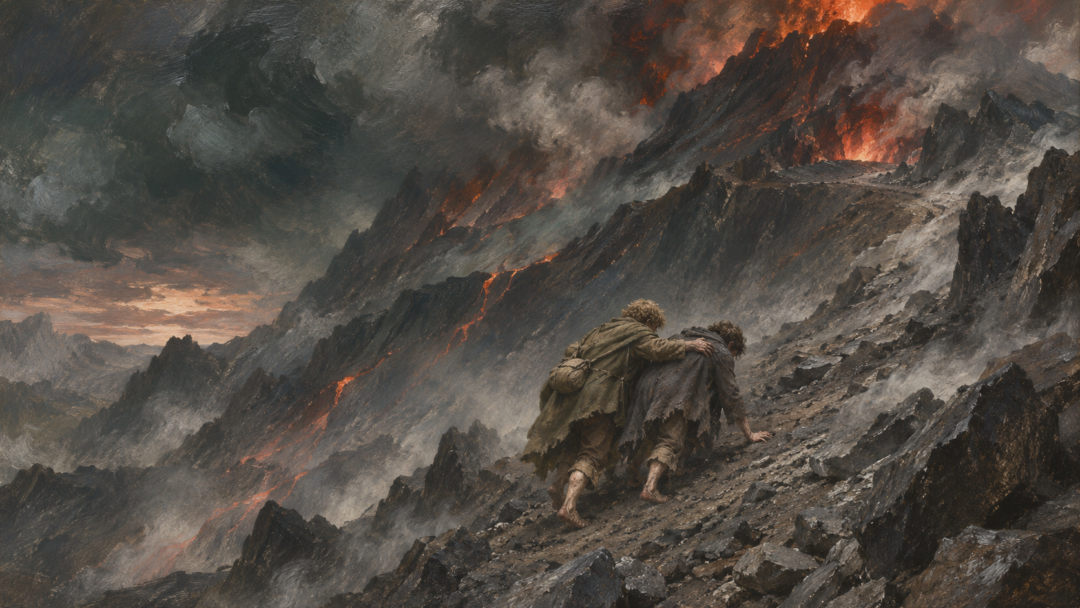
At the end, the decisive image is not an Elf-king standing above a conquered Dark Lord. It is two exhausted hobbits on the slopes of a burning mountain, helped by people whose strength lay in many different places. The great Elves had indeed grown fewer, and their world had narrowed. But Middle-earth was saved because its defenders found an ending the old armies, however splendid, had never achieved.
Sources & Notes
This article is based on close reading and interpretation of Tolkien's published works and related source material where relevant.