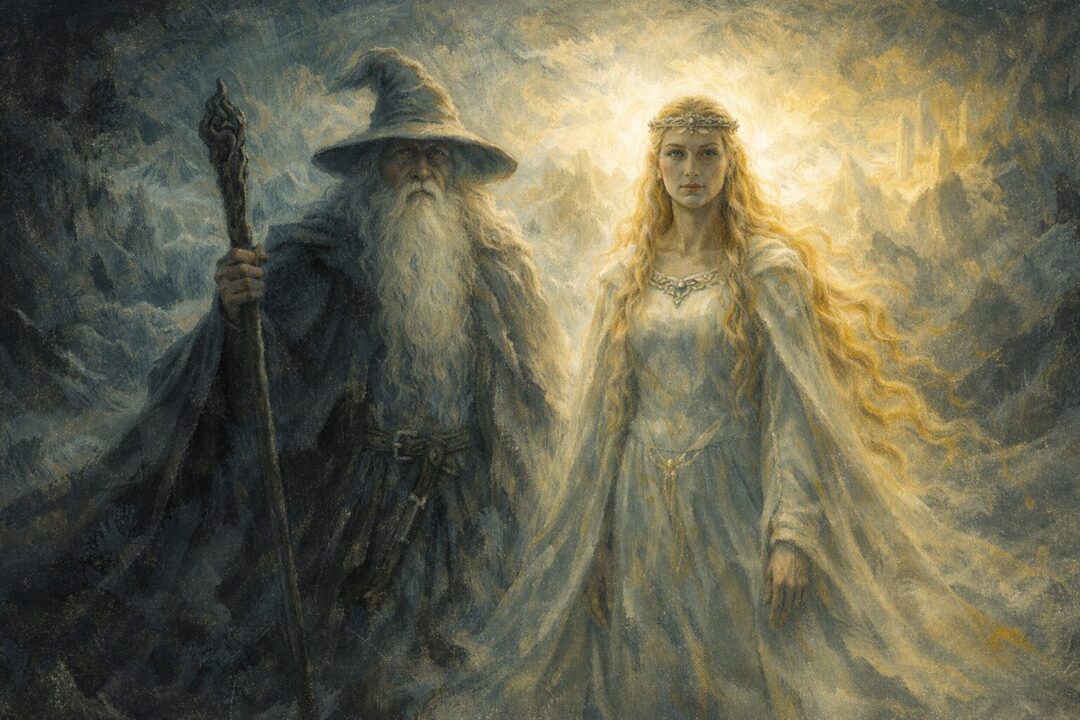
Among all the relationships in The Lord of the Rings, few feel as quietly charged—or as frequently misunderstood—as the one between Gandalf and Galadriel.
They rarely appear together on the page.
They share no dramatic confrontations.
There is no confession, no farewell, no visible emotional arc.
And yet, their connection is unmistakable.
Galadriel speaks of Gandalf with a respect that surpasses even her words for Elrond. Gandalf, in turn, listens to her counsel in a way he never does with Saruman. And when the Fellowship passes through Lothlórien, their interactions carry the weight of long familiarity rather than polite alliance.
This has led many readers to wonder: was there something more between them?
The answer is both simpler—and far more profound—than romance.
Not a Romance, but a Shared Origin
To understand the bond between Gandalf and Galadriel, we have to look far beyond the Third Age and far deeper than the surface of the narrative.
Galadriel is one of the Noldor who once lived in Valinor, under the light of the Two Trees. She witnessed the rebellion of the Elves, the pride and ruin of Fëanor, and the long tragedy of the First Age. She is not merely ancient—she is shaped by the moral consequences of choices made before the Sun and Moon ever rose.
Gandalf, though he appears as an old man, is not mortal at all. He is one of the Maiar: a spirit sent from the West, deliberately bound into frail flesh, and tasked with guiding rather than ruling. Like Galadriel, he carries memory of a world that no longer exists in Middle-earth—not as history, but as lived reality.
This alone sets them apart.
They are not simply leaders reacting to the present crisis. They are survivors of a vast moral history, both burdened with restraint imposed from beyond the world. They know what unchecked power looks like. They have seen what happens when good intentions harden into domination.
Their bond begins there.
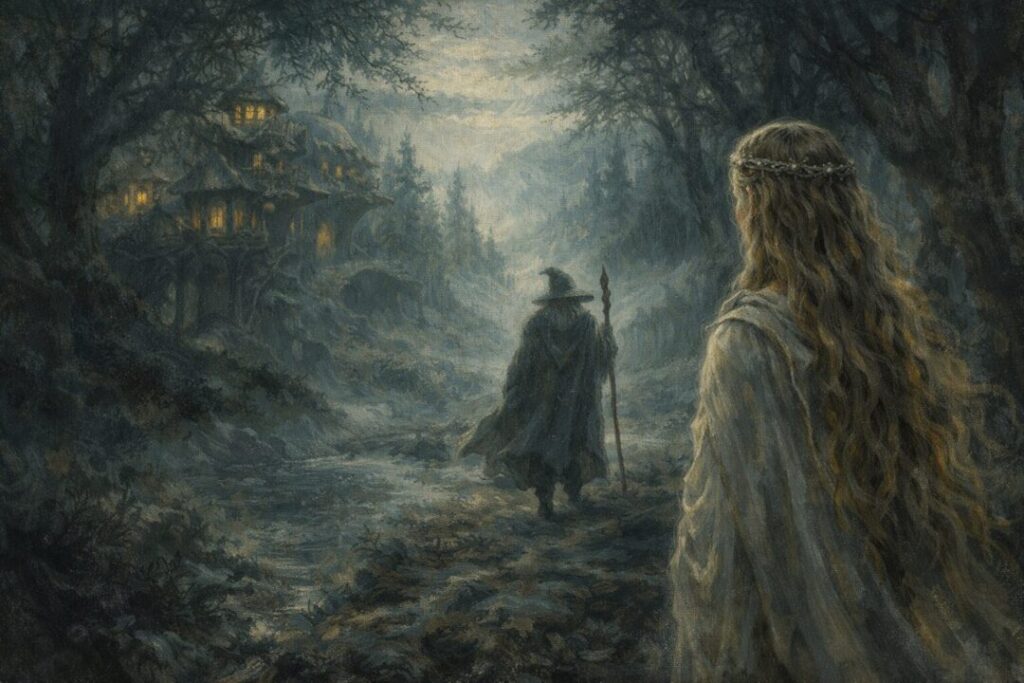
Why Gandalf Trusted Galadriel When He Did Not Trust Saruman
One of the most revealing dynamics in the story is Gandalf’s relationship with Saruman.
Despite Saruman’s authority and seniority, Gandalf does not fully trust him—and he is right not to. Saruman studies the devices of the Enemy too closely. He justifies compromise. He convinces himself that power can be mastered and used safely.
Gandalf never makes that mistake.
And neither does Galadriel.
Long before the War of the Ring, Galadriel desired power—and just as importantly, learned to refuse it. Her temptation is not sudden or accidental. When the One Ring is offered to her, she recognizes it instantly, not only as a weapon but as a mirror of her own deepest longing: to preserve, to rule, to make the world “better” according to her will.
Her refusal is the culmination of centuries of discipline.
Gandalf recognizes this immediately. He understands that Galadriel’s strength lies not in what she can do, but in what she has already chosen not to do.
This makes her uniquely trustworthy to him in a way no other ruler is.
They share a core understanding: power must be resisted, not wielded—even when the cause seems righteous.
That shared understanding forms the foundation of their bond.
The Silence Between Them Is the Point
Tolkien does not dramatize Gandalf and Galadriel’s relationship.
There is no emotional climax.
No private confession.
No explicit declaration of loyalty or affection.
That silence is deliberate.
Their relationship exists on a level the Hobbits barely perceive. It is not meant to be explained through dialogue or action. It is a connection built on mutual limitation—on knowing exactly how far one can go, and refusing to go further.
One of the most telling moments occurs not in speech, but in absence.
When Gandalf falls in Moria, Galadriel senses his loss without being told. This is not magic as spectacle. There is no ritual, no vision described in detail.
It is recognition.
One being of the same order feeling the loss of another.
That moment alone confirms the depth of their bond far more powerfully than any spoken exchange ever could.
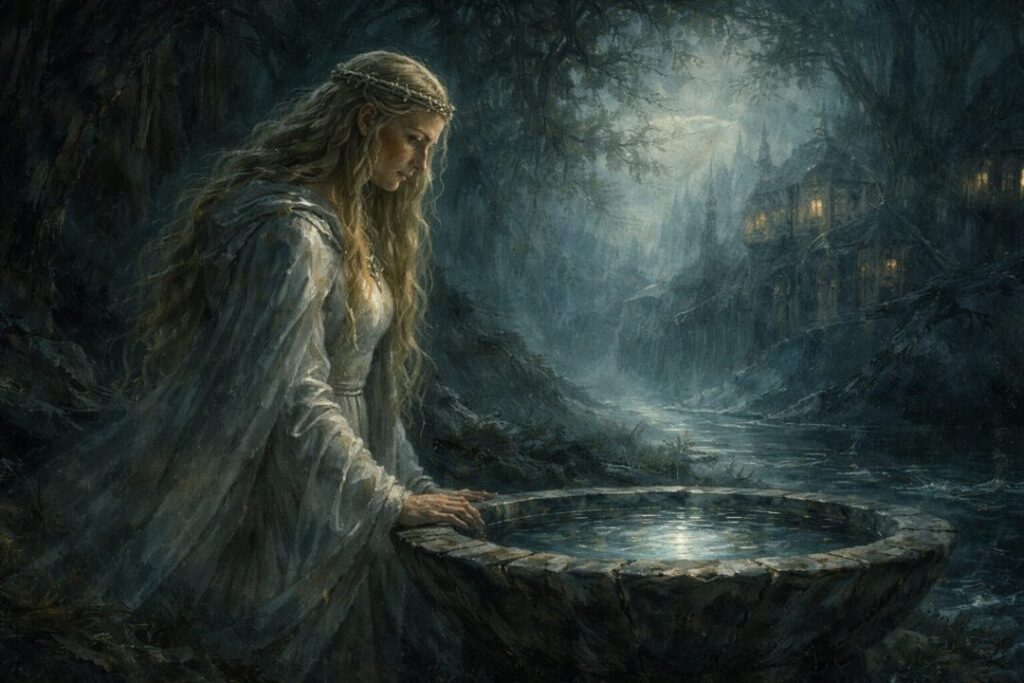
Why It Could Never Become “More”
If Gandalf and Galadriel had acted openly—emotionally, romantically, or politically—the balance of the story would collapse.
They are not meant to replace the struggle of Men and Hobbits. They are meant to support it quietly, from the edges. Their role is not to dominate the narrative, but to preserve the conditions in which others can act freely.
Their restraint is not repression.
It is wisdom.
Both understand that their time in Middle-earth is ending. The world they remember—the world of the Elder Days—is fading. Their task is not to reclaim it, but to shepherd its passing without letting darkness claim the future.
That is why their bond never takes center stage.
It belongs to a world that is already slipping away.
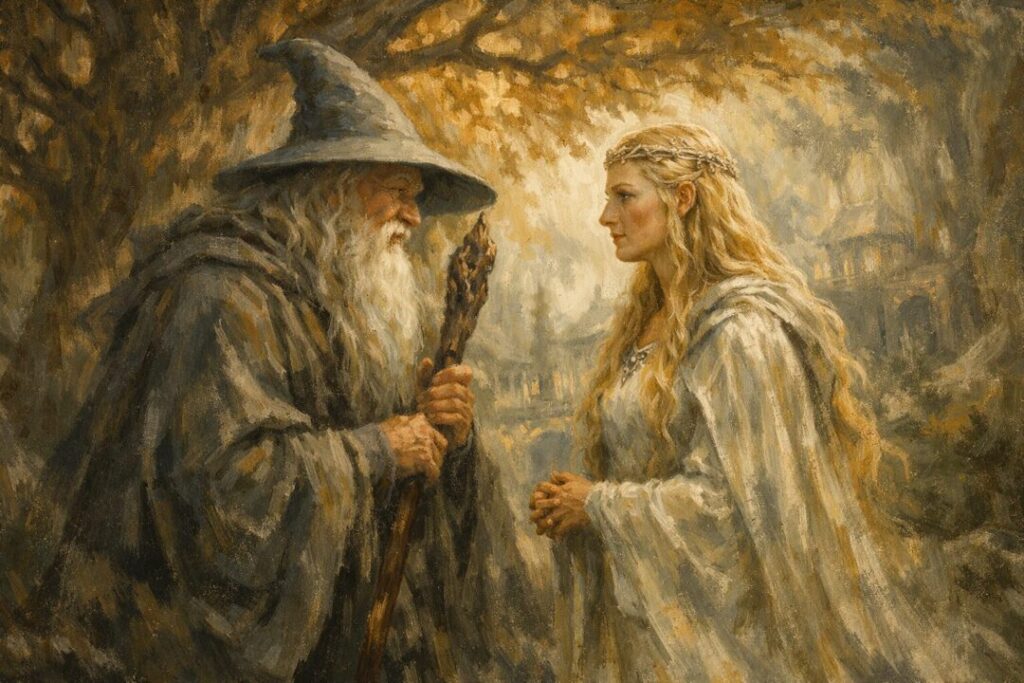
A Relationship Built on Renunciation
In the end, what connects Gandalf and Galadriel is not love as mortals understand it.
It is renunciation.
They renounce power.
They renounce control.
They renounce the temptation to shape the world according to their own will—even when they could.
This shared renunciation is what allows Middle-earth to survive.
If Gandalf seized authority, he would become a tyrant “for good.”
If Galadriel accepted the Ring, she would become a queen terrible and beautiful, and the age of free peoples would end.
They both know this.
And so they stand apart—guiding, guarding, refusing.
Their bond is one of the quietest in the legendarium—and one of the most profound.
Not because of what they do.
But because of what they refuse to do.