When Sauron falls, many of the great terrors of Middle-earth seem to end with him.
The Ring is unmade.
Barad-dûr collapses.
The Shadow that had bent wills across whole lands is broken.
So it is natural to assume that the Stone of Minas Tirith—the palantír used by Denethor—would also become harmless at once.
But the texts suggest a more complicated answer.
In the simplest sense, yes: the specific danger that came from Sauron’s active will appears to end with his destruction. The Stone is no longer part of a struggle against a living Dark Lord who can answer it from afar.
And yet the Stone is not simply restored.
Something remains.
That is why this question is more unsettling than it first appears.
The Stone Was Never Evil in Itself
A common misunderstanding has to be cleared away first.
The Stone of Minas Tirith was not like the One Ring.
It was not made by Sauron.
It was not an instrument of domination in its own nature.
It did not corrupt merely by being touched.
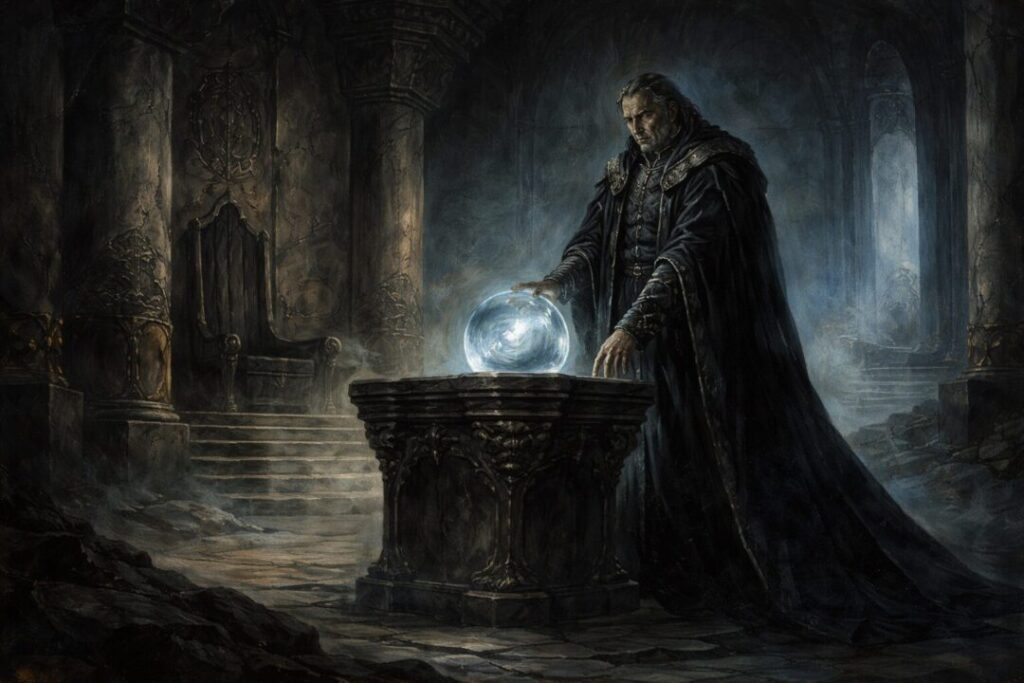
The palantíri were ancient seeing-stones, heirlooms of Númenor, preserved by the rulers of the Realms in Exile. Their proper purpose was communication, knowledge, and long sight. In origin, they belonged to the order of governance, not temptation.
That matters.
Because when Denethor uses the Stone, the problem is not that he has picked up an inherently wicked thing. The problem is that the world around the Stone has changed. One of the corresponding Stones—the Ithil-stone—had long ago fallen into enemy hands.
From that point onward, using the Stone of Minas Tirith was no longer a neutral act of watchfulness.
It became a contest.
Why Denethor Was Not Simply “Corrupted”
Denethor is often remembered as a man who looked into a dark object and lost his mind.
That is far too simple.
The lore points in a harsher and more tragic direction.
Denethor had both authority and unusual strength. As Steward of Gondor, he had a real claim to the Anor-stone. And the texts imply that Sauron did not simply seize control of his mind the way he overawed weaker users.
In fact, Denethor seems to have held out far longer and more successfully than many readers assume.
That is precisely why his fall is so disturbing.
He was not merely overpowered.
He was worn down.
Sauron could not make him believe anything whatsoever. But he could control the frame of what was seen. He could show truths selectively. He could present strength without weakness, danger without hope, and numbers without context. A proud and burdened ruler, already carrying the fate of Gondor on his shoulders, was given vision without peace.
That is how despair enters.
Not through a lie simple enough to expose.
Through truth arranged toward ruin.
The Real Danger of the Stone
This is the part that matters most.
The danger of the Stone of Minas Tirith was never just that it revealed too much.
It was that someone hostile stood in relation to it.
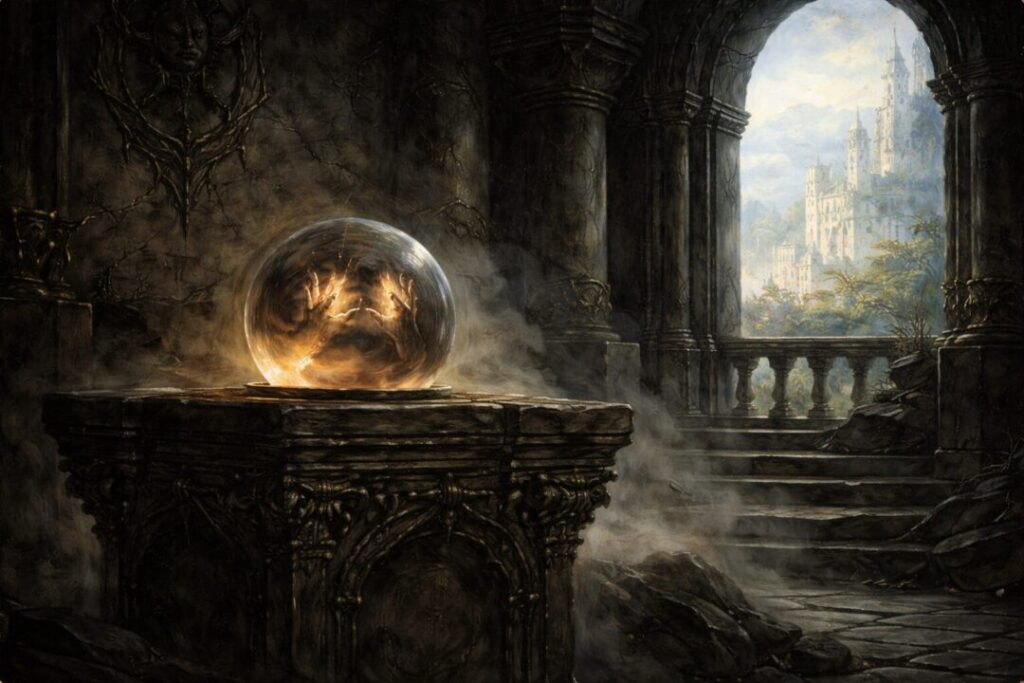
A palantír does not work like an ordinary window. It creates a link between mind, will, and sight. The stronger user can influence what is encountered. Rightful authority also matters. This is why Aragorn can later master the Orthanc-stone in open struggle, and why Denethor, though unable to defeat Sauron’s strategic advantage, is not simply reduced to a puppet.
So when people ask whether the Stone remained dangerous after Sauron’s destruction, the first answer is this:
It ceased to be dangerous in the same way.
The living enemy behind the contest was gone.
If the peril during the War had been active manipulation from the other end, then the destruction of Sauron removes the central cause of that peril. The palantír is no longer caught in a battle of wills with the Dark Lord.
That alone would have changed everything.
What Happened to the Ithil-stone Matters
There is another layer to this.
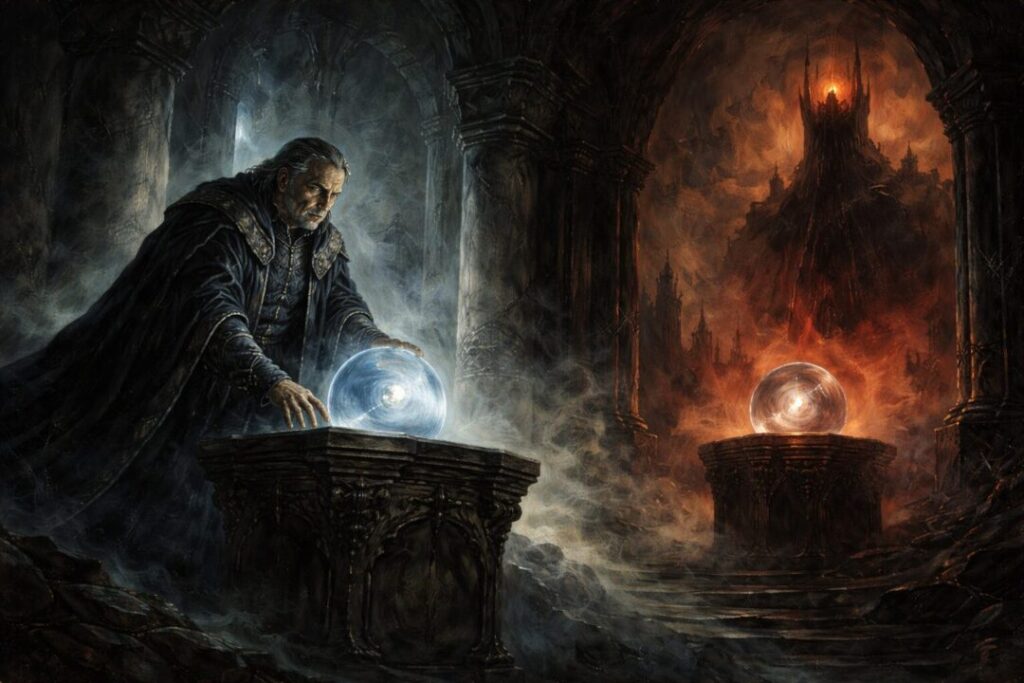
The Ithil-stone, the one Sauron used, had been taken when Minas Ithil fell and was later in Barad-dûr. The surviving tradition strongly suggests that it was likely destroyed in the fall of that tower.
That point cannot be stated with absolute certainty as a narrated scene, because the text does not pause to describe its end directly.
But the implication matters.
If Sauron’s own Stone perished with Barad-dûr, then the specific hostile counterpart that had made use of the Minas Tirith Stone so perilous was gone as well. Even if one wanted to argue that the Anor-stone was still difficult or grave to use, the old immediate threat of Sauron’s intervention would no longer stand in the same form.
So by the opening of the Fourth Age, the question is no longer whether Sauron might answer.
He cannot.
The war through the Stones is over.
But the Stone Was Still Marked
And yet the Stone of Minas Tirith does not emerge unscarred.
This is where the answer becomes darker again.
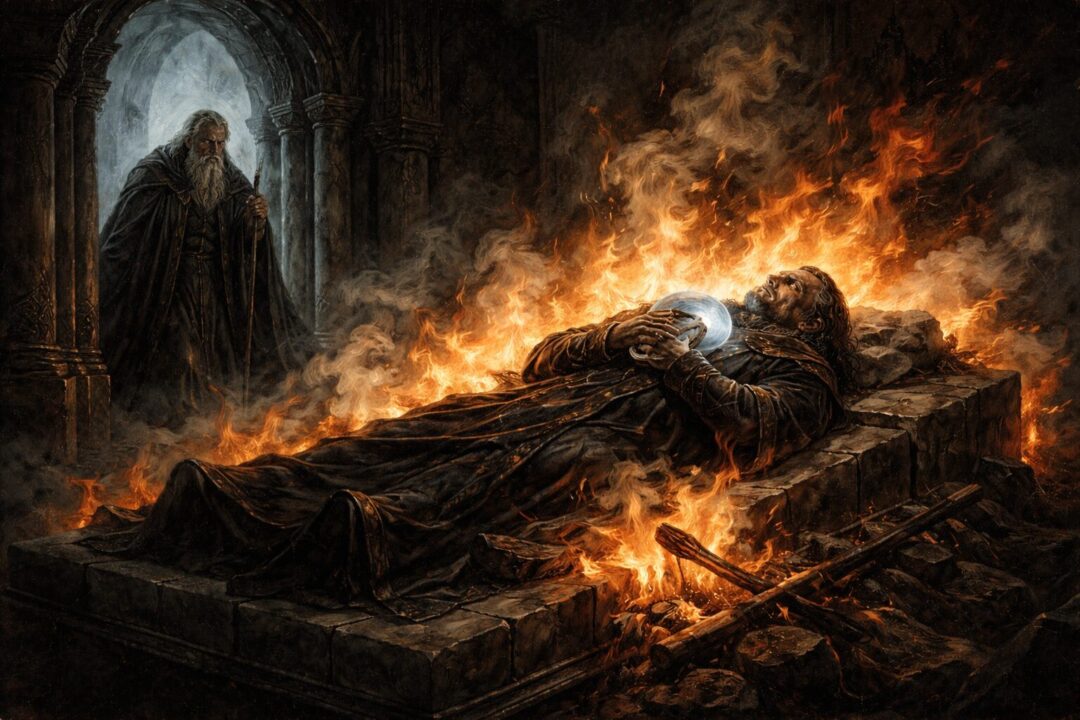
Denethor dies holding the palantír upon his breast as he burns. Afterward comes one of the most chilling notes attached to any object in the story: it is said that ever after, unless a man had great strength of will to turn the Stone to another purpose, he saw only two aged hands withering in flame.
That detail changes the whole shape of the question.
Because the Stone is no longer dangerous as Denethor knew it.
But it is not normal either.
It has become, in effect, burdened by an image of death and despair. Not morally evil. Not possessed. Not an active servant of Sauron. But impressed, scarred, almost haunted by the final moment of the Steward who perished with it in his hands.
The text does not explain the mechanism in technical detail.
It simply tells us the result.
And the result is enough.
So Was It Still Dangerous?
The most accurate answer is: yes, but not in the old sense.
It was no longer dangerous because Sauron could bend the encounter toward despair. That threat appears to end with his fall.
But it remained dangerous to ordinary use because it was no longer wholly clear or neutral in what it presented. A weaker viewer would not gain knowledge from it. He would be trapped in Denethor’s last agony, unable to turn the Stone away from that fixed vision.
That means the Stone had become limited, grim, and psychologically perilous.
Not a weapon of the Dark Lord.
But not a safe instrument for casual use either.
This distinction matters.
Too often, the logic of Middle-earth gets flattened into a simple binary: evil object, destroyed evil, danger gone.
That is not how these stories usually work.
Again and again, evil leaves marks behind it.
Why Aragorn Changes the Picture
There is one more important qualification.
The text says that only someone lacking great strength of will would be bound to that image. This implies that a sufficiently powerful and rightful user might still turn the Stone to another purpose.
And if anyone in the Fourth Age could do so, it would be Aragorn.
This does not mean the Stone was fully restored.
The text never says that.
It does mean, however, that the Stone was not absolutely unusable. Its damage was not identical for every possible user. Like other great things in Middle-earth, it still answered in part to stature, lineage, and strength.
That gives the Stone of Minas Tirith a strangely divided condition after the War.
For most, it is effectively lost.
For the greatest, it may still be mastered.
That is a very different thing from saying it was harmless.
The Deeper Pattern Behind the Stone
What happened to the Stone of Minas Tirith reflects a larger pattern that runs through the end of the Third Age.
Victory does not erase cost.
Sauron is defeated, but Denethor is still dead.
The Shadow is broken, but Gondor still bears the memory of what the struggle required.
The hostile will at the far end of the seeing-stone is gone, but the instrument itself still carries the imprint of despair.
This is one of the reasons the world of Middle-earth feels so morally weighty.
Defeat of evil does not instantly restore all damaged things to innocence.
Some can be healed.
Some can be used again, but only by the strong.
Some remain as reminders.
The Stone of Minas Tirith belongs somewhere between those last two.
Not Evil, Not Safe, Not Forgotten
So was the Stone of Minas Tirith still dangerous after Sauron was destroyed?
Not in the way it had been before.
Sauron’s fall appears to end the active domination, distortion, and strategic pressure that made the Stone such a deadly burden for Denethor. The enemy behind the gaze is gone.
But the Stone is not left untouched by that history.
Denethor’s death marks it so deeply that weaker users would see only fire and failing hands. In that sense, the Stone remains dangerous—not as a channel for Sauron, but as an object permanently shadowed by one of the bleakest moments in Gondor’s history.
And that may be the more revealing answer.
Because the Stone of Minas Tirith is not frightening after the War simply because darkness once passed through it.
It is frightening because even after the darkness is broken, something of the wound remains.
Sources & Notes
- J.R.R. Tolkien, Unfinished Tales, “The Palantíri” — explains the origin, rightful use, and limitations of the Seeing-stones, including the Anor-stone and the danger created after the Ithil-stone fell to Sauron.
- J.R.R. Tolkien, The Lord of the Rings, Book V, Chapter 7, “The Pyre of Denethor” — reveals Denethor’s use of the Stone and records that afterward most viewers saw only his withered hands in flame unless they had great strength of will.
- J.R.R. Tolkien, The Lord of the Rings, Book V, Chapter 4, “The Siege of Gondor” — shows how Denethor’s despair has been shaped by what he has seen, while Gandalf says Sauron used the Stone to bend truth toward ruin.
- J.R.R. Tolkien, The Lord of the Rings, Book III, Chapter 11, “The Palantír” — sets out how a palantír is governed by will, direction, and encounter rather than functioning as a harmless ordinary window.
- J.R.R. Tolkien, The Lord of the Rings, Book V, Chapter 2, “The Passing of the Grey Company” — shows Aragorn lawfully mastering the Orthanc-stone in direct contest with Sauron, clarifying why rightful strength changes the danger.