Leadership in Tolkien is not mainly about rank
When people think about leadership in Middle-earth, the first image is often a crown, a battlefield speech, or a heroic charge. Those moments matter. Tolkien does give us kings, captains, stewards, and lords. But if you look closely at how leadership actually works in The Lord of the Rings and related texts, he is not simply praising high status or command.
Again and again, Tolkien separates authority from domination. A person may hold office and still fail morally. Another may act with quiet responsibility long before receiving public recognition. That is why some of Middle-earth’s best leaders spend long stretches serving in obscurity, advising rather than ruling, or refusing to grasp power too quickly. Tolkien himself was deeply suspicious of mere “bossing” and control, and that broader instinct fits the moral shape of his legendarium.
So what does a good leader really look like in Middle-earth?
Not flawless. Not merely forceful. Not simply noble by birth.
A good leader in Tolkien’s world is someone who accepts burden, exercises restraint, preserves hope, and treats power as a trust held for others.
Aragorn: leadership proven in service before kingship
Aragorn is the clearest example that Tolkien does not reduce leadership to a title. Long before he is crowned Elessar, Aragorn has already spent years protecting lands and peoples who do not always know his name. He is the last Chieftain of the Dúnedain, a direct heir of Isildur, but his worth is shown in what he does, not in what he can claim.
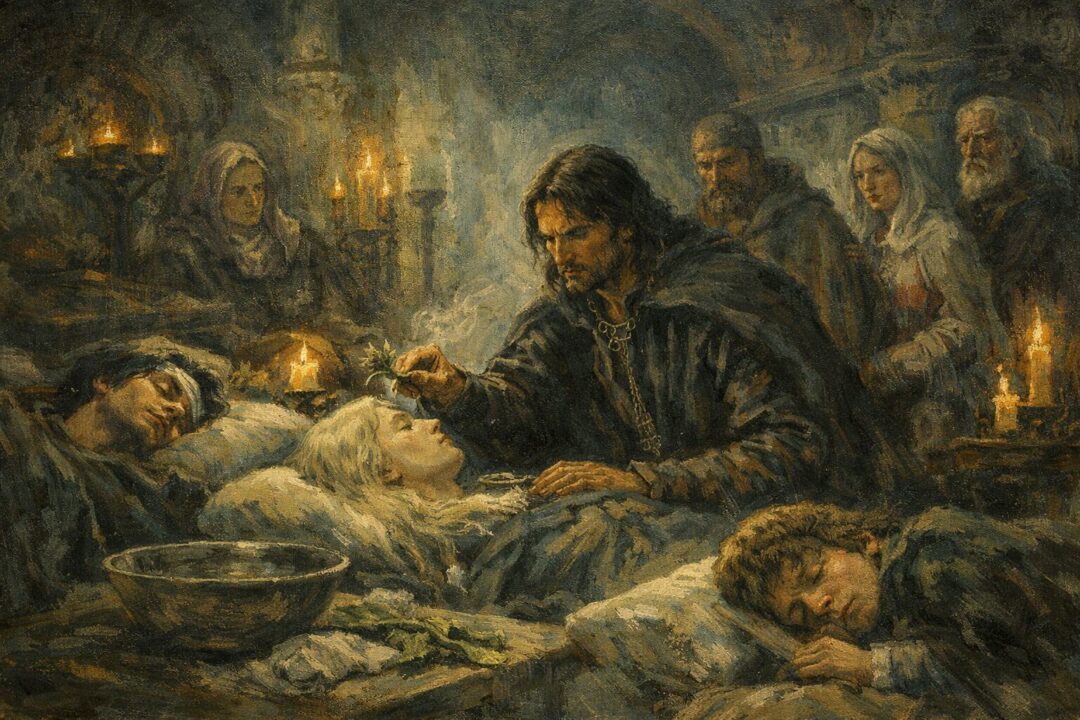
This matters because Tolkien could easily have written Aragorn as a straightforward “rightful king returns and immediately commands all.” Instead, Aragorn’s path is one of patience, hidden labor, danger, and self-mastery. He guides the Fellowship, chooses hard roads, and repeatedly puts mission above self-display. Even in Gondor, one of the strongest signs of his kingship is not military spectacle alone but healing. In the Houses of Healing, Aragorn tends the wounded, and the old saying about the hands of the king being the hands of a healer becomes central to how others recognize him.
That detail is crucial. Tolkien’s ideal ruler is not only a war leader. He restores. He binds up what has been damaged. He uses strength for preservation, not vanity.
Aragorn also listens. He takes counsel seriously, works with Gandalf, Éomer, Imrahil, and others, and does not confuse destiny with impatience. Even when he acts boldly, such as revealing himself through the Orthanc-stone and then choosing the Paths of the Dead, the boldness is tied to responsibility, not ego.
Théoden: a good leader can recover, repent, and rise
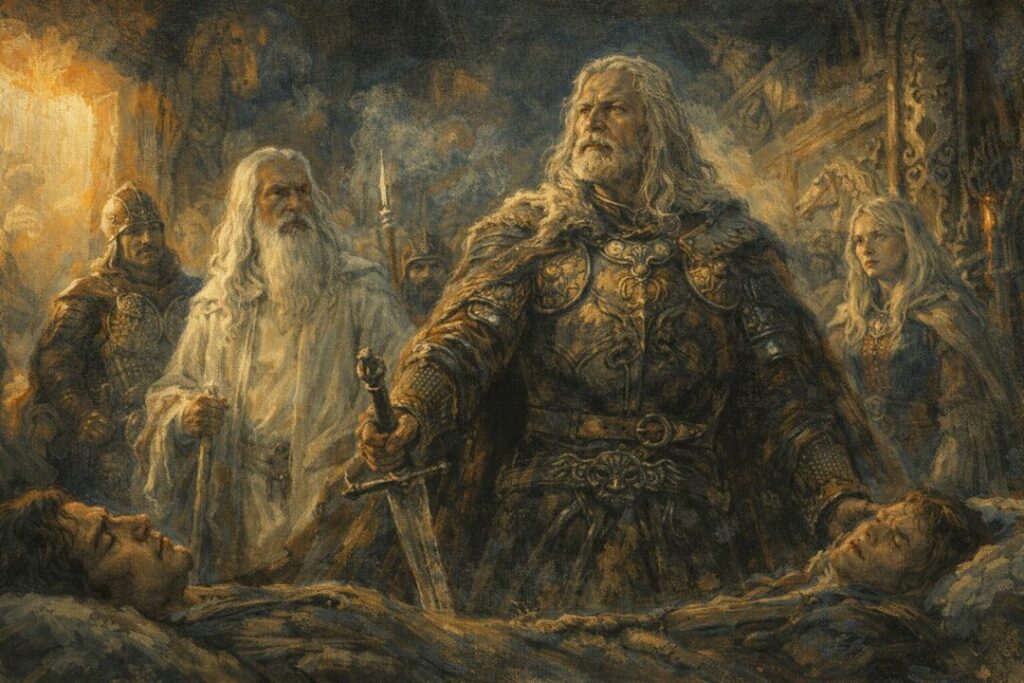
Théoden is one of Tolkien’s most moving portraits of leadership because he is not introduced at his best. By the time the reader meets him in Edoras, he is diminished, manipulated, and isolated. Yet once he is restored, he does not remain trapped in shame over his weakness. He acts. That recovery is part of what makes him a good king.
Tolkien does not present a worthy leader as someone untouched by age, grief, or fear. Théoden has suffered loss. His court has been poisoned by bad counsel. His kingdom is under real threat. But his greatness appears in what follows: he re-enters the world of duty, makes decisions, rides with his people, and rekindles hope. The famous charge of the Rohirrim is not just courage in battle. It is the visible culmination of a king choosing not to hide behind others.
That is one of Tolkien’s strongest leadership ideas: a ruler should not ask others to bear dangers he refuses to share. Théoden rides into peril with his household and riders. He is honored not because he is invulnerable, but because he is present.
He also shows that renewal matters. A failed or diminished leader is not automatically lost forever. In Tolkien, repentance, awakening, and restored courage are real possibilities. Théoden’s story gives leadership a human texture that pure triumphal figures often lack.
Gandalf: the leader who does not seize the throne
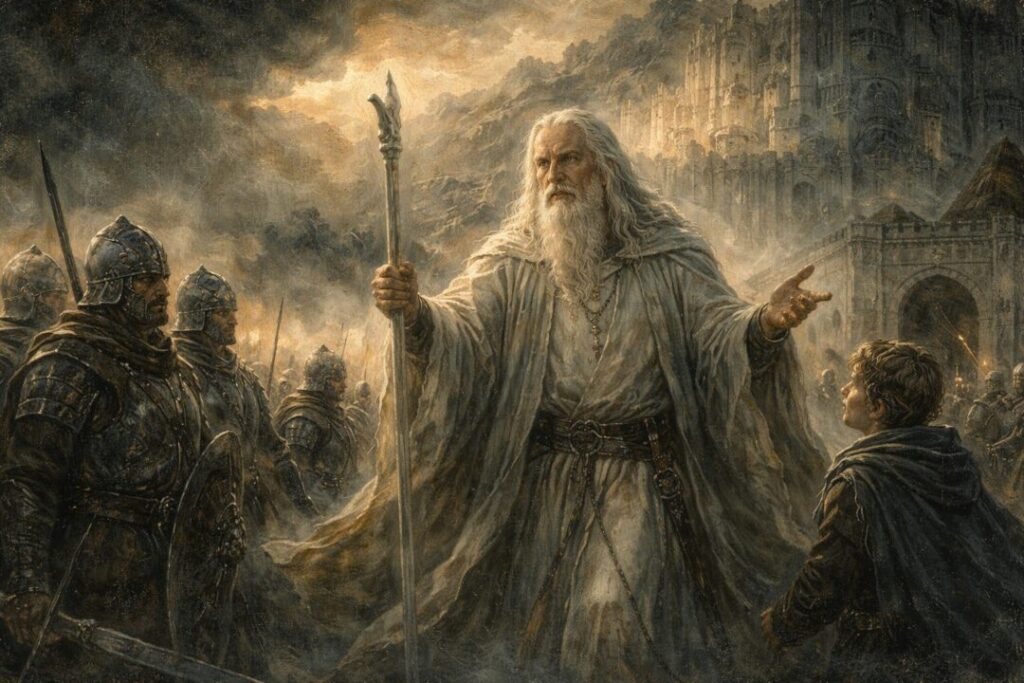
Gandalf is one of the most influential figures in the War of the Ring, but his leadership is unusual. He is not a king. He is not meant to become one. As an Istar, he was sent to Middle-earth to help oppose Sauron, but not by dominating the Free Peoples or replacing their judgment with his own. Tolkien Gateway’s summary of Gandalf’s mission and role reflects this larger pattern from the books: Gandalf encourages, warns, strengthens, and coordinates, yet leaves room for others to choose and act.
That restraint is vital. Gandalf has immense wisdom and power, yet he does not try to gather all rule into his own hands. He advises Frodo, backs Aragorn, confronts Denethor, heartens Théoden, and organizes resistance, but he does not claim the kind of ownership over others that defines Sauron. In Tolkien’s moral world, this is a major dividing line. Evil wants domination. Good leadership works through service, counsel, and the strengthening of free wills rather than their absorption.
So Gandalf represents a leadership style that is easy to miss if we focus only on crowns and armies. He is a stewarding presence. He helps others become what they are meant to be.
Faramir: wisdom without weakness, restraint without cowardice
Faramir may be Tolkien’s clearest answer to the false idea that a good captain must be harsh, reckless, or hungry for glory. Beregond’s description of him stresses something unusual for his world: Faramir is wise, learned, swift in judgment, and hardy in the field all at once. He is less reckless than Boromir, but not less resolute.
This is important because Tolkien does not frame gentleness and strength as opposites. Faramir is a man of war, but not one corrupted by the love of war for its own sake. He commands the Rangers of Ithilien under brutal conditions, yet when confronted with the Ring he does not simply snatch at it as a weapon. His restraint is one of the strongest marks of character in the story.
He also understands proportion. He does not reduce every moral question to immediate advantage. That makes him a good leader precisely because he sees that there are lines one should not cross, even under pressure. In Middle-earth, practical intelligence without moral discipline can become disastrous very quickly.
Faramir’s later willingness to lay down his office when Aragorn comes is another sign of health rather than weakness. He does not cling to power as personal property. Aragorn, in turn, renews his place with honor. Healthy leadership in Tolkien often includes this mutual recognition: the worthy ruler does not need to humiliate faithful servants, and the worthy servant does not need to grasp at rank.
Denethor: the warning case
Denethor is not a fool, and Tolkien does not write him as one. He is proud, farsighted, noble-looking, and formidable. In some ways, that makes his fall more tragic. He has many qualities associated with strong rule, yet he becomes a warning instead of an ideal.
Why?
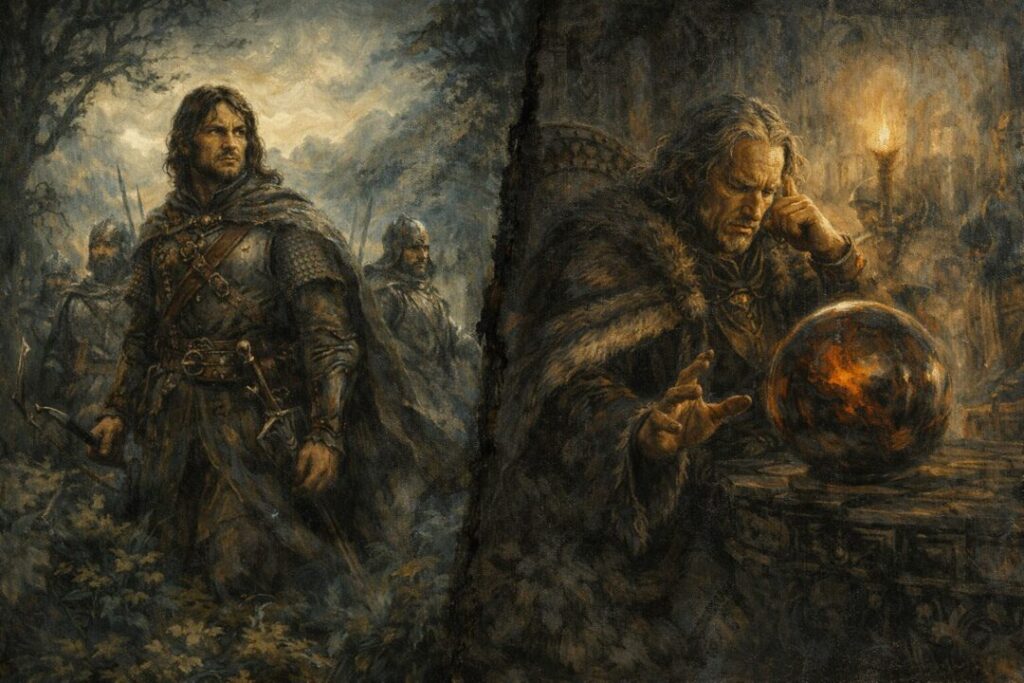
Because greatness without humility curdles. Denethor increasingly treats Gondor as something close to a possession rather than a trust. He isolates himself, resists counsel, and sinks into a vision of reality shaped by pride and despair. His use of the palantír is part of this tragedy: he seeks knowledge and control, but becomes vulnerable to Sauron’s manipulation.
The contrast with Aragorn is sharp. Both are strong-minded men. Both are capable of command. But Aragorn’s authority is ordered toward restoration, while Denethor’s authority becomes entangled with wounded pride, possessiveness, and hopelessness. Tolkien does not deny Denethor’s ability. He shows that ability alone cannot save a leader whose inner life has gone wrong.
The pattern: power as duty, not ownership
Across these examples, Tolkien keeps returning to the same pattern.
A good leader:
serves before demanding honor,
shares danger rather than outsourcing it,
accepts counsel,
preserves hope,
uses strength to protect and restore,
and does not mistake authority for private possession.
That is why the best leaders in Middle-earth are often marked by restraint. They do not always take the fastest route to visible power. They are capable of force, but not addicted to domination. They know that stewardship matters. They remember that the weak are still worth protecting. They understand that despair is itself a danger in times of war.
What Tolkien seems to be saying
If we phrase this carefully, Tolkien never gives a single neat manifesto titled “On Leadership.” But the repeated pattern in the texts is hard to miss. The most admirable leaders in Middle-earth are those who combine courage with humility, action with wisdom, and authority with service. That is true in Aragorn’s healing kingship, Théoden’s renewed courage, Gandalf’s guiding restraint, and Faramir’s principled judgment. The tragic mirror image is Denethor, whose real strengths are undone by pride and despair.
So what does a good leader really look like in Middle-earth?
Usually, not like the person most eager to rule.
Usually, like the person who understands that power is safest in the hands of someone who knows it is not truly theirs.