Huorns are easy to miss.
They don’t get a genealogy. They don’t get a heroic leader with a name and a voice that rings through the pages. They appear the way forests do in real life—gradually, quietly—until one day you look up and realize the whole landscape has changed around you.
And when they act, they do it in the margins of the story.
Not at the council table. Not on the battlefield where songs are made.
In the dark, where things disappear.
That is the first reason Huorns feel uncanny: the narrative treats them like a rumor that happens to be true.
But the second reason is more unsettling.
The texts won’t let you keep them in a neat category.
The moment Huorns become a problem
If you want the clearest “Huorn scene,” it isn’t in Fangorn.
It’s after Helm’s Deep.
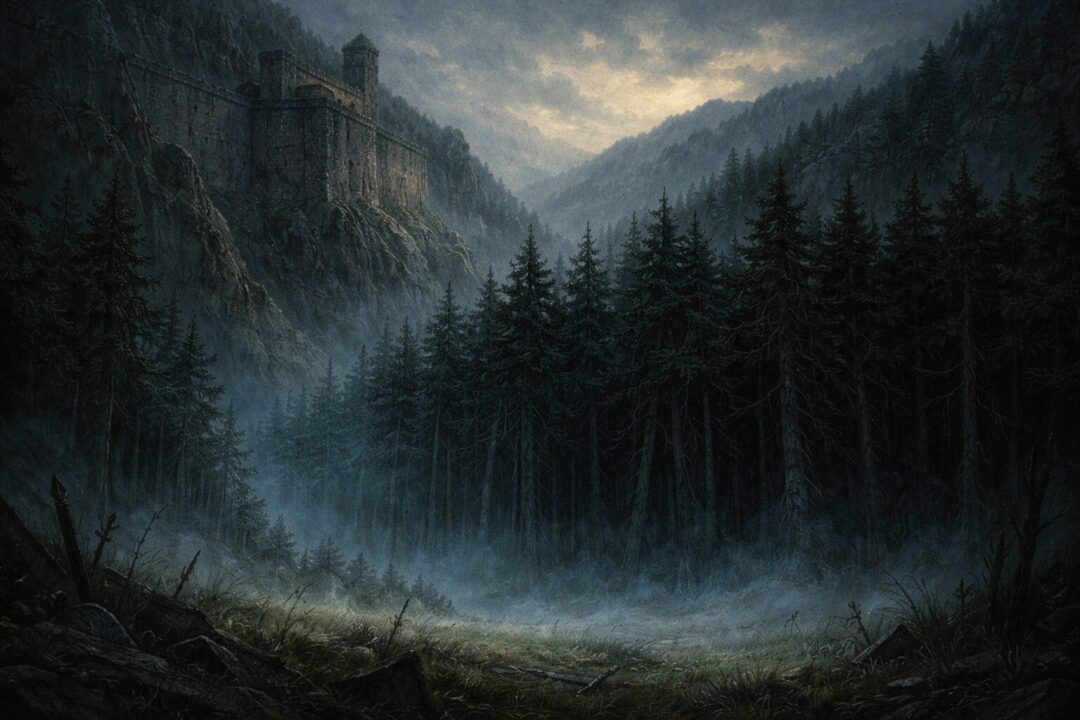
The battle ends. Morning comes. The survivors ride out—expecting to count the dead, gather weapons, and take stock of the ruin. Instead, they find a wood pressing close to the valley: trees standing where trees did not stand before.
And the Orcs who fled?
They ran into that shadowed forest.
They do not return.
The story doesn’t linger on gore. It doesn’t describe a long pursuit. It simply leaves you with an absence: an enemy swallowed by trees that should not be able to do anything at all.
That’s Huorn logic. When they are present, the world’s normal rules feel slightly less reliable.
So naturally the question follows:
What were those trees?
“They still have voices.”
Merry’s explanation—given later, when Aragorn, Legolas, and Gimli reach Isengard—contains the most direct description of Huorns in the narrative.
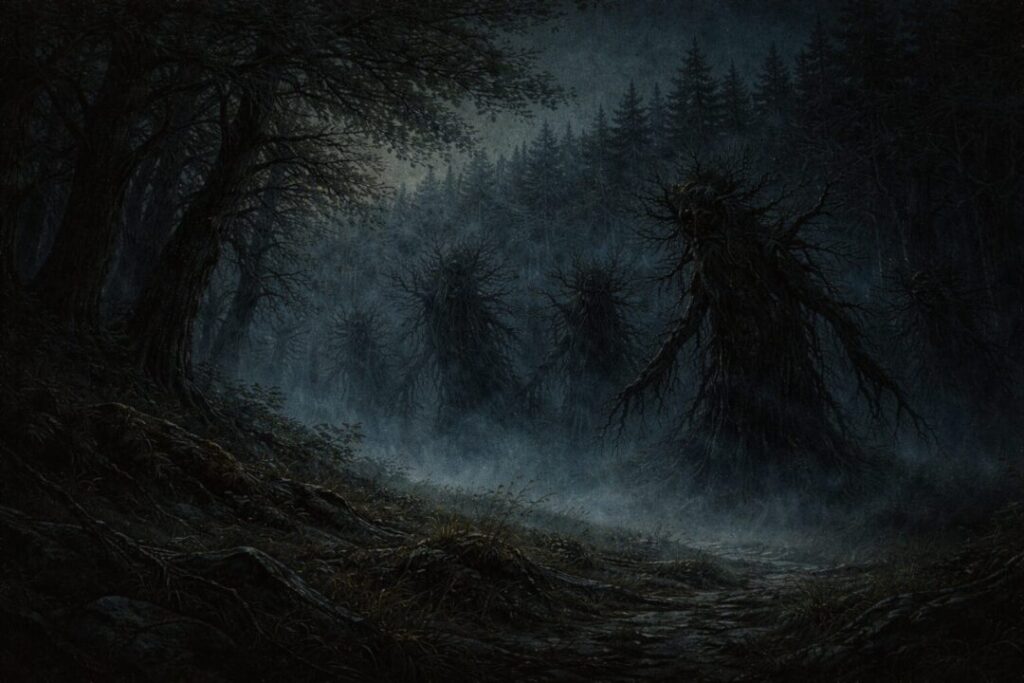
He says they can seem like an ordinary wood until you stop and listen. And then, suddenly, you realize you are surrounded by “great groping trees.” They have a power that can “wrap themselves in shadow,” and when they are angry, they can move quickly.
But the hinge of the whole description is simpler than their speed or their darkness:
They still have voices, and can speak with the Ents.
That is why they are called Huorns.
And then comes the line that keeps Huorns from ever being merely charming:
They have become “queer and wild.” Dangerous—especially if no true Ents are near to look after them.
Notice what the text is doing.
It does not say Huorns are simply “the same as Ents,” only smaller or stranger.
It places them on a boundary: voice, movement, perception—but not the same kind of mind the Ents have. They can speak with Ents, yet they are not presented as companions in the way Treebeard is. They are something Treebeard manages, tends, and sometimes restrains.
That’s the first firm point you can safely take from the texts:
Huorns are not “ordinary trees,” but they are not “ordinary Ents” either.
They are in-between.
Treebeard’s sliding scale
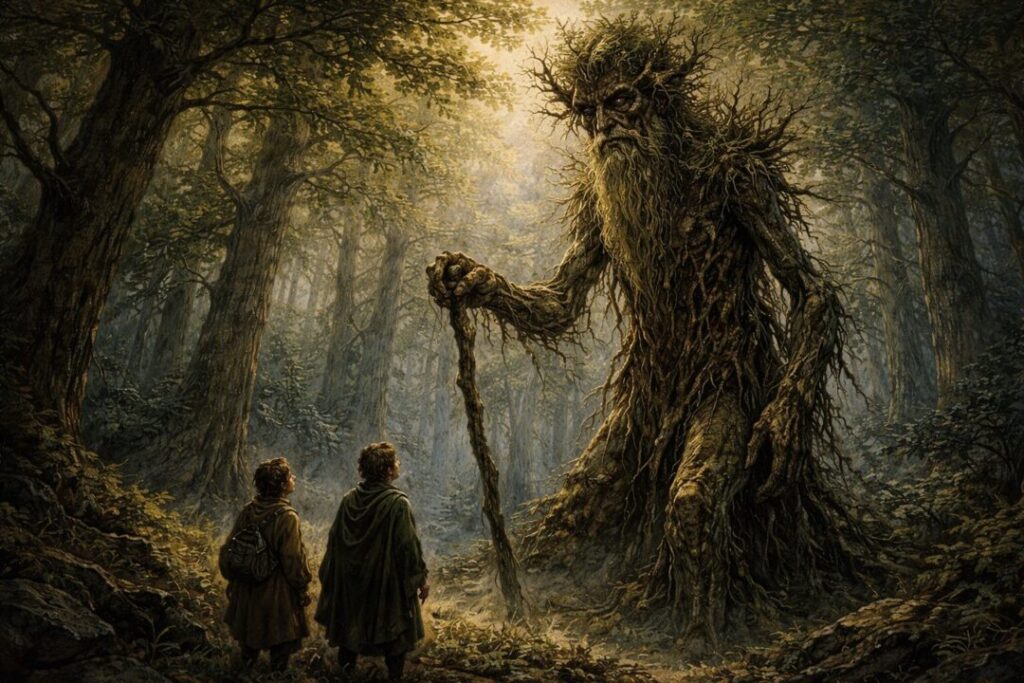
The most important passage for the “what are Huorns really?” question happens earlier, when Merry and Pippin first meet Treebeard.
Treebeard is careful with names and categories. He even warns the hobbits that there are “Ents and Ents… and things that look like Ents but ain’t.” He isn’t offering a tidy taxonomy. He’s describing a world where appearances can mislead.
Then he says something that sounds almost casual—until you realize what it implies:
Some Ents are “growing sleepy, going tree-ish,” while many trees are “half awake,” and a few are “getting Entish.”
That is going on all the time.
This is where the common debate comes from.
Are Huorns:
- trees becoming Ents, or
- Ents becoming trees?
The most accurate answer the texts allow is also the most frustrating:
Both movements are possible in principle—and the boundary between them is not fixed.
Treebeard explicitly describes Ents becoming “tree-ish.” He also explicitly describes trees becoming “Entish.” Merry later connects Huorns to this borderland: beings with voices, able to move, but “queer and wild.”
So the texts give you a spectrum rather than a wall.
And that changes the question from “Which are they?” to “What does it mean that the border can shift at all?”
What Huorns are not
At this point, it helps to clear away a few assumptions that don’t hold up well against the text.
Huorns are not just Ents under another name.
Ents speak, reason, hold councils, have personal histories, and make deliberate choices. Huorns, as described by Merry, are more like a willful wood: perceiving, moving, acting—yet not presented as fully personlike.
Huorns are not simply “enchanted trees” in the fairy-tale sense.
They are tied to the Ents. Their ability to speak with Ents is central to the name itself. And when they appear in force—at Helm’s Deep, or around Isengard—they do so in the orbit of Treebeard’s action.
Huorns are not clearly defined enough for a clean biological origin story.
The text does not hand you a creation-myth for Huorns the way it does (indirectly) for Ents. You are meant to feel that you’re seeing something half-understood, even by Treebeard.
That last point matters, because Treebeard says outright that he doesn’t understand everything that is going on.
If Treebeard—shepherd of trees—doesn’t claim perfect clarity, then the safest reading is conservative: accept what is explicitly stated, and treat everything else as implication.
Are Huorns “awake trees”?
The phrase “half awake” is one of the most revealing in the entire Ent section.
It implies that “tree life” in Middle-earth is not a single state. Some trees are simply trees. Some are more aware. Some are wide awake. And some are moving toward something closer to Entishness.
This does not require the claim that every tree has a hidden spirit identical to an Ent’s. The text doesn’t say that.
What it does say is that awareness in the forest can deepen.
And once it deepens past a certain threshold—voice, movement, will—something new enters the world: not an Ent, not merely a tree.
A Huorn.
That is why Huorns feel like a leftover from an older, wilder Middle-earth. They aren’t a separate people with cities and crafts. They are a process.
A forest changing its mind.
The Old Forest question (and what we can’t claim)
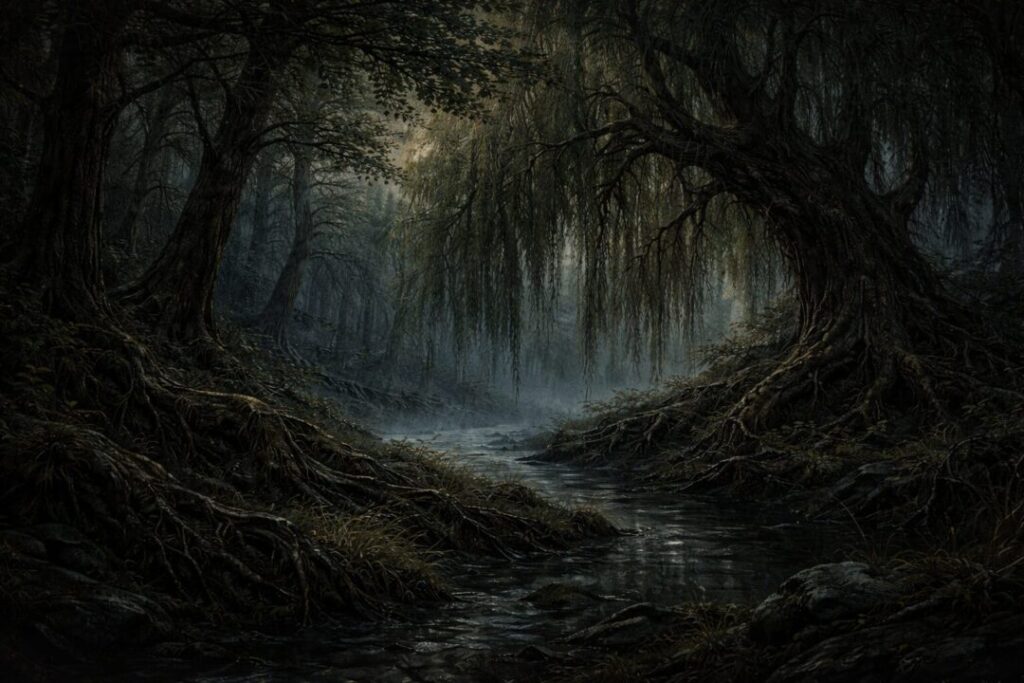
Some readers naturally connect Huorns to the Old Forest, especially because the Old Forest contains trees that behave with hostility and purpose—most notably Old Man Willow.
But here the texts force restraint.
The narrative never explicitly labels Old Man Willow a Huorn. That connection is an interpretation: a plausible one, because Treebeard’s description of “half awake” and “getting Entish” trees sounds like it could fit the Old Forest’s mood.
Yet the safest phrasing is:
The Old Forest shows that some trees can be willful and dangerous. The text does not directly call them Huorns, but it makes the possibility feel imaginable.
In other words, the Old Forest supports the concept of awake trees. It does not prove a Huorn identity.
Why Huorns matter in the War of the Ring
Huorns do not fight like soldiers.
They do not march in shining ranks. They do not exchange blows and fall heroically.
They are, instead, a kind of environmental judgment.
At Isengard, the Ents break stone and flood machinery. That is visible, dramatic, almost mythic.
But at Helm’s Deep, Huorns do something quieter and more final: they remove the enemy from the board.
And the text makes sure you feel the chill of it.
Because in Middle-earth, forests are not automatically friendly. Treebeard himself says he is not altogether on anyone’s side, because nobody is altogether on his side.
Huorns sharpen that truth.
They are not “good” in the way a banner is good.
They are loyal—when tended, directed, and held within the care of true Ents.
And they are perilous when they are not.
So… trees becoming Ents, or Ents becoming trees?
If you want a single, lore-safe sentence, it is this:
Huorns belong to the borderland Treebeard describes, where some Ents grow “tree-ish” and some trees grow “Entish.”
Merry’s account adds the distinctive marks: voice, movement, shadow, wildness.
Beyond that, the texts allow interpretation, but they do not allow certainty.
You can reasonably read Huorns as awake trees that have crossed far enough into Entishness to act—especially in groups—without becoming full Ents.
You can also reasonably read some Huorns as Ents grown so tree-ish that they no longer behave like speaking persons among the Entmoot, yet still retain voice enough to speak with Ents.
And the most text-faithful approach may be the least satisfying one:
Huorns are what you get when the boundary is real, and porous, and changing “all the time.”
Which means the real mystery isn’t whether Huorns start as trees or as Ents.
It’s that Middle-earth contains living things that can drift, slowly, across categories we thought were stable.
A forest can grow a voice.
A shepherd of trees can grow silent and rootbound.
And if you walk into the wrong wood at the wrong hour, you may discover—too late—that it was never “just trees” at all.