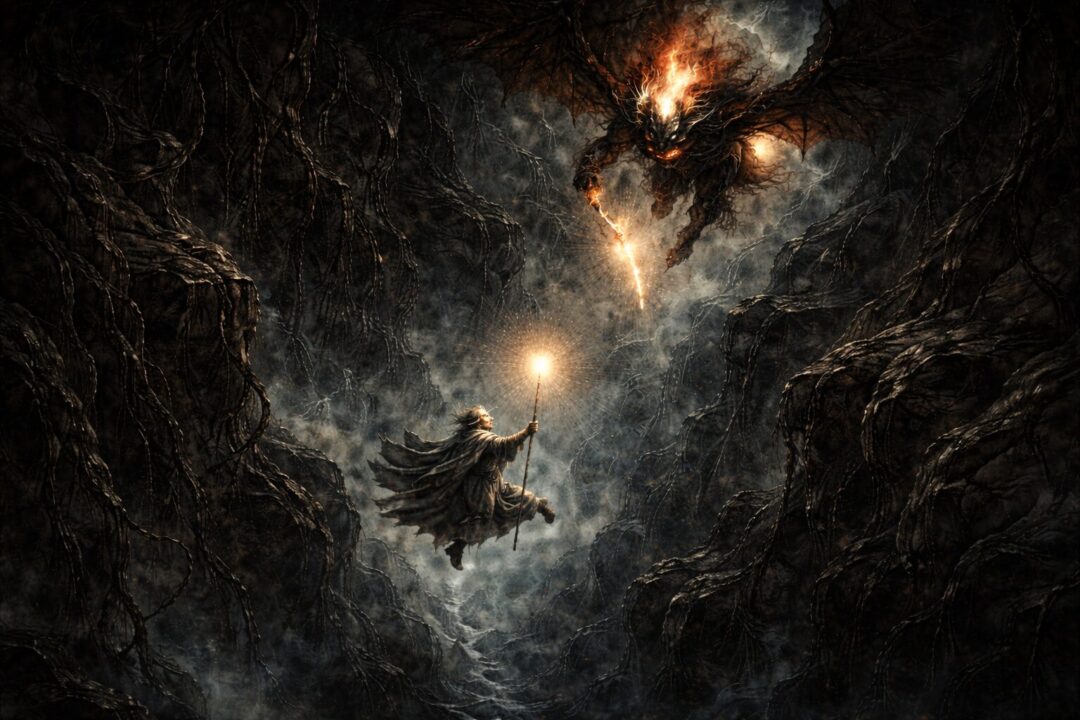
One of the most disturbing lines in The Lord of the Rings is also one of the briefest.
As Gandalf recounts his fall with the Balrog beneath Moria, he describes passing through “the deep places of the world,” where he encountered Nameless Things—creatures older than Sauron, gnawing at the foundations of the earth.
And then he moves on.
No clarification.
No elaboration.
No return to the subject.
For a world as meticulously constructed as Middle-earth, this silence is striking. Elsewhere, Tolkien provides lineages stretching back thousands of years, entire languages for peoples who barely appear on the page, and detailed explanations for the origins of evil, power, and corruption.
Yet here—at what may be the deepest point any character reaches, both physically and cosmically—he refuses to explain.
So why do the Nameless Things remain unnamed?
What Gandalf Actually Says — And What He Doesn’t
The key to understanding the Nameless Things lies not in what Gandalf tells us, but in what he deliberately withholds.
He does not describe their form.
He does not explain their nature.
He does not assign them allegiance.
He does not claim they were made by Morgoth.
Most importantly, he does not claim authority over them.
This silence matters.
Nearly every other being in Middle-earth, no matter how monstrous or mysterious, fits somewhere within a moral or historical framework. Orcs are corrupted Elves. Trolls are crude mockeries. Dragons are bred or twisted by Morgoth. Even the Balrogs, terrifying as they are, have a clear origin: they are corrupted Maiar, spirits of fire turned to shadow.
The Nameless Things do not fit this pattern.
Gandalf does not describe them as servants of evil. He does not say they oppose the Free Peoples. He does not even say they are hostile in the way Orcs or Balrogs are hostile.
Instead, he places them entirely outside the central struggle of the world.
They are not part of the War of the Ring.
They are not part of Sauron’s designs.
They are not participants in the drama of Middle-earth.
They exist beneath it.
Older Than Evil Itself
When Gandalf says the Nameless Things are “older than Sauron,” the implication is profound—and easy to underestimate.
Sauron is not merely ancient. He is a Maia: a primordial spirit who existed before the world was shaped, before the Sun and Moon, before Elves awoke. He is older than history itself.
To be older than Sauron is not just to be old. It is to predate the ordered structure of creation as we understand it.
This suggests that the Nameless Things may originate from the earliest, most chaotic stages of Arda—before the world was fully formed, when the Music of the Ainur had not yet resolved into harmony, and when matter itself was still unstable and undefined.
They are not fallen angels.
They are not corrupted spirits.
They are not rebels with motives.
They do not oppose good.
They simply exist.
This places them in a category unlike almost anything else in the legendarium. They are not evil in the moral sense. They are pre-moral. They belong to a time before the categories of good and evil were fully established in the physical world.
Why They Have No Names
In Tolkien’s world, naming is never casual.
To name something is to understand it.
To understand it is to place it within the order of creation.
And to place it within that order is, in some sense, to exercise authority over it.
This is why Elves name the stars.
Why Ents guard their true names.
Why Sauron’s titles matter.
Why even places like Mordor and Moria carry deep symbolic weight.
The fact that the Nameless Things have no names is not an omission.
It is a boundary.
They exist beyond categorization. Beyond language. Beyond the stories that Elves, Men, and Hobbits tell in order to make sense of the world.
Even Gandalf—sent by the Valar themselves, wise beyond any in Middle-earth—does not name them.
That tells us everything.
Some things lie beyond speech. And to name them would be to pretend mastery where none exists.
Not Everything Exists for the Story
One of Tolkien’s most quietly radical choices is his refusal to make Middle-earth revolve around the main plot.
The War of the Ring feels like the center of everything—but it is not.
It is simply the part of history we are allowed to witness.
The Nameless Things remind us that Middle-earth is not a closed system. It is not a stage built solely for heroes and villains. It is a world with layers of time, memory, and existence far deeper than any single conflict.
There are depths no quest will ever reach.
Mysteries no hero will ever solve.
Forces that do not care whether the Ring is destroyed or not.
This is not a flaw in the world-building.
It is what makes the world feel real.
Ancient.
Unfinished.
The Deep Places as a Boundary, Not a Destination
It is important that Gandalf does not seek out the Nameless Things.
He encounters them by falling.
The deep places are not meant to be explored. They are not lost realms waiting to be rediscovered. They are the underside of creation itself—regions where structure weakens and meaning thins.
Even Gandalf does not linger there.
He passes through, fights for survival, and returns changed.
And once he is back, he refuses to speak of what lies below.
This restraint reinforces an essential truth in Tolkien’s world: wisdom includes knowing when not to look further.
Why Tolkien Leaves Them Unexplained
Tolkien understood that explanation can be a kind of diminishment.
To define something completely is to domesticate it. To turn it into an object of study rather than a presence that unsettles.
By leaving the Nameless Things undefined, he preserves a sense of cosmic humility. Even the wise do not know all. Even the powerful must pass through regions they do not understand.
The horror of the Nameless Things is not what they do.
It is that they exist at all.
They mark the edge of knowledge. The point where maps fail. The reminder that the world was never meant to be fully mastered.
Gandalf survives the abyss—but he brings no tales back with him.
And that silence is intentional.
A World That Is Still Wild
Modern fantasy often tries to explain everything.
Every mystery becomes lore.
Every shadow becomes a backstory.
Every unknown is eventually named.
Tolkien does the opposite.
He leaves us with the unsettling truth that Middle-earth is not fully civilized, not fully mapped, and not fully safe—even from understanding.
The Nameless Things are not enemies to defeat.
They are reminders.
That creation is deeper than history.
That power has limits.
That wisdom includes restraint.
And that some darkness is not meant to be confronted—only endured.
Middle-earth is ancient not because it has a long history, but because it still contains places where history has never reached.
And beneath all songs, all wars, and all kingdoms, something still moves—unnamed, unclaimed, and unconcerned with the fate of the world above.