Bilbo Baggins once carried home an object so valuable that, by Gandalf’s estimate, it was worth more than the Shire and everything in it.
Then he effectively put it in a museum.
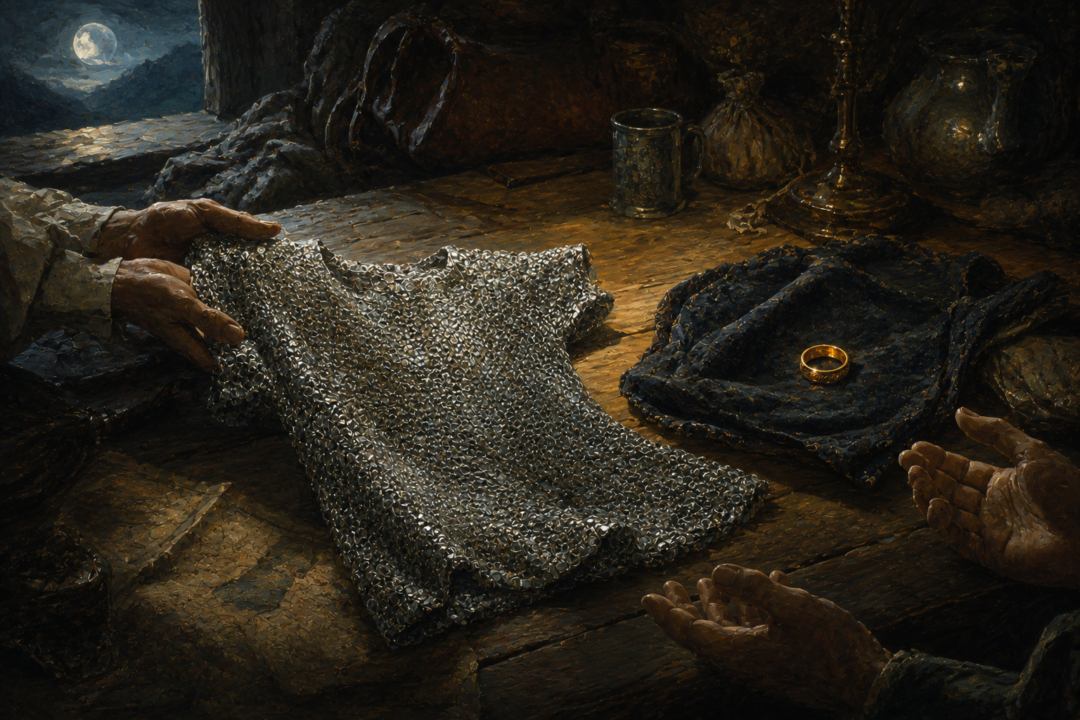
That small detail about Bilbo’s mithril coat is one of the strangest collisions of culture in The Lord of the Rings. To a Dwarf, the coat is an astonishing work of craftsmanship and a “kingly gift.” To Frodo, learning its value is almost incomprehensible. To Bilbo, it becomes something he can lend to the Mathom-house at Michel Delving and later give away to someone he loves.
The object never changes.
What changes is the culture looking at it.
And that makes Bilbo’s mithril coat more than extraordinary armor. Its journey from Erebor to the Shire, from museum-piece to life-saving equipment, reveals how differently the peoples of Middle-earth understand treasure, gifts, usefulness, inheritance, and wealth.
Thorin Does Not Give Bilbo a Trinket
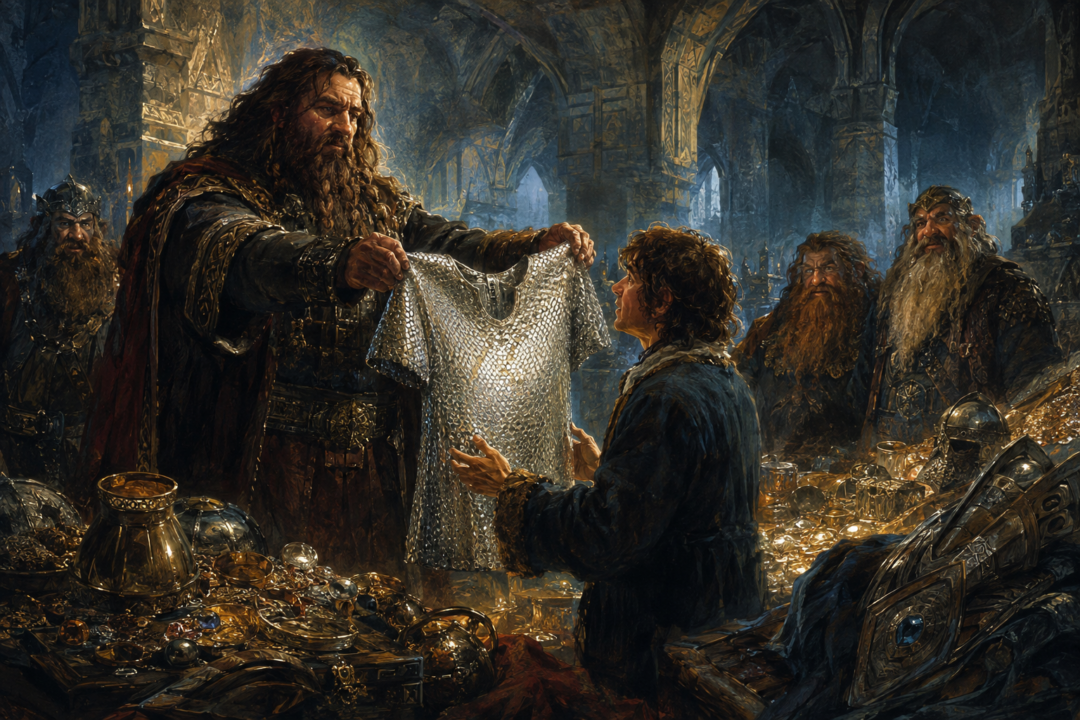
The coat first appears in The Hobbit, inside the recovered treasure of Erebor.
It is a small mail-shirt, made to fit someone far smaller than a Man or Dwarf. Thorin explains that it had been made for a young Elf-prince. In the revised text it is identified as silver-steel—mithril—and Thorin gives it to Bilbo as part of his reward.
The gesture matters because of where it happens.
The Company has entered a treasure hoard accumulated by generations of the Kings under the Mountain and then possessed for years by Smaug. Around them are objects carrying not merely monetary value but dynastic and historical significance. Thorin himself puts on royal-looking armor from the hoard.
Then he equips Bilbo.
This is not simply payment measured by weight. Bilbo is being given an artifact produced by the extraordinary metalworking traditions associated with the Dwarves, fashioned from an exceptionally precious substance, and originally intended for someone of high status.
Later, in Moria, Gimli immediately understands what that means.
When he learns that Bilbo possessed a corslet of Moria-silver, he calls it a “kingly gift.”
That reaction is our first clue that Bilbo may have received something far beyond what an ordinary Hobbit would have understood as compensation.
The Dwarves See Craftsmanship Where Others See Price
Mithril was uniquely important to Khazad-dûm.
In The Fellowship of the Ring, Gandalf explains that it could be beaten like copper and polished like glass, while the Dwarves could make it into a metal light yet harder than tempered steel. Its beauty did not diminish with time.
Even before the abandonment of Moria, mithril was enormously valuable. After Khazad-dûm fell and its mines ceased to be worked by the Dwarves, existing mithril became still more precious.
But Gimli’s reaction to Bilbo’s coat is revealing because he does not begin by asking how much it cost.
He calls it a gift fit for a king.
That distinction matters.
Dwarven culture repeatedly attaches significance to things that combine material rarity, skilled workmanship, ancestry, and memory. The treasures of Erebor are not merely piles of convertible wealth. They include objects made by generations of craftsmen and inherited through a kingdom.
This does not mean Dwarves are indifferent to material value. They plainly are not. But the texts show that objects can carry forms of value that cannot be reduced neatly to money.
Bilbo’s coat embodies several of them at once: rare material, exceptional craft, great age, and an association with vanished or diminished arts.
Gimli recognizes all of that almost instantly.
Gandalf Gives the Astonishing Number
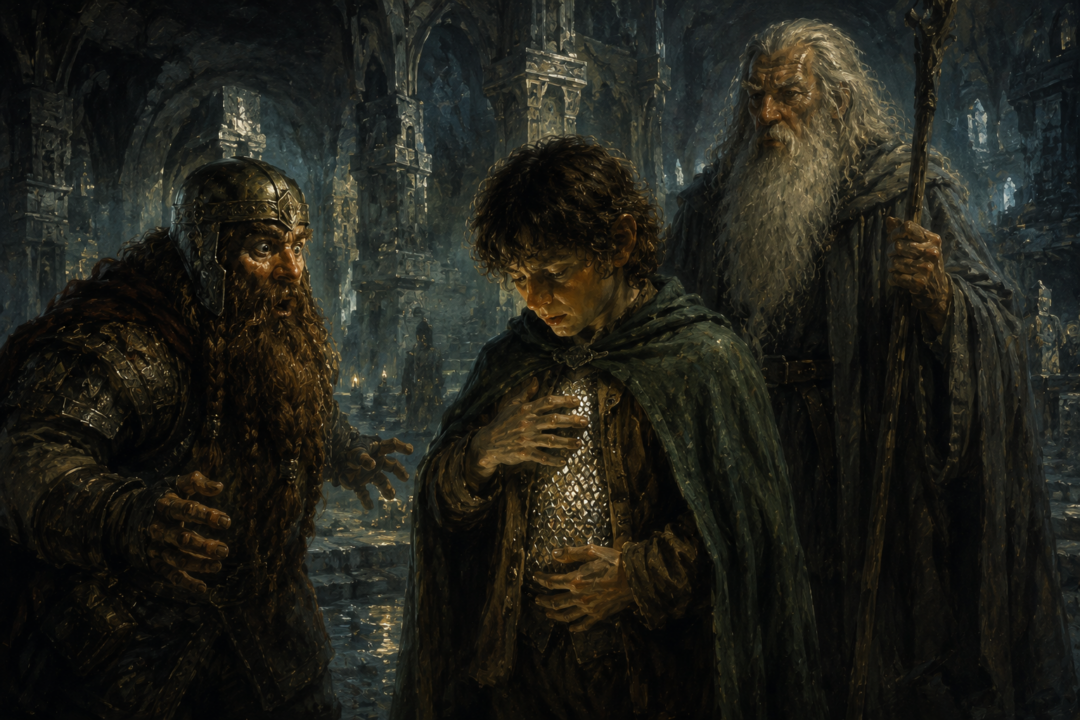
Then Gandalf translates the coat’s importance into terms Frodo can understand.
Its worth, he says, was greater than the value of the entire Shire and everything in it.
The statement is deliberately staggering.
Frodo’s reaction is physical: he touches the mail beneath his clothes, amazed that he has effectively been walking around carrying the price of his homeland under his jacket.
Yet Gandalf’s comparison should probably not be treated as a piece of precise Middle-earth accounting. The text gives us no property survey of the Shire and no mithril exchange market from which to calculate the coat’s exact price.
Its narrative purpose is clearer than its economics.
Frodo suddenly understands the scale of Bilbo’s gift.
For a Hobbit, the Shire is not an abstract kingdom. It is fields, inns, mills, gardens, farms, houses, food, family property, and generations of settled life. Comparing one shirt of mail to all of that forces Frodo to confront a completely different scale of material value.
And yet Bilbo had owned the coat for decades.
He had never behaved like the richest Hobbit in history because of it.
The Shire Has a Completely Different Category for Treasure
Perhaps the most revealing part of the coat’s history comes before Frodo ever wears it.
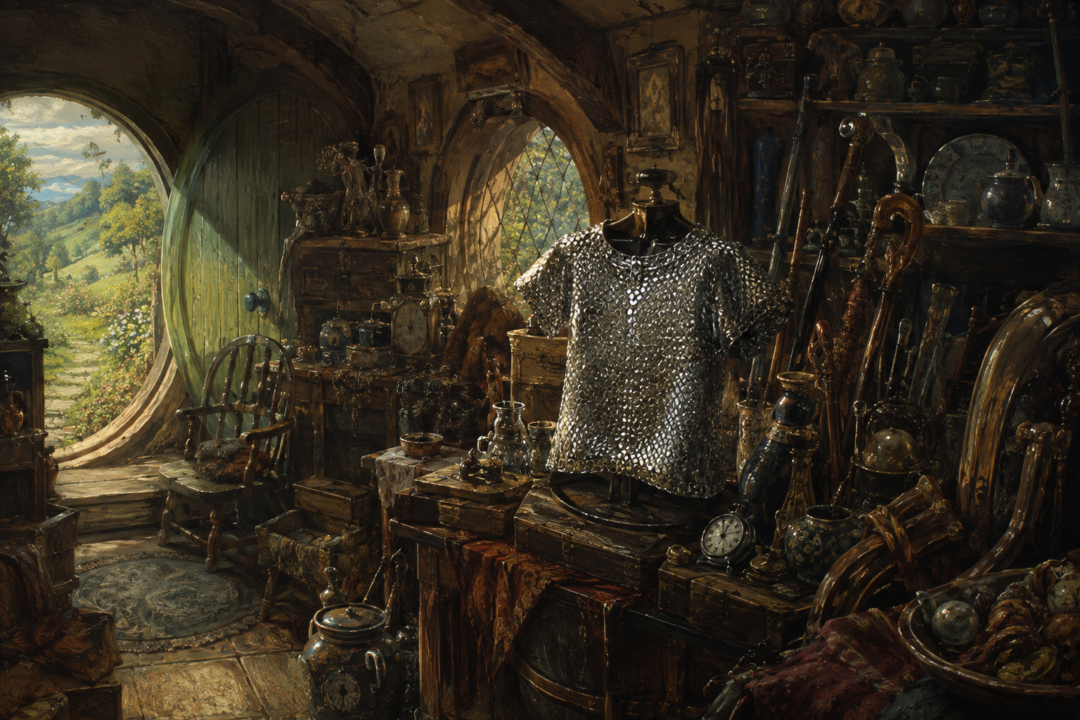
Bilbo lent it to the Mathom-house at Michel Delving.
The word “mathom” is deeply Hobbitish. The Prologue to The Lord of the Rings explains that Hobbits used the term for things they had no immediate use for but did not wish to throw away. Their homes became crowded with such objects, and gifts could circulate repeatedly.
The Mathom-house preserved particularly notable examples.
Somehow, an artifact whose worth exceeded the Shire entered this cultural system.
The contrast is almost comic.
From a Dwarven perspective, the mithril coat represents a nearly irreplaceable combination of rare metal and extraordinary craft. In Hobbit society, Bilbo can treat it as an unusual possession suitable for local preservation because he has no practical need to wear armor while living at Bag End.
This does not mean the Hobbits are incapable of recognizing beautiful or valuable things. Nor does it mean Bilbo thought the coat worthless.
Rather, the episode shows that value depends partly upon use and context.
A mail-shirt in Erebor belongs naturally to a world of warriors, kings, treasure-hoards, smithcraft, and dangerous roads.
A mail-shirt in peaceful Michel Delving has almost no ordinary function.
The same artifact has crossed a cultural boundary.
Its material value remains enormous.
Its practical value collapses.
Bilbo’s Most Important Act Is Giving It Away Again
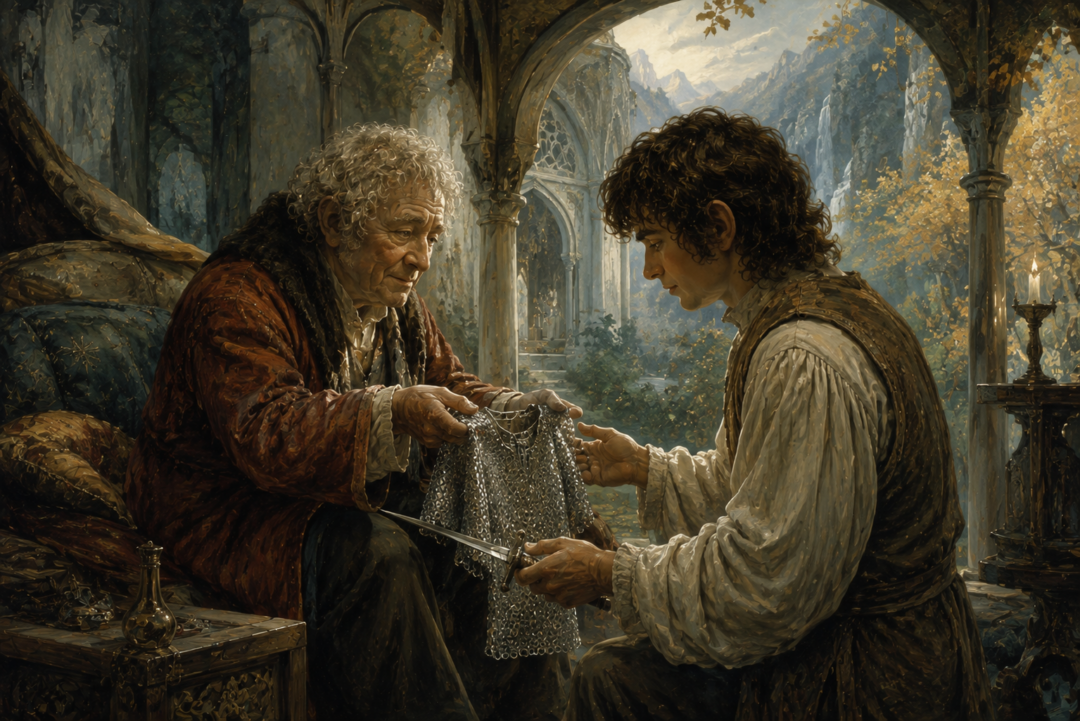
Years later, Bilbo retrieves the coat before leaving the Shire. In Rivendell, as Frodo prepares for the road south, Bilbo gives him both Sting and the mithril coat.
This second transfer transforms the meaning of Thorin’s original gift.
Bilbo does not sell the armor despite its fantastic worth. He does not preserve it as the foundation of family wealth. He does not demand that Frodo return it.
He gives it away.
Frodo suspects, after hearing Gandalf’s estimate, that Bilbo understood its extraordinary value perfectly well.
If Frodo is right, Bilbo’s generosity becomes even more striking. The coat’s immense exchange-value does not prevent Bilbo from treating it primarily as something that can protect someone he loves.
And this time, unlike during its years in the Mathom-house, the coat suddenly has exactly the use for which armor exists.
In Moria, an Orc thrusts a spear at Frodo. The blow is terrible enough that his companions initially fear he has been killed.
But the mithril holds.
The priceless museum-piece has become practical again.
Value Changes When an Object Crosses Cultures
The mithril coat therefore accumulates different meanings as it moves through Middle-earth.
In the treasure of Erebor, it is part of a royal hoard.
From Thorin to Bilbo, it becomes a reward and an extraordinary personal gift.
In the Shire, it becomes something close to a mathom: marvelous, preserved, but largely useless in everyday Hobbit life.
In Rivendell, it becomes an inheritance of affection from Bilbo to Frodo.
In Moria, Gimli recognizes its cultural and material magnitude.
And on Frodo’s body, it becomes what its maker intended it to be: armor.
None of these meanings completely erases the others.
That is the important point.
Middle-earth does not present one universal definition of wealth. Objects acquire meaning from the people who make them, inherit them, give them, preserve them, and use them.
A Dwarf can recognize generations of lost craft in something a Hobbit has stored away.
A Hobbit can possess unimaginable wealth without organizing his life around its market value.
And a gift can become more important because it is given again.
The Coat Is Also the Opposite of the Ring
There is an illuminating contrast here with another precious object Bilbo brings home.
The One Ring becomes extraordinarily difficult for him to surrender.
The mithril coat does not.
The comparison should not be pushed too far: the Ring actively corrupts and possesses supernatural power over its bearers, whereas the coat is simply a wondrously made object. But precisely because of that difference, the two possessions reveal opposite relationships between a person and a valuable thing.
The Ring encourages possession.
The coat enables generosity.
Bilbo receives the coat from Thorin and eventually gives it to Frodo. Frodo uses it, loses it when captured, regains it after Sauron’s defeat, and survives another attack because of it when Saruman tries to stab him in the Shire.
Its worth is repeatedly realized not through ownership but through protection.
The coat never demands to be possessed.
Its value can pass from hand to hand without diminishing.
A Kingly Gift Becomes a Hobbit Gift
That may be the deepest cultural transformation in the coat’s story.
Thorin gives Bilbo something Gimli considers worthy of a king.
Bilbo eventually gives the same object in a thoroughly Bilbo-like way: quietly, personally, and because Frodo might need it.
The scale of the gift remains royal.
The manner of giving becomes Hobbitish.
And the two traditions unexpectedly meet.
The Dwarves made an object of almost incalculable material worth. Thorin recognized Bilbo by giving it to him. Bilbo, living in a society where unwanted treasures could become mathoms and gifts constantly changed hands, eventually allowed that treasure to move onward.
By the time Frodo walks into Moria, he is wearing several different ideas of value at once.
He carries Dwarven craftsmanship, the wealth of a vanished mining kingdom, Thorin’s gratitude, Bilbo’s affection, and a piece of the history of Erebor beneath an ordinary traveler’s clothes.
Gandalf can tell him what the coat is worth.
Gimli can tell him what kind of gift it represents.
But Bilbo’s actions reveal something neither measurement fully captures.
The most valuable object in the Shire was not valuable because Bilbo could keep it.
It became most valuable when someone else needed it.
Sources & Notes
- The Encyclopedia of Arda, “Mithril-coat” — traces the coat from Erebor and Thorin’s gift to Bilbo through the Mathom-house and its later protection of Frodo. https://www.glyphweb.com/arda/m/mithrilcoat.php
- The Encyclopedia of Arda, “Mithril” — explains the metal’s rarity, lightness, strength, beauty, and extraordinary value after Khazad-dûm’s mines were lost. https://www.glyphweb.com/arda/m/mithril.php
- The Encyclopedia of Arda, “Mathom-house” — documents the Hobbit museum at Michel Delving where Bilbo lent the coat, grounding the contrast between treasure and ‘mathom.’ https://www.glyphweb.com/arda/m/mathomhouse.php
- The Encyclopedia of Arda, “Thorin Oakenshield” — covers Thorin’s recovery of Erebor’s hoard and his kingly presentation of the mail-shirt to Bilbo. https://www.glyphweb.com/arda/t/thorinoakenshield.php
- The Encyclopedia of Arda, “Khazad-dûm” — supplies the cultural and economic context of the Dwarves’ unique mithril workings and the loss that made surviving objects even rarer. https://www.glyphweb.com/arda/k/khazaddum.php
Sources added for the mithril coat's provenance, material value, Dwarven gift context, and Mathom-house history.