In most fantasy worlds, magic is easy to name.
It is a force, a discipline, a set of rules, or a category of power that can be described from the outside. Readers may not know every limit, but they at least know what kind of thing they are looking at.
Middle-earth does not work that way.
It contains wonders, powers, arts, enchantments, spells, curses, hidden strength, prophetic sight, preserved realms, speaking doors, terrible rings, and beings whose nature exceeds ordinary mortal understanding. Yet the closer we look, the less useful the modern word “magic” becomes.
That is not an accident.
The world of The Lord of the Rings repeatedly shows that what mortals call “magic” may actually be several very different things, and the story quietly refuses to collapse them into one category.
The word already breaks down inside the story
One of the clearest moments comes in Lothlórien.
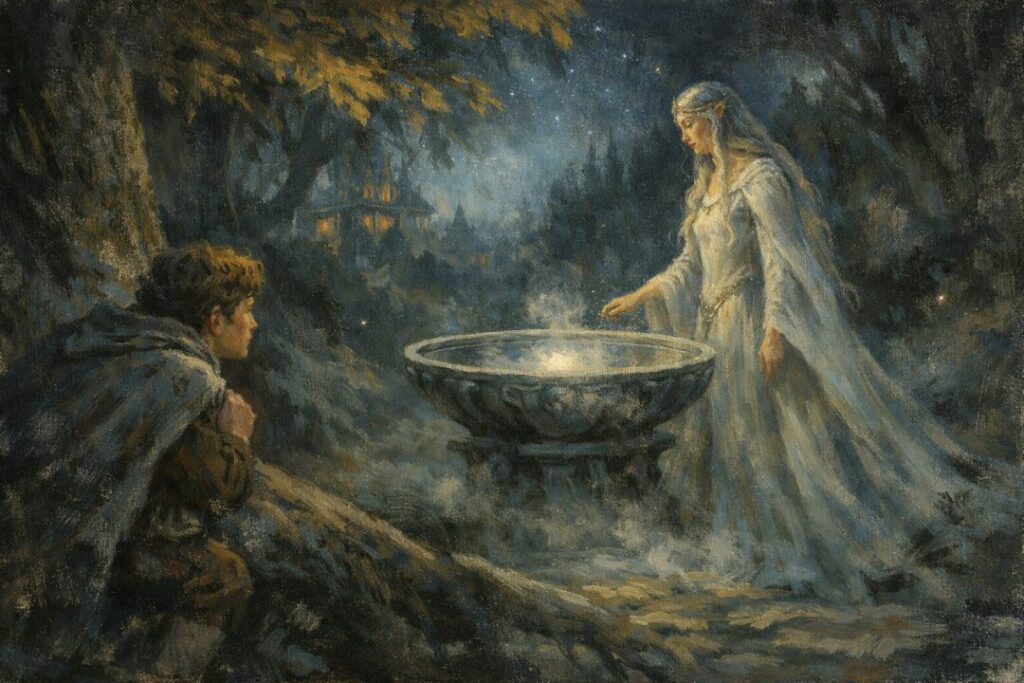
When Sam is invited to look into Galadriel’s Mirror, she says this is what his folk would call magic, though she does not clearly understand what they mean by the word. More strikingly, she observes that they use the same word for the deceits of the Enemy.
That line does a great deal of work.
It suggests that “magic” is not a precise native category in Middle-earth. It is, at least in part, a mortal label placed on things that feel uncanny from the outside. Hobbits see something marvelous, dangerous, or difficult to explain, and they group it together under one word.
But Galadriel does not.
And that difference matters because it tells us the text itself is more careful than many readers are. The world contains wonders, yes, but it does not imply that all wonders belong to the same order.
Some are bound up with making.
Some with wisdom.
Some with nature.
Some with spiritual stature.
Some with domination.
Some with deceit.
To call all of them “magic” is already to lose something important.
Elvish “magic” is often closer to art than spell-casting
This is one of the central distinctions behind the whole question.
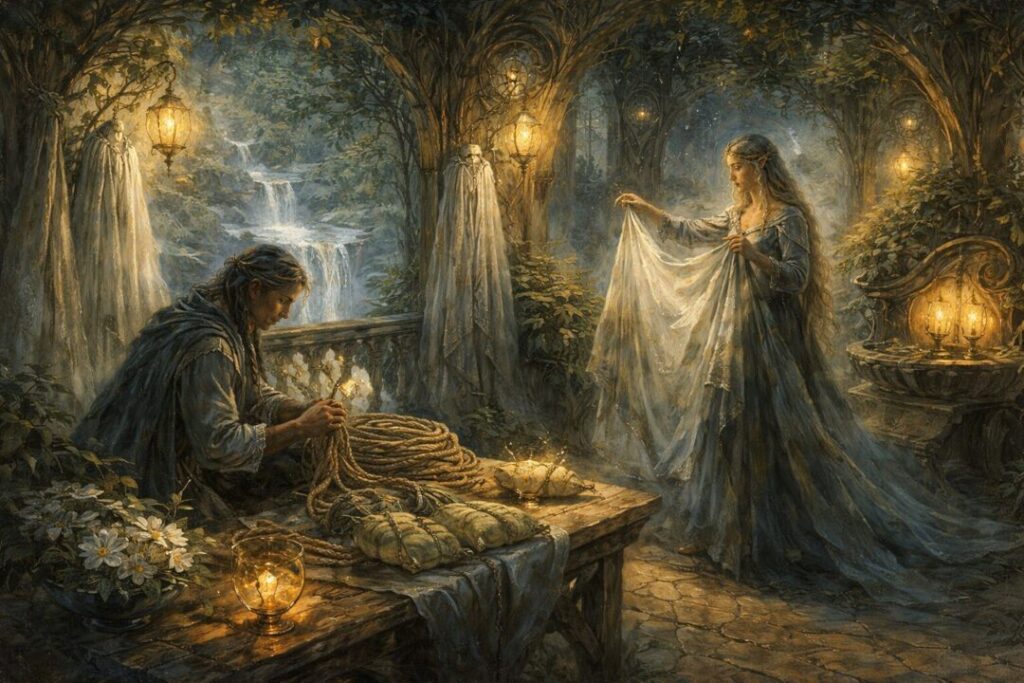
What mortals experience as Elvish magic is often presented less as the breaking of natural law and more as a deep cooperation with the nature of things. Elvish cloaks, rope, lembas, preserved realms, songs, memory, healing, and beauty all seem extraordinary to outsiders, but the text rarely frames them as flashy acts of imposed force.
They feel like skill raised to a level that ordinary people can barely comprehend.
That does not make them trivial. It makes them stranger.
Lothlórien is not impressive because it resembles a workshop of spell effects. It is impressive because time, memory, beauty, and preservation seem to gather there in a way the Fellowship cannot fully explain. Rivendell has a similar quality. So do many ancient Elvish works. They do not merely function. They endure. They hold shape against loss.
This is why the simplest modern fantasy language often misses the point.
The Elves are not primarily shown as people who cast “spells” in the ordinary genre sense. They are makers. Their power is deeply tied to being, memory, craft, and sub-creation. What appears magical to others is often inseparable from what they are.
That is also why Galadriel’s comment is so revealing. From her perspective, the mortal word is too blunt. It confuses unlike things.
The Enemy’s “magic” is different in kind, not just degree
The same word is often used for darker things, but the moral and imaginative structure is not the same.
The fear of the Nazgûl, the corruption of the Rings, the shadow over lands, the coercive will of Sauron, the blighting of beauty, the reduction of living things into tools — all of this belongs to a different pattern. It is not primarily about making. It is about mastery.
This is one of the deepest distinctions in Middle-earth.
The Enemy does not merely create marvels. He seeks to bend wills, dominate minds, reduce freedom, and impose order through force. Even when his works are clever or skillful, their aim is not delight, healing, or beauty. Their aim is possession and control.
That is why the One Ring matters so much.
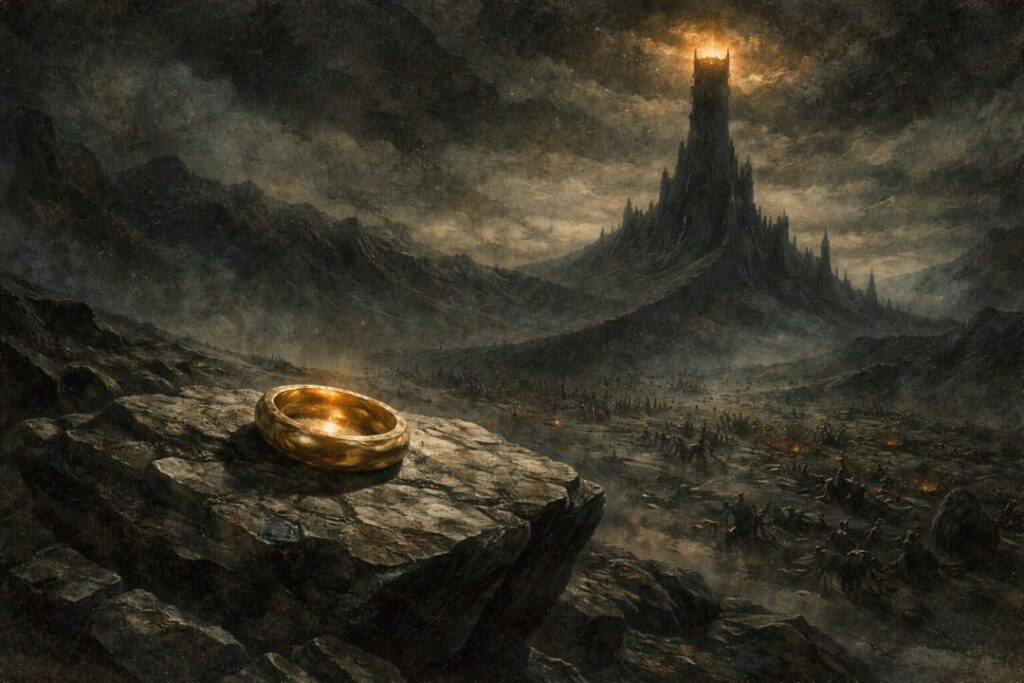
It is not simply a magical object in the broad sense. It is an instrument of domination. Its horror lies not in a bag of powers, but in purpose. It exists to govern the wielders of the other Rings and extend the will of its maker.
The same is true, more broadly, of many dark wonders in the legendarium. Their terror is not that they are supernatural. Their terror is that they are coercive.
That distinction is easy to miss if everything is filed under one word.
“Magic” in Middle-earth often means viewpoint more than category
A useful way to understand the problem is this:
very often, “magic” tells us as much about the observer as about the thing observed.
Hobbits, Men, or other outsiders encounter something ancient, refined, powerful, or spiritually weighty, and they call it magic because they do not have a better everyday word. The label marks distance. It tells us they are standing before something beyond ordinary experience.
But the thing itself may belong to a very different order.
An Elvish artifact may be an expression of ancient art and long memory.
A Maia’s act may arise from inherent spiritual nature.
A prophetic or dreamlike moment may belong to the deep structure of the world rather than to “spell-casting.”
A curse may be bound up with authority, oath, and doom rather than some neutral energy system.
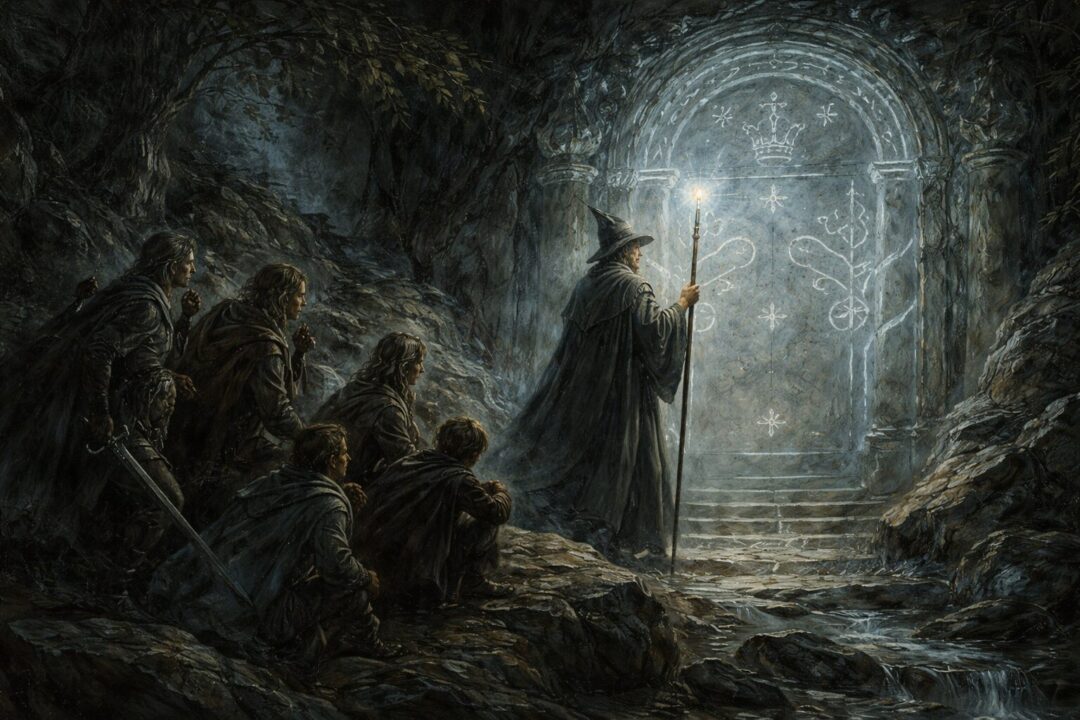
Even Gandalf complicates the picture. He speaks of spells at the Doors of Durin, which shows that words of power and learned formulae do have some place in the world. But that still does not turn Middle-earth into a tidy magic system. It only reminds us that language, knowledge, and power can intersect there in more than one way.
The important point is that the stories never stop to reduce all of this to one mechanism.
They preserve the differences.
Why the word stays vague on purpose
This matters because Middle-earth is not built to satisfy the modern appetite for total classification.
The world wants wonder to remain wonder.
Not because it is empty, but because it is layered.
If every strange thing were translated into a clean technical system, much of the atmosphere would collapse. Lothlórien would become less haunting. The Rings would become less morally weighty. Gandalf would become less mysterious. Ancient objects would become less ancient.
More importantly, the moral distinction between making and dominating would blur.
And that may be the real reason the word “magic” never fully settles in this world. It is too likely to make unlike things look alike.
The text does not deny wonder.
It refuses simplification.
The Rings show the problem most clearly
The Rings of Power are a perfect example because readers instinctively call them magical, and of course they are wondrous objects. But that word alone explains almost nothing.
The Three Elven Rings are associated with preservation, concealment, and the holding back of decay. Their use is still bound to the larger problem of power in Middle-earth, but they are not presented as identical in purpose to the One.
The One Ring, by contrast, was made to rule.
That difference is not cosmetic. It is the point.
To describe both merely as “magic rings” is true in the broadest, loosest sense, but it strips away the essential distinction of motive and design. Middle-earth cares intensely about that distinction. A thing is not understood only by what it can do, but by what it is for.
That is why power in this world is never morally neutral for long.
The question is always moving toward purpose.
Even “ordinary” wonders are left partially unexplained
Some of the most memorable marvels in Middle-earth are powerful precisely because they are not over-explained.
How exactly does lembas sustain so deeply?
How exactly do certain songs work upon the heart?
How exactly do some places hold memory so strongly?
How exactly should one classify the Mirror of Galadriel, or the responsive quality of some Elvish things, or the potency of names, oaths, blessings, and doom?
The texts often give enough to guide interpretation, but not enough to flatten mystery.
That restraint is essential to the atmosphere of the world.
Middle-earth does not treat explanation as the same thing as understanding. Often, the story gives the shape of a truth without reducing it to mechanism.
And in a world like that, “magic” remains a useful word only so long as we remember that it is imprecise.
So what counts as “magic” in Middle-earth?
The most careful answer is this:
many things in Middle-earth may appear magical, but the word does not name one single category inside the world.
Sometimes it refers to Elvish art and preservation.
Sometimes to the inherent power of beings greater than Men.
Sometimes to spoken spells or words of opening.
Sometimes to deception, fear, domination, and corruption.
Sometimes simply to the experience of encountering something marvelous that exceeds ordinary understanding.
That is why the word never fully settles.
Middle-earth does not ask us to sort every wonder into one shelf marked magic.
It asks us to notice the difference between beauty and control, between making and mastering, between wisdom and coercion, between mystery and mechanism.
And once that difference becomes visible, much of the world changes shape.
The Elves seem less like conventional sorcerers.
The Enemy becomes more frightening.
The Rings become more morally precise.
And wonder itself becomes harder to reduce.
That may be the real answer.
In Middle-earth, “magic” counts less as a clear substance than as a loose mortal word for things that are not all the same at all.
And the story is wiser than the word.