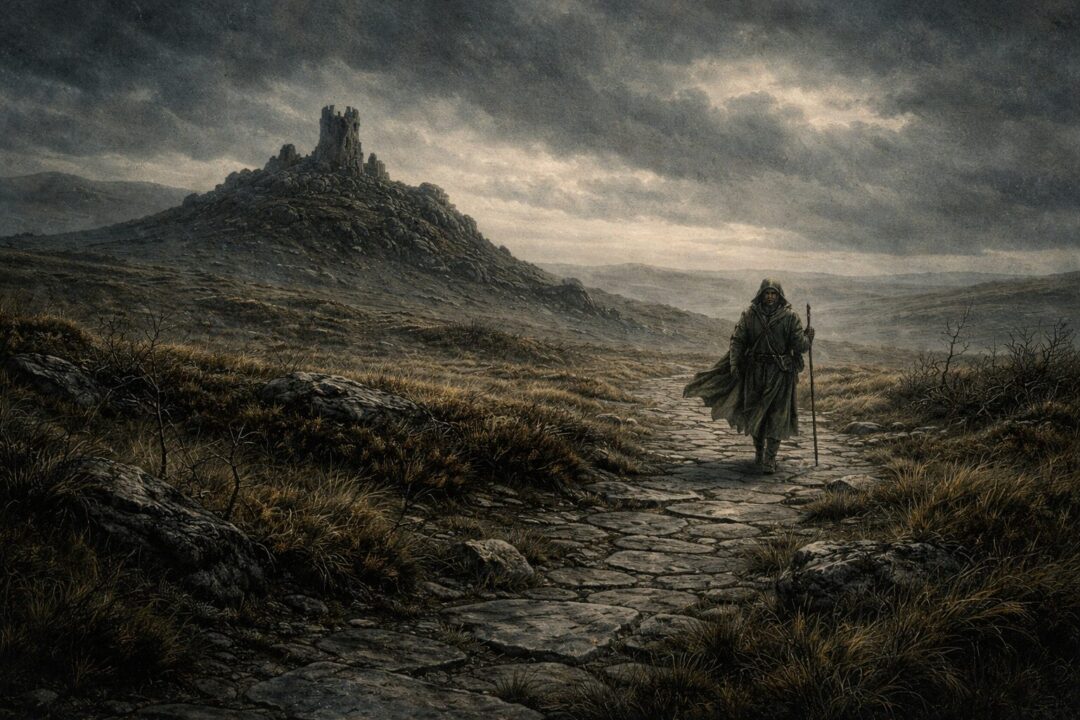
When people imagine wilderness in Middle-earth, they often imagine beauty first.
Ancient trees. Empty hills. distant mountains. Mist over forgotten ruins. A road vanishing into legend.
And Middle-earth certainly offers those images.
But that is not what true wilderness would feel like from inside it.
The deeper pattern in the books is harsher than that. Wilderness is rarely just scenic emptiness. More often, it is what remains when order has receded. Roads are broken. Settlements are sparse. Kingdoms are gone. The map still holds names, but the land between them has become difficult, dangerous, and in many places deeply unfriendly.
That matters because it changes the emotional reality of travel.
Crossing true wilderness in Middle-earth would not feel like a romantic escape from civilization. It would feel like exposure. Exposure to weather, hunger, confusion, distance, and the constant fact that help may simply not exist nearby.
The wild is beautiful in Tolkien’s world.
But it is also exhausting.
And the longer the journey goes on, the more that exhaustion becomes part of the danger.
Wilderness in Middle-earth is usually a sign of loss
One of the most important things to understand is that much of north-western Middle-earth is not wild because no one was ever there.
It is wild because far fewer people remain.
That is especially true in Eriador. By the end of the Third Age, travellers pass through wide lands filled with ruins, broken roads, abandoned watchtowers, and memories of kingdoms that no longer protect the spaces between one settlement and the next. The emptiness is historical. It is the residue of collapse.
That gives Middle-earth’s wilderness a very different atmosphere from an untouched frontier.
The road from the Shire to Rivendell is not frightening simply because it passes through lonely places. It is frightening because the loneliness is unnatural. There should once have been more between these points. More people. More protection. More structure holding the land together.
Instead, there are pockets of safety surrounded by large stretches where travellers are on their own.
Even Bree, which feels modest and ordinary, stands out because it is one of the few places where ordinary life still visibly continues. That contrast tells us how thin settlement has become.
So to cross true wilderness in Middle-earth would mean more than walking through nature.
It would mean walking through a diminished world.
The first enemy would be distance
Before any monster appears, distance would begin the real work.
That is one of the most realistic features of travel in these books. Reaching the next safe place often takes longer than modern readers instinctively feel. Days matter. Food matters. Pace matters. Weather matters. Losing even a little time can become serious, because the land is so large and the inhabited points are so far apart.
A missed road is not a minor inconvenience.
A missed road can become exposure.
That is why guides matter so much. Aragorn matters because he knows the land. Gollum matters because Frodo and Sam do not. Ghân-buri-Ghân matters because the Rohirrim cannot move through the Drúadan Forest at speed without someone who understands it from within.
Middle-earth repeatedly shows that knowing where to place your feet is its own form of power.
Without that knowledge, even a strong traveller becomes vulnerable very quickly.
A person crossing true wilderness would feel that vulnerability constantly. Not in one dramatic burst, but hour by hour. Every decision would carry weight.
Do we press on?
Do we stop here?
Is there water ahead?
Did we lose the path?
Can we risk the trees?
Can we afford not to?
That pressure is part of what makes the wilderness feel oppressive.
Forests would be worse than they look
Readers often think first of forests when they think of Middle-earth’s wild places.
And the forests are not merely large.
They are psychologically hostile.
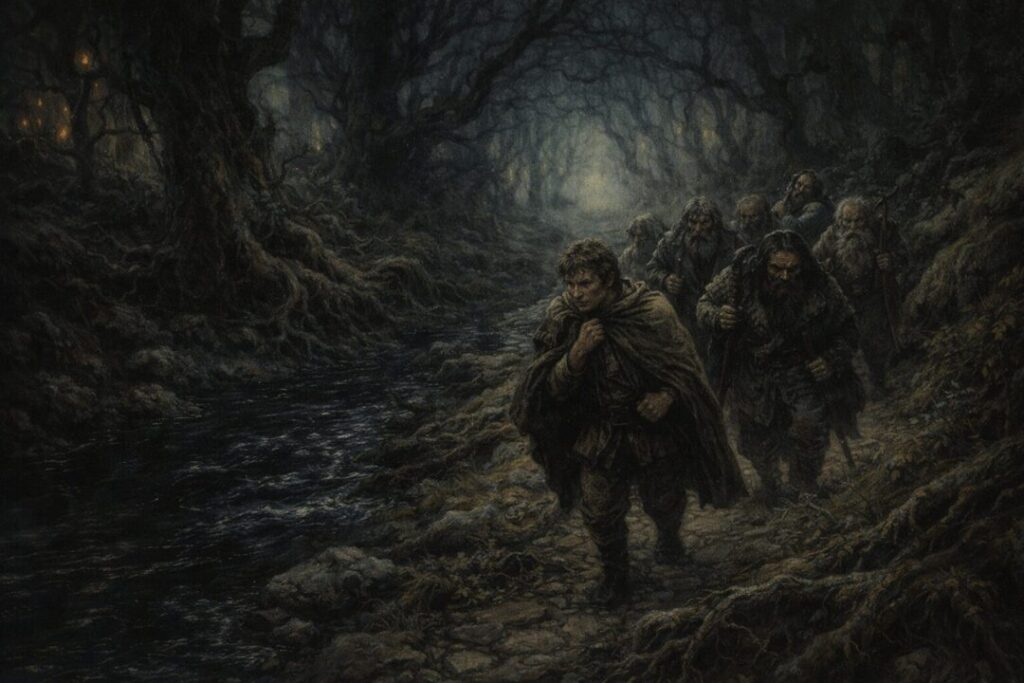
The Old Forest is the clearest example. The danger there is not just that one malicious being lives in it. The whole place feels resistant to passage. Direction breaks down. The travellers are subtly pushed, drawn, or misled. The forest is not a neutral backdrop.
It interferes.
Mirkwood makes the point differently. There the terror is not immediate violence at every step, but attrition. The path must be followed. Hunger grows. Weariness deepens. Light fails under the canopy. Judgment weakens. The company does not simply face enemies inside the forest. They begin to come apart under the conditions of the crossing itself.
That is crucial.
A real crossing of true wilderness in Middle-earth would not only threaten the body. It would work on the mind.
You would become more tired than you expected.
More irritable.
Less certain of your decisions.
More willing to risk foolish shortcuts just to end the strain.
That is exactly how wilderness becomes dangerous in the books. Not because every tree is literally alive with malice, but because prolonged uncertainty eats away at discipline.
And once that happens, the landscape needs very little help to defeat you.
The land would often be pathless in the worst possible way
Some regions are dangerous because they are hostile.
Others are dangerous because they are unreadable.
The Emyn Muil is one of the best examples. It is not a forest, not a swamp, not an open plain, but a stony maze of ridges and breaks in the land that turn movement itself into a problem. Frodo and Sam do not just struggle there because it is barren. They struggle because it is difficult to interpret. The landscape keeps refusing simple progress.
This kind of wilderness would be miserable to cross in real terms.
You would spend energy without gaining much ground.
You would climb only to descend again.
You would think a route was opening, only to find it closed.
You would keep seeing distance without getting through it.
That is a particular kind of despair.
In stories, mountains and broken hills can seem thrilling. In experience, pathless ground becomes repetitive punishment. Ankles turn. Packs grow heavier. Every detour steals strength. Even before fear enters, frustration does.
And frustration is dangerous.
It leads people to hurry when they should not hurry.
To descend where they should wait.
To trust a line of ground that only looks passable from far away.
Middle-earth understands that terrain itself can be the antagonist.
Marshes would be among the worst places of all
If forests work on certainty and pathless hills work on endurance, marshes work on both.
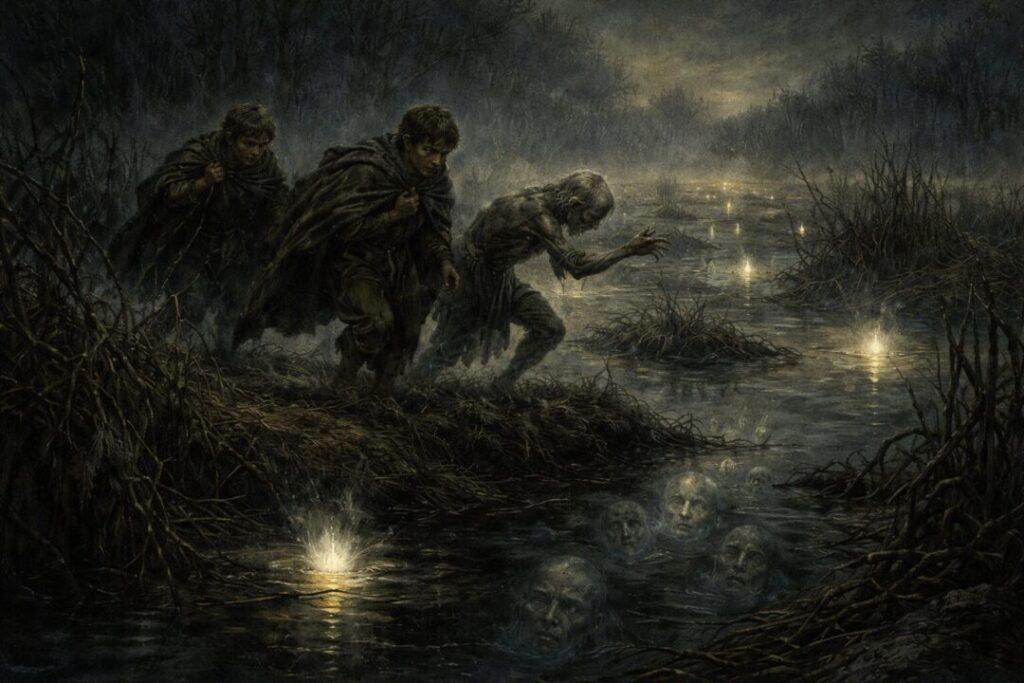
The Dead Marshes are not simply unpleasant. They are one of the strongest reminders that a landscape can be spiritually oppressive as well as physically dangerous. The ground is uncertain. The air is foul. The lights mislead. The water conceals death. Even attention itself becomes unsafe.
What makes this so effective is that the marshes are not just dangerous because one might drown there.
They are dangerous because they distort perception.
That is a recurring truth in Middle-earth: the worst places do not only threaten life. They weaken clarity. They draw the traveller away from practical judgment and toward fear, fascination, or despair.
So a real crossing of wilderness in Middle-earth would involve more than knowing where food and shelter were.
It would involve preserving your own mind.
Can you ignore what tempts you to look?
Can you continue when the ground is miserable and the smell does not leave?
Can you keep moving when the landscape feels morally wrong, not just physically hard?
That is part of why these journeys feel so heavy on the page.
The characters are not only crossing distance.
They are resisting the land’s effect on them.
Mountains would not be noble. They would be punishing.
Middle-earth’s great heights are beautiful from afar.
Up close, they become survival problems.
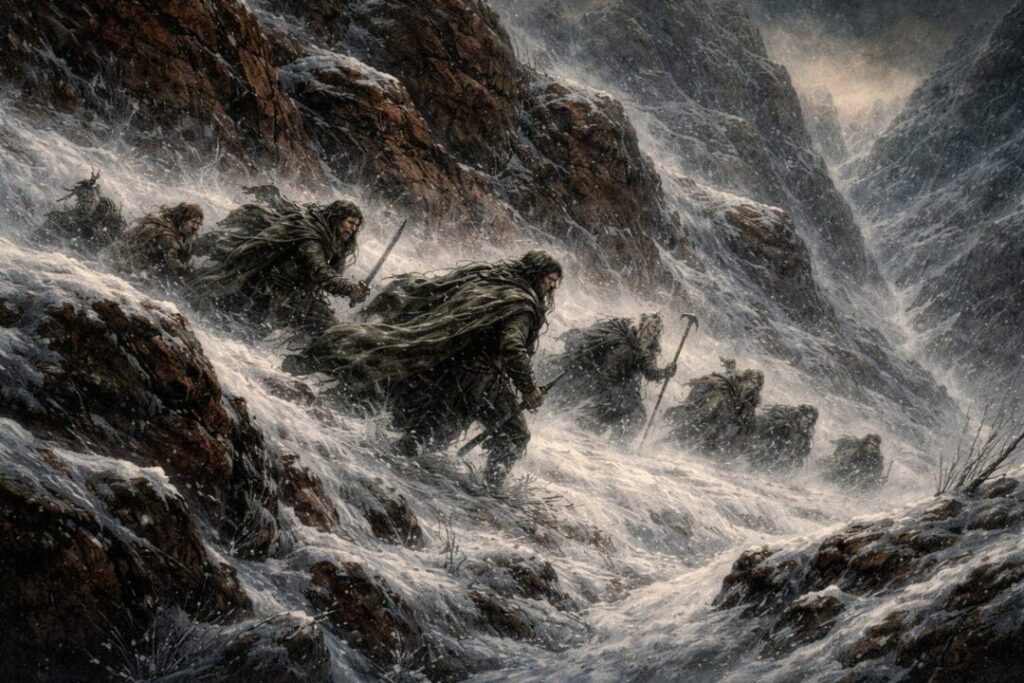
Caradhras is the clearest example. The danger there is not some elaborate plot twist. It is exposure. Snow, cold, blocked passage, loss of control, and the realization that the mountain does not have to kill you dramatically to defeat you. It only has to refuse you.
That is an important distinction.
The wild in Middle-earth often wins by making progress impossible.
Not every failed crossing ends in battle. Sometimes it ends with retreat, because the weather has already decided the matter.
That would be true of real mountain travel throughout Middle-earth. Wind would matter. Timing would matter. Visibility would matter. A pass that looked possible from a map or a distant ridge could become deadly very quickly. Supplies would tighten. Fear would rise. Group morale would become fragile.
And if there were enemies nearby, the weather would already have done half their work.
So if someone imagines crossing the wilderness of Middle-earth as a matter of courage alone, the books quietly correct that idea.
Courage helps.
But courage does not melt snow or shorten miles.
Even “empty” land would not truly be empty
Another misconception is that wilderness in Middle-earth is uninhabited.
Often it is simply inhabited by people strangers do not understand.
The Drúadan Forest makes that clear. To outsiders it is an obstacle. To the Wild Men who know it, it is navigable. That contrast reveals something essential: wilderness is partly a matter of perspective. Land that seems trackless to one group may be legible to another.
The same principle appears elsewhere in different forms. Rangers move where others would be lost. Elves pass through forests differently from Men. Dwarves read mountains differently from Hobbits. Knowledge changes the character of the land.
But that should not reassure us too much.
For the ordinary traveller, this means crossing true wilderness would involve another fear: not knowing who else belongs there more than you do.
That uncertainty matters. You are not necessarily alone. You are simply the least informed being in the landscape.
And that is not the same thing.
The real burden would be cumulative
Perhaps the most important truth is that wilderness in Middle-earth would wear people down before it destroyed them.
Not usually in one moment.
By accumulation.
Poor sleep.
Wet clothes.
Bad footing.
Too little food.
Fear of being seen.
Fear of being lost.
Long stretches with no sign that the effort is bringing safety nearer.
This is exactly why the books place so much weight on endurance. The heroes are often not the strongest fighters in a narrow sense. They are the ones who continue under conditions that slowly strip comfort, certainty, and energy away.
That is what real wilderness would be like in this world.
Not one glorious confrontation after another.
A grinding test of whether you could remain disciplined, hopeful, and recognizably yourself while the land kept taking small things from you.
Your warmth.
Your appetite.
Your patience.
Your sense of direction.
Your trust in tomorrow’s shelter.
By the time danger finally took visible form, you would already be diminished.
Why Middle-earth’s wilderness feels so powerful
This is why the wild parts of Middle-earth linger so strongly in memory.
They are not only settings.
They reveal what the world has become.
The empty miles of Eriador, the oppressive depth of Mirkwood, the trap of Caradhras, the maze of the Emyn Muil, the corruption of the Dead Marshes: all of them show a world where travel is still possible, but never safely assumed.
That makes wilderness in Middle-earth feel older and more serious than fantasy landscape often does. It is not there to provide scenery between plot points. It is there to test limits, expose dependence, and remind us how thin the islands of refuge really are.
So what would crossing true wilderness in Middle-earth really be like?
Beautiful, yes.
But beauty would be the least reliable part of it.
It would be cold sooner than expected.
Longer than expected.
Lonelier than expected.
And far more mentally exhausting than most people imagine.
Because in Middle-earth, the wild is not just where civilization ends.
It is where the world begins pressing back.