Near the very end of The Return of the King, after the coronation of King Elessar and the long healing of the Shire, Gandalf makes a quiet announcement that many readers miss.
He will not return north immediately with the Hobbits.
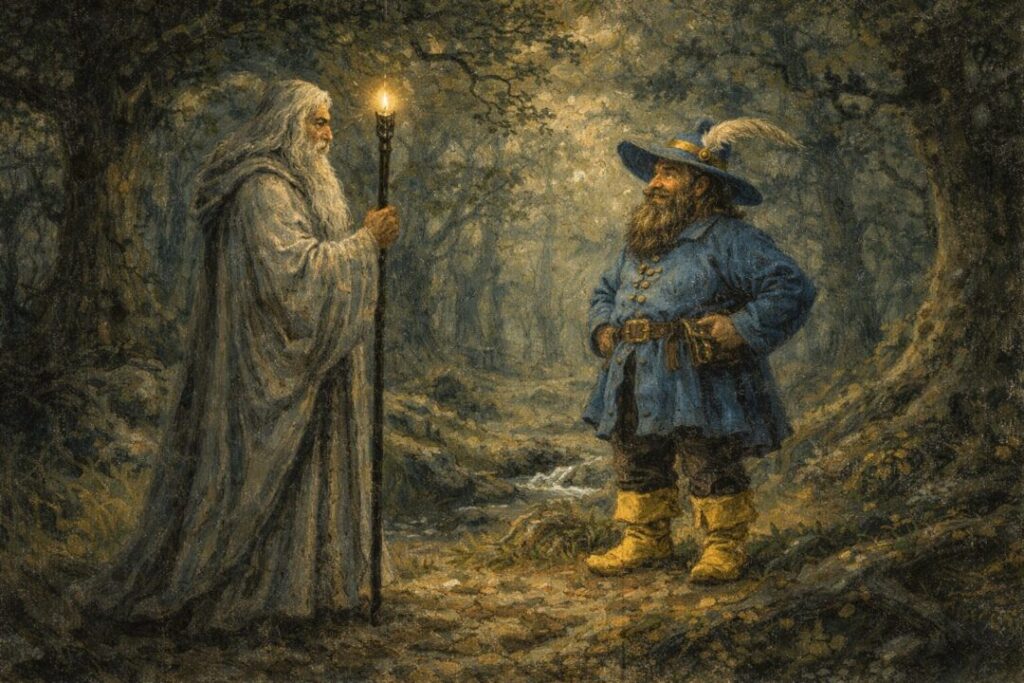
Instead, he says that he intends to visit Tom Bombadil.
“I have many things to talk about.”
It is a brief line. No explanation follows. The narrative does not return to it.
Yet this small statement is one of the most intriguing hints in the entire conclusion of The Lord of the Rings. At a moment when great events are ending and the Third Age is drawing to a close, Gandalf deliberately chooses to seek out the most enigmatic being in Middle-earth.
The text never tells us what they discussed.
But if we remain within what the canon firmly establishes, we can explore what this meeting may have meant.
Who Is Tom Bombadil?
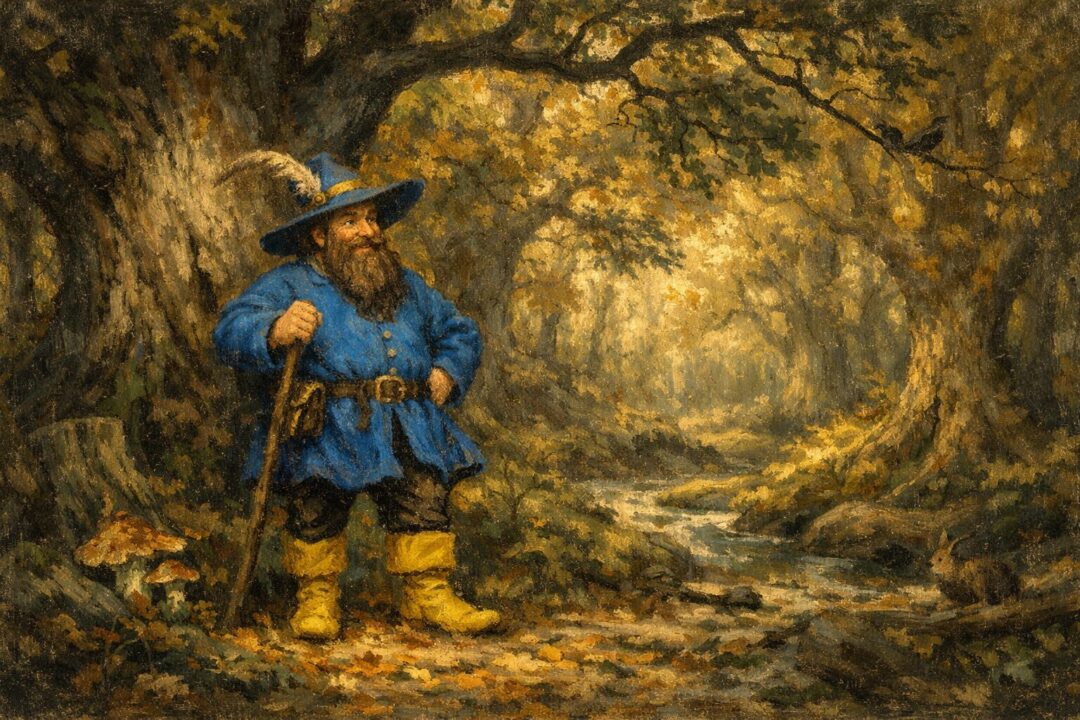
Tom Bombadil appears only in The Fellowship of the Ring, during the Hobbits’ journey through the Old Forest and the Barrow-downs. Despite his brief presence, he is one of the most unusual figures in the legendarium.
Several things about him are explicitly shown in the text:
- The One Ring has no effect on him. When Frodo puts it on, Tom can still see him clearly.
- When Tom himself puts on the Ring, he does not become invisible.
- He shows no desire to possess it.
- He returns it freely and without hesitation.
At the Council of Elrond, Bombadil’s name arises when the possibility of hiding the Ring is discussed. Gandalf explains that Tom would not be corrupted by it. However, he also warns that Tom would not understand the need to guard it carefully. The Ring simply would not matter to him. He might misplace it or forget it entirely.
Elrond adds a striking remark: if all else fell, Bombadil might remain “Last as he was First.” This implies an extraordinary antiquity. Earlier, Tom himself says he was there “before the Dark Lord came from Outside,” and that he remembers the first raindrop and the first acorn.
These statements strongly suggest that Bombadil predates Sauron’s dominion in Middle-earth. However, the canon never explicitly identifies what Bombadil is. He is not named as a Maia, a Vala, or any other known order of being.
Any attempt to define him more precisely moves into speculation.
What the text does confirm is this: Tom Bombadil exists entirely outside the struggle for power that defines the War of the Ring.

Who Is Gandalf at This Point?
By the time Gandalf speaks of visiting Bombadil, the War of the Ring has ended. Sauron has fallen. The One Ring has been destroyed. Aragorn has been crowned King of Gondor and Arnor.
Gandalf the White has fulfilled his mission.
Canonically, Gandalf is one of the Istari — emissaries sent from the West to aid the Free Peoples against Sauron. He was forbidden to dominate or rule by force. His task was to guide, counsel, and inspire resistance.
Throughout the story, Gandalf consistently refuses the Ring. When Frodo offers it to him in the Shire, he recoils in fear of what he might become if he claimed it. His wisdom lies not in wielding power, but in restraining it.
Now, with Sauron defeated, Gandalf’s purpose in Middle-earth is complete. Soon, he will depart from the Grey Havens and sail into the West, ending his long involvement in the affairs of the Third Age.
In other words, Gandalf is preparing to leave the world he has guarded for centuries.
And before he does, he seeks out Tom Bombadil.
What They Share
What makes this visit remarkable is the relationship between these two figures.
Gandalf and Bombadil are among the very few beings in Middle-earth who stand entirely apart from the desire for dominion.
Bombadil is immune to the Ring because he has no interest in power. The Ring does not tempt him because it offers him nothing he desires.
Gandalf resists the Ring because he understands the danger of power, even when used with good intentions.
In different ways, both embody resistance to domination.
Both are ancient.
Both have seen ages pass.
Both operate without seeking kingship or control.
Yet there is a difference.
Gandalf actively labors in the struggle against Sauron. He organizes resistance, rallies kings, and directs battles — always within the limits imposed upon him.
Bombadil does none of these things. His domain is local. He protects the Old Forest and its boundaries, but he does not intervene in the wider wars of Middle-earth.
He is not indifferent to suffering — he rescues the Hobbits more than once — but he does not involve himself in grand strategy or global conflict.
That distinction matters.
Gandalf works within history.
Bombadil stands almost outside it.
The End of the Third Age
The destruction of the Ring marks the end of an era.
The power of the Three Rings fades.
The Elves prepare to depart.
The ancient magic that once shaped the world diminishes.
The dominion of Men begins.
Tom Bombadil, however, does not depart. There is no suggestion that he will leave Middle-earth. His existence appears rooted in the land itself. He is bound to his country and content within it.
Gandalf, by contrast, is leaving forever.
It is reasonable — carefully phrased — to see this visit as a symbolic moment: one ancient being who has labored within history speaking, perhaps for the last time, with one who has stood apart from it.
The narrative gives us no record of their words. This silence is consistent with the perspective of The Lord of the Rings, which is largely filtered through Hobbit experience. Much of the deeper metaphysical structure of the world remains off-page.
We are not meant to hear every conversation.
What They Likely Did Not Discuss
It is important to remain within canonical limits.
There is no textual evidence that:
- Bombadil secretly guided events in the War of the Ring.
- Bombadil is a hidden Vala.
- Bombadil is Eru Ilúvatar in disguise.
- Bombadil holds ultimate authority over Middle-earth.
Such interpretations exist in fan discussion, but they are not confirmed in the primary texts.
Gandalf does not visit Bombadil for military counsel. The war is over. The Ring is destroyed.
The timing is significant.
This is not a strategic meeting.
It is a meeting in peace.
A Conversation Beyond Power
If we remain strictly within what the text supports, one thematic possibility becomes clear.
The Ring’s destruction demonstrates that domination is not the highest power in Middle-earth.
Sauron seeks control. Saruman seeks control. Even Boromir briefly imagines using the Ring for control.
But the world is saved through humility.
Through Frodo’s endurance.
Through Sam’s loyalty.
Through acts of mercy.
Through refusal.
Tom Bombadil represents an even more radical freedom from domination. The Ring cannot even tempt him because he does not operate within its framework of power.
Gandalf, too, passes his greatest test when he refuses the Ring.
Their meeting, therefore, may represent a quiet acknowledgment of what has been proven: that restraint, not force, preserved Middle-earth.
Gandalf has fought long against Sauron. He has witnessed war, loss, and the fading of the Elves. Bombadil has remained steady in his forest, untouched by the tides of empire and collapse.
Now, at the end of the Age, they speak.
Perhaps of the passing of time.
Perhaps of the changing world.
Perhaps of nothing grand at all.
The text does not tell us.
And that restraint is fitting.
Two ancient beings.
After the fall of the Dark Lord.
In a world finally at peace.
Speaking quietly in the Old Forest.
What they said remains unknown.
But the silence is not a gap in the story.
It is part of its design.