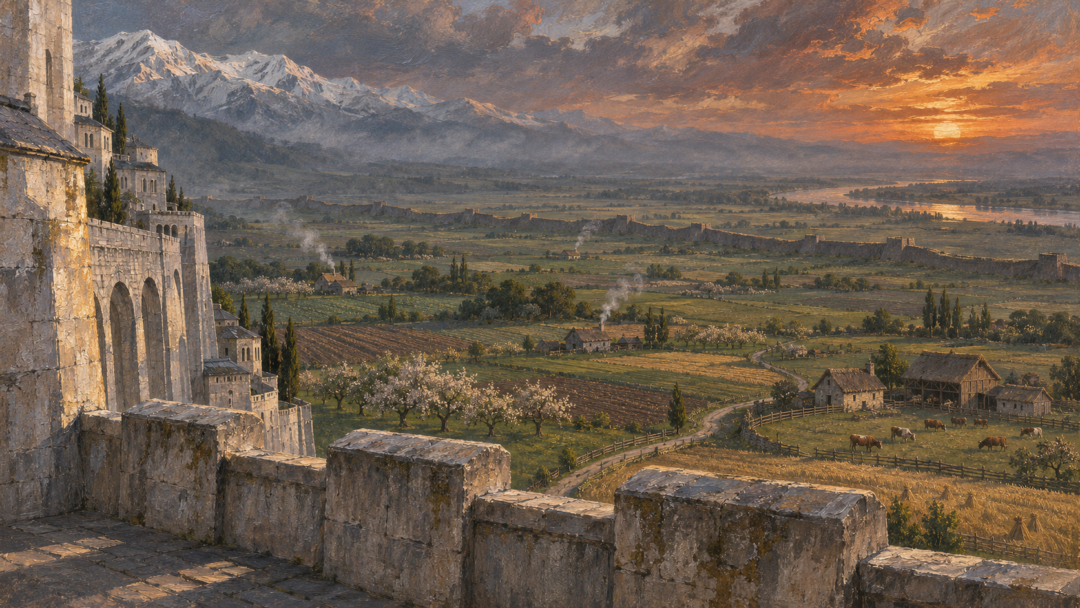
Before the siege of Minas Tirith, Pippin asks an urgent hobbit question: where can he eat? Beregond, a soldier of the Citadel, takes him to his company's buttery. They emerge with bread, butter, cheese, apples from the last winter stores, and fresh ale. They carry the basket onto the battlements and eat while looking across the countryside. It is no royal feast, but familiar food carried in a basket. Much of the meal has a connection with the land in sight.
The city's immediate source of food is the Pelennor, cultivated land enclosed by an outer defensive wall, the Rammas Echor. Beyond it lie Gondor's populated valleys and southern provinces, linked to the capital by roads and the Anduin. The books describe that landscape without supplying a complete menu or trading ledger.
The Pelennor was farmland before it was a battlefield
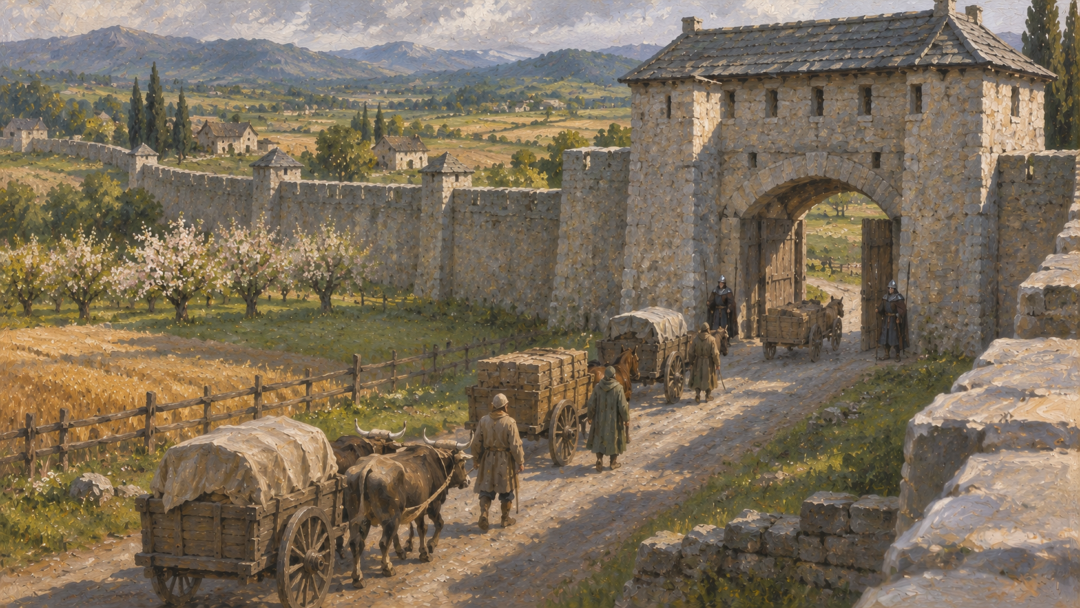
As Gandalf and Pippin approach Minas Tirith, they first pass through the Rammas Echor rather than the city's famous Great Gate. This outer wall stretches from the mountains towards the Anduin and around the White City's approaches. Inside it, the ground descends in slopes and terraces towards the river. The Pelennor is more than the place where the Rohirrim will charge: it is the capital's farmland.
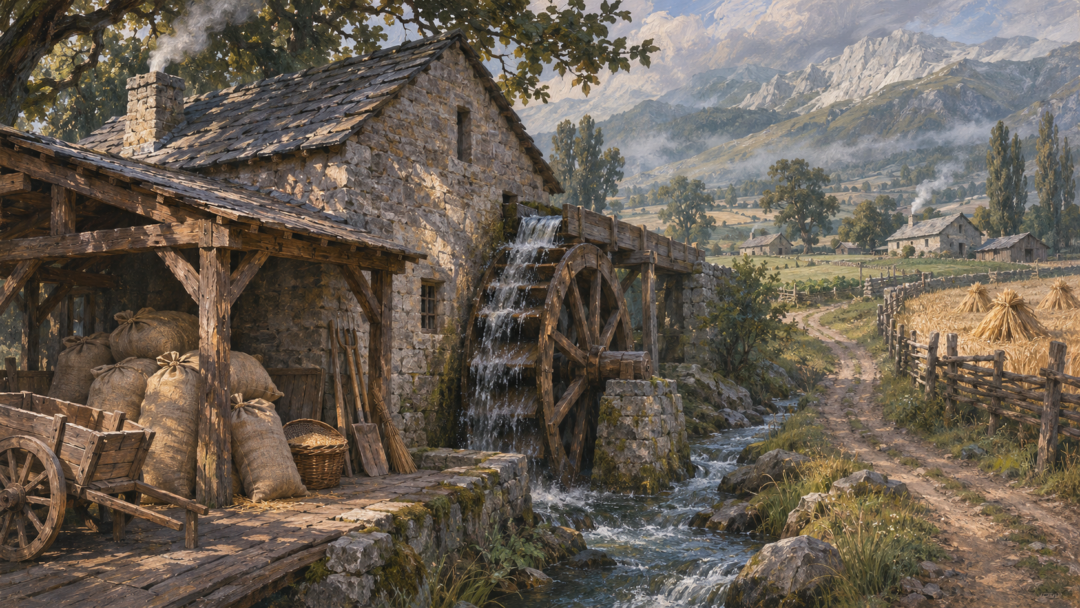
In The Return of the King, the chapter “Minas Tirith” describes practical details. There are tilled fields, orchards, homesteads, and streams running down from the highlands. There are garners for storing crops, livestock folds, and byres for cattle. The passage also mentions oasts, buildings associated with drying agricultural produce. Food is grown, animals kept, and harvests preserved here. The buildings matter because a harvest must last beyond the day it is gathered. Stored produce can feed people even when the fields are bare.
Pippin's lunch makes sense here. Bread points to grain and flour; butter and cheese to dairy animals; apples to orchards and winter storage. No particular loaf or apple is traced to a Pelennor farm, and the grain varieties are unnamed. Still, the connection is a sound inference. The infrastructure for producing and storing such foods stands just outside the city's inner walls. Grain also has to be threshed and milled before bread can be baked, though no particular Pelennor mill is named.
Seen from above, the fields are dotted with farmsteads, little walls, barns and cattle sheds. Pippin notices something missing: no cattle or other beasts are visible. War is approaching and the livestock have apparently been moved. Relatively few farmers and herdsmen live there; many Gondorians live in the seven circles or farther away. The Pelennor is productive land, not an independent rural kingdom with a population equal to its capital. Garden vegetables probably formed part of ordinary meals too, though the text names neither particular vegetables nor kitchen gardens on the Pelennor.
The Rammas is part of the food story too. Built after Ithilien fell under the enemy's shadow, it shields farmland as well as the city. Its guarded openings admit roads; near the river, the Harlond offers quays and landing places for vessels coming upstream from southern Gondor. Those routes and defences determine whether produce can reach the people above.
Bread from the fields, help from the provinces
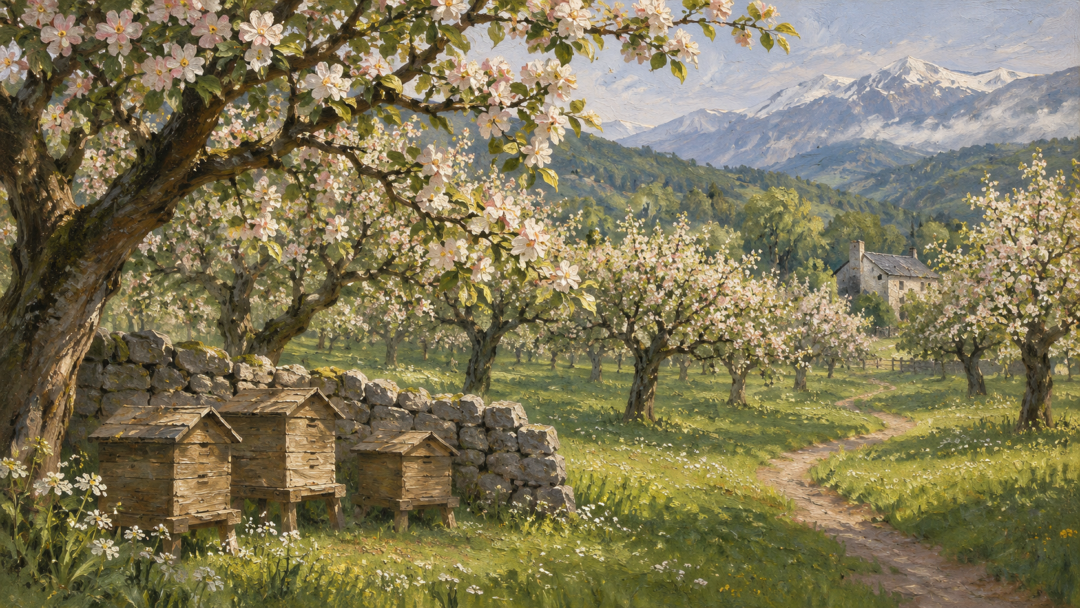
The land immediately around the city is only part of its hinterland. The account of the Pelennor names Lossarnach in the mountain-border valleys and Lebennin farther south as places where much of Gondor's population lives. These districts belong to Gondor and connect with the capital by road. They probably helped provision the city, although their regular shipments are unlisted.
Lossarnach has a personal connection to Minas Tirith. Beregond's father lives there, and his son Bergil speaks fondly of its spring flowers, woods and fields. The southward road from Minas Tirith runs towards its valleys and mountain villages, then onwards to Lebennin. Settled countryside and a direct road make it a likely supplier. No particular export crop is named.
Lebennin extends the network southward. It lies between the White Mountains and the sea, watered by several streams and associated in song with green fields and flowers. Pelargir and the Anduin connect southern Gondor with the capital's Harlond. Boats are expressly described as using the capital's river landings from the southern fiefs. Their cargoes are unspecified; food shipments are plausible, not individually documented.
Anórien provides another approach from the north and west. Gandalf rides through it on the way to Minas Tirith, and the road from Anórien and Rohan joins the Pelennor through an outer gate. It is a vital route, not evidence for any particular Anórien crop or routine meat imports from Rohan.
The arrival of Gondor's provincial soldiers gives these districts faces. Pippin and Bergil watch Forlong of Lossarnach enter with two hundred men; behind come troops from the Ringló Vale, Morthond and other southern districts. Among them are hunters and herdsmen from Anfalas and fishermen from the mouths of the Anduin. These are fighting men, not food convoys or recorded grain taxes. Their occupations reveal Gondor's working communities.
There is also a warning hidden in the small size of this muster. The capital expected more help. A fleet of Corsairs threatening the southern coast has forced the fiefs to retain men for their own defence. That danger could also disrupt commerce. A realm's roads are useful only while they remain passable.
When the fields burn
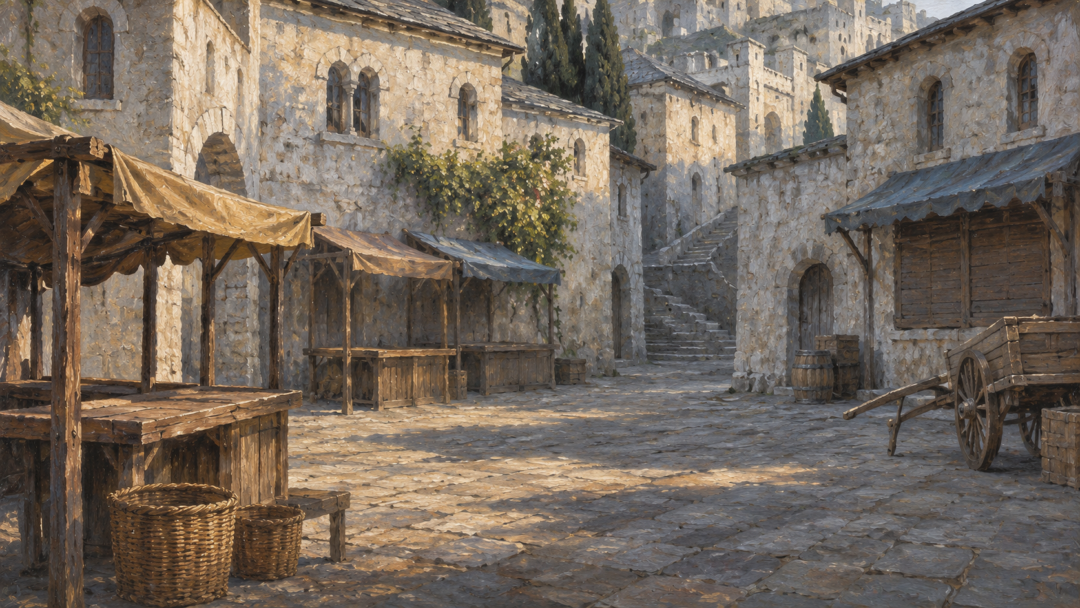
Before the enemy reaches the Pelennor, Minas Tirith is already changing its daily habits. From the walls Pippin sees covered wagons, ox-drawn vehicles and smaller carts moving south along the great road. They are not bringing a harvest to market. Beregond explains that they carry away the elderly, children and women who must accompany them, seeking refuge towards Tumladen, Lossarnach and Lebennin. The evacuation reduces the number of mouths behind the walls.
Then the outer defences fail. As Faramir's men retreat from the east, watchers see fires spreading across the Pelennor; houses and barns are burning. Enemy troops breach the Rammas and occupy the farms. The city gates close behind the defenders. Fields and trees burn as siege camps, trenches and engines spread over the ground. The city's food-growing land becomes an enemy camp.
The defenders understand the danger even though the main wall of Minas Tirith seems nearly impossible to break. In “The Siege of Gondor,” some answer that Sauron possesses a weapon as old as siege warfare: “Hunger. The roads are cut.” Here is the food problem in a sentence. The attackers can threaten the city by denying access to fields and stopping supply carts.
This does not mean that the population immediately starves. Beregond's earlier buttery scene shows that supplies are kept within the city, including fruit saved from the previous winter. The Citadel has scheduled meals, from a morsel before duty to a daymeal at sunset. Pippin later encounters a much smaller serving of bread, butter and thin milk in a grim hour, but the text does not establish a citywide famine or tell us how many weeks the stores would last.
There is a longer loss beyond the siege itself. Burned orchards need time to grow again; destroyed barns and farmhouses interrupt work even after the enemy has gone. The narrative does not calculate the damage to Gondor's next harvest, so those consequences remain inference. The battle ends among scorched homesteads and barns. Victory comes on ground whose everyday usefulness has been wounded.
Why the relief of Minas Tirith matters beyond the walls
The Rohirrim's arrival is remembered for horns, horses and the Witch-king's defeat. In geographic terms, it also means that the enemy's hold on the northern approaches can be challenged. Rohan's riders pass through the broken outer defences into occupied fields. Their charge breaks into the encirclement rather than delivering supplies. Without relief, even the strongest city would remain trapped behind its own walls.
The southern half of the story completes the picture. The Corsair fleet that had threatened Gondor's coastal provinces is defeated at Pelargir, and Aragorn takes its ships upriver with men gathered from Lebennin, Lamedon and other southern lands. They arrive at the Harlond and join the battle. The familiar river landing becomes a route for rescue. These ships carry fighters, not a recorded food cargo, showing the waterway's strategic value.
After the battle, the enemies within the Rammas have been driven out, yet the book never supplies a tidy account of shops reopening or farms being restocked. The victory makes recovery possible, though the war remains unfinished. Gondor's survival depends not only on holding its high stone walls but on maintaining the living country around them, a country that can be guarded, devastated and eventually worked again.
Picture Pippin and Beregond sharing stored apples on the battlement, overlooking the fields. The little basket holds more than a soldier's snack: it brings orchard, dairy, storehouse and road together in a single meal. A few days later, those same fields are burning. That is why the struggle for the Pelennor is also a struggle for the ordinary possibility of sitting down to eat.
Sources & Notes
- Tolkien Gateway, Pelennor Fields — the townlands and fields of Minas Tirith on the west bank of the Anduin, running down to the river in slopes and terraces, home to farmers and herdsmen in small settlements and enclosed by the Rammas Echor, with the South Road from Gondor's southern provinces crossing them to the city. https://tolkiengateway.net/wiki/Pelennor_Fields
- Tolkien Gateway, Rammas Echor — the great wall, some thirty miles long, that enclosed Minas Tirith together with the Pelennor Fields, its farmlands and pastures, running from the feet of Mindolluin to the Harlond, the city's harbour on the Anduin. https://tolkiengateway.net/wiki/Rammas_Echor
- Tolkien Gateway, Lossarnach — the fertile vale in the southern White Mountains below which lay great orchards of fruit trees that supplied much of the fruit required in Minas Tirith, and whose flowers and blossom drew visits from the city's people. https://tolkiengateway.net/wiki/Lossarnach
- Tolkien Gateway, Lebennin — the fief of southern Gondor between the White Mountains and the Anduin, the 'Land of Five Streams', with Pelargir in its south and a large population of hardy Men at the time of the War of the Ring. https://tolkiengateway.net/wiki/Lebennin
- Encyclopedia of Arda, Pelennor Fields — the townlands and fields of Minas Tirith, protected from invasion by the long circular wall of the Rammas Echor and crossed by the South Road and North-way. https://www.glyphweb.com/arda/p/pelennor.html
- Encyclopedia of Arda, Lossarnach — 'Gondor's vale of flowers', an ancient fiefdom near Minas Tirith famous for the flowers of its upper slopes and the orchards and blossoms of its lower-lying parts. https://www.glyphweb.com/arda/l/lossarnach.html
Food supply of Minas Tirith: Pelennor townlands and Rammas Echor enclosure, provincial hinterland of Lossarnach (fruit orchards) and Lebennin, and river access via the Harlond.