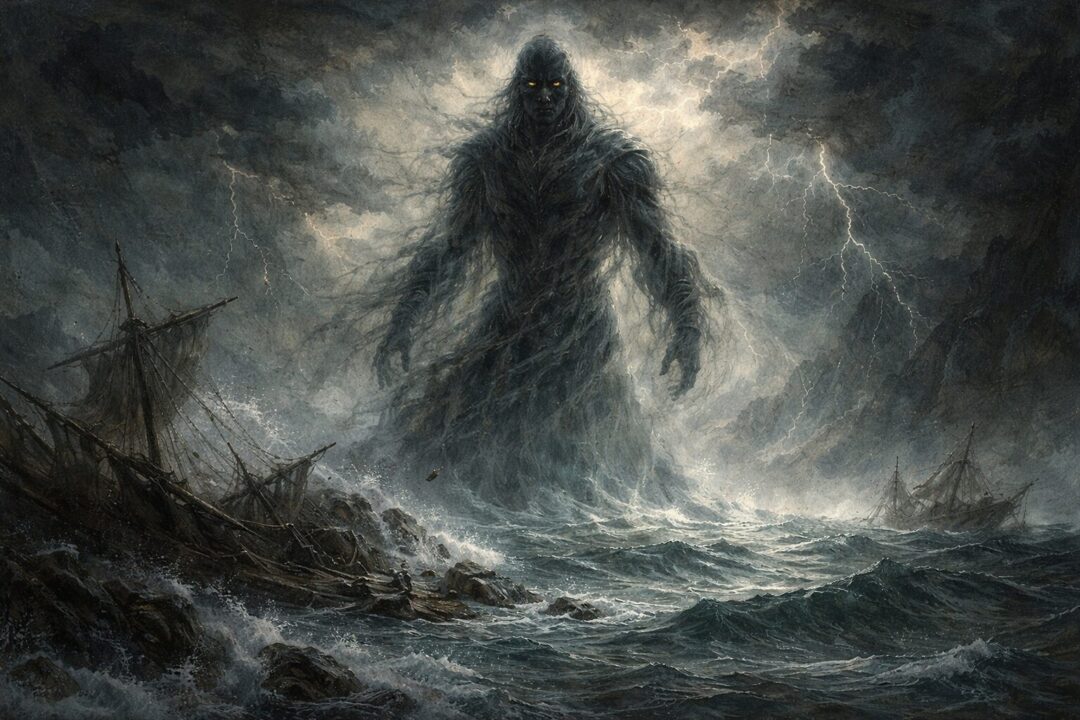
Few images in modern fantasy are as iconic as the armored Dark Lord of Mordor — towering, iron-crowned, faceless.
But if we return carefully to the primary texts of Middle-earth, a striking fact emerges:
The books never clearly describe Sauron wearing a helmet.
The image is powerful. It is unforgettable. But it is not actually textual.
So what do we truly know about Sauron’s physical appearance in the Third Age? Did he even have a stable body? And if he did stand armored within Barad-dûr, what might have existed beneath that armor?
To answer this, we must move slowly, and only as far as the canon allows.
Sauron Was Originally a Shapeshifter
Sauron was not always a dark tyrant confined to a single terrible form. In the beginning, he was one of the Maiar — a lesser Ainu who entered the world at its shaping. In The Silmarillion, he is first named Mairon, and is described as originally of the people of Aulë. His early nature is associated with order, craft, and skill.
In the First Age, we see clearly that Sauron possesses the ability to take on different shapes. In the tale of Beren and Lúthien, he appears as:
- A great werewolf
- A monstrous bat-like creature
- A dark sorcerer of dreadful power
These are not illusions. They are real physical forms he assumes.
Most importantly, in the Second Age, he appears in a fair and noble shape as Annatar, Lord of Gifts, when he comes among the Elves of Eregion. The text emphasizes that he was able to deceive them because he appeared wise and beautiful. There is nothing outwardly monstrous about him in this form.
At this stage, Sauron can clothe himself in whatever body best serves his purpose.
But this freedom does not last.
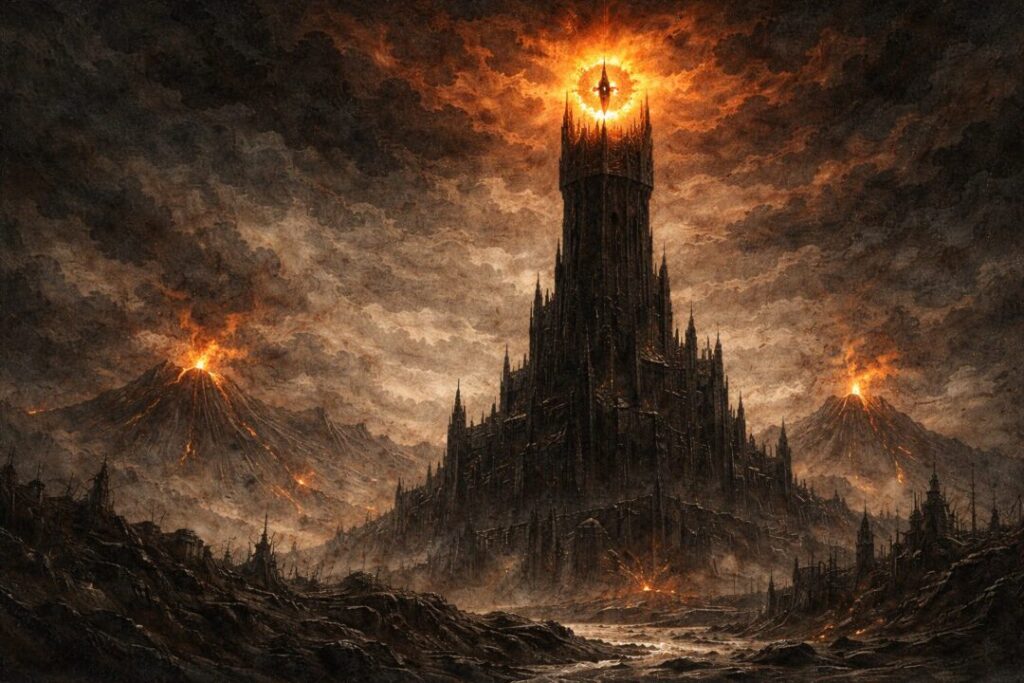
The Destruction of Númenor: A Permanent Change
In the Akallabêth, Sauron is taken prisoner to Númenor by Ar-Pharazôn. There he corrupts the king and the people, leading them into rebellion against the Valar. When Númenor is destroyed, Sauron’s physical body is annihilated in the cataclysm.
Here the text gives us something crucial:
Though his spirit survives, he is no longer able to assume a fair form.
This is stated directly. After the downfall of Númenor, Sauron’s ability to appear beautiful is permanently lost. Whatever body he rebuilds afterward must reflect his corruption.
This is the first irreversible narrowing of his physical freedom.
He is still powerful.
He is still embodied.
But he is diminished.
And from this point onward, every form he takes is “terrible.”
Did Sauron Have a Body in the Third Age?
Yes — and this is not speculative.
In The Lord of the Rings, Gollum tells Frodo and Sam that Sauron has “only four fingers on the Black Hand.” This small detail confirms several important facts:
- Sauron has a physical, humanoid hand.
- The injury inflicted by Isildur — when he cut the Ring from Sauron’s finger — remains.
- His Third Age body is stable enough to retain permanent mutilation.
This is not the description of a floating eye or a disembodied spirit.
Furthermore, in a late letter, Sauron is described during the Third Age as having “a form of a man of more than human stature, but not gigantic.” That phrase is carefully balanced. He is larger than an ordinary man, but not a towering titan.
This clarification matters.
He is not an abstract symbol.
He is not a pillar of flame.
He is not formless shadow.
He is embodied — though in a terrible shape.
The War of the Last Alliance
We know that Sauron personally fought in the War of the Last Alliance at the end of the Second Age. In The Silmarillion, he comes forth from Barad-dûr and wrestles with Gil-galad and Elendil. Both kings perish in that struggle. Isildur cuts the Ring from Sauron’s hand, and Sauron’s body is overthrown.
This scene confirms that Sauron had a solid, physical body capable of:
- Wielding weapons
- Engaging in close combat
- Being slain (in bodily form)
The text does not describe his armor in detail. It does not mention a helmet, spikes, or specific visual features. We are told only what matters narratively: he was terrible in battle, and his hand bore the Ring.
It is reasonable — though not explicitly stated — that he wore armor appropriate to a warlord. But the famous iron-crowned image is not drawn from the text itself.
So if we ask what Sauron looked like “under his helmet,” we must acknowledge something important:
The helmet itself is not described in the canon.
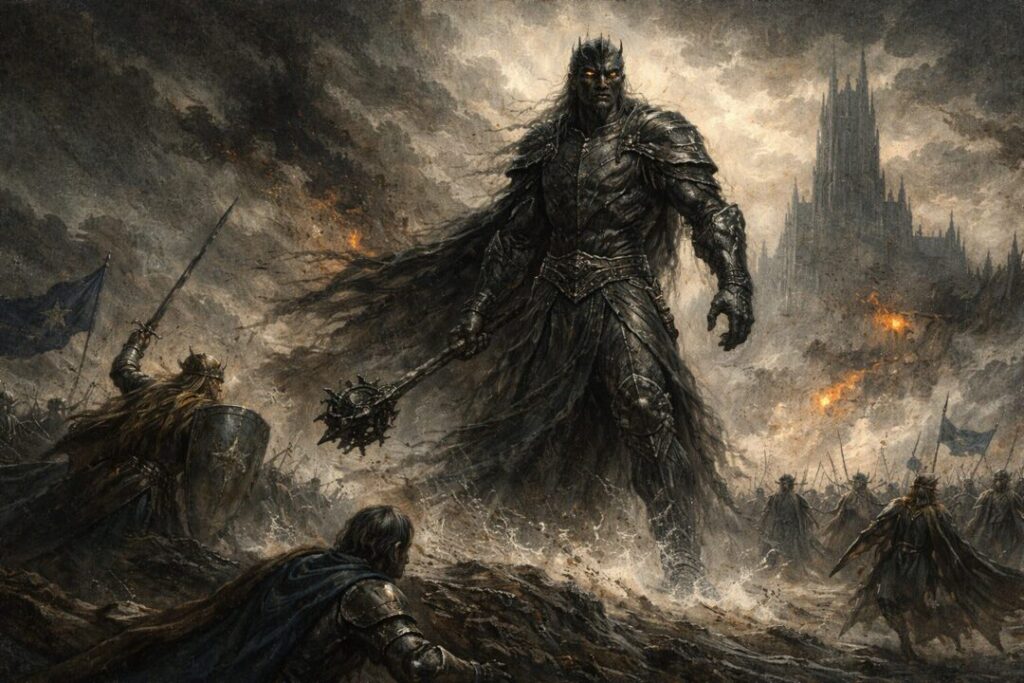
The “Eye of Sauron”: Literal or Symbolic?
Throughout The Lord of the Rings, Sauron is most often associated with the Eye.
Frodo sees a searching Eye in visions.
The Orcs speak of “the Eye.”
The Red Eye is emblazoned upon banners and shields.
In the Mirror of Galadriel, Frodo sees an Eye rimmed with fire, searching relentlessly.
But nowhere does the text state that Sauron is physically a giant eye atop Barad-dûr.
The Eye functions in several ways:
- As a symbol of his vigilance
- As an emblem of his dominion
- As a metaphor for his all-seeing will
When Frodo perceives the Eye, these are visionary or psychic experiences. The narrative context strongly suggests that Frodo is glimpsing Sauron’s mind or presence, not observing his anatomical form.
This is consistent with Sauron’s nature as a Maia. His power of perception radiates outward. His will stretches across Mordor and beyond. To those sensitive to such things, that presence may manifest symbolically as a burning eye.
But symbolic vision does not negate physical embodiment.
He has a body.
He has a hand.
He can sit in the Dark Tower.
He can suffer mutilation.
The Eye is not a replacement for his body. It is a representation of his will.
Was He Monstrous?
After Númenor, Sauron can no longer appear fair. The text describes him as “terrible,” “dark,” and filled with malice.
But the books do not describe grotesque anatomy.
There is no mention of:
- Horns
- Flaming skin
- Non-humanoid distortion
- Inhuman limbs
His horror is primarily moral and spiritual.
Unlike Morgoth, whose essence became diffused into the very matter of Arda, Sauron remains concentrated in his own embodied form. His power is great, but it is narrower than it once was.
He is bound increasingly to the One Ring. As The Lord of the Rings makes clear, much of his native power is invested into it. This investment limits him. He cannot abandon his physical form lightly. He cannot rebuild infinitely.
His body in the Third Age is not a shape he can discard easily. It is the vessel of a diminished but still formidable will.
So beneath armor — if armor he wore — we should imagine:
A tall, dark lordly figure.
Humanoid in structure.
Scarred.
Maimed.
Grave and terrible.
Not grotesque in detail — but overwhelming in presence.
Why the Text Leaves It Unclear
One of the most striking literary choices in The Lord of the Rings is that Sauron never appears directly in the story in person.
He has no dialogue.
He never steps into the narrative as a visible antagonist.
He is always distant.
This is deliberate.
The story is largely filtered through the perspective of Hobbits. Their knowledge of Sauron is fragmentary. Their encounters with him are psychological and spiritual rather than physical.
By withholding a clear description of his face, the narrative achieves several things:
- It preserves mythic distance.
- It emphasizes his will over his appearance.
- It prevents him from becoming a conventional “monster.”
The terror of Sauron does not lie in how many spikes crown his helm. It lies in the weight of his gaze, the suffocating pressure of his attention, the vast machinery of domination he has built.
He is less a creature to be looked at — and more a presence to be endured.
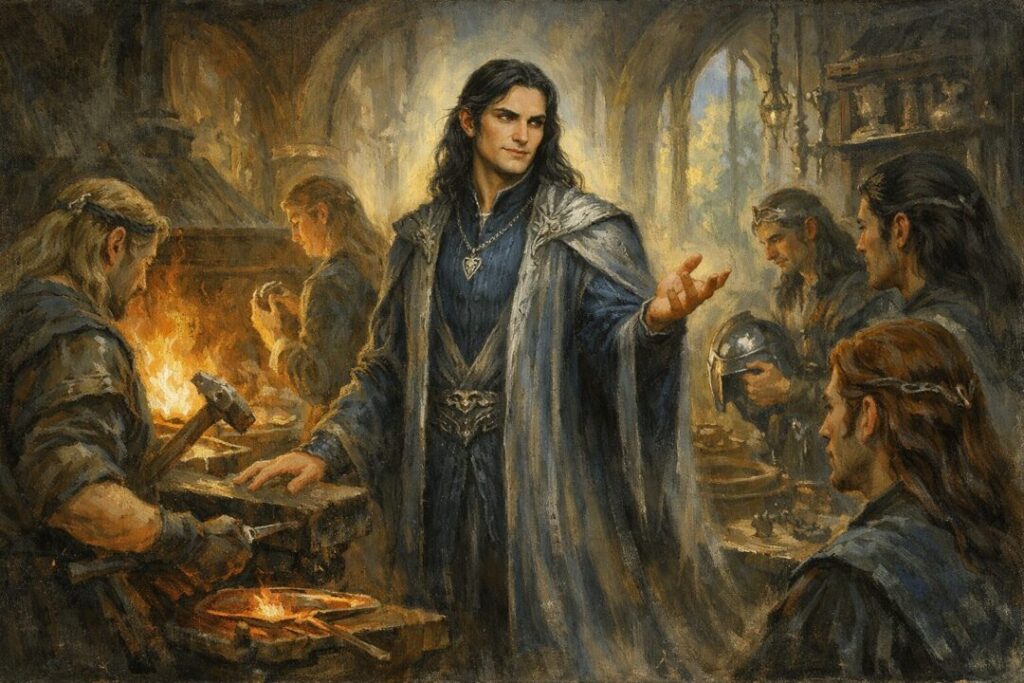
So What Would You See?
If you stood before Sauron in the late Third Age — if you could survive such a moment — the texts suggest you would see:
A being in the shape of a man.
Taller than mortal men.
Dark and terrible.
Marked by the loss of one finger.
No longer capable of beauty.
Not a floating Eye suspended in air.
Not a faceless void.
Not a shapeless shadow.
But a fallen Maia, locked into a single corrupted body — diminished from his former glory, yet still dangerously powerful.
And perhaps the restraint of the text is the most unsettling detail of all.
We are told just enough to confirm his embodiment.
Just enough to confirm his injury.
Just enough to confirm his fall.
But never enough to reduce him to spectacle.
The horror of Sauron is not in the precise shape of his features.
It is in what he chose to become — and in the terrible will that still burned behind whatever face he wore.