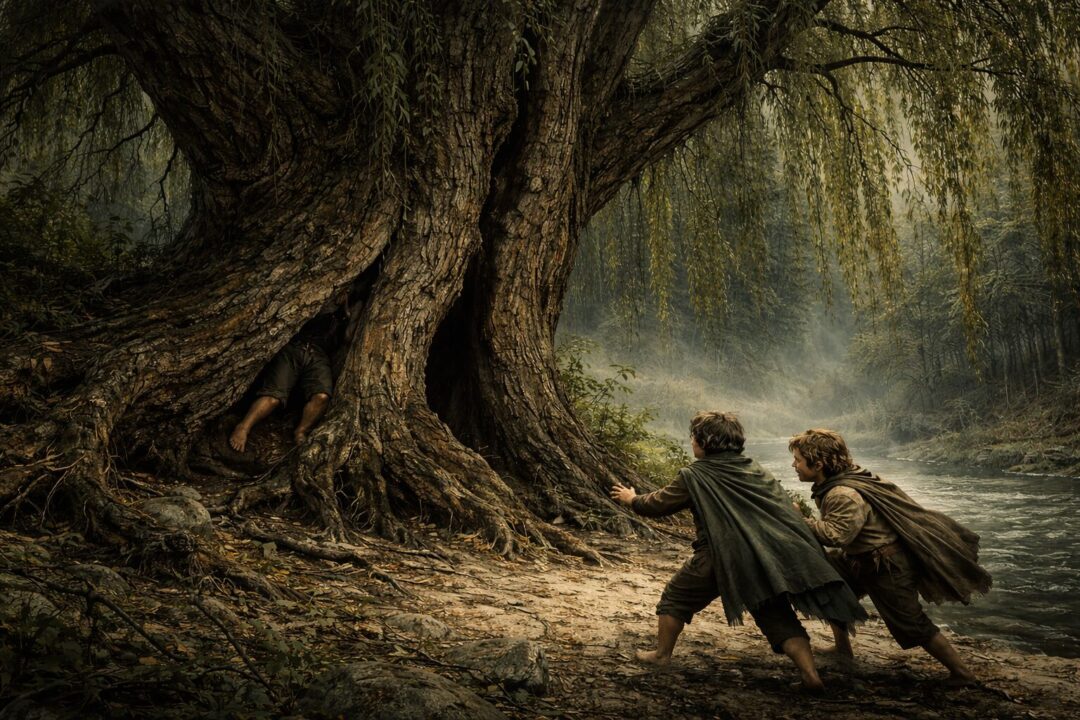
Old Man Willow is one of those Middle-earth encounters that doesn’t behave like an “early obstacle.”
He appears near the beginning of the long road—before the Riders have been understood, before the world has fully widened, before the epic scale of the War of the Ring has had time to settle into your bones.
And yet the scene in the Old Forest can leave a deeper aftertaste than many battles.
Not because it is louder.
Because it is older.
Old Man Willow is not introduced with heraldry or prophecy. He is introduced the way you introduce a danger you already know too well: by the way everyone changes the moment his name is spoken.
When Frodo cries out that his friends are caught, Tom Bombadil reacts instantly:
“Old Man Willow? … I know the tune for him.”
That single line tells you something crucial about what the Hobbits have stumbled into.
This is not a random tree. This is a presence with a history.
And the text is careful—very careful—about what it does and does not say Old Man Willow is.
Let’s keep to what can be supported.
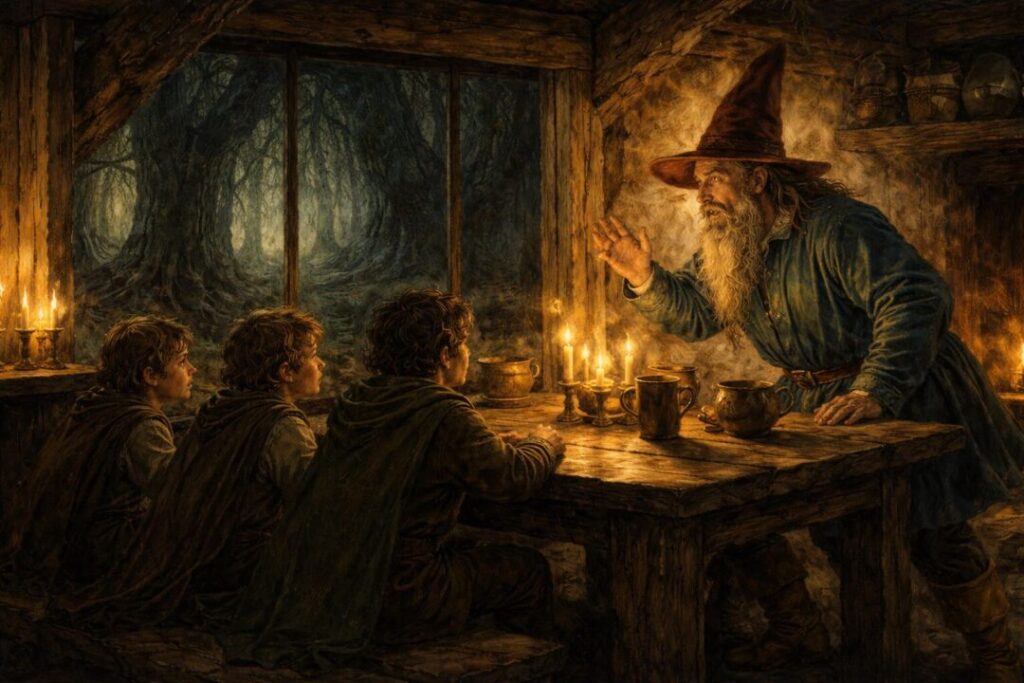
The Old Forest is ancient on purpose
Before you can understand Old Man Willow, you have to understand the chapter’s quiet premise: the Old Forest is not merely “a wood.”
It is a survivor.
In Tom Bombadil’s account, the Old Forest is “indeed ancient, a survivor of vast forgotten woods.”
That phrase matters because it frames everything that follows. The Hobbits are not entering a normal place that happens to contain something strange.
They are entering a remnant of a much older world—a world whose rules and priorities were formed long before the Shire ever existed.
That is why the prose repeatedly makes the Hobbits feel like intruders even when they behave politely. In Tom’s telling, the Hobbits begin to “feel themselves as the strangers where all other things were at home.”
This is one of the central reversals of the Old Forest chapter: the Hobbits are not the default “people” of the scene.
They are the exception.
And that reversal sets the stage for Old Man Willow.
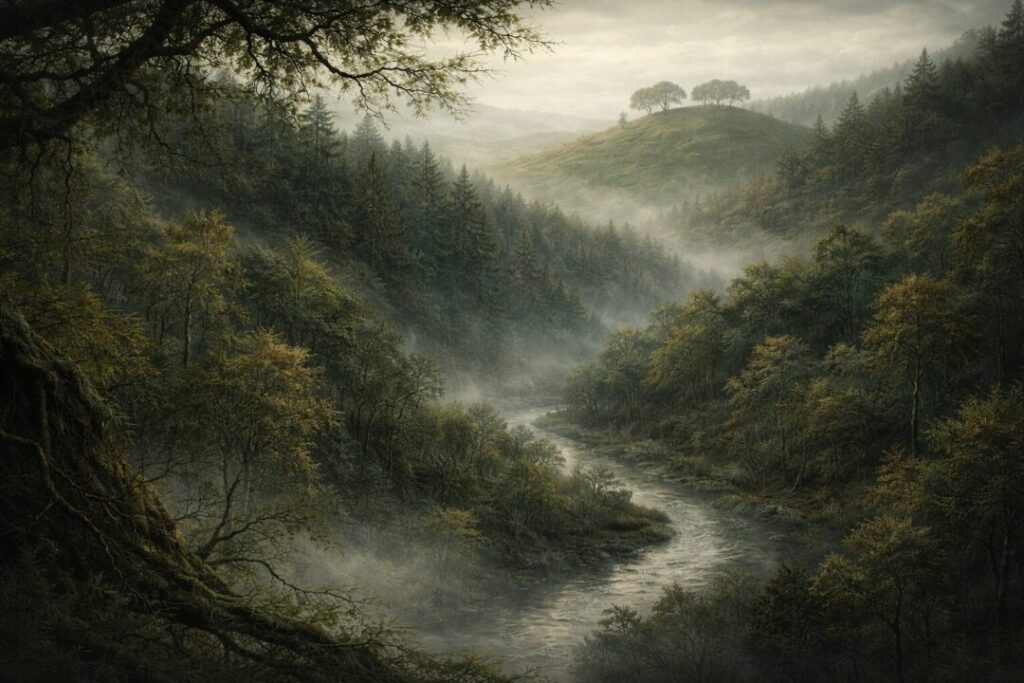
The Withywindle is treated like a source, not a location
Even before Tom arrives, Merry points out something that reads like a warning disguised as local knowledge.
Looking down toward the Withywindle valley, he calls it “the queerest part of the whole wood – the centre from which all the queerness comes, as it were.”
The phrasing is subtle but important: “centre,” “from which,” “comes.”
This is causal language. The valley is not simply strange. It is an origin point—something like a wellspring.
Later, Tom echoes the same idea in a different key. After rescuing them, he explains how they ended up there at all:
“All paths lead that way, down to Withywindle… Old grey Willow-man… and it’s hard for little folk to escape his cunning mazes.”
Again: not coincidence. Not bad luck. Pull.
The Withywindle is where the Forest’s will gathers—and Old Man Willow is the name attached to that will.
Old Man Willow is a tree with a “spirit” in the text itself
So what exactly is Old Man Willow?
The safest answer is also the truest: he is a willow tree described as having a malignant, controlling inner life—so strongly described that the narration speaks of him as more than wood and leaf.
Tom calls him “Old grey Willow-man,” a name that is half description, half accusation.
And when Tom later “lays bare the hearts of trees,” the narration makes Old Man Willow the peak example of that hidden interior:
“None were more dangerous than the Great Willow: his heart was rotten… and his song and thought ran through the woods on both sides of the river.”
This is not movie-language. It is the text’s own insistence that the Forest has minds within it—and that Old Man Willow’s mind is among the darkest.
Even more striking: the account speaks directly of “his grey thirsty spirit,” which “drew power out of the earth,” spreading through the ground and air until it had “under its dominion nearly all the trees of the Forest from the Hedge to the Downs.”
That is the closest the chapter comes to defining what Old Man Willow is:
- a physical tree (“the Great Willow”)
- possessing a described “spirit”
- exerting influence across other trees, widely enough to be called “dominion”
The text does not explicitly label him as an Ent, a Huorn, or any other category used elsewhere in the story. Readers sometimes connect those dots, but that connection is interpretation, not a statement made here.
What is stated is that Old Man Willow can act at a distance through the Forest, and can work upon travellers through sleep and confusion.
How he attacks: sleep, trapping, and the violation of “rest”
Old Man Willow’s attack is eerie because it begins with something ordinary.
The Hobbits are tired. The riverbank is quiet. The temptation is simply to sit.
Then drowsiness falls on them—so heavy that even when they notice it, they have trouble resisting it. When the trapping begins, it is not described like a sudden leap. It is described like a closing.
Merry and Pippin are drawn into cracks in the trunk; Frodo is tipped into the water; Sam is left awake just long enough to understand what’s happening.
When Sam and Frodo attempt fire, the tree responds like something that can feel pain and anger: flame scorches its ancient rind; a tremor runs through it; leaves hiss “with a sound of pain and anger.”
Again, the text insists on interiority: not just movement, but reaction.
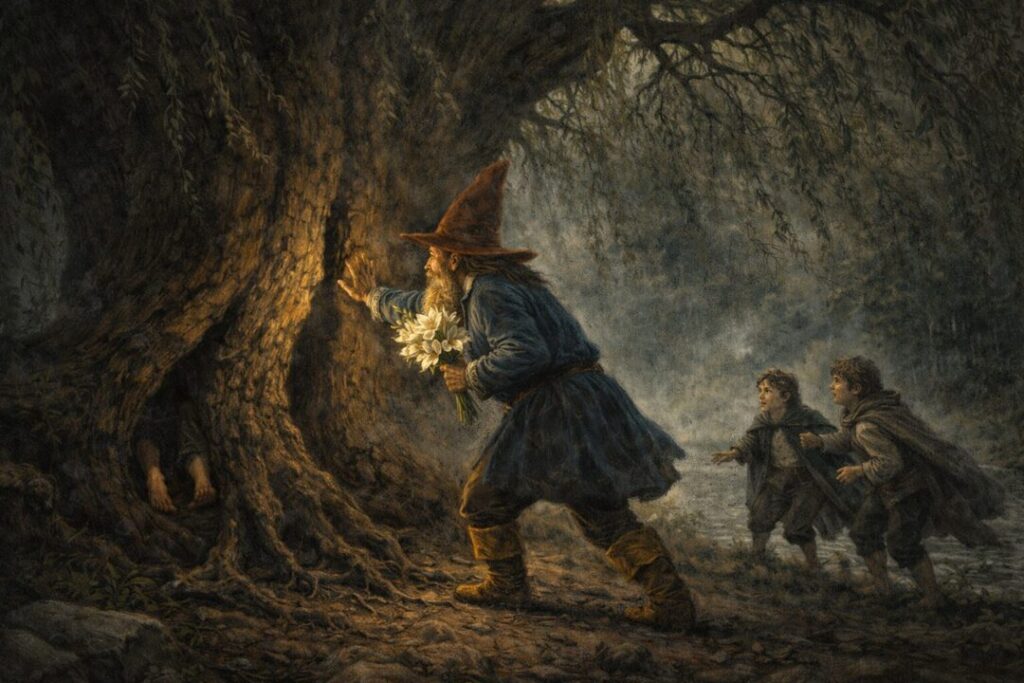
And when Tom arrives, he treats Old Man Willow not as an object to chop down, but as something to command.
“You should not be waking… Go to sleep! Bombadil is talking!”
That line matters because it implies Old Man Willow has a “waking” state—an active, dangerous attention that can be forced back into dormancy.
Tom does not destroy him. He checks him.
Why he feels older than the Shire: “ageing no quicker than the hills”
Here’s the heart of your question: why does Old Man Willow feel older than the Shire itself?
Because the narrative explicitly frames the Old Forest as belonging to a timescale the Shire barely touches.
Tom’s account describes trees in the Old Forest as “ageing no quicker than the hills,” and calls them “the fathers of the fathers of trees, remembering times when they were lords.”
That is deep time. Hill-time. Memory that isn’t measured in generations of people.
Now put that beside what the Prologue says about the Shire’s beginning. The Shire-reckoning begins with the Hobbits’ crossing of the Brandywine, and “the year of the crossing… became Year One of the Shire.”
However beloved it is, the Shire is a relatively recent arrangement in the long history of the North.
The Old Forest is presented as the opposite: a leftover world that refuses to forget.
So when Old Man Willow feels “older than the Shire,” that feeling is not merely mood.
It’s structure.
You are meant to sense that the Hobbits have stepped out of their small, managed history and into something that remembers being vast.
Why the Forest hates “walking things”
The Old Forest chapter contains one of the clearest statements of why certain parts of the natural world are hostile in this story.
Tom’s words reveal that many trees are “filled with a hatred of things that go free upon the earth, gnawing, biting, breaking, hacking, burning: destroyers and usurpers.”
Notice: the hatred isn’t of Hobbits specifically. It’s of a pattern—of living creatures who use the world without belonging to it.
That frames Old Man Willow less as a random villain and more as the sharpest expression of the Forest’s grievance.
If the Old Forest is ancient and wounded, Old Man Willow is the place where that wound has turned into will.
Tom Bombadil, mastery, and the limits of control
It’s tempting to treat Tom Bombadil as the “answer” to Old Man Willow. But the text complicates that.
Goldberry explains that Tom is “Master of wood, water, and hill,” and repeats the title: “Tom Bombadil is the Master.”
But she also draws a boundary that matters for understanding Old Man Willow:
“The trees and the grasses and all things growing or living in the land belong each to themselves.”
So Tom’s mastery is not ownership in the ordinary sense. The land is not his possession. It remains itself.
That’s why Old Man Willow still exists at all. Tom can restrain him. He can command him into sleep. But the Forest’s inner life is not erased.
In other words: Old Man Willow is not a problem with a simple fix, because he is not an intruder into the Old Forest.
He is what the Old Forest has become.
So what exactly is he?
Here is the most lore-safe conclusion the text supports:
Old Man Willow is an ancient willow tree in the Old Forest whose inner “spirit” is described as malicious and powerful, extending influence through the surrounding woods by “song and thought,” and able to trap travellers through sleep and physical force.
The story does not explicitly classify him beyond that. It gives you imagery—root-threads in the earth, twig-fingers in the air—because the point is not taxonomy.
The point is the feeling you had when you first read it:
that you had wandered into a place that remembers being older than you,
older than your roads,
older than your houses,
older—perhaps—than your certainty that the world is meant to be safe for walking things.
And once you see that, Old Man Willow stops being an odd early episode.
He becomes a warning in miniature:
Middle-earth contains ancient corners where the past is not dead—
it is awake, listening, and singing you toward the river.