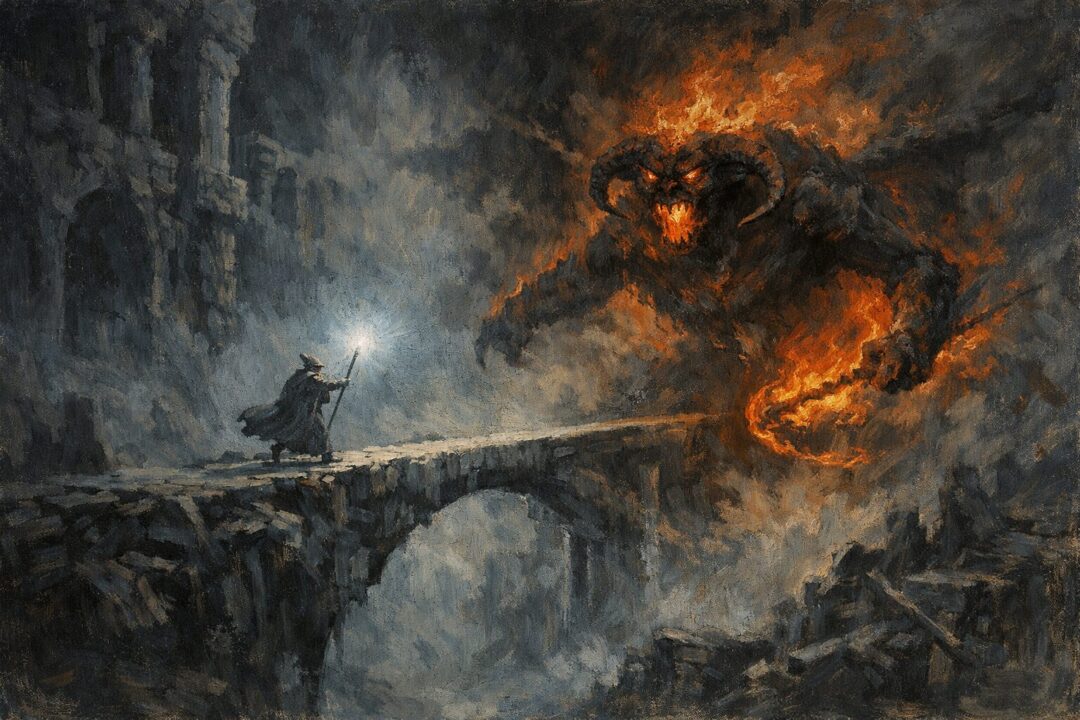
When Gandalf faces the Balrog on the Bridge of Khazad-dûm, he does not begin with a spell name, a title, or a boast.
He says: he is “a servant of the Secret Fire.”
That line is so famous that it is easy to let it pass by as pure drama. It sounds grand. Ancient. Mysterious. But in Middle-earth, it is not empty language. It points toward one of the deepest ideas in the legendarium.
And once you see what it refers to, the confrontation in Moria becomes much larger than a wizard blocking a demon on a narrow bridge.
Because the Secret Fire is not just a poetic name for flame.
It is bound up with creation itself.

The Secret Fire Is the Flame Imperishable
In Tolkien’s cosmology, the Secret Fire is another name for the Flame Imperishable. The clearest lore summaries identify it as the mysterious creative power of Eru Ilúvatar. In the account of the making of the world, Eru sends the Flame Imperishable into the Void so that Eä becomes real and the world is set in being.
That is the first thing to understand.
The Secret Fire is not merely heat, light, or a magical weapon.
It is not one more elemental force among others.
And it is not described as something possessed independently by created beings.
It belongs, in the deepest sense, to the act by which reality itself is made living and actual.
That is why the phrase feels so much weightier than ordinary fire language in Middle-earth. Gandalf is not claiming mastery over some rare substance. He is identifying himself with the side of true creation, true order, and the authority that evil cannot originate for itself. This last point is an inference from the cosmology and from the wording of the Moria scene, but it fits the textual pattern closely.
Why This Matters in the Moria Scene
The line comes in one of the most charged moments in The Fellowship of the Ring.
The Fellowship is trapped. Orcs gather behind. The Balrog advances. Gandalf stands alone on the bridge and declares, “I am a servant of the Secret Fire, wielder of the flame of Anor… The dark fire will not avail you, flame of Udûn!”
That statement is carefully structured.
Gandalf contrasts the Secret Fire with the Balrog’s “dark fire.”
He contrasts the “flame of Anor” with the “flame of Udûn.”
And he does so while barring passage, not merely defending himself.
This means the scene is not simply fire against fire.
It is a clash between rightful and corrupted power.
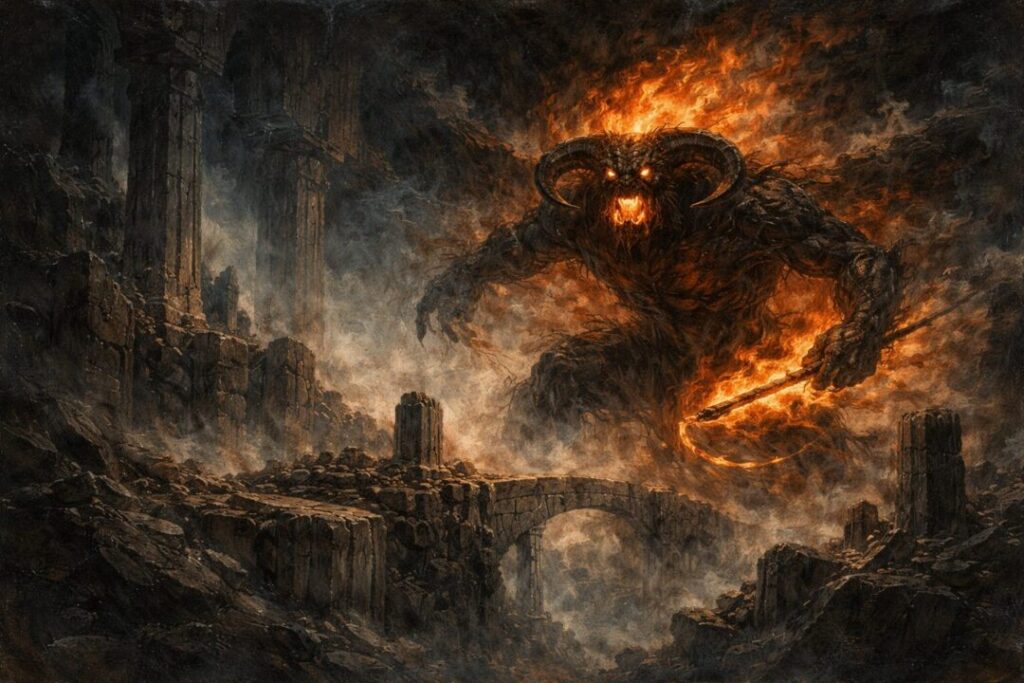
The Balrog is indeed a spirit of fire, but not a pure or lawful one. The Balrogs were Maiar corrupted by Morgoth in the earliest ages, ancient beings of shadow and flame bent away from the order of the world. Durin’s Bane is one of those surviving horrors.
So when Gandalf invokes the Secret Fire, he is not just announcing strength. He is placing himself under a higher allegiance and naming the deeper source of legitimacy behind his stand. That is an interpretive reading, but it is strongly supported by what the Secret Fire is and by the way Gandalf frames the confrontation.
Gandalf Is Not Just a Wizard in the Ordinary Sense
This matters even more once we remember what Gandalf actually is.
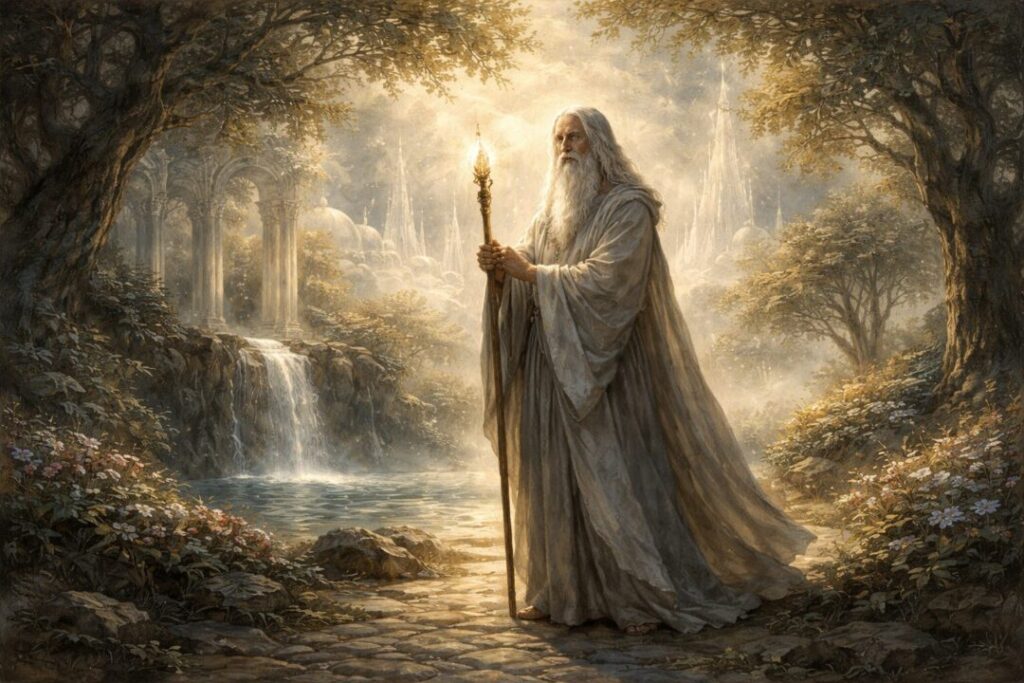
He is one of the Istari, and before that one of the Maiar: a primordial spirit who existed before the shaping of the world and who entered it in service to the Valar. In Middle-earth he appears as an old man, but that is not his deepest nature.
That puts him and the Balrog in a striking relationship.
They are not the same in loyalty, but they are of the same broad order of being: both are Maia spirits. One remains a servant of the good order of Arda. The other is an ancient fire-spirit corrupted into terror and domination.
Seen that way, Gandalf’s words at the bridge sound less like theatrical dialogue and more like recognition.
He knows what stands before him.
And he names what stands behind himself.
Not rank.
Not personal glory.
Service.
That is one of the deepest reasons the line lands so hard.
What Gandalf Is Probably Not Doing
It is tempting to read the phrase as if Gandalf were casting a named spell powered directly by the Secret Fire.
The texts do not actually say that.
We should be careful here.
Middle-earth is full of power, but it does not usually explain power in the language of technical spell systems. Gandalf’s words may accompany an exertion of spiritual authority, and they certainly precede direct confrontation, but the text does not define the Secret Fire as a combat technique he can deploy at will.
So the safest reading is not that Gandalf is “using” the Secret Fire like a weapon.
The safer reading is that he invokes it as the authority under which he stands. He declares what he serves, and therefore what kind of being he is in that moment of judgment. That is interpretation, but it stays closer to the evidence than treating the line as a literal spell formula.
The Meaning of the “Flame of Anor”
The second half of Gandalf’s statement is harder to pin down.
“Flame of Anor” is not fully explained in the primary text. “Anor” is the Sindarin name for the Sun, so the phrase can naturally be read as the flame or light of the Sun. Some lore references also note a possible connection to Narya, Gandalf’s Ring of Fire, but that link is interpretive rather than certain.
That distinction matters.
It is safe to say that “flame of Anor” carries an image of lawful, high, or heavenly fire in contrast to the Balrog’s dark and corrupted fire. It is not safe to insist that the phrase definitively means Narya and nothing else, because the text never says that outright.
In other words, the line remains partly mysterious by design.
But even with that uncertainty, its structure is clear: Gandalf opposes the Balrog with a fire that belongs to light, not darkness; to order, not rebellion.
Why He Says “Servant”
This may be the most important word in the whole declaration.
Servant.
Gandalf does not say he is master of the Secret Fire.
He does not say he commands it.
He says he serves it.
That fits his role everywhere else in the story.
The Istari were sent not to dominate Middle-earth, but to help resist Sauron, to encourage courage and wisdom in others, and to oppose tyranny without becoming tyrants themselves. Gandalf consistently works this way: guiding, warning, awakening, strengthening.
So at the bridge, his self-description is perfectly in character.
He is strongest precisely when he does not claim ownership.
He stands in obedience to something higher than himself.
And in Middle-earth, that is always the dividing line between good power and fallen power.
Sauron wants mastery.
Morgoth wanted creation on his own terms.
The Balrog is a relic of that rebellion.
Gandalf answers all of it with service. This is an interpretive synthesis, but it closely reflects the moral pattern of the legendarium.
The Secret Fire and the Limits of Evil
The deeper idea beneath the Moria scene is this:
Evil in Middle-earth can corrupt.
It can twist.
It can dominate.
It can burn.
But it does not create in the highest sense.
That is why the Secret Fire matters.
If it is the Flame Imperishable, then it belongs to the source of being itself. Morgoth could mar the world, but not originate its deepest life. Sauron could forge, manipulate, and enslave, but always by distortion of what already exists. The Balrog’s fire is terrible, but it is not primal in the same way. It is fallen fire.
And Gandalf’s words expose that difference in a single stroke.
The dark fire will not avail.
Not because the Balrog is unreal.
Not because it is weak.
But because corrupted power, however fearful, stands downstream from a greater reality it cannot own. That final sentence is interpretive, but it is the most coherent way to read the line in light of the cosmology.
Why This Moment Feels Bigger Than Combat
This is why the exchange on the bridge feels larger than a duel.
The scene is not only about whether Gandalf can hold the passage.
It is about what kind of world this is.
A world where the highest power is not domination, but creation.
A world where lawful authority is expressed as service.
A world where even in the depths of Moria, surrounded by fear and ruin, the oldest truth still stands against the Shadow.
That is why Gandalf invokes the Secret Fire here.
Because the Balrog is not merely a monster in his path.
It is an ancient perversion of the same created order Gandalf serves.
And so he does not answer it with pride.
He answers it with allegiance.
Once you see that, the line stops being just one of the coolest moments in The Lord of the Rings.
It becomes one of the clearest windows into what Middle-earth believes power truly is.