Some gifts in Middle-earth are obviously important.
A sword reforged. A ring destroyed. A ship departing.
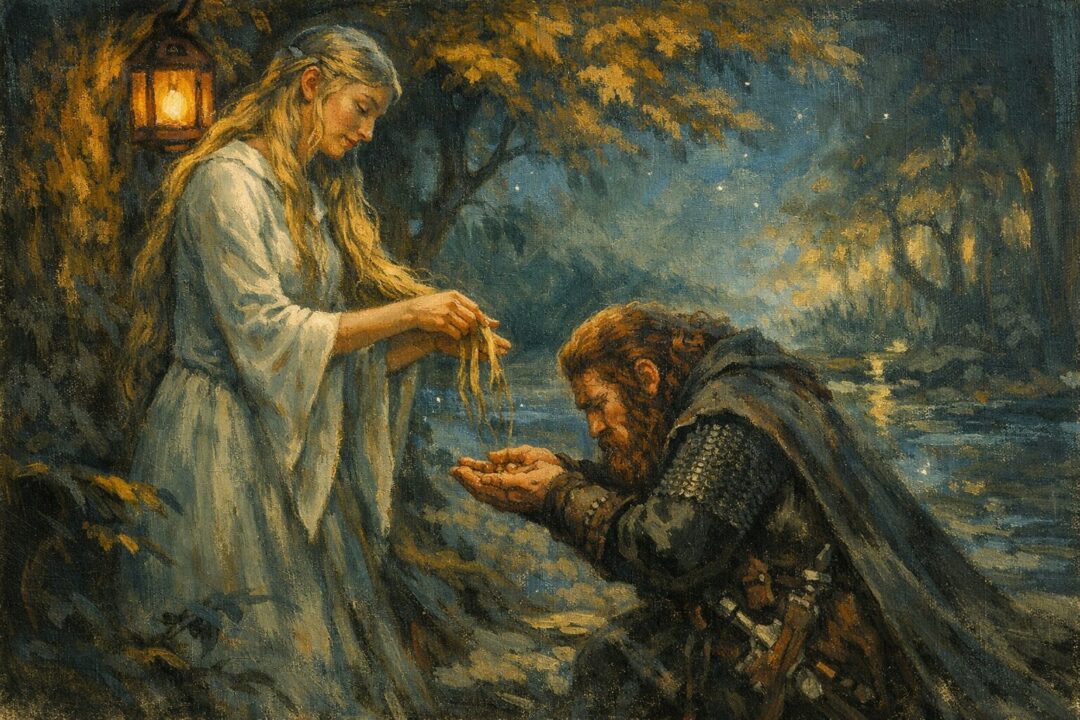
But Galadriel’s gift to Gimli is not loud like that. It happens in a clearing among golden trees, with the sound of water not far away, and it is made of something that—on the surface—does not change any battle at all.
Three hairs.
Not a weapon. Not a spell. Not a jewel.
Just three strands cut from her head and laid into a Dwarf’s hands.
And yet the text goes out of its way to make you feel that this is unusual.
Not merely tender. Not merely surprising.
Unusual in a way that reaches backward.
A request that should not be spoken
When the Company is preparing to leave Lórien, Galadriel gives gifts to each of them. The scene has a ceremonial calm, but it is not carefree. The Road is still dangerous. The quest is still unthinkable.
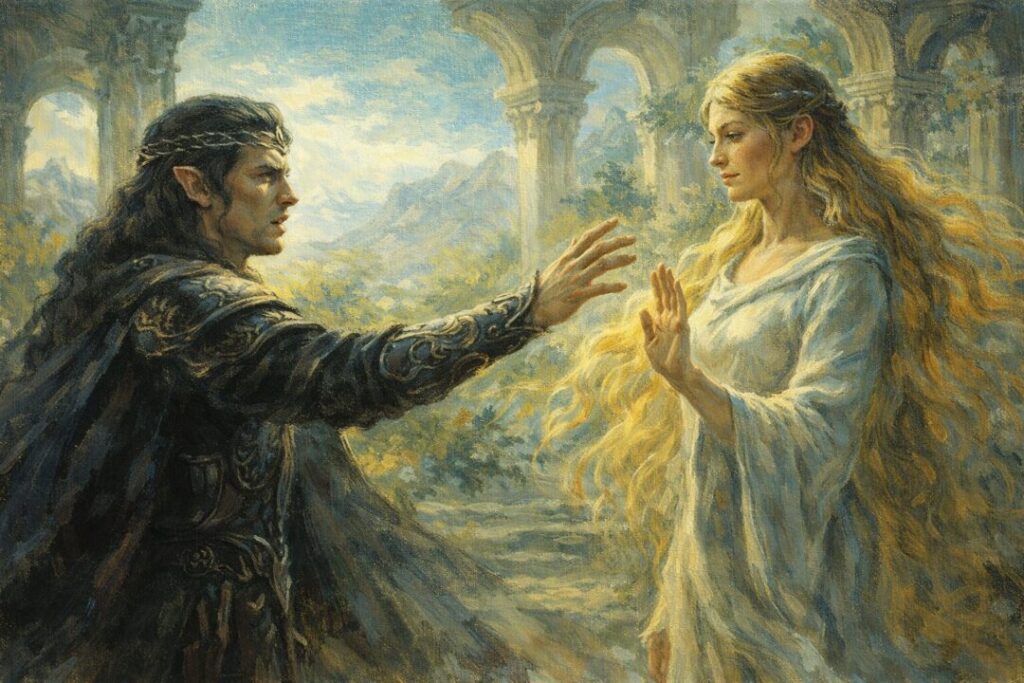
Then she comes to Gimli, and he tries to refuse.
He says there is nothing he wants—nothing, “unless it might be” permitted even to name a single strand of her hair, which he praises as surpassing the gold of the earth.
What matters here is how carefully the request is framed.
He does not demand it.
He does not bargain for it.
He almost withdraws it while speaking, as if he can feel the line he is about to cross.
And even then, the text is clear: he speaks only because she commands him to name his desire.
This is not grasping.
This is reverence—with enough humility to recognise that reverence is not entitlement.
That distinction is the hinge of the whole moment.
Galadriel’s answer is framed as a shock
Galadriel responds in a way that the text explicitly treats as startling.
She laughs, and then she unbraids one of her long tresses and cuts off three golden hairs, giving them to him.
The emphasis isn’t only on the gift.
It’s on the fact that it is a gift that the Elves around her did not expect her to grant.
And then Gimli, receiving something that could have turned into possessiveness in another story, immediately defines it as the opposite:
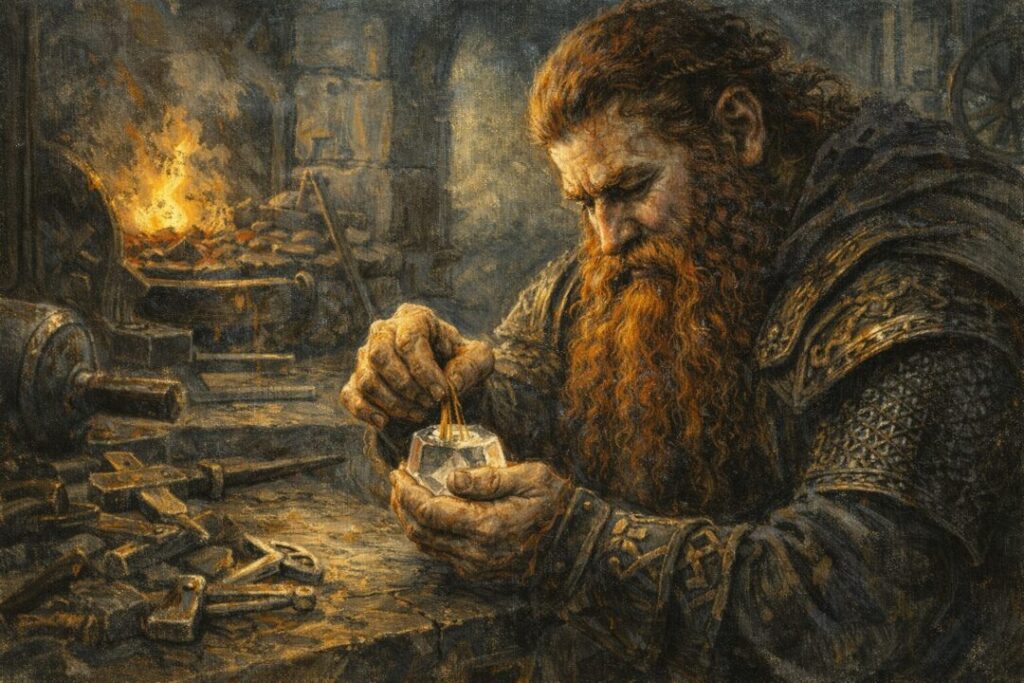
He says he will treasure it, and if he ever returns to his smithies, he will set it in imperishable crystal as an heirloom of his house, and as a pledge of goodwill between the Mountain and the Wood “until the end of days.”
So the scene offers you two things side by side:
A request made without entitlement.
And a gift received without greed.
That alone would be remarkable, given how Elf and Dwarf histories usually read.
But the deeper point is what this moment is echoing.
The older echo: three requests, and a refusal
In Unfinished Tales, in “The History of Galadriel and Celeborn,” there is a detail that casts a long shadow over this scene.
Fëanor, in the Blessed Realm in the days before the great disasters, beheld Galadriel’s hair with wonder and delight. He begged three times for a tress, and Galadriel would not give him even one hair. The note adds that the two became “unfriends for ever.”
That’s the older shape:
Three requests.
No gift.
A refusal hard enough to become permanent estrangement.
And, in the same passage, an association is made—carefully, not as a certainty—between this wonder at her hair and the thought of capturing and blending light that later took shape in the Silmarils.
It matters that the text presents this as “many thought,” not as an explicit confirmed cause.
But even without taking it as strict causation, the thematic connection is hard to miss: admiration that bends toward possession; beauty that becomes something to claim; craft that becomes something to hoard.
In that older world, the line between wonder and ownership is crossed again and again—and it never ends well.
So now return to Lórien.
A Dwarf asks for a strand of the same hair.
And Galadriel gives him three.
If you know the older echo, you can feel what is happening: the story is not merely giving Gimli a token. It is deliberately placing a new kind of response into an old pattern.
Why “three” matters
Nothing in the primary text says, “She gave three because Fëanor asked three times.”
That is interpretation, and it should be treated as interpretation.
But the canon does give you enough to say this much confidently: the number is not random in its effect, because it draws attention to itself and invites comparison to a well-attested earlier triple request and refusal.
And once you see that, the contrast becomes the point.
Fëanor’s asking is bold. It is persistent. It ends in permanent enmity.
Gimli’s asking is reluctant. It is offered as a desire he barely dares name. And it ends in a pledge of goodwill between peoples who have not historically been good at goodwill.
This is not merely “Elf gives Dwarf a gift.”
It is “the old story does not have to end the same way.”
The gift is about reconciliation—but it is also about time
Readers often focus on what the gift means for Dwarves and Elves.
And it does mean something there. Gimli explicitly makes it a token between “the Mountain and the Wood.”
But the more haunting implication is what the gift says about Galadriel’s own arc and about the age itself.
Because Lórien is not simply a forest with a queen.
Lórien is one of the places where the Elder world is still lingering in the Third Age. It is a kind of preservation, sustained by one of the Three Rings—something the text treats as beautiful, and also as doomed to fade once the One is destroyed.
So this gift is given at the edge of ending.
The Company is leaving. The world is changing. The Elves’ time in Middle-earth is going out like a tide.
And in that moment, Galadriel chooses to enact the opposite of the old possessive pattern.
Instead of refusing and becoming “unfriends for ever,” she gives.
Not to an Elf-lord of Valinor.
To a Dwarf of the later days.
That is a quiet reversal with a quiet message: the Elder Days were not only a time of greater beauty. They were also a time of greater rigidity—greater pride, longer grudges, sharper separations.
And here, near the end, one of the oldest figures in the story performs a small act that suggests those ancient fractures are, finally, capable of healing.
Not in councils.
Not in wars.
In the way a gift is asked for and received.
What happens to the hairs?
The text tells you what Gimli intends: he will set them in crystal as an heirloom and a pledge.
It does not, in the main narrative, follow the object into some later scene where it is displayed as proof.
That absence is important. The gift is not a plot device.
It is a sign.
And the larger sign is not only this:
Elf and Dwarf can bless each other.
It is also this:
The world can end without ending in bitterness.
The ending that completes the signal
If you read only to the farewell in Lórien, the gift feels like a perfect small coda—beautiful, symbolic, and self-contained.
But the appendices give you a final, strange footnote that makes the whole gesture feel even more like an “end of the Elder Days” marker.
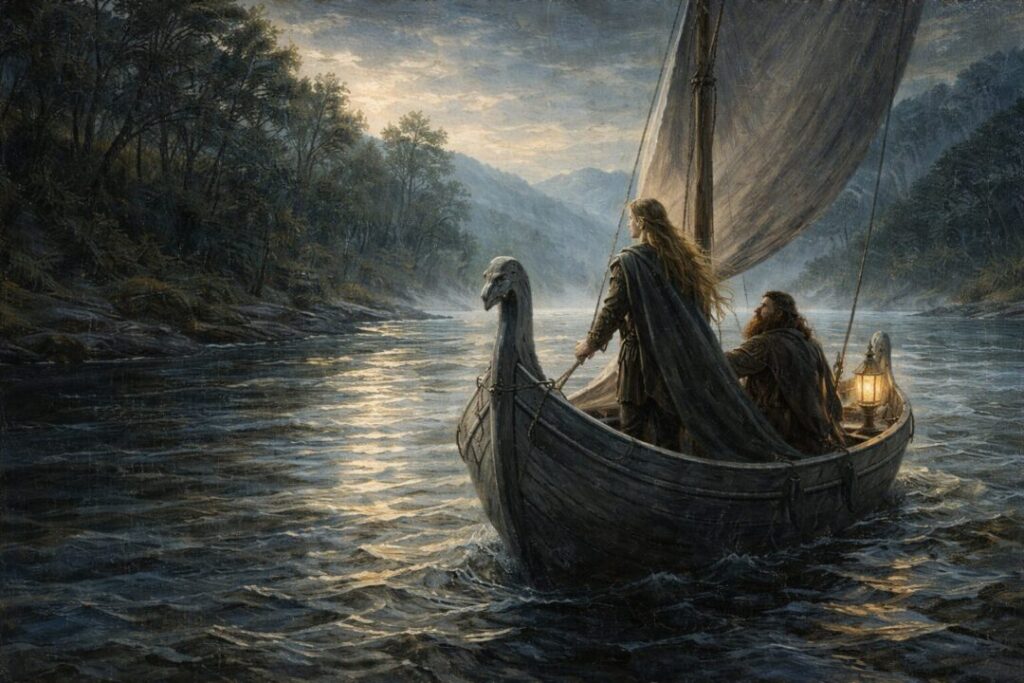
In Appendix A we are told, as a report preserved in the Red Book, that Legolas took Gimli with him over Sea because of their great friendship. The text immediately adds how strange that would be: that a Dwarf would leave Middle-earth for any love, or that the Eldar would receive him, or that the Lords of the West would permit it.
Appendix B then places that departure after the death of King Elessar, and concludes: when that ship passed, “an end was come in the Middle-earth of the Fellowship of the Ring.”
Notice the phrasing.
Not merely an end of a journey.
An end of a Middle-earth.
That is the atmosphere the texts wrap around these departures: not just personal farewells, but the closing of a mode of being.
And that is why Galadriel’s gift to Gimli belongs to the same theme.
It is one of the last moments where the Elder world touches the later world and chooses generosity instead of possessiveness.
It does not keep the Elder Days alive.
It signals that they are finishing—and that their finishing is not only loss.
It is also release.
What the gift really signals
So what does Galadriel’s gift “really” signal about the end of the Elder Days?
It signals that one of the oldest patterns is being unmade.
In the deep past, beauty was hoarded. Light was trapped. Desire turned into ownership, and ownership turned into oath, and oath turned into ruin.
In Lórien, at the edge of fading, the story shows you the inverse:
A Dwarf names a desire without claiming it.
An Elf grants it without fear.
And the object becomes not a treasure to guard from others, but a pledge between peoples.
This does not erase the grief of the Elder Days.
It does not undo the long defeats.
But it does something quieter and, in its way, rarer:
It suggests that the moral temperature of the world can change.
That the great can become humble.
That the small can become noble.
And that the end of an age is not only the draining away of light.
Sometimes it is the moment when old pride finally loosens its grip—and lets a gift pass, freely, into hands it would once have refused.