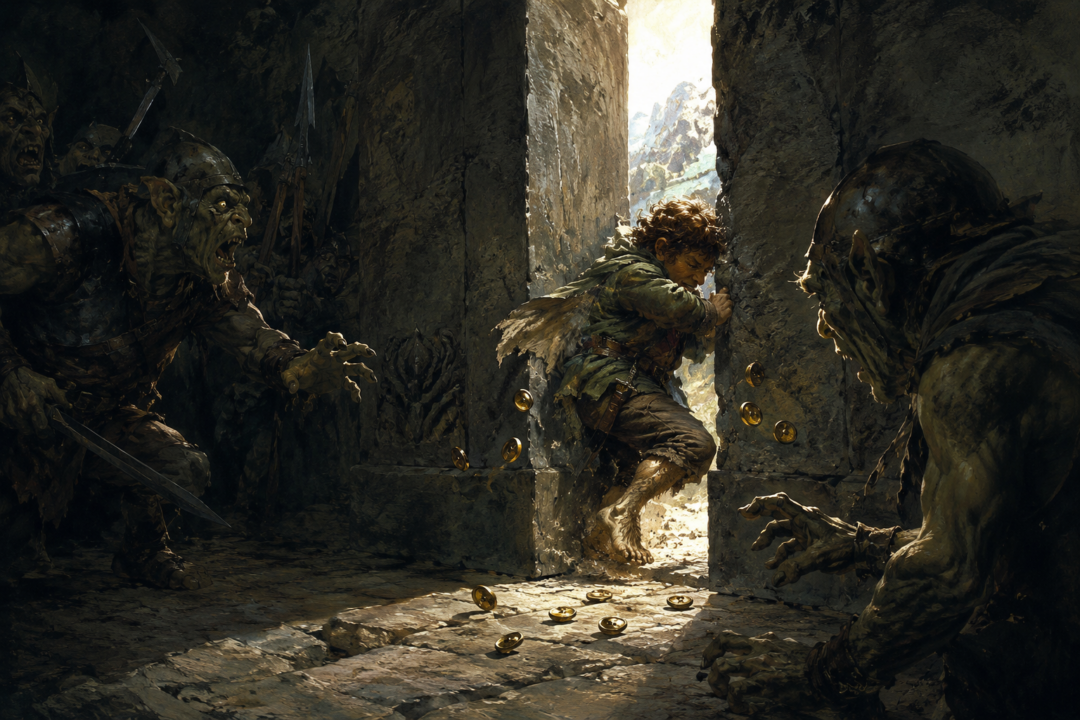
A handful of brass buttons seems like an absurdly small detail to remember after an escape from goblins beneath the Misty Mountains.
Yet the buttons matter.
There is one important correction first: the missing buttons are Bilbo’s, not Gandalf’s. In The Hobbit, Bilbo tears buttons from his coat and waistcoat while forcing himself through the Goblins’ lower gate. Gandalf later explains that he already knew about this same exit and had guided Thorin’s company toward it during their own escape.
That small distinction reveals something easily missed about the whole sequence.
Bilbo and Gandalf do not independently discover two convenient ways out of Goblin-town. They emerge through the same ancient Goblin back-door—but under dramatically different circumstances. Gandalf escapes because he knows where he is going. Bilbo reaches it because he follows Gollum, survives a moral crisis in the darkness, and then forces his way through a doorway that is almost closed.
The buttons are physical evidence of just how narrow that difference was.
The Back-Door Was Not a Secret Passage
The lower gate of the Goblin tunnels can initially feel like one of those fortunate exits that adventure stories produce exactly when their heroes need one.
It was nothing of the kind.
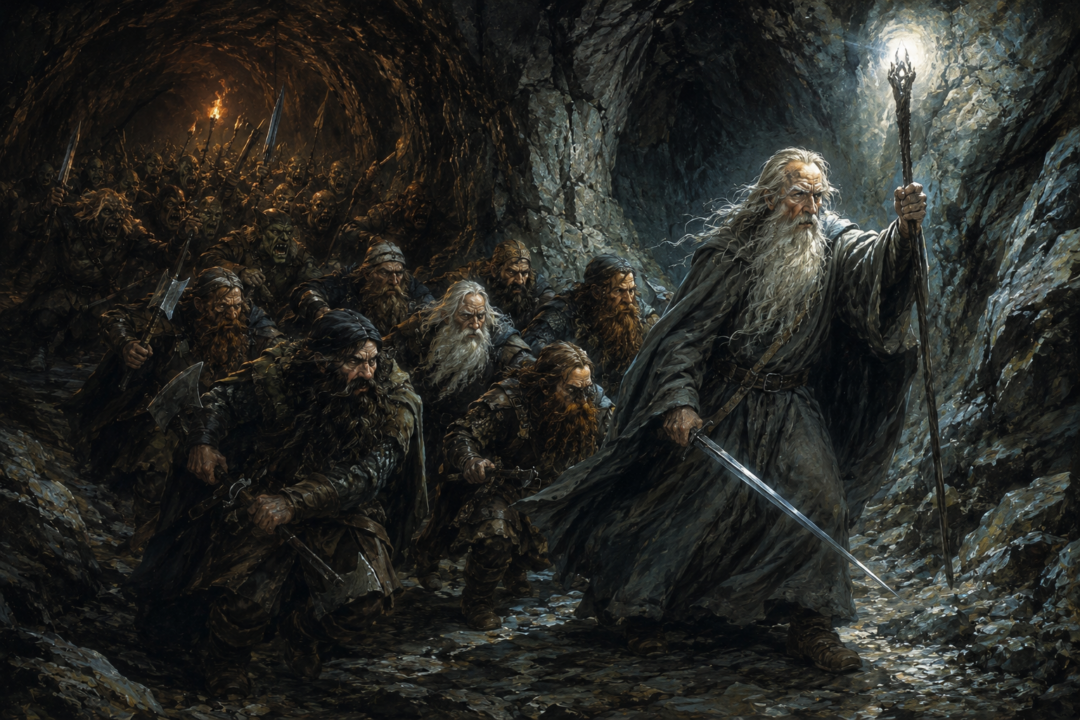
After Bilbo rejoins Gandalf and the Dwarves, Gandalf explains that he knew about the back-door. The route was apparently known to people familiar with that region of the Misty Mountains. What required exceptional skill was navigating the underground passages while pursued by Goblins and keeping the fleeing company moving in the correct direction.
The Goblins themselves had made the gate long before. Gandalf explains that it served two purposes: it could provide an escape from their underground realm, and it gave them access to the lands east of the mountains, where they could venture out and cause harm.
This changes the geography of the escape.
Goblin-town is not simply a cavern with one entrance. It is part of a functioning underground network with multiple connections to the surface. The company had entered through a comparatively recent opening higher in the mountains, while the ancient lower gate opened toward Wilderland.
Gandalf understood that network well enough to use the Goblins’ own infrastructure against them.
Bilbo did not.
Gandalf’s Escape Was Knowledge Under Pressure
Gandalf’s role beneath the mountains is impressive precisely because his knowledge does not make the situation safe.
When the Goblins seize the company, Gandalf avoids capture at the entrance and follows the prisoners. In the Great Goblin’s cavern, his intervention turns the situation violently against their captors. The Great Goblin is killed, and Gandalf leads the Dwarves into the tunnels.
But the escape remains desperate.
The Goblins pursue them through darkness. Gandalf must choose the route while the company runs, fights, falls, and struggles to stay together. He later describes the affair as extremely close.
His advantage is not that he possesses a magical shortcut.
It is that he knows an exit exists and can retain enough control in the tunnels to reach it.
That is an important distinction in The Hobbit. Gandalf repeatedly possesses knowledge unavailable to the others, but knowledge rarely eliminates danger. It gives the company a possibility of survival.
They still have to reach it.
And during that flight, Bilbo does not.
Bilbo Falls Out of Gandalf’s Carefully Managed Escape
The crucial accident happens when Dori, carrying Bilbo, is attacked from behind.
Bilbo falls.
When he wakes, he is alone in complete darkness.
At that moment, Gandalf’s knowledge can do nothing for him. Bilbo does not know the tunnel system. He cannot call safely for help. He does not even know which direction will lead him toward his companions.
His separation creates one of the great structural reversals in The Hobbit.
Until this point, Gandalf has repeatedly rescued the company from disasters. Now Bilbo must survive beyond Gandalf’s protection.
His discovery of the Ring occurs because he has been removed from the route Gandalf is controlling.
Then he meets Gollum.
And strangely, Gollum becomes Bilbo’s accidental guide toward the same destination Gandalf has already chosen.
Gollum Knows the Way Bilbo Needs
Gollum knows that the passages beyond his underground lake eventually connect with the Goblins’ exit.
After the riddle-game collapses and Gollum realizes what has happened to his Ring, Bilbo follows him through the darkness. Gollum believes Bilbo may be heading toward the way out and moves toward the passage himself.
That leads Bilbo to the final confrontation.
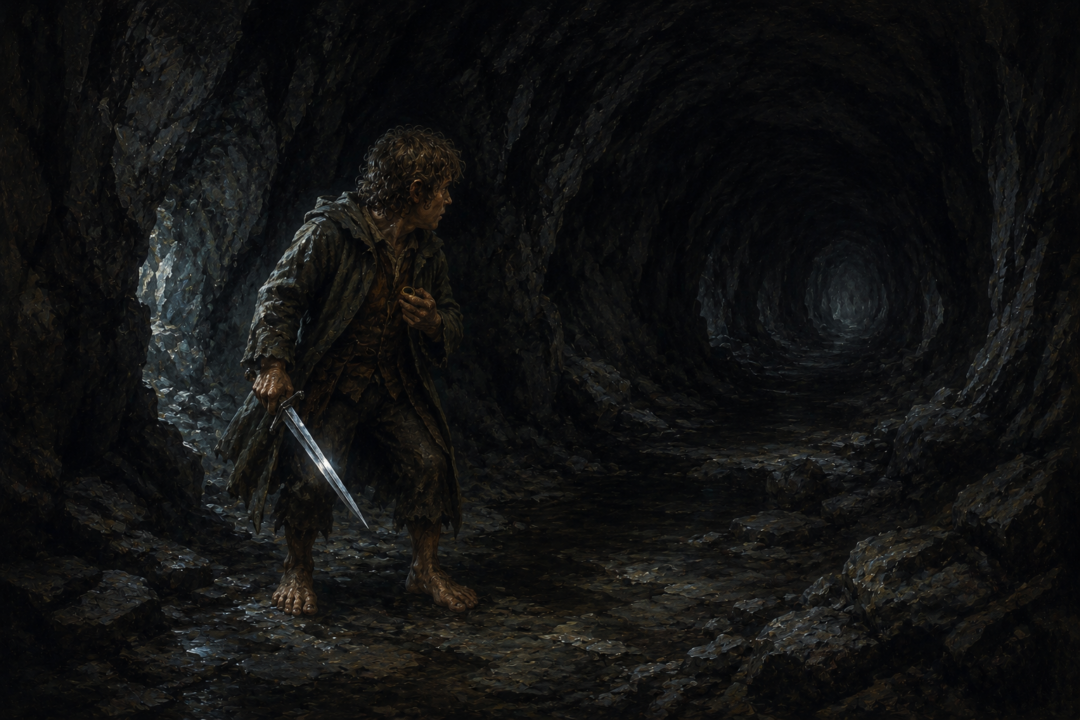
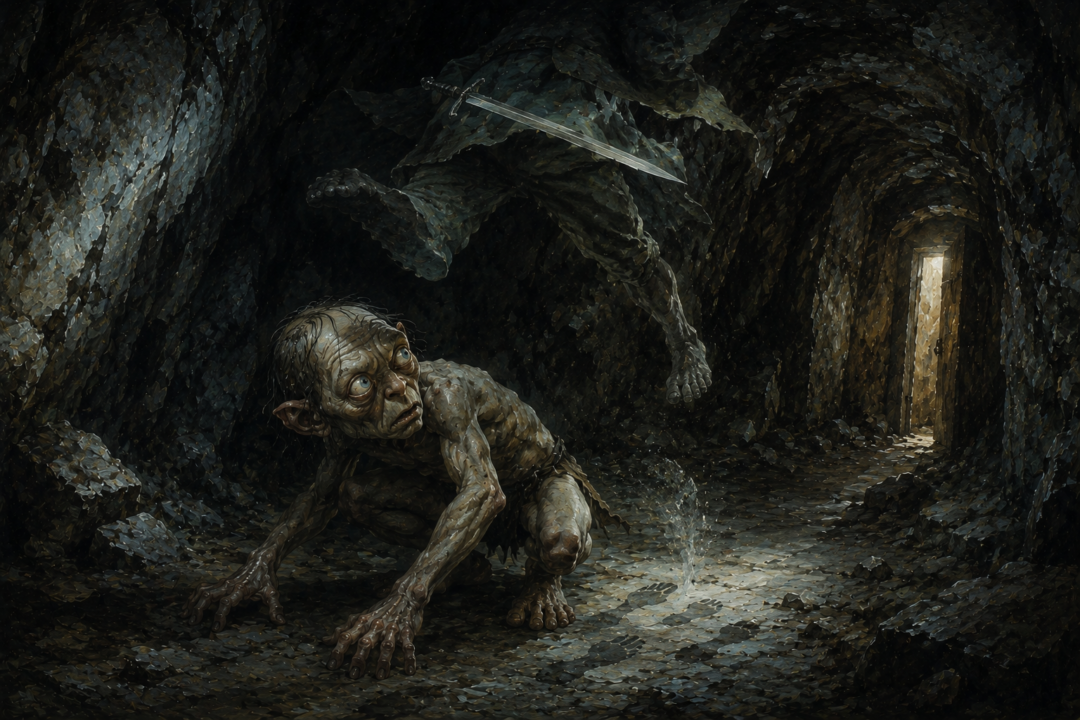
Invisible and armed with his small Elvish blade, Bilbo finds Gollum blocking his path. He could attempt to kill him. Instead, pity intervenes.
Bilbo jumps over Gollum.
The importance of that choice reaches far beyond the Misty Mountains, but even within this immediate scene it has a practical consequence: Bilbo enters the passage leading toward the Goblin gate.
He has reached Gandalf’s route without Gandalf.
Not because he understands the mountains, but because he has survived long enough to follow someone who does.
The Same Door, But Not the Same Escape
This is where the buttons become revealing.
Gandalf and the Dwarves had already burst through the lower gate. Their escape left the guards alerted and the entrance endangered.
By the time Bilbo reaches it, Goblins are everywhere.
The great stone door is still slightly open, but a Goblin has pushed it nearly shut.
Bilbo puts on the Ring and attempts to cross the guarded space unseen. He is knocked about in the confusion, dodges the Goblins, and reaches the doorway.
Then he discovers that invisibility does not make a body immaterial.
He tries to squeeze through.
His buttons catch between the stone door and its frame.
For a terrible instant, the invisible burglar is trapped by his own clothes.
The Ring can hide Bilbo from sight, but it cannot make him thinner.
That is one of the scene’s most characteristic details: extraordinary magic collides with an embarrassingly ordinary physical problem.
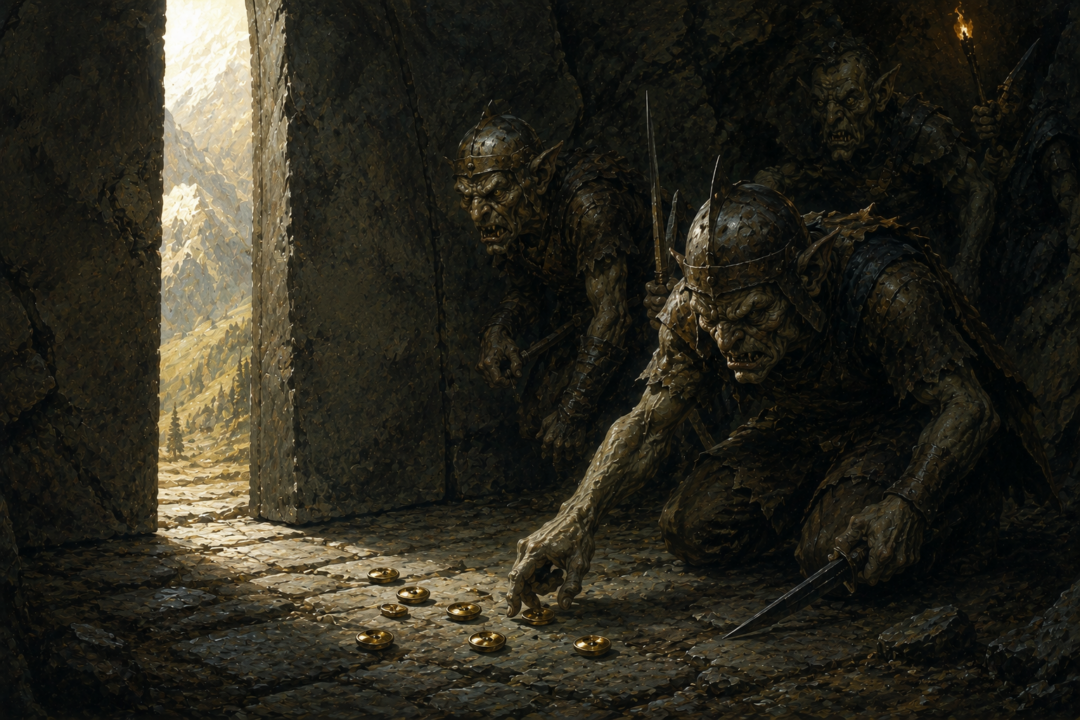
Bilbo finally wrenches himself free. His buttons burst away, his clothes tear, and he escapes into daylight while the bewildered Goblins find the brass buttons he has left behind.
Why Gandalf Did Not Lose His Buttons
The answer is wonderfully mundane.
Gandalf went through first.
More precisely, Gandalf and the Dwarves reached the back-door during the earlier phase of the escape, when they could force their way through the guards and get outside. Bilbo arrives later, after the alarm and pursuit have transformed the gate into an even more dangerous bottleneck.
The door that had allowed the company through is now nearly closed.
So there is no canonical story about Gandalf sacrificing a button, leaving a magical marker, or secretly signaling Bilbo. The textual detail belongs to Bilbo alone.
But comparing their escapes exposes the sequence of events.
Gandalf knew the destination.
Gollum unknowingly led Bilbo toward it.
The Dwarves’ escape alerted the guards.
The gate began closing.
And Bilbo reached it barely in time.
His torn clothing therefore records the delay created by his separation from the company.
The Buttons Also Mark a Changed Bilbo
There is another reason the detail matters.
Bilbo cares about his buttons.
That sounds trivial until we remember what he represents at the beginning of the story: comfort, respectability, good meals, proper clothing, predictable routines, and a well-ordered hobbit-hole.
The Misty Mountains physically damage that respectable exterior.
When Bilbo later stands before Beorn, he is painfully aware of his missing buttons. The embarrassment is comic, but the journey has already begun transforming what those outward signs of respectability mean.
He looks less like the comfortable hobbit who left Bag End.
Yet he has accomplished something that Thorin and the others scarcely believe.
He escaped Gollum.
He passed the Goblin guards.
He found his way out alone.
He then approaches his companions invisibly and surprises them, demonstrating for the first time that he may actually possess the talents expected of their supposed burglar.
The damaged clothes and the emerging burglar arrive together.
The Ring Did Not Save Bilbo by Itself
It is tempting to reduce the escape to a simple explanation: Bilbo found a magic Ring, became invisible, and escaped.
The actual scene is much more interesting.
The Ring helps enormously, but Bilbo still needs courage, judgment, physical effort, and luck.
He must follow Gollum without being discovered. He must decide what to do when Gollum blocks the passage. He must leap over him. He must navigate Goblins who cannot see him but can still collide with him. Finally, he must tear himself through the nearly closed door.
Even invisibility produces a danger: although the Goblins cannot properly see Bilbo, they notice something strange at the doorway when his body interferes with the light.
The Ring provides power.
It does not remove Bilbo from the physical world.
That limitation is embodied perfectly by the buttons caught against stone.
A Tiny Detail That Maps the Entire Escape
The missing buttons are ultimately a miniature map of what happened beneath the Misty Mountains.
Gandalf knew about the Goblins’ ancient lower gate and deliberately led Thorin’s company toward it.
Bilbo, separated from them, had no such knowledge.
Gollum unintentionally brought him toward the same route.
The company passed through first.
The Goblins reacted.
The door was pushed almost shut.
Bilbo arrived afterward and escaped through the remaining crack at the cost of torn clothes and scattered brass buttons.
Nothing supernatural needs to be invented to make the detail meaningful.
In fact, its power comes from how ordinary it is.
After Goblin swords, magical fire, an enchanted Ring, underground riddles, and a creature lurking beneath a mountain, Bilbo’s final obstacle is a buttonhole and a stone door.
Gandalf escapes through knowledge.
Bilbo escapes through pity, stealth, nerve, desperation—and one tremendous squirm.
And the brass buttons left on the Goblins’ doorstep quietly prove just how close the adventure came to ending there.
Sources & Notes
- The Encyclopedia of Arda, “Goblin-town” — https://www.encyclopedia-of-arda.com/g/goblintown.html
- The Encyclopedia of Arda, “Bilbo Baggins” — https://www.encyclopedia-of-arda.com/b/bilbobaggins.html
- The Encyclopedia of Arda, “Gollum” — https://www.encyclopedia-of-arda.com/g/gollum.html
Reference entries document the characters, places, events, and textual details discussed in this article.