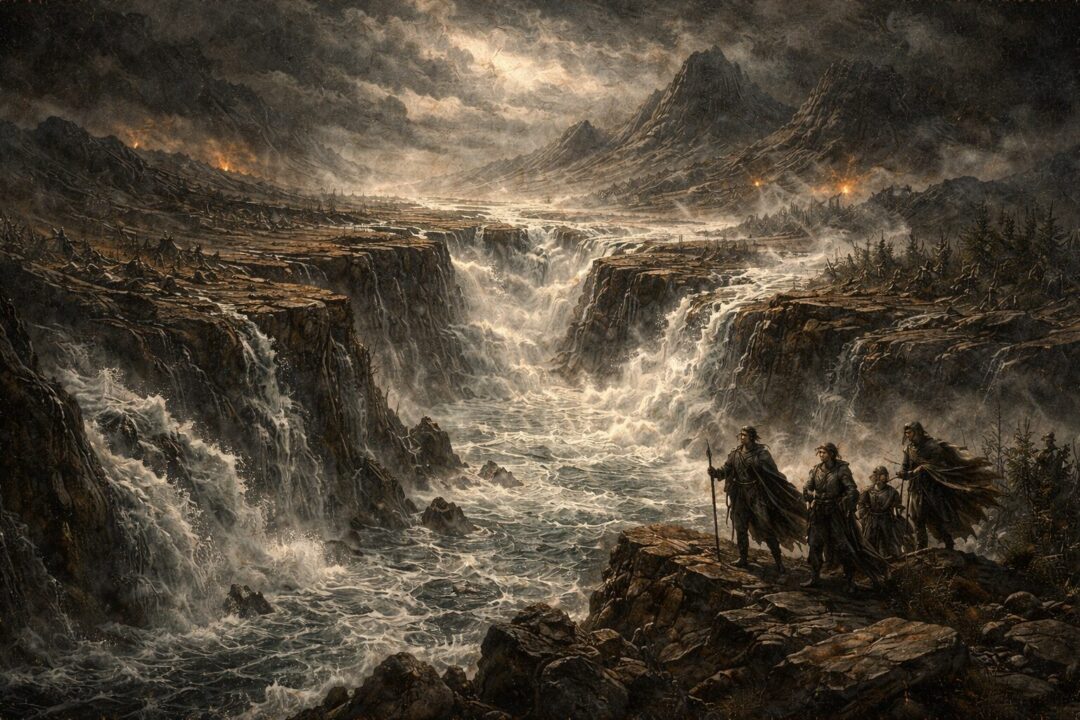
The War of Wrath is often remembered for its ending.
Morgoth bound.
Ancalagon cast down.
Beleriand destroyed.
But the chronicles state something easy to overlook:
The war lasted more than forty years.
That detail alone changes everything.
Because the version most readers carry in memory feels immediate — a divine army arrives, a final battle erupts, and Morgoth falls.
The texts suggest something far longer.
And far more devastating.
The War Begins: Eärendil’s Plea Answered
The turning point comes when Eärendil reaches Valinor and delivers “the errand of the Two Kindreds.” His plea is granted.
In response, the Valar prepare a host.
The Silmarillion names Eönwë as the leader of that host, the herald of Manwë. The Vanyar return to Middle-earth. The Noldor of Aman are implied to be present as well, though the text does not give a full list of contingents.
What matters is this:
A power unseen in Middle-earth since the early First Age crossed the Sea.
And yet the narrative does not describe immediate victory.
Instead, the Tale of Years records that the War of Wrath endured for over four decades (F.A. 545–587).
That duration is not symbolic.
It is chronological.
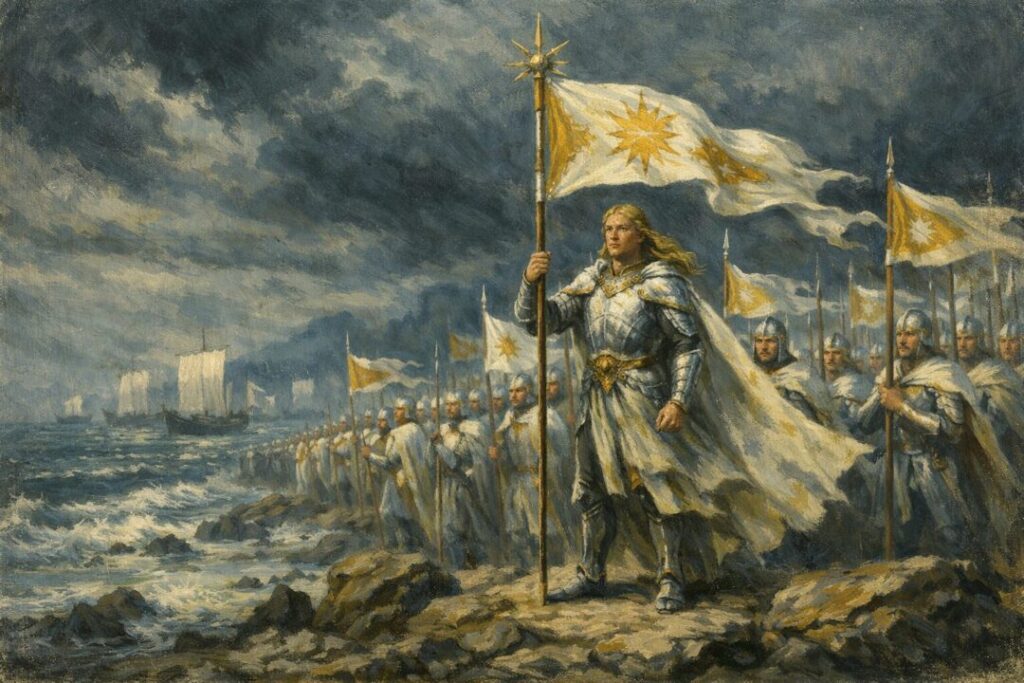
“The Whole Power of the Throne of Morgoth”
When the hosts met, the confrontation is named “the Great Battle.”
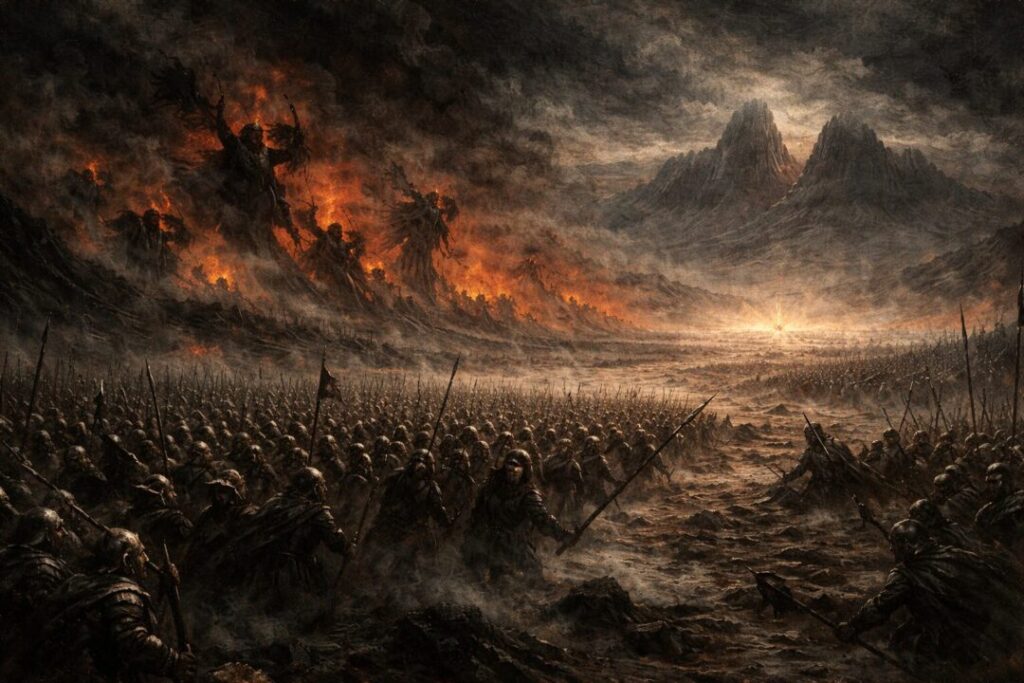
The text states that “there was marshalled the whole power of the Throne of Morgoth,” and that it had become “great beyond count.”
This is crucial.
Morgoth at this stage is diminished compared to his primeval might. Earlier in the First Age, much of his inherent power had been dispersed into the substance of Arda itself. He could no longer contend personally with the Valar as he once had.
But his military strength remained enormous.
Orcs beyond counting.
Balrogs who had survived previous wars.
And, at the end, dragons.
The war was not a brief rout.
It required forty years to break his power.
The Silence of the Text
What happened during those years?
Here the historian must be careful.
The Silmarillion does not give a year-by-year account. It does not describe campaigns, sieges, or territorial gains. It does not name individual battles apart from the climactic confrontation.
The most we are told is this:
Anfauglith could not contain Morgoth’s armies.
All the North was aflame with war.
From this we may cautiously infer sustained, large-scale conflict across northern Beleriand.
But we cannot responsibly invent details.
No canon source describes specific intermediate engagements.
The forty years are real.
The details are largely withheld.
And that restraint appears deliberate.
The Absence of the Eldar of Beleriand
One of the most striking lines in the chapter notes that none of the Elves who had long dwelt and suffered in the Hither Lands joined the Host of the West.
This means that the Sindar, the Noldor exiles who survived, and the remaining peoples of Beleriand were not central actors in the final war.
The judgment upon Morgoth was executed by the powers from beyond Middle-earth.
The long war that followed was therefore not a continuation of earlier Elvish resistance — but something greater and more terrible.
The Valar themselves had intervened.
And the cost would reflect that scale.
The Coming of the Winged Dragons
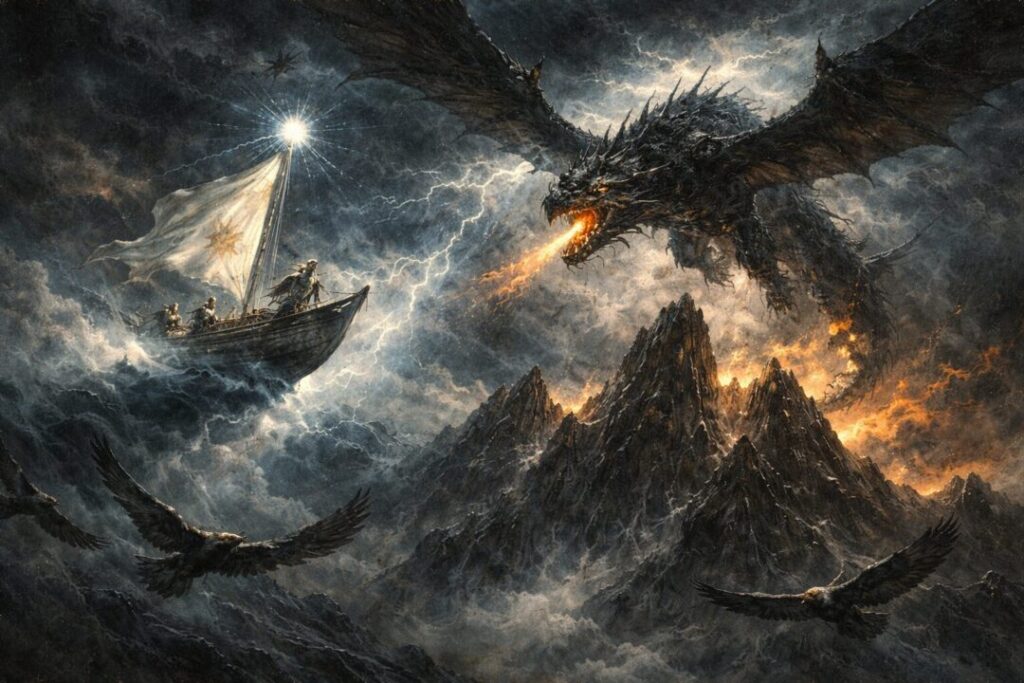
Near the end of the war, Morgoth unleashes a final defense.
The text describes “winged dragons” emerging from Angband — creatures not previously seen in the wars of Beleriand.
Their assault nearly turns the tide.
Here the narrative sharpens.
Eärendil appears in the sky, “shining with white flame,” bearing the Silmaril.
Thorondor and the Eagles join him.
The battle in the air lasts through the day and into a “dark night of doubt.”
Before the rising of the sun, Eärendil slays Ancalagon the Black, “the mightiest of the dragon-host,” and casts him down upon Thangorodrim, breaking its towers.
This is the moment most often remembered.
But it is not the whole war.
It is its climax.
The Fall of Morgoth
After the dragons are defeated, the host of the Valar prevails.
The pits of Morgoth are broken.
The might of the Valar descends into the deeps of the earth.
Morgoth flees into his mines and sues for peace and pardon.
He is bound with Angainor — the very chain once used to restrain him in Valinor. His iron crown is beaten into a collar for his neck. The two remaining Silmarils are taken from him.
And he is thrust beyond the Door of Night into the Timeless Void.
This is not merely defeat.
It is removal from the world.
Why Did It Take Forty Years?
The text does not provide a direct explanation.
But several factors are evident:
- Morgoth’s armies were immense.
- Angband was vast and deeply fortified.
- The war was fought across a broad and devastated landscape.
- The powers unleashed were catastrophic in scale.
The destruction that followed suggests that the struggle was not localized.
“For so great was the fury of those adversaries,” the text states, “that the northern regions of the western world were rent asunder.”
The sea roared through chasms.
Rivers found new paths or vanished.
The hills were trodden down.
Sirion was no more.
The war did not merely defeat Morgoth.
It reshaped the map of the world.
The Sinking of Beleriand
When the war ended, most of Beleriand lay beneath the Sea.
Only fragments remained: Lindon in the west, and a few surviving lands.
This was not collateral damage from a single battle.
It was the accumulated consequence of forty years of conflict between powers greater than those that had fought any prior war in Middle-earth.
The First Age did not fade gently.
It ended in geological upheaval.
A War Deliberately Unwritten
Why does the narrative move so quickly across forty years?
The restraint may itself be meaningful.
The Silmarillion is not a military chronicle.
It is a mythic history concerned with moral turning points.
The War of Wrath is presented less as a sequence of tactics and more as divine judgment.
The emphasis falls not on strategy — but on consequence.
The destruction of Morgoth is absolute.
So too is the destruction of Beleriand.
The victory is complete.
The cost is irreversible.
The Long Twilight of the First Age
When Morgoth is cast out, the First Age ends.
But it does not end with celebration.
It ends with ruin.
Many Elves depart.
The Edain are granted Númenor.
The world enters a quieter, narrower age.
The War of Wrath was not simply a final battle.
It was the long twilight of the First Age — a forty-year reckoning that broke both tyrant and continent alike.
And perhaps that is why the narrative is restrained.
Because some wars are too vast to catalogue.
They are remembered not for their maneuvers — but for what remains after them.