Beleriand is one of the great absences in Middle-earth.
By the time most readers enter the world through The Hobbit or The Lord of the Rings, it is already gone. The stories still carry its shadow. Songs remember it. Elves grieve for it. Names survive in fragments. But the land itself has vanished beneath the western sea.
That disappearance can sound almost mythic at first, as though Beleriand were simply a lost Atlantis of the Elder Days.
But the texts are more severe than that.
Beleriand does not disappear because history moves on. It is broken in war. And only then does the sea take it.
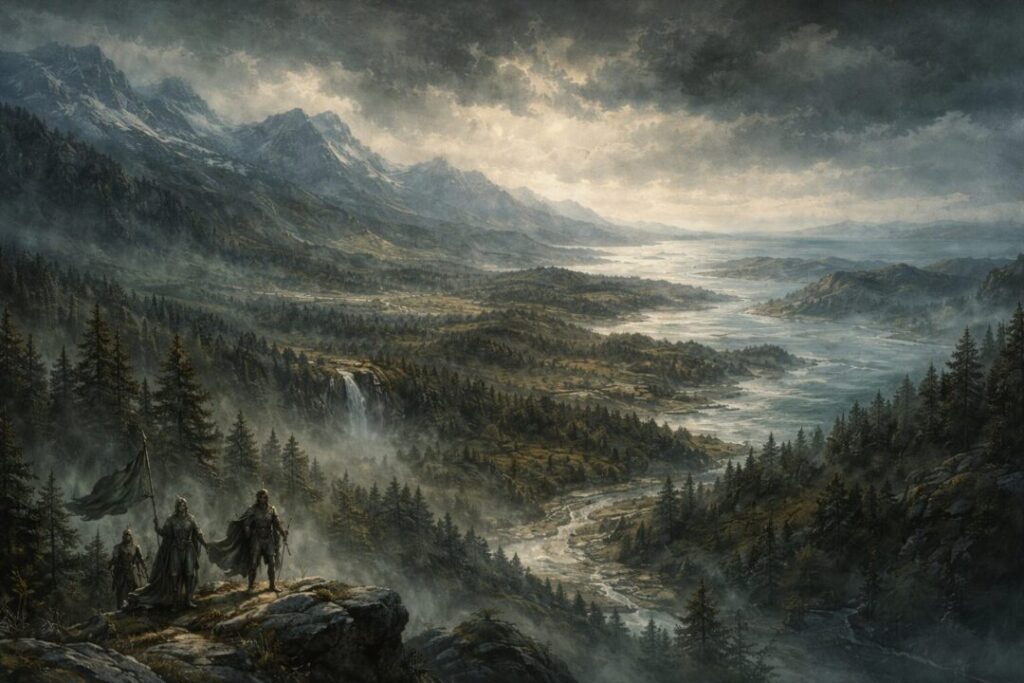
Beleriand Was the Heart of the First Age
For most of the First Age, Beleriand is not a side region or forgotten frontier. It is the main stage of the struggle against Morgoth.
This is the land of Thingol’s Doriath, of Turgon’s Gondolin, of Finrod’s Nargothrond, of the Havens, the Falas, the March of Maedhros, the long resistance of the Noldor, and the tragic alliance of Elves and Men. When readers think of the great heroic age before the time of Aragorn, they are usually thinking of Beleriand.
That matters because its destruction is not the fall of some already-empty realm.
It is the loss of the central landscape of an entire age.
The Sea Did Not Take Beleriand for No Reason
A common way of speaking about this story makes it sound as if the sea simply rose and swallowed the land in one dramatic act.
The published texts are more restrained.
They connect the ruin of Beleriand directly to the War of Wrath, the final conflict at the end of the First Age. After Eärendil reaches the Blessed Realm and pleads for help, the Host of the West comes at last against Morgoth. The war lasts for more than forty years, and its violence is so immense that Beleriand is broken and laid waste. The sea follows that ruin.
That is an important distinction.
The sea is not described as a separate moral sentence falling from nowhere. The texts do not say that the Valar deliberately chose to drown Beleriand as punishment for its peoples. What they do show is that the last war against Morgoth becomes so catastrophic that the land itself does not survive it.
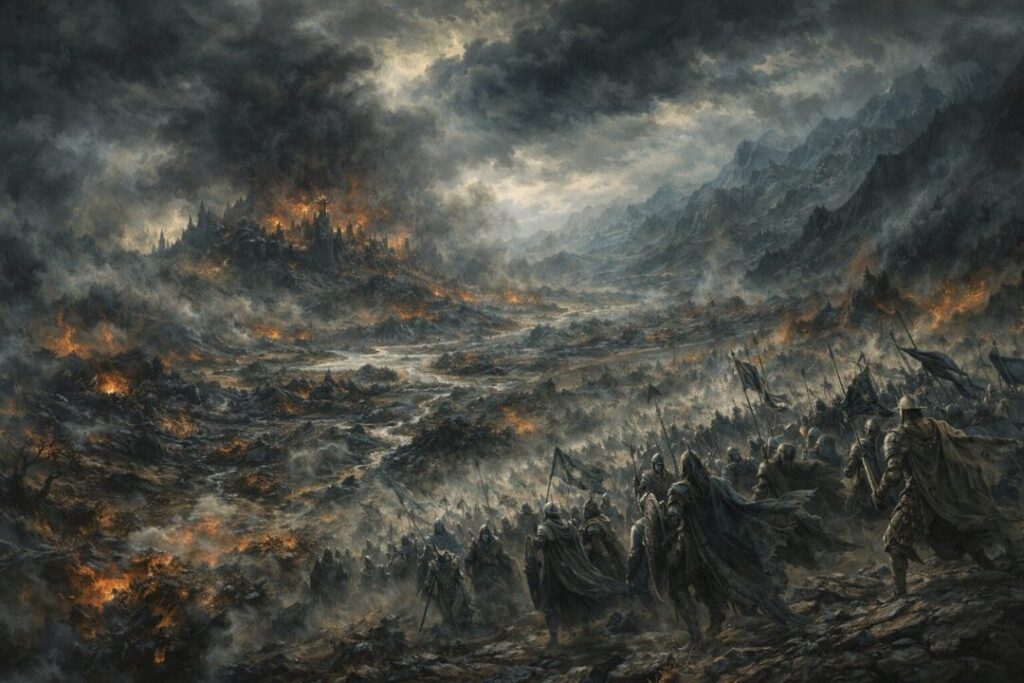
Why the War of Wrath Was Different
Earlier wars in Beleriand are already devastating.
The Dagor Bragollach breaks the long siege. Dragons are unleashed. Hidden kingdoms fall. Entire peoples are scattered. By the time the First Age nears its end, the land has endured centuries of fire, siege, terror, and repeated ruin.
But the War of Wrath is different in scale.
This is not merely another campaign between armies living within the limits of Middle-earth. It is the final overthrow of Morgoth by the greatest force ever sent against him after his long domination in the North. The result is not only the fall of Angband and the defeat of his armies, but a convulsion so great that the geography of the northwest is changed permanently.
The texts remain notably sparse about the exact physical sequence. They do not give a modern geological account. They do not map each collapse year by year in narrative detail. But the published tradition is clear on the broad point: Beleriand is broken in the war, and many of its lands sink beneath the sea.
It Was Not Necessarily One Instant
Readers often imagine Beleriand sinking in a single sudden night.
The texts do not explicitly say that.
What they do say is that the War of Wrath lasts from F.A. 545 to 587 in the later chronology, more than four decades. That suggests a prolonged catastrophe rather than a single isolated moment. The ruin may have culminated dramatically, but the canon does not require us to imagine one clean instant when all the western lands vanished at once.
That is where careful phrasing matters.
We can say with confidence that the war caused the destruction and submergence of most of Beleriand.
We should be more cautious about claiming a step-by-step mechanism the texts never fully spell out.
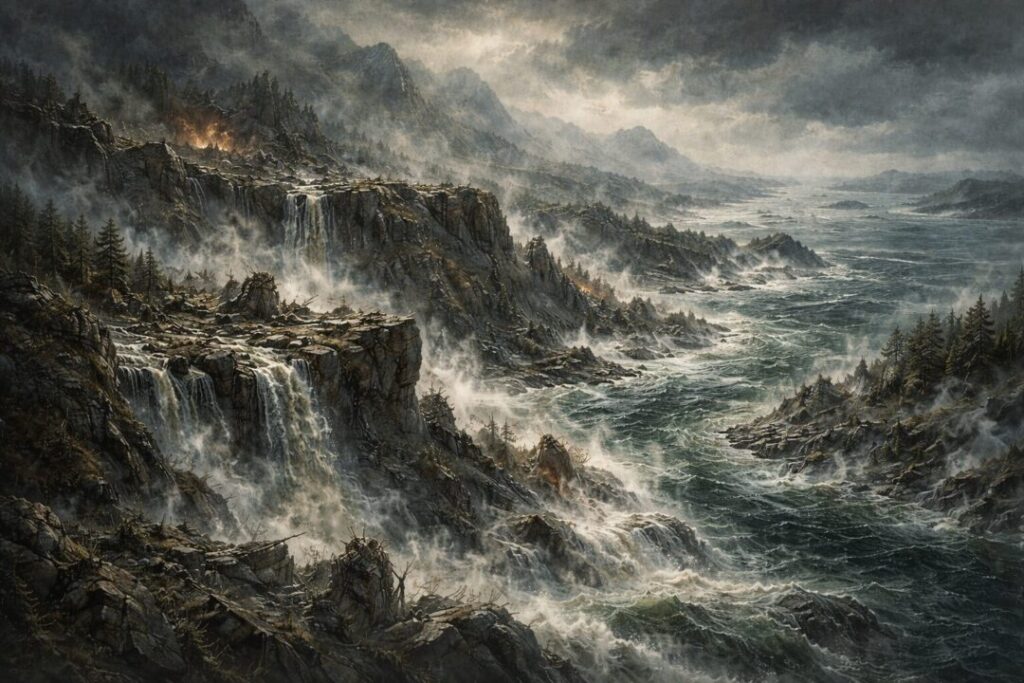
What Actually Remained
The destruction is enormous, but it is not absolute.
The clearest surviving remnant is Ossiriand, afterward known as Lindon. In the early Second Age, Lindon stands as the western fringe of the continent, and the sea has broken through the Blue Mountains to create the Gulf of Lhûn. That alone tells us how radically the coastline has changed. Lands once inland become coasts. Old frontiers become shorelines. The western edge of Middle-earth is remade.
Some losses are remembered through small survivals.
Tol Morwen is explicitly named as a remnant of drowned Beleriand, preserving the memorial association of Túrin and Morwen. This is one of the most haunting details in the aftermath: not only kingdoms but graves and memories are left stranded in the sea.
Other surviving islands, such as Tol Himling and Tol Fuin, are widely associated with the later mapped remains of Beleriand, but here the wording should be careful. These are strongly linked to later map tradition and reference works, yet they are not all foregrounded equally in the narrative prose of the published Silmarillion. It is safer to treat them as traditional remnants attested especially through the cartographic tradition rather than making them all sound equally emphasized in the main story text.
Why This Matters for Middle-earth as a Whole
The drowning of Beleriand reveals something essential about the moral and physical logic of the legendarium.
Victory does not restore the world to innocence.
Morgoth is overthrown, but the cost is staggering. The central lands of the Elder Days are gone. Ancient realms survive only in memory. Even when evil is defeated, the damage it has drawn into the world is not simply reversed.
That pattern will matter again later.
The defeat of Sauron ends the War of the Ring, but it does not preserve the Elvish world unchanged. The destruction of the One Ring also means the fading of the Three. Great victories in Middle-earth are real, but they are rarely tidy. They close one shadow while also ending something beautiful. Beleriand is the largest and most dramatic version of that pattern.
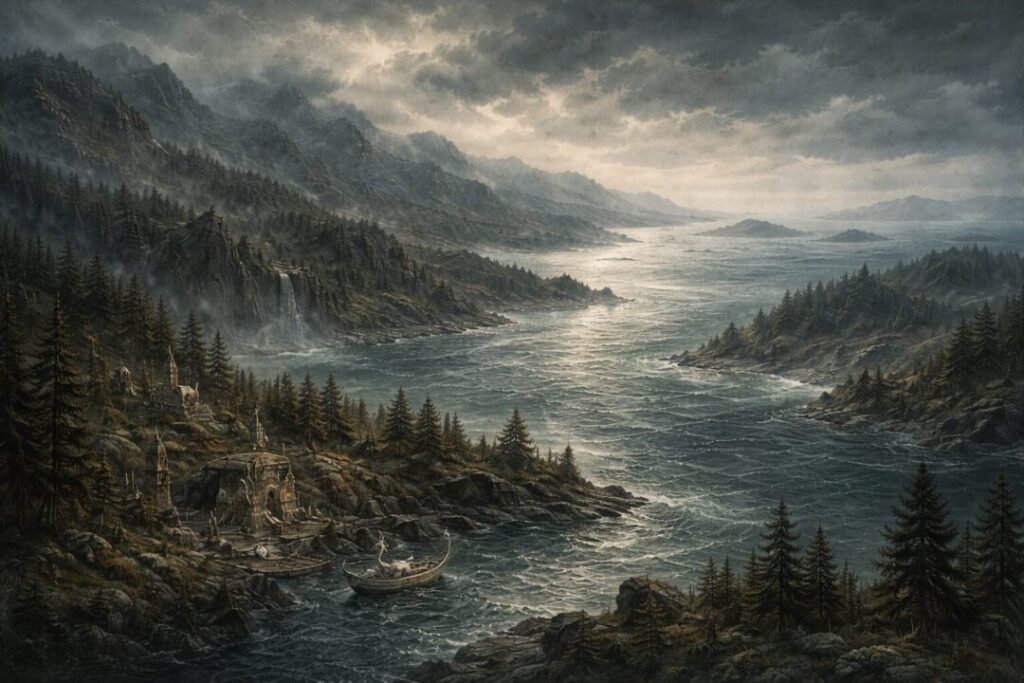
Why the Sea Feels So Final
There is also a deeper emotional reason the drowning of Beleriand strikes readers so hard.
If a kingdom burns, it might be rebuilt. If a city falls, its ruins might be found. But when the sea covers a land, recovery becomes almost unimaginable.
That is why Beleriand feels less like a conquered realm and more like a severed world.
By the Second and Third Ages, its greatest stories remain alive only through song, memory, and lineage. Elrond still carries its history. Galadriel still remembers it. Círdan endures on the western shore of the remade world. But the land where those stories happened is no longer accessible in the old way.
The sea does not merely destroy.
It removes.
And in doing so, it turns history into legend even inside the world itself.
Beleriand Was Not Erased Because It Did Not Matter
In one sense, the opposite is true.
Beleriand had to feel immense, beautiful, and irreplaceable for its loss to carry this kind of force. It is not scenery discarded after use. It is the homeland of the First Age’s deepest griefs and greatest acts of endurance. That is why its drowning matters so much.
The sea takes Beleriand because the final war against Morgoth breaks the land beyond recovery.
And that is what makes the story so powerful.
The last victory of the Elder Days is still a victory.
But it leaves the world smaller than before.
The Real Tragedy of Beleriand
The strangest thing about Beleriand is not just that it is lost.
It is that its loss is bound up with salvation.
Morgoth had to be overthrown. The war had to be fought. The suffering of Elves and Men in the North could not simply continue forever. And yet the price of ending that tyranny was not only the defeat of the Dark Power, but the ruin of the very lands where the resistance to him had lived for centuries.
So what happened to Beleriand?
It was not neatly swept away.
It was shattered in the greatest war of the Elder Days, and the sea entered where the world had been broken.
That is why its memory feels so different from the ruins of later ages.
Beleriand does not merely lie in the past.
It lies under it.
Sources & Notes
- J.R.R. Tolkien, The Silmarillion, “Quenta Silmarillion: Of the Voyage of Eärendil and the War of Wrath” — the Host of the West comes against Morgoth, and Beleriand is broken and laid waste in the Great Battle.
- J.R.R. Tolkien, The Lord of the Rings, Appendix B, “The Tale of Years” — the First Age chronology places the War of Wrath in F.A. 545–587 and notes that Thangorodrim was broken and most of Beleriand was drowned.
- J.R.R. Tolkien, The Silmarillion, “Of the Rings of Power and the Third Age” — after the ruin of Beleriand, Lindon remains west of the Blue Mountains under Gil-galad, showing the remade Second Age coastline.
- J.R.R. Tolkien, The Silmarillion, “Quenta Silmarillion: Of Túrin Turambar” — the later survival of Tol Morwen preserves one haunting remnant of drowned Beleriand and its memories.