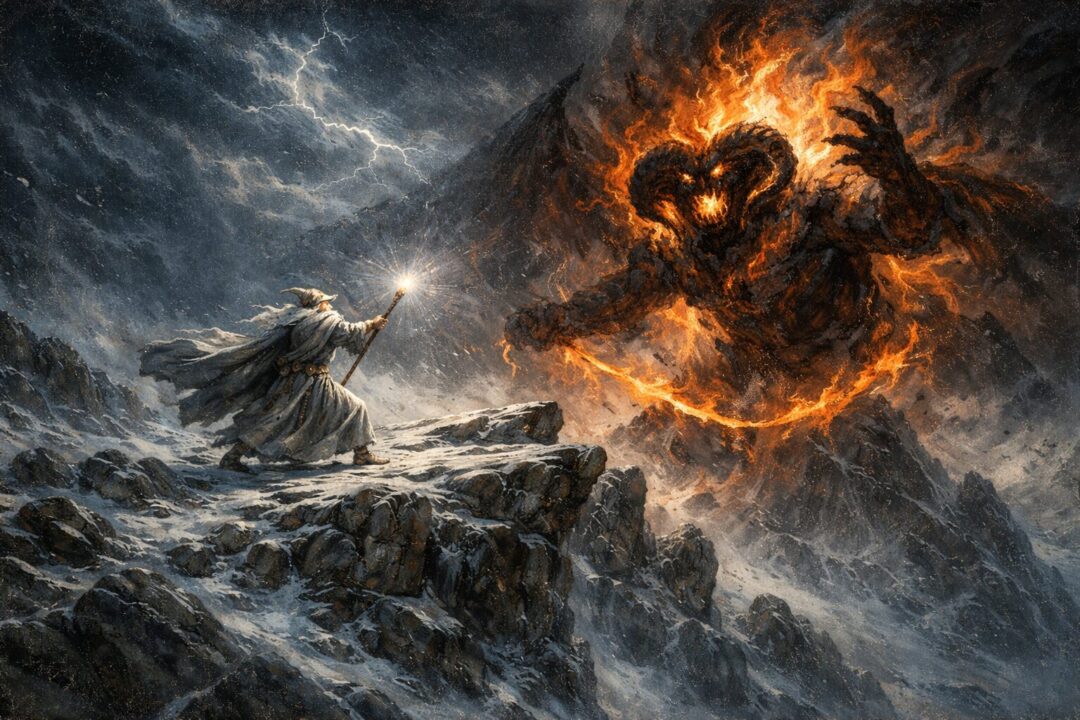
Gandalf’s fall in The Fellowship of the Ring is one of the defining moments of the entire legendarium.
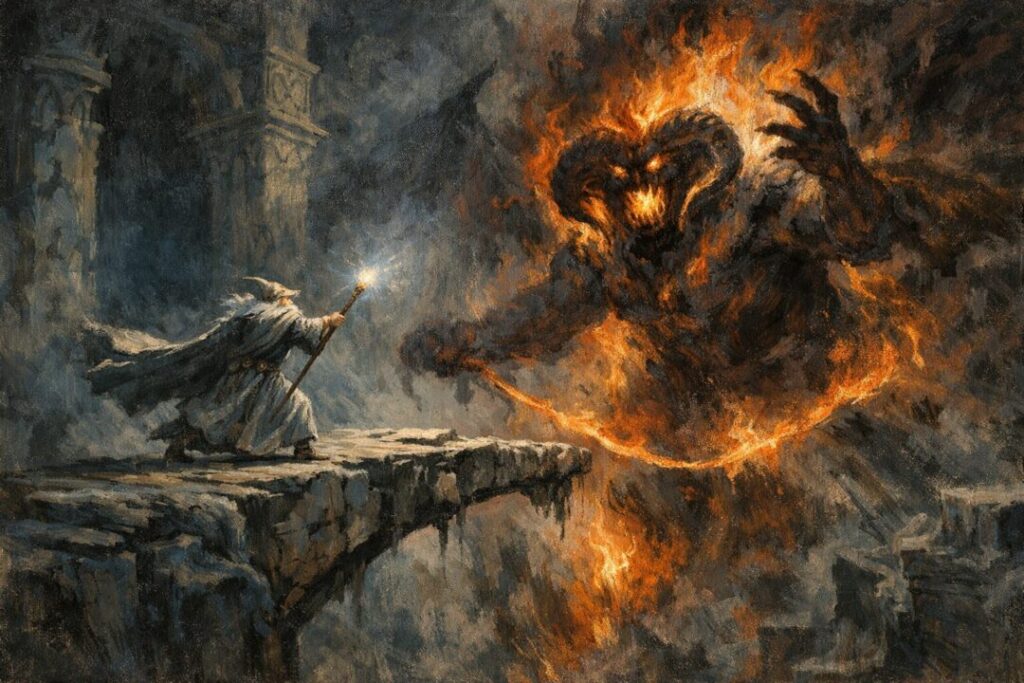
On the Bridge of Khazad-dûm, he confronts a Balrog of Morgoth—one of the last surviving terrors of the First Age. The confrontation is brief, sudden, and catastrophic. Gandalf breaks the bridge beneath the creature’s feet, casts it into the abyss, and is himself dragged down after it.
For the Fellowship, Gandalf is simply gone.
There is no body to bury.
No time to mourn properly.
Only the echo of his fall and the certainty of loss.
Yet Tolkien later makes something unmistakably clear: Gandalf did not merely fall or vanish. He died.
When Gandalf later recounts the event in The Two Towers, he describes his experience in words that are precise and deliberate:
“Then darkness took me; and I strayed out of thought and time…”
This language is not metaphorical flourish. In Tolkien’s mythology, to pass “out of thought and time” is to leave the physical world entirely. Gandalf’s spirit did not linger in Middle-earth. It departed it.
And once that is understood, a deeper question inevitably follows:
What became of Gandalf’s body?
Gandalf’s Death Was Physical and Real
Before addressing the fate of Gandalf’s body, it is necessary to clarify what Gandalf is—and what he is not.
Gandalf is not an Elf, nor a Man. He is one of the Maiar, a class of immortal spirits who existed before the shaping of the world. These beings are not naturally bound to physical form. Their native state is incorporeal.
When the Wizards were sent to Middle-earth in the Third Age, they were deliberately clothed in bodies—not as a convenience, but as a limitation. Their physical forms were intended to restrain their power, to make them vulnerable, and to force them to operate through counsel, patience, and moral example rather than domination.
These bodies were not illusions or temporary disguises.
They were real.
They could feel hunger, exhaustion, fear, and pain. They aged slowly. They could be wounded. And crucially, they could die.
Gandalf’s battle with the Balrog confirms this reality beyond any doubt.
He does not describe a moment of spiritual withdrawal or fading. He describes a long, exhausting struggle—from the deepest pits of Moria, through tunnels and stairways, up to the peak of Zirakzigil. Only there does he finally cast down the Balrog, and only then does he himself perish.
This was not symbolic death.
It was not a trance.
It was the destruction—or complete failure—of Gandalf’s embodied form.
Did Gandalf’s Body Remain in Moria?
Here the texts become strikingly silent.
Tolkien never explicitly states what happened to Gandalf’s body immediately after his death. There is no description of its condition. No indication that it was discovered, destroyed, or preserved. No account of any being encountering it.
The narrative simply moves on.
This absence has fueled many theories—but Tolkien gives us firm boundaries we must not cross.
What can be said with confidence is this:
- Gandalf’s spirit departed his body entirely.
- His body ceased to function as a living form.
- His return required direct intervention from beyond the world.
What cannot be said—because Tolkien never says it—is whether Gandalf’s physical remains persisted for any length of time. We are not told whether they lay upon the mountain, were consumed by the elements, or were altered by forces unseen.
The texts provide no confirmation of decay, destruction, or disappearance.
And that silence is not accidental.
Gandalf’s Return Was Not Reincarnation
When Gandalf returns, now clothed in white, he does not describe his experience in the language of rebirth.
He does not speak of being born again, nor of a cycle completed and restarted. Instead, he uses a different and very deliberate phrase:
“I have been sent back until my task is done.”
This is not the language of reincarnation.
It is the language of commission.
Gandalf was sent back.
Importantly, this sending was not performed by the Valar, nor by any power within the world. Tolkien later clarified—in correspondence outside the narrative—that Gandalf’s return was an act of Eru Ilúvatar himself.
That distinction matters.
Elves who die may be rehoused through processes governed by the Valar. Men, once dead, leave the world entirely. Gandalf’s return follows neither pattern.
His restoration comes from a higher authority than any that normally operates within Arda.
This alone suggests that the fate of his body cannot be understood through ordinary metaphysical rules.
Was Gandalf Given the Same Body?
Here Tolkien is especially careful—and especially vague.
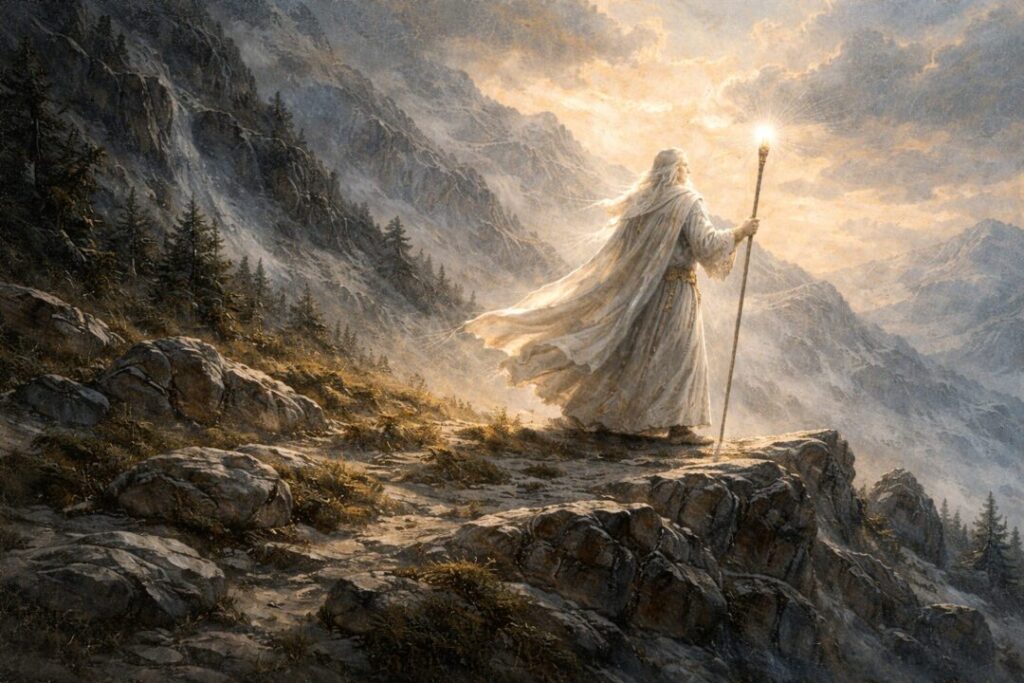
Gandalf says that he was “clothed again” in flesh. The phrase is evocative, but imprecise. It does not tell us whether the body he received was the same one restored, or a new one fashioned to resemble the old.
Tolkien never states outright that Gandalf received a new body.
Nor does he say that the original body was revived.
Because of this, the only intellectually honest conclusion is also the most restrained:
The texts do not confirm whether Gandalf’s returned body was identical to his former one, only that he was restored to embodied life by divine authority.
What is clear is that his condition after returning is not identical to what it was before.
Gandalf himself says that he is no longer the same. His authority is greater. His clarity is sharper. His purpose is no longer uncertain. Even his appearance reflects this change—his whiteness is not merely a color, but a sign of office and responsibility.
Whatever form he inhabits after his return, it is no longer merely the body of a wandering wizard.
Why Tolkien Leaves the Fate of the Body Unexplained
Tolkien almost never describes direct divine intervention in mechanical detail.
Eru Ilúvatar acts rarely, and when he does, his actions are usually perceived only through their consequences. The reshaping of the world, the downfall of Númenor, and the final music of creation all occur without exhaustive explanation.
Gandalf’s return is one of the clearest moments of divine action in The Lord of the Rings—and yet Tolkien still refuses to describe how it happens.
Why?
Because the process is not the point.
Gandalf’s death marks the end of one phase of resistance against Sauron: cautious, hesitant, constrained. His return marks the beginning of another: decisive, focused, and urgent.
The mechanics of how flesh is restored would add nothing to the moral weight of that transition.
By refusing to describe what happened to Gandalf’s body, Tolkien ensures that the moment remains liminal—half within the story, half beyond it.
It is not something the characters fully understand.
And it is not something the reader is meant to dissect into components.

A Death That Truly Mattered
Gandalf’s first death is not undone or erased.
It costs him everything.
He loses his former role, his former limitations, and his former uncertainty. He returns not because death failed, but because his sacrifice was accepted—and because his task was not yet complete.
In that sense, the fate of his body in Moria is deliberately overshadowed by the meaning of his death.
The physical details are left behind.
What remains is transformation.
Tolkien’s silence preserves the gravity of the moment. It prevents Gandalf’s return from becoming a mere reset or narrative convenience. Instead, it stands as one of the rare moments where the boundary between the world and what lies beyond it is crossed—and then sealed again.
Some doors, once crossed, are not meant to be described.
And Gandalf’s body, left behind at the edge of life and death, belongs to one of those doors.