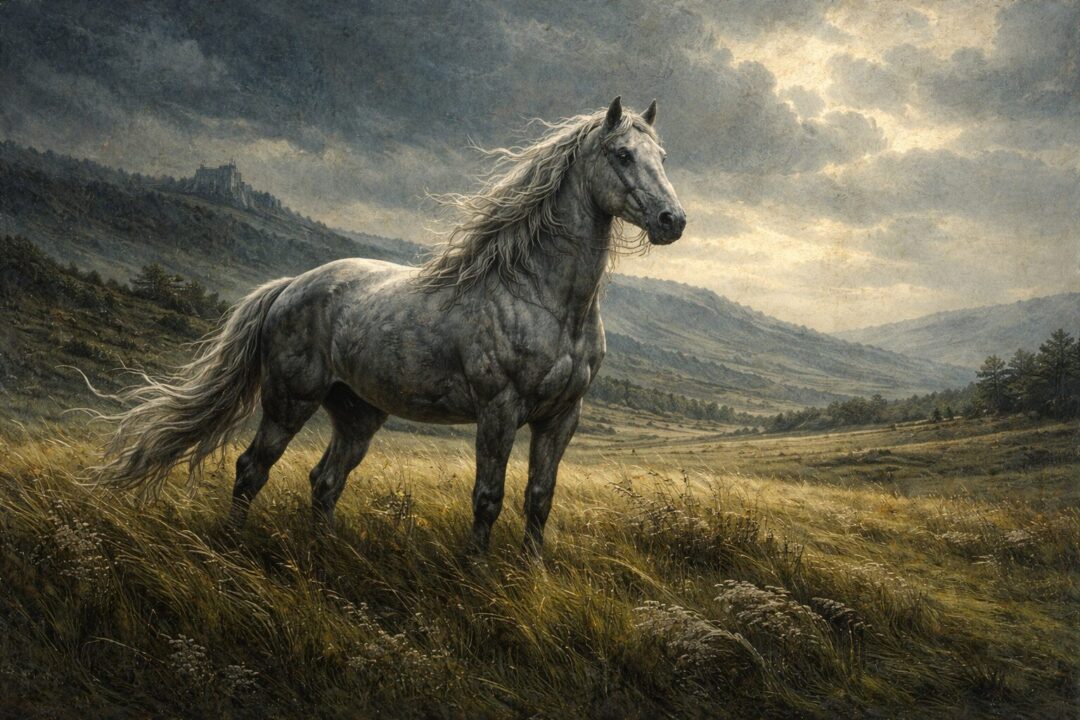
Shadowfax is easy to remember as speed and silver—Gandalf’s living storm, the lord of horses, the one creature in the War of the Ring that seems to move as if the world’s weight cannot touch him.
But his real strangeness is not how fast he runs.
It is where he ends.
Because Shadowfax does not finish the story in Rohan, where his name is known and his kind is honored. He does not fade quietly into the grassy fields of the Mark. Instead, the text leads him—almost invisibly—toward the same horizon as the Ring-bearers.
And once you see that, you start asking a sharper question than “Where did he go?”
You start asking what Shadowfax was, and why the ending places him where it does.
Shadowfax is not treated like an ordinary horse
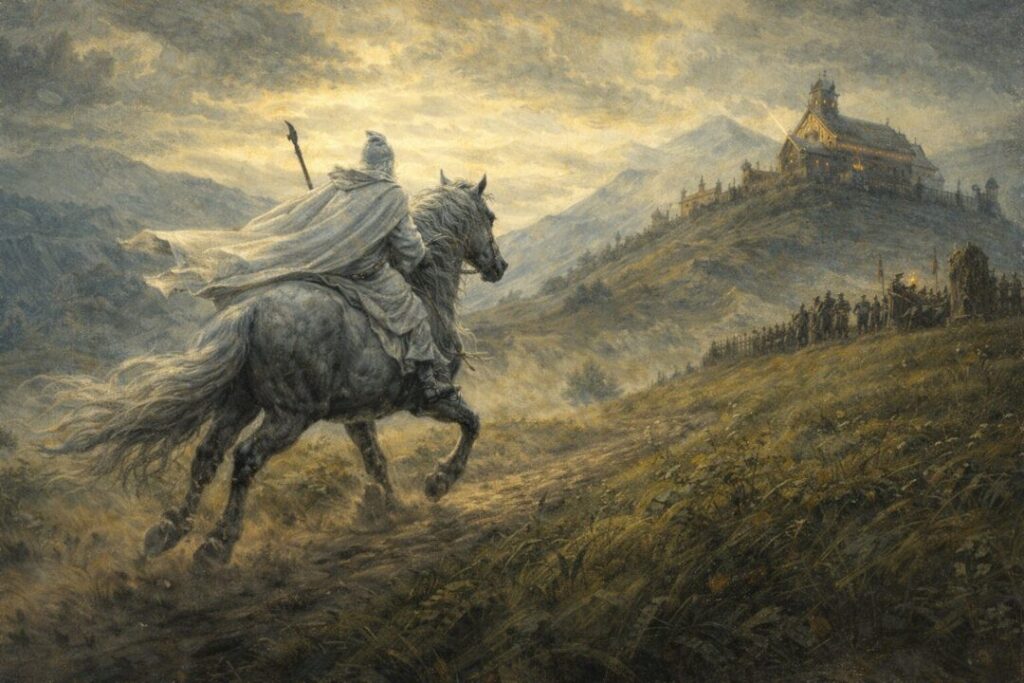
When Gandalf first speaks of Shadowfax in The Two Towers, the language pushes beyond admiration into something closer to reverence. Shadowfax is one of the Mearas, the great horses of Rohan. That much is clear in the narrative: he is a horse the Rohirrim themselves cannot master, and his choosing of Gandalf reads as much like judgment as loyalty.
He also understands speech, or at least meaning, in a way the text repeatedly emphasizes through Gandalf’s interactions with him. The relationship is never framed as rider and beast. It is framed as two wills moving together.
That matters, because it explains why Shadowfax’s “after” would never be a simple retirement.
He is not a mount that can be put away once the war is won.
He is bound to Gandalf’s work—so closely that the story almost treats them as a single emblem: the White Rider and the great horse that bears him.
So when the Age turns, the question becomes unavoidable:
If Gandalf leaves Middle-earth, what happens to the horse who “belongs” to his road?
The Grey Havens detail most people miss
Near the very end of The Lord of the Rings, the company comes to Mithlond, the Grey Havens. The focus is on parting—on the final breaking of the Fellowship’s shape.
And then the text quietly sets the scene:
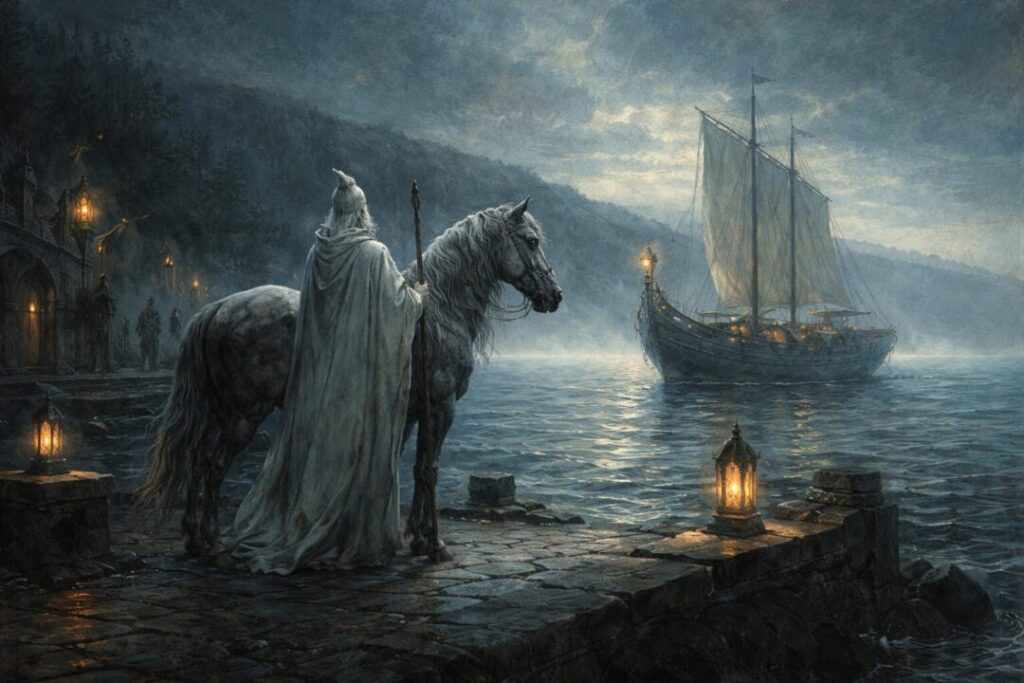
A white ship lies at the quay, and beside a great grey horse stands a figure robed in white—Gandalf.
The narrative does not name the horse.
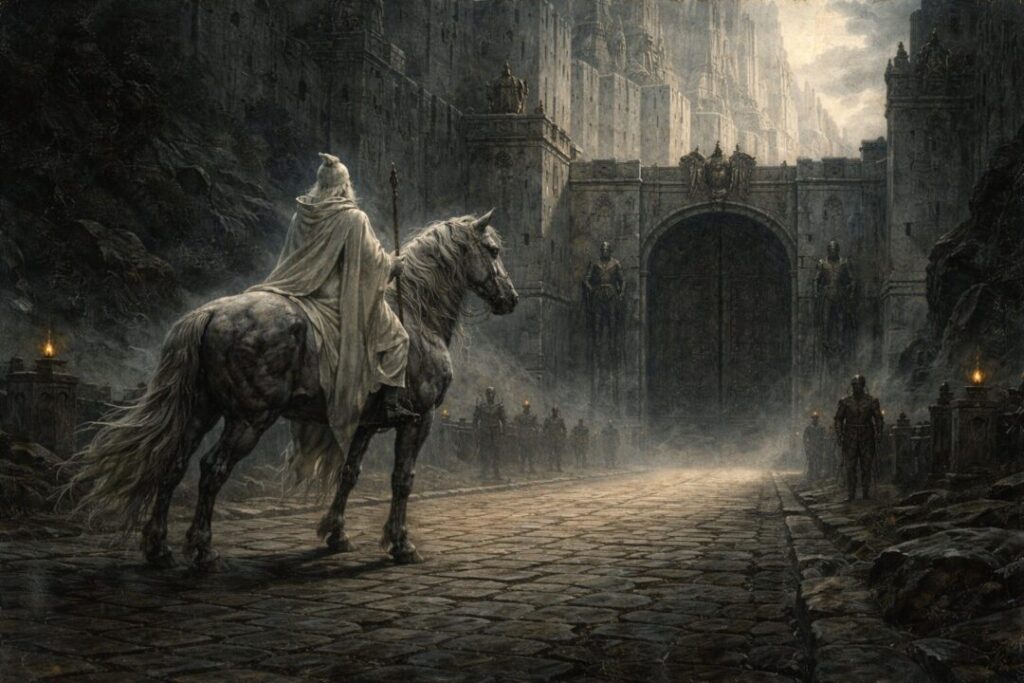
But it does not need to, and that’s part of the point. By this stage of the story, Gandalf’s horse is not a rotating cast of animals. It is Shadowfax. The association has been made firm across the War: Rohan, Isengard, Minas Tirith, the last stand before the Black Gate.
So the book gives you an image that is both simple and loaded:
Gandalf at the edge of the Sea, and a great grey horse waiting with him.
If you stop there, you might still wonder: Does Shadowfax remain behind after Gandalf boards? The chapter itself does not explicitly describe the horse stepping onto the ship.
And that is where the best evidence comes from somewhere else.
The one place the author answers it plainly
In a letter (published as Letter 268), Tolkien addresses this exact curiosity: whether Shadowfax went “across the Sea” with Gandalf.
His answer is straightforward in intent, even while acknowledging the book’s silence: he says he believed Shadowfax certainly went with Gandalf, even though it is not stated in the narrative.
And then he gives the reason.
Shadowfax, Tolkien suggests, came from “a special race”—an “Elvish equivalent of ordinary horses”—and his “blood” came from “West over Sea.” Because of that, Tolkien notes it would not be unfitting for him to “go West.”
That matters for two reasons:
- It removes the main uncertainty. Whatever the narrative does or does not explicitly narrate, Tolkien’s own view is that Shadowfax did not remain behind.
- It frames Shadowfax’s nature in a way the story only hints at: his lineage has a connection to the West that ordinary horses do not.
This is not the same as saying Shadowfax is immortal, or “magical” in a modern fantasy sense. The texts do not grant him that. But they do place him closer to the older world than the Rohirrim themselves.
What does “going West” mean for Shadowfax?
Here is where readers often drift into confident claims that the canon does not support.
The book does not tell us where Shadowfax lived in Aman, or what became of him there, or how long he endured. It does not describe him running in the fields of Valinor, or being welcomed into the stables of the Valar, or meeting any legendary horse of earlier ages.
Those are images people like to imagine. But they are not stated as fact.
What the evidence allows us to say—carefully—is this:
- Shadowfax was at the Grey Havens with Gandalf, beside the White Ship.
- Tolkien believed Shadowfax went across the Sea with Gandalf, despite the narrative not spelling it out.
- Tolkien also believed it was fitting because Shadowfax’s “blood” came from “West over Sea.”
That is the secure ground.
Beyond that, the most responsible answer is: we are not told.
Why the story leaves it half-unsaid
Tolkien’s letter includes an explanation for why the book might omit “the obvious detail.” He suggests that real chronicles often leave out the very things later readers want to know, and that truth sometimes has to be inferred from what is shown.
That aligns with how The Lord of the Rings is written as a transmitted record, not as a modern omniscient camera.
In that style, Shadowfax’s end is treated like a small historical fact that the chronicler didn’t stop to underline—because the sorrow of parting was centered on the people left on the shore.
But for the attentive reader, the omission creates a different effect.
It makes Shadowfax’s fate feel like a quiet door closing.
You are meant to notice him—this great grey presence at the edge of the Sea—and feel, for a moment, how much is leaving Middle-earth at once.
Not only Elves. Not only Ring-bearers. But a kind of creature, too.
What Shadowfax represents at the end of the Third Age
Shadowfax is not just “Gandalf’s horse.” He is one of the last living signs that the world still contains remnants of older, higher things—beings that stand closer to the Elder Days than the ordinary lives of Men.
Rohan is a realm of Men, proud and heroic, but still fully within the circles of the changing world. Shadowfax, though beloved there, is never fully theirs. He comes when he wills. He departs when he wills. He is lent, not held.
So when the War ends and the Fourth Age begins—an age explicitly called the Dominion of Men—Shadowfax’s departure becomes symbolic.
It is the older world receding.
The West is not just a destination for the great. It becomes a kind of final gathering place for what cannot remain in the new age without becoming diminished, misunderstood, or misused.
And in that light, Shadowfax going West is not a “reward” in the modern sense.
It is a last fittingness.
A creature with “blood” from beyond the Sea does not end as a footnote in a stable-yard. He passes out of the tale the way he ran through it: lightly, swiftly, almost without sound—following the White Rider into the closing of the Third Age.
So what happened to him?
If you want the most accurate answer the texts allow, it is this:
Shadowfax reached the Grey Havens with Gandalf, and Tolkien believed he crossed the Sea with him.
Everything after that—where he lived, how long he lived, what “West” felt like to a horse—is not stated in canon.
But the story’s final image is enough.
A great grey horse at the shore.
A white-robed rider beside him.
And the sense that Middle-earth is losing more than kingdoms.
It is losing the last traces of a world that could still produce something like Shadowfax.