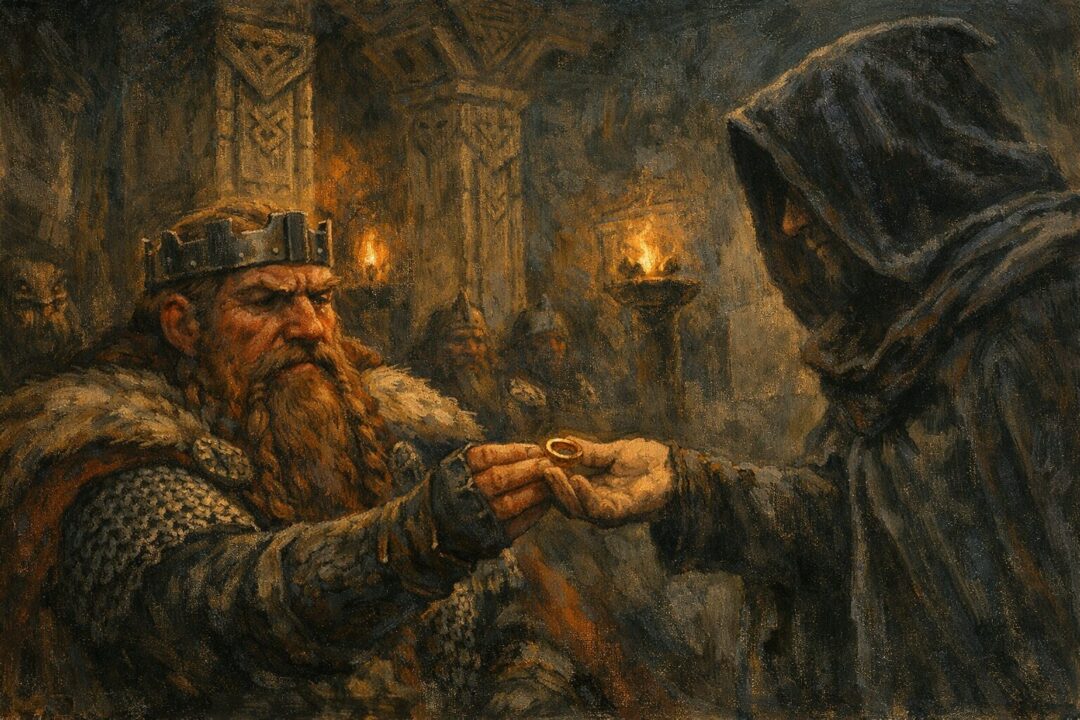
Some mysteries in Middle-earth are created by silence.
This one is created by a sentence that is too clear.
We are told, in plain words, what became of the Seven Rings given to the Dwarves:
Three were recovered by Sauron. The others the dragons consumed.
That is not a rumor in the tale. It is not a later legend. It is presented as a known fact by those who understand the history of the Rings.
And yet, even with the ending stated so directly, the story feels unfinished—because the details we most want are exactly the ones the texts do not provide.
Who held each Ring?
Which dragon consumed which?
And if Sauron recovered three, why do they never reappear in the War of the Ring?
To answer those questions, we have to stay close to what is actually said—then be honest about what is not.
The Seven Were Not “Lost.” They Were Accounted For.
The simplest correction is this:
The Seven Rings did not vanish into vague myth.
The narrative gives a concrete outcome:
- Four were destroyed by dragons (“consumed” in fire).
- Three were recovered by Sauron.
This matters because it means the Dwarves did not secretly retain a Ring in the late Third Age, and Sauron was not actively hunting for all seven at the end.
He already had what could be had.
And what could not be had was ash.
What the Seven Did to Dwarves
The texts make a second point just as important:
The Rings did not turn Dwarves into shadows.
Dwarves are described as hard to dominate by Rings—“tough and hard to tame,” with hearts difficult to fathom.
So the Seven did not “enslave” them in the manner of the Nine.
But the Rings did have an effect.
They were used for the getting of wealth. Greed was kindled—wrath and an overmastering desire for gold. And this is where the story becomes tragic in a very Dwarvish way:
Wealth draws attention.
And in the older world, the attention that answers wealth is often dragon-fire.
The tradition is even stated: the founding of each great hoard began with a ring—yet the hoards were plundered, and dragons devoured them.
That is the shape of the Seven’s influence: not mind-control, but amplification.
They made Dwarves richer—and therefore more exposed.
“The Dragons Have Consumed Them”
This phrase is easy to skim past, but it is one of the hardest facts in the Ring-lore:
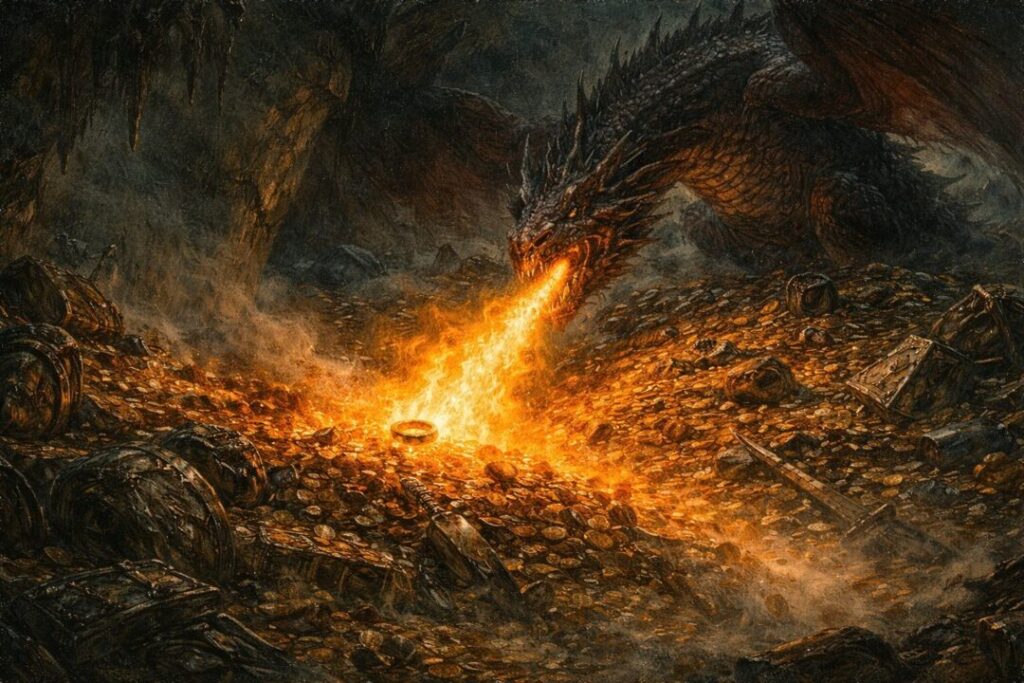
Dragons destroyed Rings of Power.
The texts do not describe a detailed scene of melting gold bands one by one. They simply tell us the result: some Rings were “consumed in fire.”
That is enough.
It places the loss of four Rings in the long history of dragon assaults on Dwarven wealth—particularly in the northern regions where Dwarves had hoards and dragons prowled.
We are not told which dragons did it.
We are not given a list of possessors.
So any attempt to assign Ring #1 to Dragon X is speculation and should be labeled as such.
But the outcome is not speculative at all.
Four ended in dragon-fire.
The Three Sauron Recovered
The next question seems obvious:
If Sauron recovered three Rings, why didn’t he simply use them again?
The narrative gives us a clue that is surprisingly blunt.
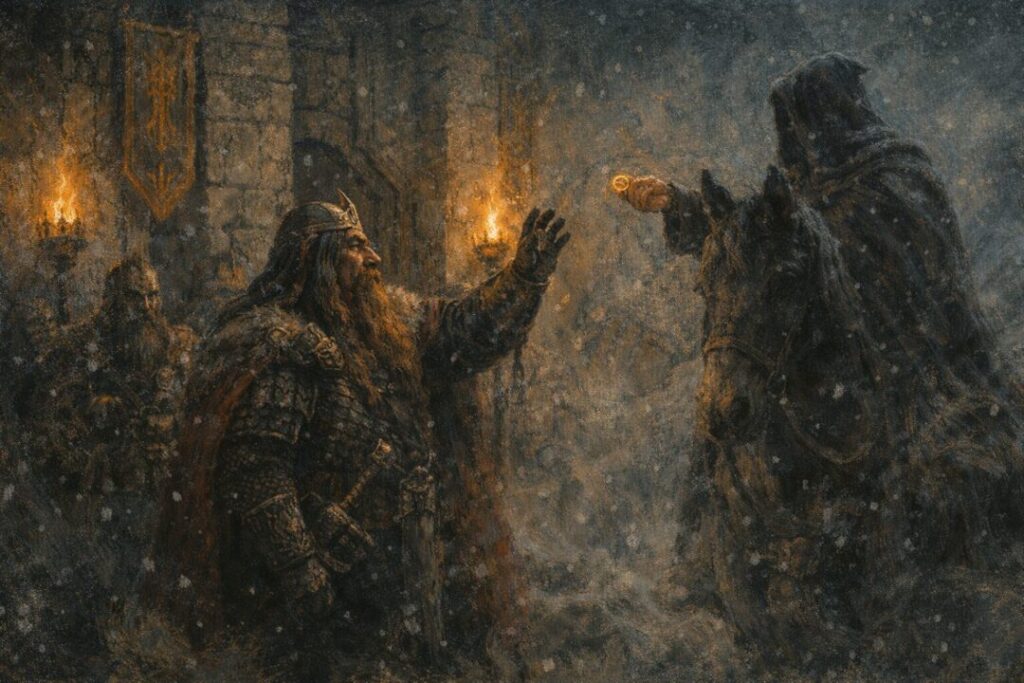
At the Council in Rivendell, Glóin recounts a message from Mordor: a horseman comes in the night to the gate of Erebor and offers “friendship.” And then the promise:
“Rings… such as he gave of old.”
Not a threat. Not an attempt to enthrall Dáin.
A bargain.
This is the most revealing detail we have about what those recovered Rings meant to Sauron in the late Third Age.
They were not presented as weapons.
They were presented as leverage.
That suggests a hard truth: by that time, the Seven were not reliable tools for Sauron’s domination, at least not in the way the Nine were for Men.
They could inflame greed.
They could swell hoards.
But Dwarves did not become wraiths.
And Sauron’s strategy by the end is not “make Dwarves greedy.”
It is “find the Ring-bearer.”
So the recovered Rings become something colder and simpler:
bribes, bait, bargaining chips.
The Last Named Ring: “The Last of the Seven”
Only one of the Seven is tied to a specific late-Third-Age incident in the narrative.
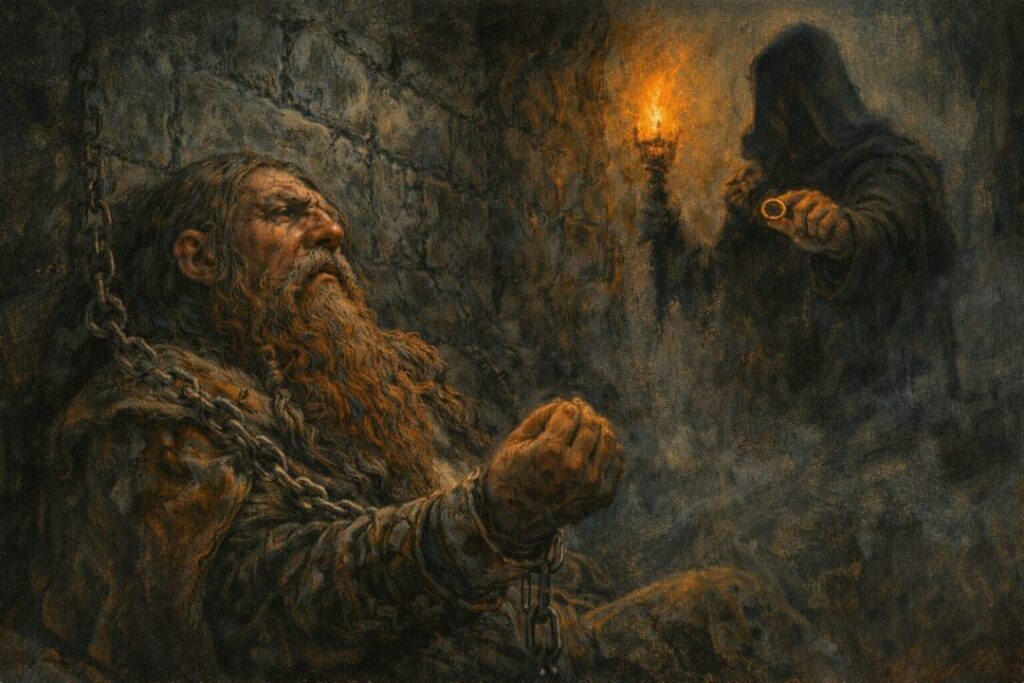
Gandalf tells of entering Dol Guldur in disguise and finding a Dwarf dying in the pits, raving of a Ring—“the last of the Seven.”
The text does not linger on graphic detail. It does not need to. The implication is clear enough:
A Dwarf of Durin’s line (known from other parts of the story to be Thráin II) had possessed a Ring of Power—and it was taken from him in Dol Guldur.
This is the cleanest thread we have connecting one of the Seven to a named possessor at the end of the Third Age.
But notice what the text still does not do:
It does not tell us which earlier kings held it before Thráin, beyond the broader fact that it was in Durin’s line.
It does not tell us when Sauron took the other two Rings.
It does not tell us how long he held them.
So we can say with confidence:
- Thráin II possessed “the last of the Seven.”
- It was taken from him in Dol Guldur.
Anything beyond that needs careful language.
Why Didn’t Sauron “Reclaim” Them?
In one sense, the question answers itself:
He did reclaim what was reclaimable.
He recovered three.
Four were destroyed.
There is nothing left to reclaim after that.
But the deeper version of the question is:
Why didn’t he redeploy them?
Why not use the recovered Rings to strengthen servants, raise new lords, corrupt new kingdoms?
The texts never give a single sentence that says, “Sauron did not reuse them because…”
So we must be conservative.
What the evidence supports is this:
- Dwarves were hard to dominate by Rings.
- The Seven tended to produce wealth and greed, not obedience.
- Sauron used the Rings he held as bargaining tools when it suited his aims.
- His central plan depended on the One Ring above all.
From this, a restrained conclusion follows:
By the late Third Age, the recovered Dwarf-rings were not central to Sauron’s strategy. They were useful as temptation and negotiation—not as the core mechanism of his rule.
That does not mean they were “powerless.”
It means they were no longer the kind of power he needed.
The Quiet Meaning of the Seven
The Seven Rings are sometimes treated like a lesser set—footnotes beside the One, the Nine, and the Three.
But their story is one of the sharpest moral patterns in Middle-earth:
A tool intended for domination becomes a mirror.
The Rings did not remake the Dwarves into something alien.
They enlarged what was already there: love of craft, hunger for treasure, fierce possessiveness.
And that enlargement shaped their history.
The Rings swelled hoards.
The hoards drew dragons.
The dragons destroyed Rings.
And when Sauron finally held the last three, he treated them not as trophies—but as coins to spend.
In the end, the Seven become a kind of bitter irony:
They enriched Dwarves, yet helped ruin them.
They aided Sauron indirectly, yet did not become his instruments.
They were made to bind—yet they ended as ash, or as bargaining.
And perhaps the strangest part is that this ending is not dramatic.
It is quiet.
A line at a council table.
A whisper in a dungeon.
A promise at a gate in the night.
Four in fire.
Three in the Dark Lord’s hand.
And then—nothing.
Which is exactly what makes them so haunting.