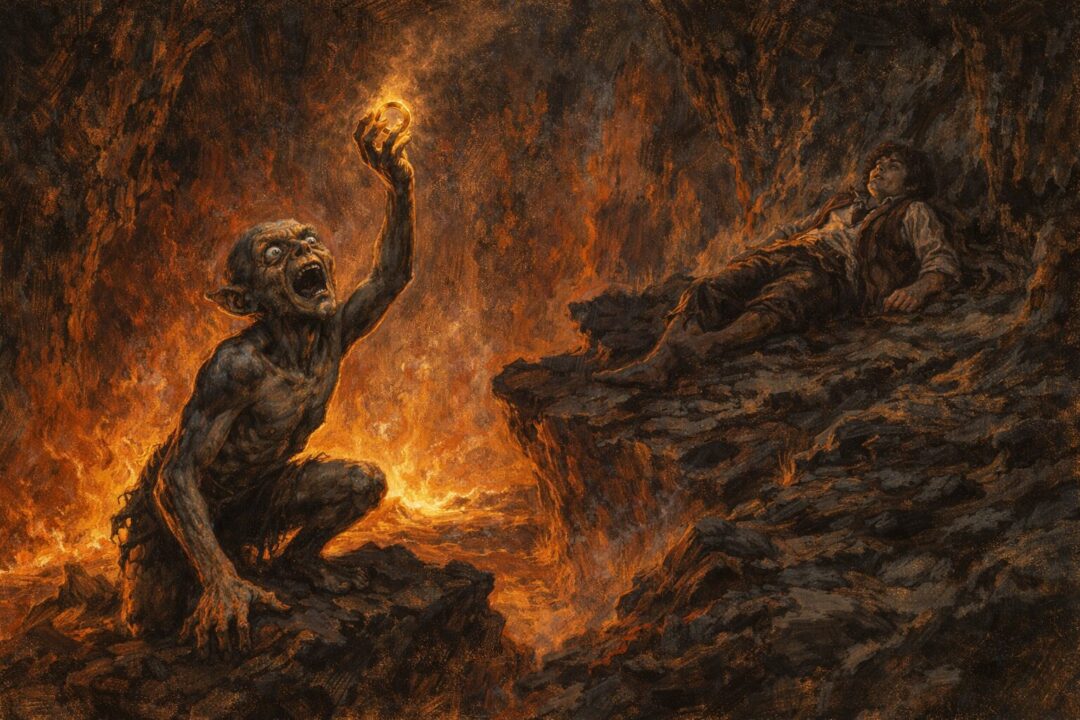
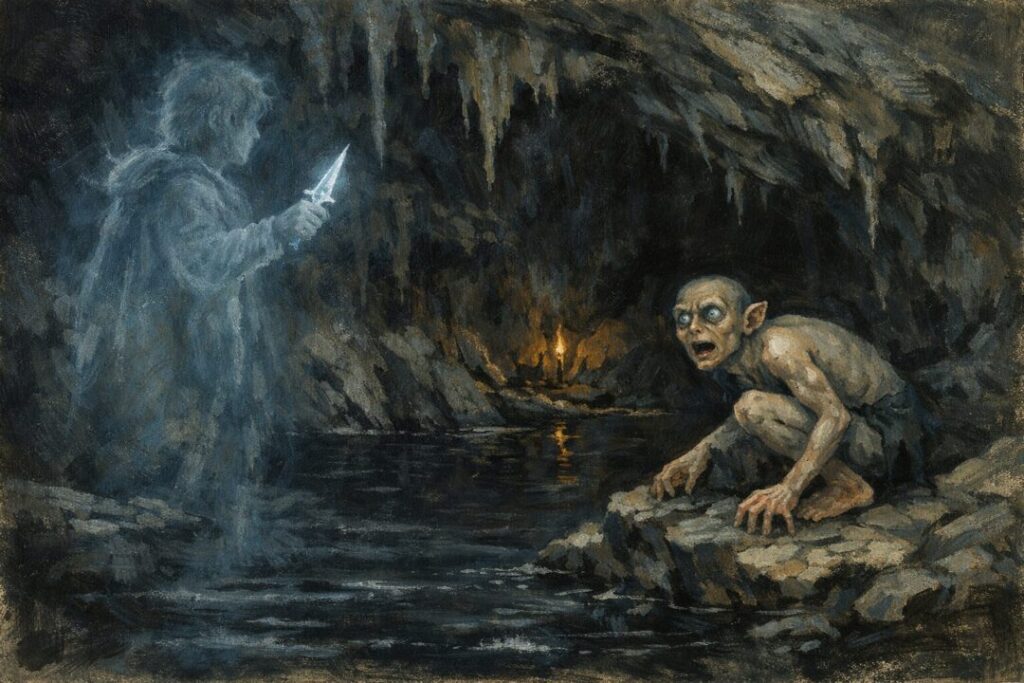
Deep beneath the Misty Mountains, in the chapter “Riddles in the Dark,” Bilbo Baggins stands on the edge of a decision that almost no one notices the first time they read it.
He is invisible.
Gollum is in his way.
His dagger is drawn.
The text tells us plainly that Bilbo “thought of stabbing Gollum.” This is not metaphor. It is not symbolic. He considers killing him to escape.
And then he does something unexpected.
He sees Gollum not as a monster—but as a wretched, lonely creature.
And he is moved to pity.
He leaps over him instead.
At that moment, the story continues as we know it. But what if it had not?
What Actually Changes Immediately?
Surprisingly little.
If Bilbo had killed Gollum, the events of The Hobbit would likely proceed much the same:
- Bilbo still possesses the Ring.
- He still escapes the Goblins.
- Smaug is still slain.
- The Battle of Five Armies still occurs.
- Bilbo still returns to the Shire with the Ring.
Nothing in the immediate narrative depends on Gollum’s survival.
The consequences come later.
Gollum’s Role in Revealing the Ring
In The Fellowship of the Ring, Gandalf recounts how he tracked down Gollum years after Bilbo’s adventure. Gollum’s testimony confirms several crucial facts:
- The Ring was found in the Great River.
- It prolonged Gollum’s life far beyond natural span.
- It left him twisted and corrupted.
This confirmation supports Gandalf’s growing suspicion that Bilbo’s Ring is the One Ring.
More importantly, Gollum is captured and tortured in Mordor.
Under torment, he reveals two words to Sauron:
“Shire.”
“Baggins.”
These words trigger the hunt for the Ring.
The Nazgûl ride north because of Gollum.
Without Gollum, Sauron does not know where to look.
That alone changes the timeline dramatically.
Would Gandalf Still Discover the Truth?
Possibly—but more slowly.
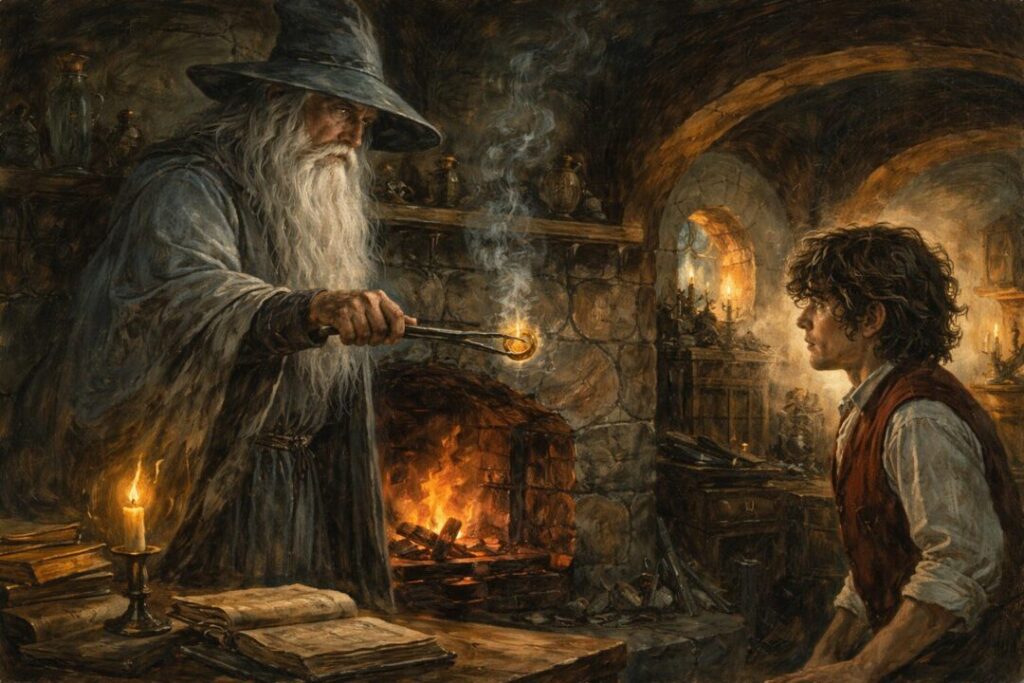
Gandalf already had suspicions. He researched the Ring in Minas Tirith and found Isildur’s account describing the fiery inscription. He eventually tests the Ring in Bag End and confirms its identity.
This part likely still happens.
However, without Gollum’s testimony:
- There is no confirmation that the Ring survived in the Anduin.
- There is no report of the name “Baggins” reaching Sauron.
- The urgency may be different.
It is possible—though speculative—that the Nazgûl would not ride out when they did. Frodo’s flight from the Shire might never occur in the same way.
This is the first major ripple.
The Moral Pattern: “Pity Stayed His Hand”
Gandalf later tells Frodo:
“It was Pity that stayed his hand… and he has been well rewarded.”
This statement suggests something deeper than coincidence.
Bilbo begins his ownership of the Ring with mercy, not murder.
Gandalf implies this matters spiritually.
The Ring corrupts through domination and possessiveness. Beginning its possession with an act of needless killing would have aligned Bilbo more closely with the Ring’s nature.
We cannot state with certainty that Bilbo would have become darker. The texts do not say this explicitly.
But the narrative strongly connects mercy with resistance to corruption.
Bilbo’s relatively light burden compared to Gollum’s centuries of degradation may not be accidental.
Frodo’s Later Choice
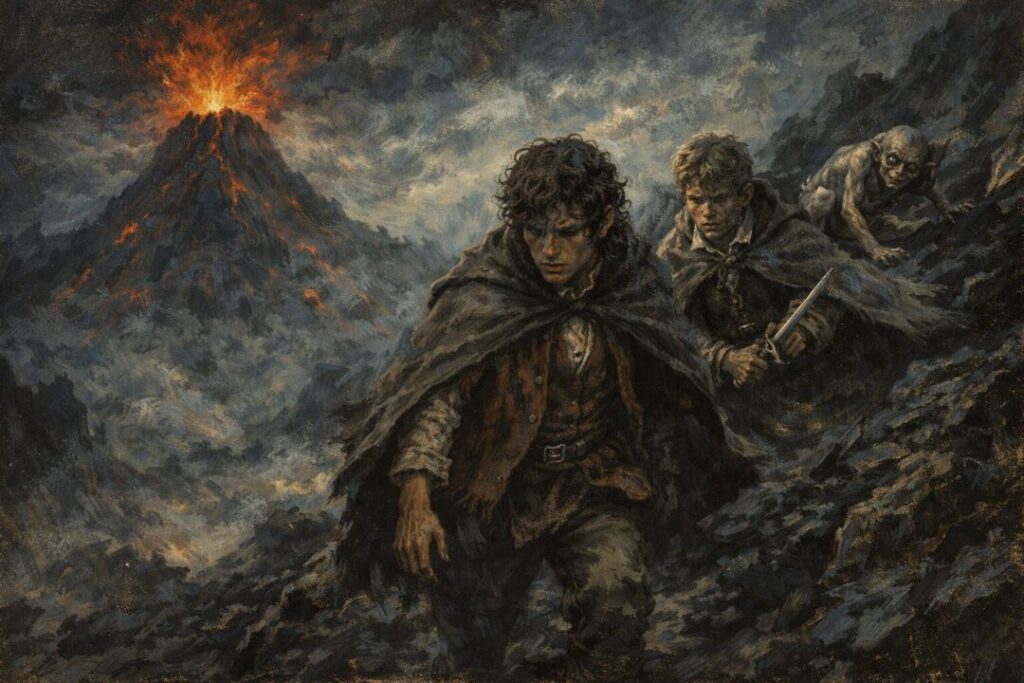
Years later, in Mordor, Sam wishes to kill Gollum.
Frodo refuses.
He recalls Gandalf’s words about Bilbo’s pity and says that even Gollum may yet have a part to play.
This is critical.
At Mount Doom, Frodo does not throw the Ring into the Fire.
He claims it.
The Quest succeeds not because Frodo conquers the Ring, but because Gollum—driven by obsession—seizes it and falls.
The Ring is destroyed by accident, struggle, and providence—not by heroic willpower.
Without Gollum alive at that moment, the texts give no evidence that Frodo would have destroyed it voluntarily.
This is not speculation; the text explicitly shows Frodo claiming the Ring.
Therefore:
If Bilbo had killed Gollum, Gollum would not be present at Mount Doom.
And the destruction of the Ring becomes deeply uncertain.
Would the Quest Even Happen?
Here we must be cautious.
Even without Gollum, Gandalf might still discover the Ring’s identity. The Council of Elrond might still convene. Frodo might still volunteer.
However, Gollum’s survival influences several key events:
- The Nazgûl hunt.
- Aragorn’s tracking.
- Intelligence about Mordor.
- Guidance through the Dead Marshes.
- The path to Cirith Ungol.
Without Gollum, Frodo and Sam would have struggled to reach Mount Doom at all.
The texts do not guarantee success without him.
Fate, Providence, and Unseen Design
Middle-earth operates under a moral structure where small acts echo forward.
Gandalf warns against dealing out death in judgment because “even the very wise cannot see all ends.”
Bilbo does not know Gollum’s future role.
He simply chooses mercy.
Yet that mercy becomes woven into the ultimate victory.
The destruction of the Ring depends on:
- Bilbo sparing Gollum.
- Frodo sparing Gollum.
- Gollum surviving long enough to intervene.
Remove the first act, and the chain may collapse.
What Would Most Likely Happen?
Here we move into careful speculation.
The most conservative conclusion is this:
If Bilbo had killed Gollum, the Ring’s destruction would become far less certain.
Possible outcomes include:
- Gandalf still discovers the Ring, but the Nazgûl move differently.
- Frodo reaches Mount Doom but fails to destroy the Ring.
- Sauron eventually regains it.
The texts show that Frodo alone cannot complete the task at the final moment.
Therefore, removing Gollum removes the mechanism by which the Ring is destroyed.
That is not dramatic interpretation—it is textual reality.
Why This Moment Matters
The cave scene is not just a character beat.
It is the hinge of the entire legendarium.
The War of the Ring is not won by strength.
It is not won by wisdom.
It is not won by strategy.
It is won by mercy—repeated twice.
Bilbo’s pity.
Frodo’s pity.
If Bilbo had chosen differently, the moral architecture of the story would fracture.
The Ring might remain.
Sauron might rise unopposed.
Or the struggle might drag on into a darker age.
We cannot say with certainty what would happen.
But the texts strongly imply this:
Gollum’s survival is not accidental.
It is necessary.
And it begins with a Hobbit lowering his blade in the dark.